Direct Answer: De-escalating homeowner and business-owner friction requires clear role boundaries across desk examiners, independent adjusters, and public adjusters, proactive plain-language explanations of ACV holdbacks and disposal holds, and synchronized written updates that prevent contradictory promises.
.md twin for estimator QA and carrier file documentation.
A contents loss is never just an accounting exercise to the person who owns the property. For a homeowner watching smoke-stained family heirlooms get boxed into numbered cartons, or a commercial owner watching inventory sit idle while customers walk away, every delay feels personal and every unfamiliar insurance term sounds like an excuse.
When communication breaks down across the adjuster interface, the policyholder gets caught in a crossfire of contradictory messages: a crew lead promises that an item will be replaced, an independent adjuster cautions that it looks cleanable, a public adjuster warns of underpayment, and a desk examiner goes silent for ten days waiting on a supervisor sign-off. Frustrated insureds escalate to state insurance complaints, social media reviews, or premature legal demands that slow resolution even further.
Preventing that escalation does not require softer technical standards; it requires disciplined, empathetic expectation-setting aligned with The Adjuster Desk: One Standard, Two Chairs and Three Adjusters, Three Economies. When every participant speaks plainly about process, role authority, and documented timelines, stress stays manageable even on complex claims.
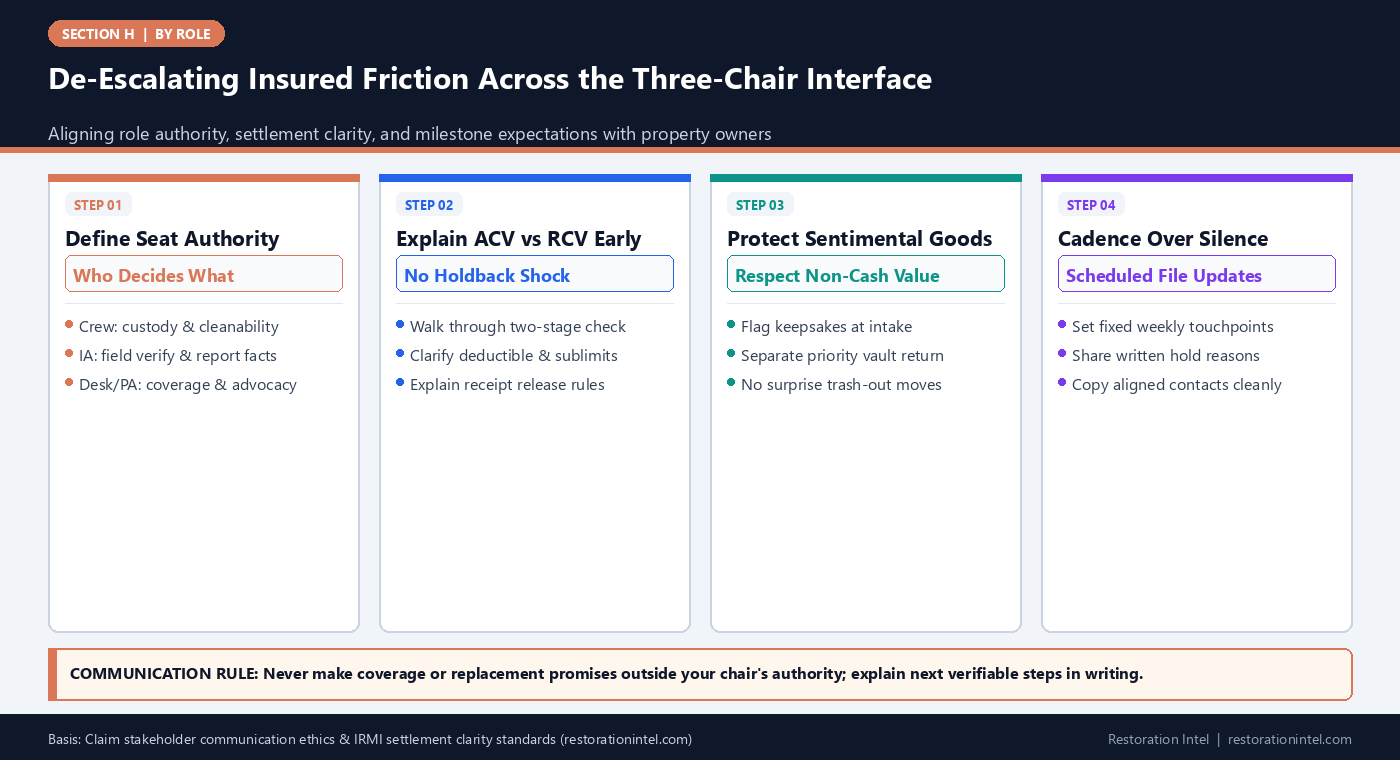
De-Escalating Insured Friction Across the Three-Chair Interface
High-Stress Insured Friction Points & Role-Aligned Communication Responses
Practical guidance for handling recurring homeowner and business-owner escalations without crossing licensing, legal, or operational boundaries.
| Insured Friction Trigger | Underlying Fear or Confusion | Unsafe / Escalating Response | Neutral, Role-Aligned Script & Action | Supporting Document |
|---|---|---|---|---|
| Initial ACV Check Looks Too Low | Believes carrier cut claim permanently instead of holding depreciation | Blaming the desk examiner or promising full cash without receipts | Explain RCV minus recoverable depreciation, show ACV line math, and outline receipt steps | IRMI RCV/ACV Two-Stage Guide & Line Summary |
| Demanding Immediate Disposal of Ruined Goods | Wants odor, mold, or painful visual reminders removed immediately | Hauling away unphotographed furniture or blaming IA delays | Log high-priority biohazards now; explain 48-hour IA verification hold on durables | Signed Pre-Disposal Hold & Priority Clearing Log |
| Anxiety Over Sentimental Heirlooms | Fears family photos, keepsakes, or trophies will be lost or discarded | Treating heirlooms identically to generic pantry boxes | Tag keepsake boxes 'Priority / No-Discard' and keep them accessible or with family | Keepsake Chain-of-Custody & Vault Priority Tag |
| Sublimit Shock on Jewelry or Business Gear | Assumed full Coverage C limit applied to every personal item | Arguing policy wording on site without authority | Flag sublimit category neutrally and route formal policy citation from desk examiner | Written Coverage Sublimit Explanation from Desk |
| Vault Access & Essential Item Delays | Needs seasonal clothes, medications, or work tools during rebuild | Burying daily essentials deep inside long-term sealed warehouse crates | Pack an 'Immediate Living / Business Continuity' kit retained by the owner day one | Day-One Essential Retention Checklist |
| Commercial Revenue & Stock Pressure | Business owner panics over inventory paralysis and lost customers | Ignoring commercial cash-flow urgency during slow residential cadence | Prioritize salable stock audit and coordinate interim business-continuity needs | Commercial Inventory & BPP Triage Schedule |
Maintaining Clear Role Boundaries Without Sounding Bureaucratic
Much of the friction insureds experience comes from blurred authority. When a restoration crew member tells a homeowner, ‘Your insurance will definitely buy you a brand-new sectional,’ or an independent adjuster implies a coverage decision is final when the desk examiner actually holds authority, the resulting correction feels like betrayal to the customer.
Conversely, hiding behind stiff phrases such as ‘That is not my department’ alienates a distressed homeowner. Effective communicators across all three seats explain their exact role positively: field technicians and IAs own physical fact-finding, condition testing, and chain of custody; desk examiners own policy interpretation, reserve authorization, and settlement issuance; and licensed public adjusters own policyholder claim presentation and negotiation where retained.
Explaining that division of responsibility during the opening conversation prevents the insured from asking technical crews for coverage rulings or blaming an IA for statutory policy caps.
- Own your factual lane: Restoration leads and IAs commit to accurate physical documentation, timelines, and custody—never verbal coverage guarantees.
- Respect licensing boundaries: Unlicensed restoration personnel must never negotiate policy terms or act as unauthorized public adjusters.
- Warm handoff over deflection: When an insured raises a policy question outside your scope, summarize their question in writing and route it directly to the desk examiner or PA.
Preventing 'Holdback Shock' and Sublimit Surprises Through Early Education
Few moments generate hotter anger than when an insured receives an initial check for $18,000 on a $30,000 contents schedule and assumes the carrier arbitrarily docked them 40 percent. Because Actual Cash Value (ACV), Replacement Cost Value (RCV), and recoverable depreciation feel counterintuitive to first-time claimants, silence until the first check arrives virtually guarantees an explosion.
Desk examiners, IAs, and PAs can defuse this ahead of time by walking the homeowner or business owner through a simple one-page worked example before the schedule is even finalized: showing Gross RCV, Deductible allocation, Recoverable Depreciation holdback, and exact receipt rules needed to unlock stage-two funds.
Equally important is flagging special policy sublimits—such as $1,500–$2,500 caps on jewelry, firearms, or business property at a residence—in plain, empathetic language the moment those items appear on the intake list, rather than letting the insured spend weeks gathering specs expecting unrestricted payout.
- Pre-payment walkthrough call: Review the two-stage ACV-then-RCV release mechanics before the initial settlement check is cut.
- Receipt retention coaching: Give policyholders a simple folder or digital checklist showing what vendor invoice details unlock holdback reimbursement.
- Early sublimit clarity: Ask the desk examiner to confirm applicable sublimits in writing early so expectations stay grounded in policy reality.
Protecting Keepsakes, Daily Essentials, and Commercial Continuity
Physical pack-out operations create acute emotional stress when family milestones—photo albums, wedding attire, children’s artwork, religious items, or inherited keepsakes—disappear into unlabeled bulk boxes alongside kitchen pans. Even if those items carry little resale market value, losing track of them destroys trust faster than a pricing dispute.
Practitioners prevent this friction with two simple operational habits aligned with ANSI/IICRC S320 customer-care discipline: first, pack a ‘Day-One Essential Kit’ containing daily medications, work laptops, school supplies, basic clothing, and pet gear that stays with the owner rather than entering warehouse storage; second, isolate sentimental keepsakes in distinctly labeled priority containers with explicit no-disposal safeguards.
On commercial claims, the parallel priority is operational continuity: identifying essential POS terminals, client records, and critical inventory so a business owner can resume partial operations or fulfill backorders while secondary contents are cleaned.
- Day-one owner retention bag: Confirm medications, IDs, laptops, and immediate clothing remain with the policyholder before vault trucks load.
- Distinct keepsake labeling: Use high-visibility priority tags on family heirlooms and never authorize disposal of sentimental items without signed owner consent.
- Transparent vault access policy: Explain upfront how insureds can schedule supervised warehouse retrievals if an essential document or seasonal item is needed mid-claim.
Maintaining Predictable Written Cadence Across Multi-Party Claims
In high-stress claims, silence breeds suspicion. When an insured hears nothing for twelve days because the desk examiner is awaiting an HVAC diagnostic report or a PA is compiling retail comparables, the homeowner assumes their file has been abandoned or deliberately stalled.
Establishing a predictable written communication cadence—such as a brief Friday status summary listing completed steps, current open bottlenecks, and the exact target date for the next milestone—dramatically lowers inbound complaint volume across all chairs. Even an update stating ‘Waiting on manufacturer serial confirmation for three appliances; remaining 210 undisputed lines submitted for ACV issuance’ reassures the owner that work is actively progressing.
On represented losses where formal carrier communication runs through the public adjuster, keeping technical pack-out custody updates transparent and documented ensures neither the policyholder nor the carrier receives conflicting timelines.
- Fixed weekly status note: Send a brief, factual status update on a predictable day rather than waiting until every exception clears.
- Single-voice milestone log: Align inspection dates, warehouse return windows, and open RFI items in one shared written summary.
- Respect representation protocols: On PA-represented claims, follow state and carrier rules on cc’ing the policyholder while keeping technical custody records factual.
Practitioner Verification Checklist (H-31)
- Clarify role boundaries upfront so crews and IAs own physical custody and documentation while desk examiners and PAs handle coverage and advocacy.
- Walk insureds through ACV vs RCV holdback math, deductibles, and receipt requirements before the initial settlement check arrives.
- Pack a Day-One Essential Retention Kit and apply high-visibility ‘No-Discard’ priority tags to all sentimental keepsakes before truck loading.
- Confirm early written carrier guidance on potential sublimit items so policyholders are never surprised weeks into the claim.
- Send predictable weekly written status updates detailing completed milestones, open holds, and next concrete action dates.
Standards, Authority References & Related Reading
Primary standards, insurance definitions, and sibling Restoration Intel guides referenced in this brief:
- ANSI/IICRC S320 Standard for Professional Contents Restoration
- IRMI Insurance Glossary: Actual Cash Value (ACV)
- IRMI Insurance Glossary: Replacement Cost Value (RCV)
- IRMI Insurance Glossary: Depreciation
- Related Guide: Adjuster Interface (Desk Examiner, IA & Public Adjuster): Initial Scope & Loss-Walkthrough Intake
- Related Guide: Adjuster Interface (Desk Examiner, IA & Public Adjuster): Performance Metrics, Margin Tracking & Cycle-Time KPIs
- Related Guide: The Adjuster Desk: One Standard, Two Chairs
- Related Guide: Three Adjusters, Three Economies
- Related Guide: A Pack-Out Record Is Not a Priced Inventory
.md twin for desk QA and team training.Frequently Asked Questions
Why do homeowners get upset when receiving an initial ACV check?
Most first-time claimants expect full replacement value immediately and interpret recoverable depreciation as a permanent deduction. Explaining the two-stage ACV-then-holdback settlement process before payment arrives prevents that shock.
Should restoration field technicians discuss whether an item is covered by the policy?
No. Field crews should describe physical damage, cleanability, and safety facts accurately while directing all policy coverage and sublimit interpretations to the carrier desk examiner or licensed public adjuster.
How can pack-out teams prevent disputes over lost sentimental items?
Segregate keepsakes, photos, and heirlooms into distinct high-visibility priority boxes at intake, document them clearly on the chain-of-custody manifest, and require explicit owner sign-off before any item is discarded.
What helps most when a commercial claim is stalled waiting on specialty diagnostics?
Bifurcating undisputed contents and critical business-continuity items for early release while giving the business owner scheduled weekly written updates on the pending diagnostic items.