Direct Answer: Shared file discipline in pre-submission QA aligns public adjusters, independent adjusters, and desk examiners around a single pre-flight audit—verifying math parity, photo-to-line linkage, scope hygiene, policy sublimit grouping, and duplicate elimination before a schedule enters formal review.
.md twin for estimator QA and carrier file documentation.
Every time a contents schedule bounces back from a desk examiner with a request for clarification, weeks of claim cycle time evaporate. Yet most desk kickbacks are not caused by deep policy disagreements—they are triggered by avoidable clerical and structural defects that a disciplined twenty-minute pre-submission audit would have caught.
Across the adjuster interface, quality assurance functions as shared file discipline. A restoration estimator or public adjuster preparing a submission needs to inspect the packet through the exact lens a carrier desk examiner will use minutes after opening it; likewise, an IA submitting a verification report to a carrier file needs internal QA gates ensuring their room counts, depreciation inputs, and photo links reconcile cleanly.
Applying a repeatable pre-submission audit across XactContents, Xactimate, and Symbility submissions protects ANSI/IICRC S320 evidentiary integrity while dramatically reducing friction between policyholder and carrier representatives.
Five-Gate Pre-Submission QA Audit for Shared Claim Files
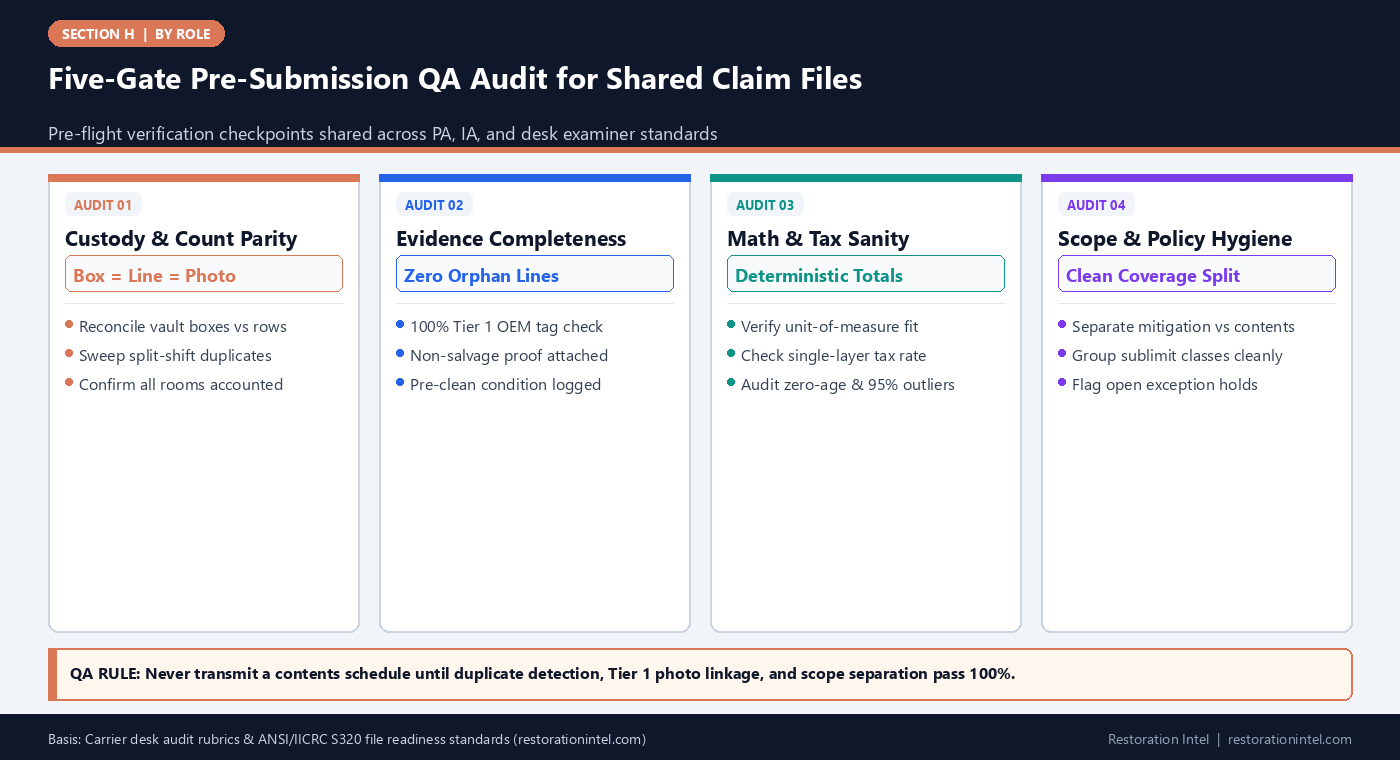
Pre-Submission Quality Assurance Audit Checklist Across Claim Interfaces
Objective pre-flight checks performed prior to releasing a schedule from field capture, IA reporting, or PA submission to carrier desk review.
| QA Audit Gate | Verification Test Run | Common Defect Caught | Impact on Desk Review | Required Corrective Action |
|---|---|---|---|---|
| Duplicate & Multi-Tech Sweep | Sort by room, item name, model, and photo timestamp | Two technicians photographing the same garage tool chest on split shifts | Triggers credibility audit and full-file recount demand | Merge or delete duplicate rows while retaining primary photo link |
| Tier 1 Spec & Photo Check | Filter all items >$500 RCV and verify brand/model + tag photo | High-dollar TVs or appliances listed with blank model numbers | Automatic desk downgrade to lowest entry-level comp | Pull rating-plate photo from raw media or run warehouse verification |
| Scope Separation Audit | Cross-check contents invoice against Xactimate structure & mitigation | Pack-out labor, drying equipment, or contents cleaning double-billed | Carrier holds entire payment pending multi-invoice reconciliation | Isolate mitigation, pack-out/cleaning labor, and RCV property cleanly |
| Unit & Tax Math Integrity | Inspect 'Pair/Set/Box' multipliers and verify single-pass sales tax | Six dining chairs billed as '6 sets' or tax applied at line and summary | Arithmetic rejection and immediate reserve variance alert | Standardize UOM fields and audit summary footer formula |
| Depreciation Outlier Review | Sort schedule by depreciation % ascending and descending | Blank ages yielding 0% depreciation or excessive 90%+ cuts on active goods | Triggers line-by-line desk override or PA objection | Verify age bands and attach condition photos for extreme outliers |
| Sublimit & Exclusion Tagging | Group cash, jewelry, firearms, BPP, and non-covered perishables | Sublimited items mixed into general kitchen/bedroom totals | Delays Coverage C payout until sublimits are manually carved out | Tag sublimit category headers and move excluded items to non-claim log |
Eliminating Duplicate Lines, Split-Shift Overlaps, and Missing Rooms
Large residential pack-outs and commercial losses rarely get captured by one person in a single uninterrupted pass. Multiple technicians work adjacent bedrooms, evening shifts finish closets opened by morning crews, and IAs sometimes combine early site photos with insured-supplied lists. Without an intentional deduplication sweep prior to submission, overlapping entries inevitably slip into the final schedule.
Desk examiners look specifically for duplicate patterns—such as identical serial numbers appearing in two adjacent rooms, a boxed kitchen sub-lot overlapping with loose countertop appliances, or a dining set listed once by the insured and again in the pack-out manifest. Even three or four accidental duplicates can cause an examiner to question the reliability of the entire five-hundred-line file.
As part of shared file discipline, every pre-submission QA pass should include a room-completeness reconciliation against the master floor plan (confirming zero skipped rooms or closets) paired with a sorted duplicate check across high-value items, serial numbers, and pack-out box IDs.
- Room-boundary sign-off: Verify every room on the master intake sketch appears in the final schedule—even if marked ‘Unaffected / No Claim’.
- Serial & high-value sort: Sort items above $250 descending by RCV and check adjacent entries for duplicate appliances, tools, or electronics.
- Box-to-line reconciliation: Confirm total packed boxes in warehouse receiving match the exact box numbers referenced across schedule rows.
Enforcing Scope Hygiene Across Mitigation, Pack-Out, and Structure
One of the most frequent administrative holds at the carrier desk occurs when contents charges collide with structural or emergency mitigation billing. Examples include billing content manipulation inside an Xactimate structural repair estimate while simultaneously charging pack-out hours on a contents invoice, or including dehumidifier monitoring and air scrubbers inside a personal property cleaning packet.
Both Which Xactimate Line Items Adjusters Approve and Two Standards, One Truck emphasize that carrier auditors treat cross-invoice overlap as a high-priority red flag. Even when the contractor performed legitimate work, blurry boundaries force the desk examiner to freeze all three invoices until a project manager proves nothing was billed twice.
A pre-submission QA audit cross-checks labor categories across structure, mitigation, and contents before release—ensuring move-out/move-back manipulation, vault storage, cleaning labor, and total-loss valuation occupy distinct, non-overlapping buckets.
- Zero double-manipulation rule: Cross-check structural room-reset line items against contents pack-out and pack-back labor hours.
- Distinct invoice headers: Separate mitigation equipment, contents restoration services, and RCV/ACV personal property schedules into clean, cross-referenced packets.
- Clean vs replace boundary check: Verify no item billed for full cleaning/deodorization also appears on the non-salvageable replacement payout list.
Auditing Photo Linkage, Metadata Integrity, and Sublimit Grouping
A schedule that looks mathematically tidy can still fail desk audit within five minutes if its supporting evidence links are broken or disorganized. Broken image hyperlinks, unreadable low-resolution thumbnails, and missing model numbers on high-dollar lines force desk examiners to issue formal Requests for Information (RFIs) instead of issuing payment.
During pre-submission QA, a reviewer should sample or sweep all Tier 1 assets (every item above $500 and every non-salvageable replacement line) to confirm three elements: readable identity/spec proof, intact photo attachment, and realistic age/condition documentation. Catching five missing serial photos before submission takes thirty minutes; chasing them after an RFI takes two weeks.
At the same time, QA should verify that policy-sensitive sublimits—jewelry, firearms, silverware, cash, and business property—are grouped and subtotaled transparently. Whether the packet comes from an IA or a PA, clear sublimit organization signals technical competence and lets the desk examiner apply policy caps cleanly without manual re-sorting.
- 100% Tier 1 & total-loss spot-verify: Confirm every high-dollar and non-salvageable line carries working photo proof and spec detail.
- Sublimit summary block: Present clear subtotals for special-limit property classes separate from unrestricted Coverage C household goods.
- Export integrity test: Open the exported PDF, ESXA/XML, and spreadsheet deliverables on a clean screen to verify zero truncated columns or broken image paths.
Standardizing Statistical QA Sampling on Multi-Thousand-Line Losses
On large residential estates or commercial contents claims exceeding two thousand line items, manually re-verifying every paperback book and kitchen utensil before submission is economically impossible. Yet skipping pre-submission QA altogether guarantees erratic errors that erode credibility during carrier review.
The industry-balanced solution across IAs, PAs, and restoration desks is stratified QA sampling: 100 percent verification of Tier 1 high-value items, specialty exceptions, and non-salvageable claims, paired with statistical random box or room sampling across Tier 2 and Tier 3 bulk household goods.
Recording that QA audit summary directly in the file cover letter—stating how many boxes were spot-verified, confirming duplicate checks passed, and listing open exception holds transparently—sets a tone of shared file discipline that accelerates desk examiner sign-off across the entire claim.
- Stratified review allocation: Audit 100 percent of high-dollar/total-loss lines and a documented random sample (e.g., 10–15 percent) of standard packed boxes.
- Zero-error threshold on math & taxonomy: Run automated or spreadsheet formula checks across 100 percent of rows for negative quantities, missing UOMs, and tax errors.
- Transparent QA cover memo: Include a one-page packet index summarizing room counts, valuation basis, sublimit flags, and QA verification date.
Practitioner Verification Checklist (H-30)
- Reconcile every room on the master sketch and every packed warehouse box against the submitted schedule to eliminate skipped zones or duplicates.
- Audit 100 percent of Tier 1 (> $500) and non-salvageable lines for readable brand/model specs, photo linkage, and valid LKQ retail anchors.
- Cross-check contents invoices against structure and mitigation estimates to verify zero double-billing on manipulation, cleaning, or equipment.
- Run automated formula checks for unit-of-measure accuracy, single-pass sales tax, and depreciation outliers (0% or >90% anomalies).
- Group special policy sublimits clearly and attach a one-page QA cover index summarizing packet structure and any open inspection holds.
Standards, Authority References & Related Reading
Primary standards, insurance definitions, and sibling Restoration Intel guides referenced in this brief:
- ANSI/IICRC S320 Standard for Professional Contents Restoration
- Verisk Xactimate Estimating Platform
- Verisk XactContents Platform Overview
- Symbility Claims Support Portal
- Related Guide: Adjuster Interface (Desk Examiner, IA & Public Adjuster): Team Handoff Between Field Capture and Desk Estimating
- Related Guide: Adjuster Interface (Desk Examiner, IA & Public Adjuster): Performance Metrics, Margin Tracking & Cycle-Time KPIs
- Related Guide: The Adjuster Desk: One Standard, Two Chairs
- Related Guide: Which Xactimate Line Items Do Adjusters Actually Approve?
- Related Guide: Two Standards, One Truck: Documentation When the Brand and the Scorecard Disagree
.md twin for desk QA and team training.Frequently Asked Questions
What is the single most common reason desk examiners kick back contents schedules?
Missing documentation on high-dollar or non-salvageable items—specifically omitted brand/model specs, unlinked photos, or lump-sum bulk lots—followed closely by duplicate entries and scope overlap with structural estimates.
Should an item billed for cleaning ever appear on the total-loss replacement schedule?
Only if documented test-cleaning failed under pre-agreed criteria and the duplicate cleaning charge is credited or clearly separated as an authorized failed-test diagnostic fee; otherwise double-billing triggers immediate audit holds.
Why include a QA cover memo with a public adjuster or contractor submission?
A concise one-page cover index showing room counts, valuation methodology, sublimit subtotals, and open exceptions lets the desk examiner navigate a complex file rapidly and signals disciplined preparation.
How can teams audit 2,000-line claims without stalling cycle time?
Use stratified QA: verify 100 percent of Tier 1 high-dollar items, non-salvageable lines, and math formulas, while running targeted random sampling across low-value bulk boxes.