Direct Answer: Defensible contents pricing across desk examiners, independent adjusters, and public adjusters rests on verifiable Like-Kind-and-Quality (LKQ) retail anchors, transparent tax and delivery treatment, documented age-and-condition depreciation inputs, and strict compliance with pair-or-set and actual-spend settlement rules.
.md twin for estimator QA and carrier file documentation.
Valuation disputes rarely happen because someone forgot how to multiply quantity by unit price. They happen when two sides pull incompatible Like-Kind-and-Quality (LKQ) comparables or apply opaque depreciation percentages without tying them to physical evidence. A public adjuster pricing a damaged commercial espresso machine from a boutique reseller listing and a desk examiner substituting a consumer-grade appliance are both defending numbers—yet neither number persuades the other without shared specification criteria.
Understanding how carrier valuation systems evaluate Replacement Cost Value (RCV), Actual Cash Value (ACV), and depreciation creates immediate common ground. In XactContents and Symbility, pricing defensibility requires matching functional utility, material grade, and technical capacity—not hunting for the highest or lowest internet listing.
Whether you sit at the carrier desk auditing vendor schedules, inspect losses as an IA, or prepare policyholder proofs of loss as a PA, building valuation files around reproducible retail links, documented regional tax/shipping norms, and transparent depreciation curves turns contentious negotiations into verifiable math.
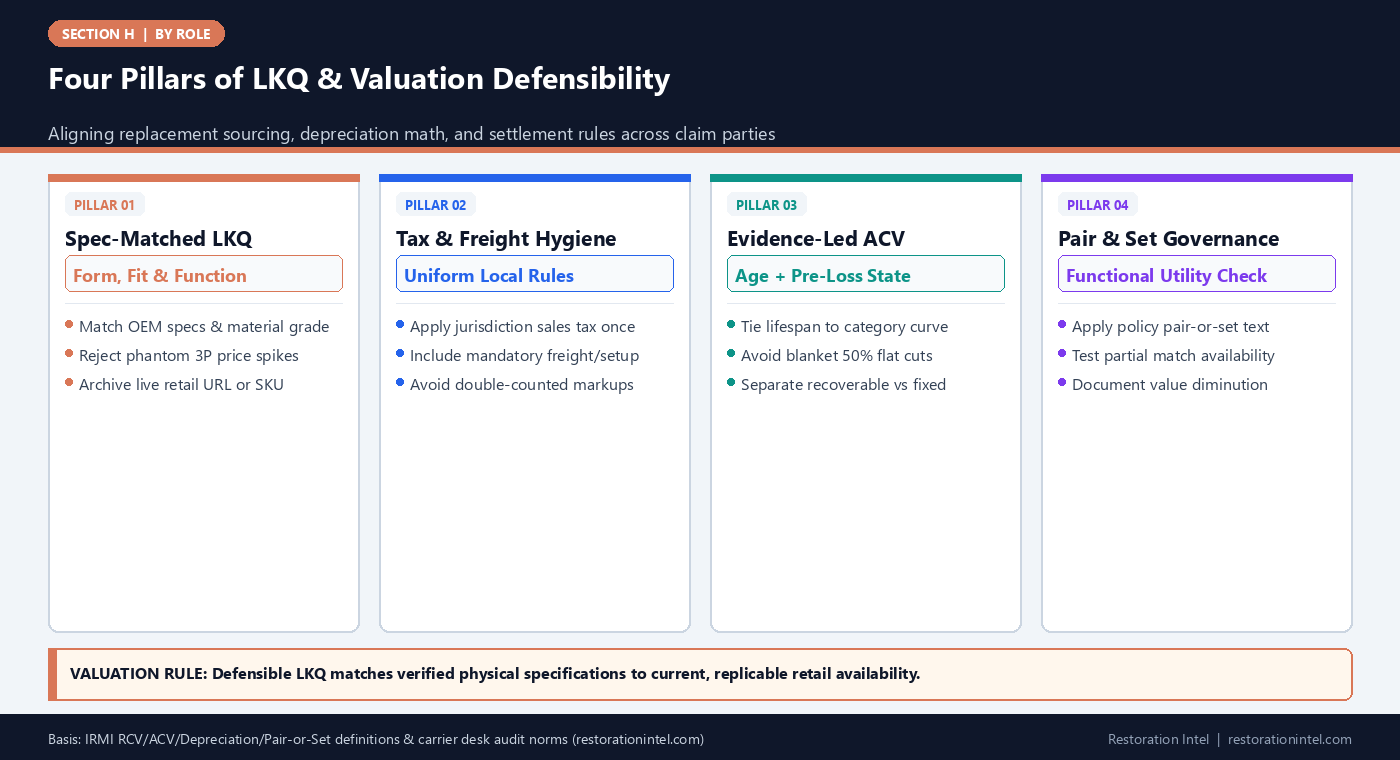
Four Pillars of LKQ & Valuation Defensibility
LKQ Sourcing & Valuation Defensibility Standards Across Claim Positions
How common pricing and depreciation friction points are evaluated and resolved using objective claim documentation.
| Valuation Component | Defensible File Standard | Common Unsupported Shortcut | Desk Examiner Audit Trigger | Resolution Protocol |
|---|---|---|---|---|
| Discontinued OEM Model LKQ | Current successor model matching capacity, construction, and feature tier | Using inflated out-of-stock collector marketplace listings | Unit price exceeds normal retail category band by >35% | Supply manufacturer spec sheet comparing discontinued vs successor SKU |
| Custom & Solid-Wood Furniture | Documented joinery, hardwood species, dimensions, and retail maker comp | Pricing heirloom solid walnut against flat-pack laminate retail | Generic 'dresser' description priced above standard tier | Attach tag/joinery photos and two comparable artisan/retail quotes |
| Sales Tax & Delivery Freight | Consistent local tax rate applied uniformly with verifiable delivery fee | Double-taxing catalog prices or adding arbitrary shipping percentages | Tax rate mismatch or freight billed on small parcel items | State jurisdiction tax rate and vendor shipping policy in file summary |
| Depreciation & Useful Life | Category-specific life expectancy adjusted for documented pre-loss condition | Applying flat 50% across every item or claiming 0% on 8-year goods | Identical depreciation rate across electronics, linens, and cast iron | Apply transparent age/condition schedule with photo-backed exceptions |
| Pair or Set Valuation | Policy-specific Pair or Set evaluation for matched suits, china, or audio | Replacing an entire 12-piece set because one standard bowl broke | Full-set RCV claimed without proof of unavailability or loss in value | Check manufacturer replacement stock and document fair diminution math |
| Holdback & Actual Spend | Clear Gross RCV, Depreciation, Net ACV, and receipt-release tracking | Treating agreed RCV as unconditional day-one cash payout | Premature holdback demand prior to verified purchase receipts | Track item-level replacement receipts against lesser-of-RCV-or-spent cap |
Sourcing Like-Kind-and-Quality Comparables That Survive Desk Scrutiny
Like-Kind-and-Quality (LKQ) does not mean identical brand-new retail price on a discontinued model, nor does it mean substituting the cheapest discount-bin item that shares a noun. Under IRMI Replacement Cost principles, LKQ requires functional equivalence in material composition, performance capacity, construction grade, and core features available in the current retail market.
Desk examiners routinely reject comparables pulled from unverified third-party marketplace listings where an out-of-production toaster or jacket is listed at three times its normal retail value. Conversely, public adjusters rightly challenge automated estimating catalog substitutions that swap a commercial-grade stainless range or solid-oak bookcase for entry-level builder laminate simply because the original model number was omitted or discontinued.
The durable resolution on both sides is spec-based LKQ documentation: anchor the original item with brand, dimensions, wattage/BTU, fabric or wood grade, and feature set, then pair it with an in-stock national or regional retailer SKU (including PDF/screenshot timestamp and URL) that matches those exact functional attributes.
- Three-attribute minimum match: Align material/construction, performance capacity, and brand/quality tier before selecting an LKQ comp.
- Eliminate phantom marketplace prices: Exclude speculative auction or out-of-stock reseller listings when mainstream successor SKUs exist.
- Timestamped retail snapshots: Save dated SKU screenshots or catalog references because retail pricing and promotions fluctuate weekly.
Applying Transparent Age, Condition, and Useful-Life Depreciation
Depreciation is often treated as a tug-of-war—high percentages from the desk to lower initial payout, or zero-age claims from the field to maximize early cash flow. Yet IRMI depreciation standards and ACV methodology depend on objective variables: actual age, expected useful economic life of that category, and observable pre-loss condition or obsolescence.
A ten-year-old cast-iron skillet, solid-wood dining table, or framed lithograph loses very little functional life per year compared to a five-year-old smartphone or daily-wear athletic shoes. Applying an across-the-board 40 or 50 percent blanket haircut ignores real economic life and invites legitimate PA pushback; conversely, marking clearly worn upholstery as ‘new / 0 years’ destroys the credibility of the entire submission.
When estimating platforms like XactContents apply default category tables, both IAs and PAs should audit outliers explicitly—documenting documented refurbishments, rare condition preservation, or heavy prior wear with clear photo notes rather than hiding behind software defaults.
- Category-calibrated lifespans: Differentiate fast-obsolescence electronics and soft linens from long-lived tools, cookware, and hardwood furnishings.
- Cap maximum functional depreciation fairly: Avoid absurd 95 percent deductions on actively used, well-maintained household assets still serving full utility.
- Separate recoverable vs non-recoverable: Clearly identify any non-recoverable depreciation driven by ACV-only policy endorsements or obsolete property.
Handling Sales Tax, Shipping, Freight, and Specialty Set Clauses
Small arithmetic inconsistencies across tax and delivery columns create outsized audit friction. Some retail quotes embed shipping in unit price while others charge separate white-glove freight; some estimators apply sales tax at the line level and accidentally apply a second tax layer in the summary footer. Desk examiners audit tax and freight consistency early because a two-percent calculation error across 400 lines skews reserves significantly.
Equally misunderstood is the IRMI Pair or Set Clause. When one speaker in a matched studio pair, one volume in a limited encyclopedia set, or one dining chair in an eight-piece discontinued set is destroyed, the insured does not automatically receive a full new set without demonstrating economic impact. Standard ISO policy language obligates the insurer either to repair or replace the damaged part to restore the pair or set to its pre-loss value, or to pay the difference between the actual cash value of the property before and after the loss.
Documenting whether an individual matchable piece exists on the secondary or manufacturer-parts market—and calculating fair diminution in value when it does not—resolves pair-or-set disputes with precision.
- Single-pass tax verification: Confirm local sales tax rate against loss zip code and verify tax is never applied twice.
- Freight tied to actual logistics: Include white-glove delivery or LTL freight only on heavy furnishings/appliances where standard free parcel shipping does not apply.
- Pair-or-set market check: Document OEM single-unit discontinuation before proposing full-set replacement or diminution allowance.
Reconciling Estimate Audits, Desk Counter-Offers, and Holdback Releases
Once a contents schedule enters desk review, the fastest path to agreement is a structured line-level variance table rather than a global percentage demand. When a carrier examiner adjusts forty lines out of three hundred, issuing a redline report showing original RCV, adjusted RCV, revised depreciation, and the specific reason code (missing model proof, lower LKQ comp, or sublimit cap) allows the IA or PA to respond selectively to the disputed forty items while releasing undisputed ACV funds immediately.
At the back end of the claim, recoverable depreciation holdback disputes usually trace back to weak receipt-to-line alignment. Policyholders who buy upgraded appliances or consolidate small purchases onto vague big-box receipts struggle to prove which scheduled lines were replaced unless the original schedule carried clear item numbers and agreed RCV ceilings.
Educating insureds early—that final recovery is capped at the lesser of agreed RCV or actual amount necessarily spent per line—keeps holdback reconciliation clean for everyone at claim close.
- Release undisputed ACV promptly: Separate agreed lines from contested high-dollar exceptions so insured cash flow is not frozen over five disputed items.
- Reason-coded counter-offers: Require specific LKQ links or condition evidence behind every desk reduction or PA supplement.
- Receipt-mapping template: Provide policyholders a simple line-ID checklist so replacement invoices reconcile cleanly for holdback payout.
Practitioner Verification Checklist (H-28)
- Anchor every Tier 1 and disputed item to a current, in-stock retail LKQ comparable matching material, capacity, and quality tier with saved URL/SKU proof.
- Audit tax rates, delivery/freight fees, and unit-of-measure multipliers across the entire schedule to prevent double-counting.
- Base depreciation on category useful-life curves adjusted for photographed pre-loss condition rather than blanket percentages or zero-age defaults.
- Apply policy-accurate Pair or Set evaluation, documenting single-piece replacement availability before claiming full-set indemnity.
- Issue line-level variance reason codes on desk reviews and supplements so undisputed ACV funds release without full-file holds.
Standards, Authority References & Related Reading
Primary standards, insurance definitions, and sibling Restoration Intel guides referenced in this brief:
- IRMI Insurance Glossary: Replacement Cost Value (RCV)
- IRMI Insurance Glossary: Actual Cash Value (ACV)
- IRMI Insurance Glossary: Depreciation
- IRMI Insurance Glossary: Pair or Set Clause
- Related Guide: Adjuster Interface (Desk Examiner, IA & Public Adjuster): Team Handoff Between Field Capture and Desk Estimating
- Related Guide: Adjuster Interface (Desk Examiner, IA & Public Adjuster): Handling Non-Salvageable Lists & High-Dollar Exceptions
- Related Guide: The Adjuster Desk: One Standard, Two Chairs
- Related Guide: Which Xactimate Line Items Do Adjusters Actually Approve?
- Related Guide: Three Adjusters, Three Economies
.md twin for desk QA and team training.Frequently Asked Questions
Can a public adjuster or estimator use discontinued eBay or collector prices as RCV?
Generally no, unless the item is a true antique or collectible insured on an agreed-value or market-value basis. Standard RCV requires the current retail cost of a functionally equivalent, in-stock like-kind-and-quality replacement.
Why do desk examiners reject blanket 0% depreciation on household contents?
Almost all personal property experiences physical wear, aging, or technological obsolescence over time. Claiming zero depreciation on multi-year-old items undermines file credibility and prompts stricter line-by-line audits.
How does the Pair or Set clause work when one matching chair or cabinet unit is ruined?
Standard policy language allows the carrier to repair or replace the damaged part to restore the set, or pay the difference in value of the entire set before and after the loss—not automatically buy a brand-new full set if fair partial remediation exists.
What should happen to undisputed lines while five high-dollar items are still under pricing review?
Good claims practice separates undisputed items so initial ACV payment can be issued promptly while targeted LKQ or engineering proof is gathered for the open exceptions.