
Updated November 14, 2026 — reformatted to Restoration Intel house standard with Print-First PDF brief and Markdown twin.
Direct Answer: AI visibility for commercial restoration is whether ChatGPT, Perplexity, Gemini, and Google AI name your company when a facility manager asks for a commercial restoration contractor in your city. It is not a Google ranking. It is whether the answer engine has enough clean, citable facts to recommend you instead of the.
.md twin for AI Governance & Field Technology.
AI visibility for commercial restoration is whether ChatGPT, Perplexity, Gemini, and Google AI name your company when a facility manager asks for a commercial restoration contractor in your city. It is not a Google ranking. It is whether the answer engine has enough clean, citable facts to recommend you instead of the national brand.
Facility managers increasingly ask an answer engine before they open a binder. If the model cannot verify you, it names SERVPRO, BELFOR, or ATI because those entities appear in the same form on thousands of pages. If the model answers with a competitor you beat on the building last year, you lost the job before the phone rang.
Why nationals win the prompt today
Answer engines do not prefer franchises. They prefer entities they can verify. National brands have consistent NAP data, thousands of reviews, and service pages in every major city. Independents often have a residential website, mismatched directory listings, and no page that says they handle commercial water, fire, and mold for facility managers in a named city. When the model is unsure, it names the brand it has seen most often. That is sparse data, not a conspiracy.
The three fixes that move commercial recommendations
1. Entity cleanup. Same legal name, address, and phone on the website, Google Business Profile, and major directories. Commercial categories selected. Service area written as cities, not “the metro.”
2. Citable commercial pages. A page an FM and an AI can quote: response-time SLA, verticals you actually work, IICRC credentials, insurance limits, and how an Emergency Response Agreement works. Residential “what to do after a flood” pages do not get you recommended for a 200-unit property.
3. Proof someone else already trusted. Case studies with square footage and downtime. Reviews that use facility-manager language. Third-party mentions. Preferred-vendor or ERA language published, not buried in a PDF.
Score yourself in two minutes
Use the ten-point scorecard on the Field App. Eight to ten points means you are citable. Five to seven is mid-pack; the national still wins ties. Zero to four means the model does not have enough facts to name you. That is the job of the audit.
What the AI Visibility Audit checks
We prompt ChatGPT, Perplexity, and Google AI for commercial restoration in your city. We record whether you appear, who appears instead, and the three fastest fixes for your market. You also get the rest of the Commercial Restoration Vault — the ERA kit, TPA fast-track, sales arsenal, 90-day plan, and retention scorecard.
This week
- Ask ChatGPT: “Who are the commercial water damage restoration contractors in [your city] that facility managers use?”
- Do the same in Perplexity and Google.
- Score the Field App card. Fix NAP first. Then publish one commercial page with an SLA and a city name.
Questions
Is this the same as SEO?
No. SEO is pages in Google. AI visibility is whether an answer engine will stake a recommendation on your entity. You want both. The commercial pages that help SEO are the same pages AI can cite.
How long until AI names us?
Entity cleanup can show up in weeks. Citations and reviews take longer. The audit tells you which of the three fixes is the bottleneck in your city.
Do we need to rank #1 for “water damage near me”?
Not for this. That keyword is a homeowner emergency auction. Facility managers ask different questions. Write for those. See how facility managers choose a vendor.
Get the audit and the Vault
One email. No sales call.
The Vault · Field App · How FMs choose · Win without a franchise
AI Visibility for Commercial Restoration Companies — Visual Workflow
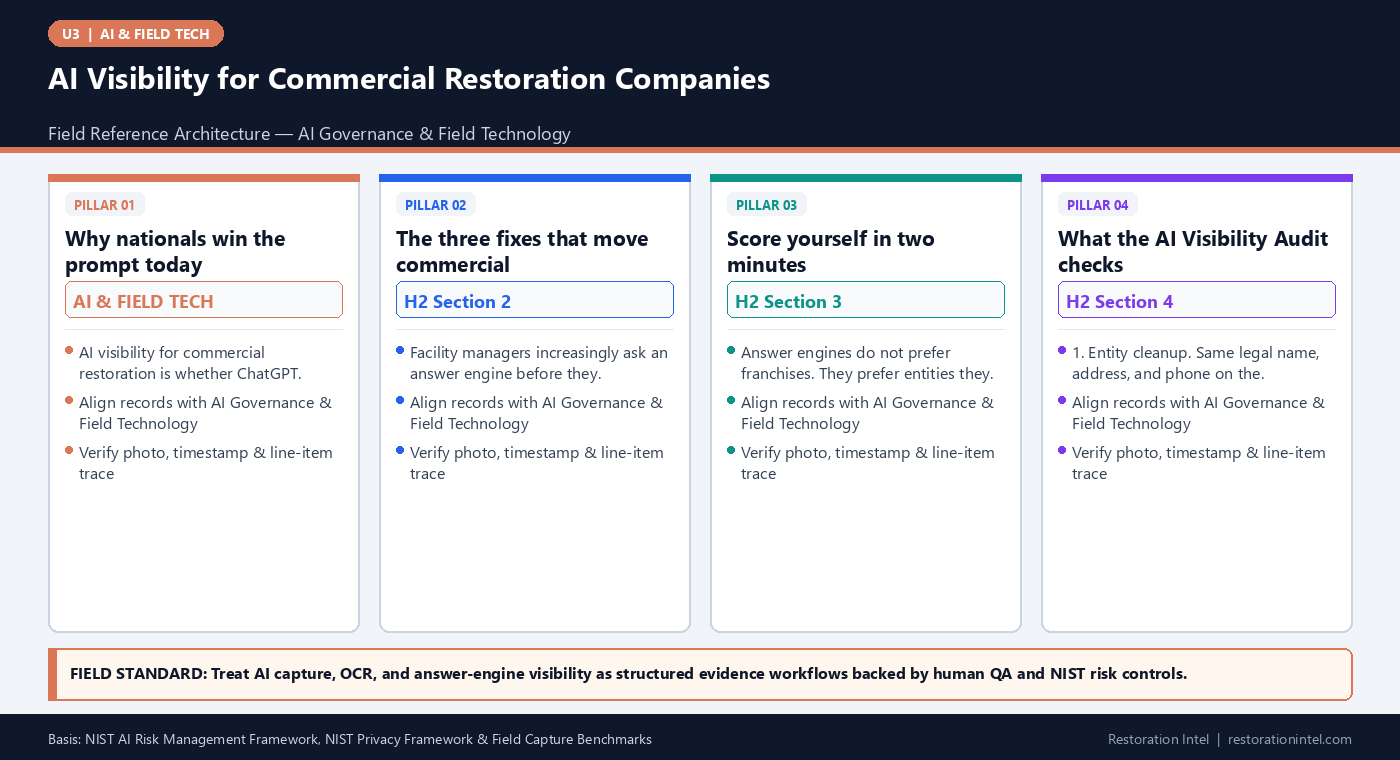
Field Operational Breakdown & Verification Matrix
Structured operational summary of AI Visibility for Commercial Restoration Companies mapped to Restoration Intel documentation gates.
| Operational Stage | Field Focus in This Guide | Documentation Requirement | Verification Gate |
|---|---|---|---|
| 1. Why nationals win the prompt today | AI visibility for commercial restoration is whether ChatGPT, Perplexity, Gemini, and. | Timestamped photos, measurements & scope notes | Cross-check against primary standard prior to submission |
| 2. The three fixes that move commercial | Facility managers increasingly ask an answer engine before they open a binder. If. | Timestamped photos, measurements & scope notes | Cross-check against primary standard prior to submission |
| 3. Score yourself in two minutes | Answer engines do not prefer franchises. They prefer entities they can verify.. | Timestamped photos, measurements & scope notes | Cross-check against primary standard prior to submission |
| 4. What the AI Visibility Audit checks | 1. Entity cleanup. Same legal name, address, and phone on the website, Google. | Timestamped photos, measurements & scope notes | Cross-check against primary standard prior to submission |
Field Documentation & Scope Verification Standard
To align AI Visibility for Commercial Restoration Companies with Restoration Intel house standards under AI Governance & Field Technology, field and estimating personnel should maintain an auditable record from first site walk through final carrier sign-off. That record begins by separating verifiable site conditions from assumptions: timestamped wide and close-up photographs, instrument readings paired with calibration or baseline context, and written scope notes tied directly to the line-item or contractual requirement.
When preparing a claim packet, internal SOP, or commercial facility handoff, pair the checklist below with the downloadable Print-First PDF brief and plain-text Markdown twin so estimators, project managers, and desk examiners work from identical scope boundaries without losing provenance between field capture and final review.
Operational consistency across AI Governance & Field Technology assignments also depends on maintaining clean separation between original site observations, insurer policy or municipal code constraints, and subsequent supplemental change orders. Every transition in containment, equipment deployment, clearance testing, or reconstruction sequencing should be logged sequentially with author attribution, date and time metadata, and cross-references to the governing technical manual or carrier guideline so third-party reviewers can audit the decision path without re-inspecting the structure.
Supervisors and quality-assurance leads can use this standardized package format during post-loss file audits, adjuster reinspections, and internal technician training to confirm that intake forms, drying or remediation logs, chain-of-custody records, and closeout certificates remain complete, internally consistent, and ready for immediate human review or automated compliance screening.
Practitioner Verification Checklist
- Confirm scope boundaries and loss classification for: AI Visibility for Commercial Restoration Companies.
- Capture timestamped field photos, measurements, and serial/assembly notes before mobilization or tear-out.
- Tie every line item or operational recommendation to primary references (NIST AI Risk Management Framework, NIST Privacy Framework).
- Verify internal cross-links and preserve all customer intake/compliance forms intact on the canonical page.
- Export and attach the Print-First PDF field brief and verify the sibling Markdown twin (.md) resolves HTTP 200.
Standards, Authority Citations & Related Guides
- NIST AI Risk Management Framework
- NIST Privacy Framework
- Verisk XactContents Platform Overview
- Related Guide: The $7,986 Hiding in Your Xactimate
- Related Guide: A Pack-Out Record Is Not a Priced Inventory
- Related Guide: Field Guide: Verisk XactContents & Symbility Field-Mapping Reference Sheet
.md twin for carrier and field review.Frequently Asked Questions
What is the core operational takeaway of AI Visibility for Commercial Restoration Companies?
AI visibility for commercial restoration is whether ChatGPT, Perplexity, Gemini, and Google AI name your company when a facility manager asks for a commercial restoration contractor in your city. It is not a Google ranking. It is whether the answer engine has enough clean, citable facts to recommend you instead of the.
Which industry standards govern ai governance & field technology documentation?
Practitioners should anchor field logs and claim packets to NIST AI Risk Management Framework and NIST Privacy Framework, ensuring verifiable measurements and photo provenance.
Where can field and estimating teams access the offline or AI-readable edition?
Each upgraded Restoration Intel guide ships with a 2-page Print-First PDF brief and a plain-text Markdown twin (.md) linked directly inside the article download cards and /llms.txt.