Direct Answer: Automotive repair shops, machine shops, and commercial garages require strict Day-1 scope boundaries separating Building/TIB lifts and air lines, BPP machinery, employee-owned toolboxes, customer vehicles under Garagekeepers coverage, and OSHA/EPA hazmat zones around solvent tanks, welding cylinders, and oil-water separators.
.md twin for estimator QA and carrier file documentation.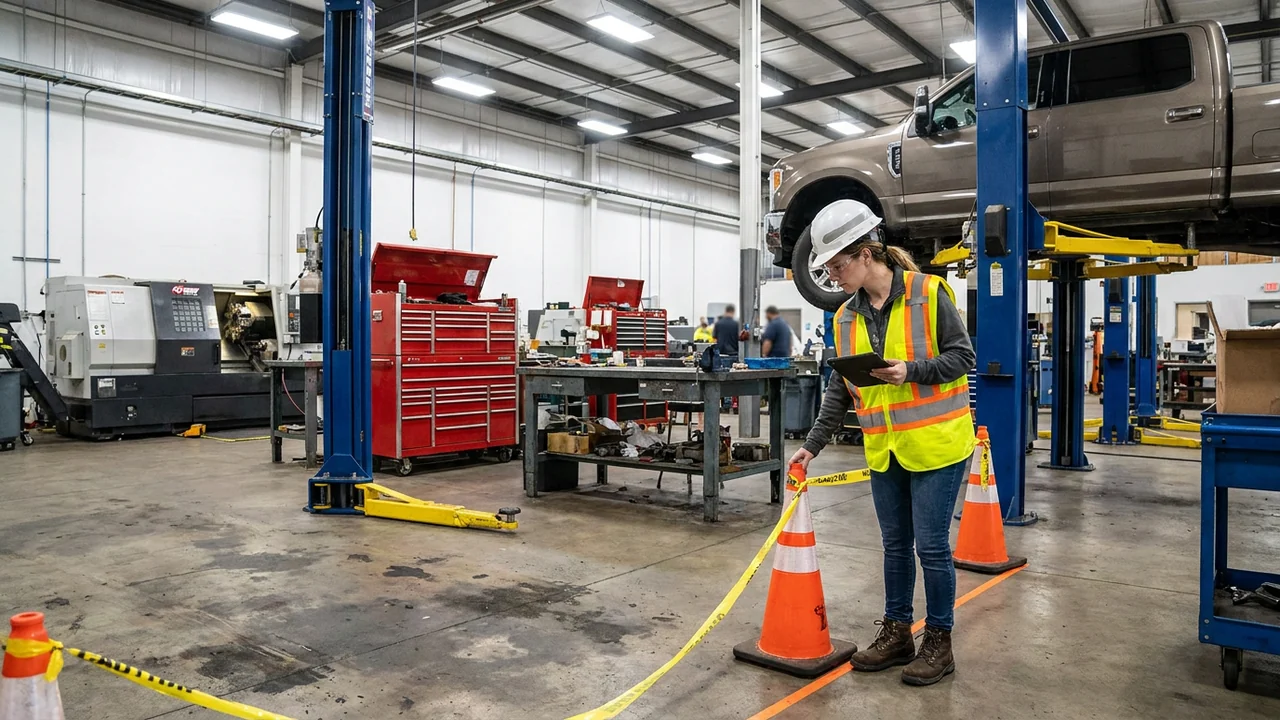
Walking into an automotive service facility, collision shop, or precision machine shop after a fire, sprinkler discharge, or storm flood presents hazards and ownership boundaries rarely encountered in standard office pack-outs. Within a single bay, a restoration crew can stand beside a 480-volt CNC vertical machining center, a hydraulic two-post lift holding a customer’s SUV, an agitated mineral-spirits parts-washer tank, pressurized oxy-acetylene welding cylinders, and four rolling mechanic toolboxes owned individually by technicians rather than the business.
Touching the wrong asset or flushing soot-laden wash water toward a floor trench triggers immediate legal, environmental, and safety exposure. Flushing hydrocarbon residue or firefighting foam into a bay drain can overwhelm an oil-water separator and violate municipal pretreatment permits. Moving a customer vehicle without explicit Garagekeepers carrier authorization creates bailment liability, while mixing employee-owned Snap-on chests into the shop’s Business Personal Property (BPP) schedule collides with tight policy sublimits.
Setting hard physical and administrative perimeters under ANSI/IICRC S320, OSHA HazCom, and commercial equipment classification rules protects crews and accelerates every downstream step from serial capture to policy-aligned valuation. EHS & policy disclaimer: Environmental, OSHA, fire-code, and coverage boundaries vary by jurisdiction, facility permit, and insurance form; always coordinate hazmat clearances with qualified EHS specialists and confirm coverage placement with the adjuster.
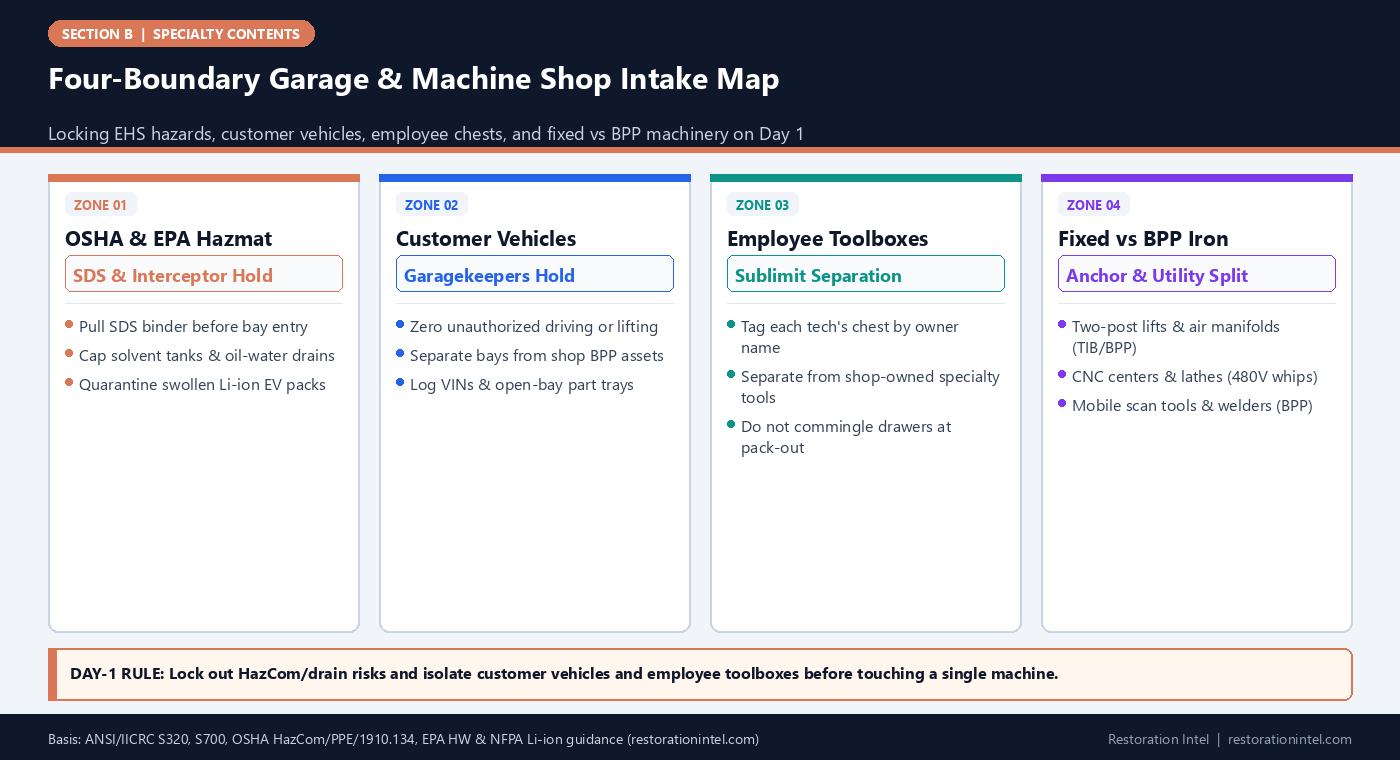
Four-Boundary Garage & Machine Shop Intake Map
Automotive & Machine Shop Scope, Hazard & Ownership Boundary Matrix
Day-1 operational boundaries separating safety controls, third-party bailment property, and commercial policy buckets.
| Shop Zone / Asset Class | Primary Physical or EHS Hazard | Ownership / Policy Boundary | Mandatory Day-1 Stop / Hold Rule | Field Documentation Required |
|---|---|---|---|---|
| Hydraulic Two-Post & Four-Post Lifts | Suspended vehicle load, hydraulic line pressure, concrete anchor integrity | Often Building / TIB or bolted trade fixture (verify lease) | Never lower or relocate a lift holding a customer vehicle without mechanic/adjuster sign-off | Lift column capacity plate, ALI sticker, floor anchor condition & disconnect photos |
| Solvent Parts Washers & Fluid Tanks | Flammable mineral spirits, chlorinated/aqueous chemistry, vapor ignition | Shop BPP / leased vendor drum service (e.g., Safety-Kleen) | De-energize heater/pump; keep closed and verify leased vendor ownership before moving | SDS sheet match, tank serial/vendor label, fluid level & thermal damage photos |
| Floor Drains & Oil-Water Separators | Hydrocarbon discharge, heavy metals, coolant/solvent runoff into sewer | Building infrastructure / environmental permit boundary | Block floor trenches with absorbent booms before any mitigation washdown or extraction | Drain map, separator access cover photo, sheen/soot contamination notes |
| CNC Centers, Lathes & Surface Grinders | 480V three-phase power, pressurized coolants, micron rust creep | Shop BPP or Scheduled Equipment / leased CNC finance | Verify electrical LOTO; do not wipe precision ground steel ways with dry shop rags | Controller/spindle serial plates, coolant sump condition & rust-onset photos |
| Diagnostic Scan Tools & EV/Battery Gear | Lithium-ion thermal runaway, high-voltage EV service packs, ESD sensitivity | Shop BPP (check software/subscription schedules) | Quarantine damaged Li-ion packs outdoors per NFPA guidance; isolate sensitive tablets | Tablet/VCI dongle serials, battery swelling inspection & subscription status |
| Technician Rolling Toolboxes & Customer Cars | Heavy tip hazard on multi-drawer chests; customer bailment liability | Employee Personal Property sublimit vs Garagekeepers policy | Do not unlock or pack mechanic chests without owner sign-off; zero touch on customer cars | Owner-tagged chest photos, VIN log of bay vehicles & open teardown part trays |
OSHA HazCom, PPE, and Chemical Drum Stabilization Before Entry
Automotive and machining facilities pack dense chemical hazards into tight bays. Before any crew starts room-sweep capture, the project lead must retrieve the Safety Data Sheet (SDS) binder or digital portal under OSHA HazCom (29 CFR 1910.1200). Typical shop inventories include mineral-spirits parts washers, brake-fluid reservoirs, cutting-oil sumps, lead-acid batteries, acid wheel cleaners, and compressed oxygen, acetylene, and argon welding cylinders.
When fire or suppression water strikes those containers, combustion byproducts mix with petroleum vapors and metal particulate. Crews entering soot-heavy bays must wear PPE under OSHA 1910.132 and respiratory protection compliant with OSHA 1910.134 where organic vapors or fine metallic dust exist.
Inspect cordless tool batteries and any hybrid or electric-vehicle (EV) battery modules on benches under NFPA lithium-ion safety guidance and J-16 battery stabilization rules: swollen or submerged packs must be quarantined outdoors rather than loaded onto vault trucks.
- SDS-first walkthrough: Verify chemical identities on parts washers, coolant sumps, and aerosol racks before pack-out or extraction.
- Cylinder & pressure check: Confirm welding valves are shut, safety caps sit on disconnected bottles, and heat-exposed cylinders are supplier-inspected.
- Li-ion thermal quarantine: Isolate damaged EV modules and cordless battery packs in outdoor non-combustible drums.
EPA Oil-Water Separators, Solvent Tanks, and Runoff Containment
Standard water mitigation crews instinctively bring truck-mounted extractors and pressure washers into concrete service bays. In a garage or machine shop, uncontrolled washdown is an environmental hazard. Bay floor trenches routinely drain into underground oil-water separators (OWS) or sand/grit interceptors regulated under local pretreatment ordinances and US EPA hazardous waste rules.
Flushing emulsified cutting oils, soot, hydraulic fluid, or surfactant-heavy degreasers into an oil-water separator breaks the gravity separation cycle, sending hydrocarbons past the baffle into municipal sewers and triggering costly pump-out or regulatory fines. Equally dangerous are open solvent parts-washer tanks sitting atop 30-gallon or 55-gallon drums: many are leased and serviced by third-party environmental vendors on closed-loop waste manifests.
Day-1 scope boundaries must draw a bright line around fluid management. Mitigation crews deploy poly berms and hydrophobic absorbent socks around floor trenches, test standing bay water before vacuum disposal, and hand off spent solvent drums, coolant sumps, and separator pump-outs to licensed environmental waste haulers with manifest tracking.
- Berm the trench drains: Isolate every bay floor drain and oil-water separator grate before wet-cleaning concrete slabs or machinery frames.
- Leased solvent-tank flag: Check parts-washer drum decals for third-party environmental service contracts before disconnecting or moving tanks.
- Hazardous waste manifesting: Never dump spent coolant, hydraulic fluid, or mineral spirits into general restoration wastewater holding tanks.
Hydraulic Lifts, Fixed Air Lines, and CNC Machinery Boundaries
Fixed and semi-fixed shop equipment creates constant boundary friction between landlord Building coverage, tenant Tenant Improvements and Betterments (TIB), and Business Personal Property (BPP). Two-post and four-post hydraulic lifts bolted to concrete pads, in-ground hydraulic cylinder lifts, hard-piped black-iron or aluminum compressed-air loops, paint spray booths, and waste-oil shop heaters frequently require reviewing the lease’s trade-fixture clause alongside E-02 machinery classification tests.
CNC vertical machining centers, manual engine lathes, Bridgeport mills, and hydraulic press brakes complicate the picture because they are often lag-bolted or precision-leveled on floor pads and fed by 480-volt three-phase disconnects—yet they remain manufacturing trade equipment rather than building utilities. By contrast, shop exhaust fans, makeup-air heaters, and monolithic spray-booth ductwork penetrating the roof deck typically lean toward Building or TIB.
Contents crews must never unbolt lifts, cut rigid air headers, or disconnect three-phase CNC drops during emergency intake. Establish a mechanical lockout/tagout (LOTO) boundary, photograph every anchor bolt, electrical whip, and hydraulic hose junction, and schedule qualified millwrights or lift installers once coverage routing is clear.
- LOTO before touch: Verify zero electrical and stored hydraulic/pneumatic energy on lifts, presses, and CNC cabinets before close inspection.
- Anchor & utility photos: Document floor bolts, wall disconnects, and roof penetrations to support Building vs TIB vs BPP carrier determinations.
- Immediate bare-steel defense: Where water or acidic soot hits precision CNC ways and spindles, seek adjuster clearance for rapid VCI fogging or corrosion-inhibiting mist before rust pits ground surfaces.
Separating Customer Vehicles and Employee-Owned Toolboxes
Two third-party property pools sit inside almost every repair garage: customer vehicles (and their disassembled engine or transmission parts laid out on teardown carts) and employee-owned rolling tool chests. Customer vehicles in the shop for service fall under Garagekeepers or Garage Liability policies—not the shop’s BPP contents limit—and carry strict chain-of-custody and bailment obligations.
Restoration personnel should never drive, push, or lower a customer vehicle off a hydraulic lift without documented direction from the shop owner and the responsible adjuster or Garagekeepers carrier. Even worse than moving a car improperly is throwing labeled customer bolts, disassembled valve covers, or bagged wiring harnesses into generic shop-tool boxes during chaotic post-fire cleanup.
Meanwhile, individual mechanics routinely own $15,000 to $60,000+ in rolling cabinets filled with Snap-on, Matco, Mac, and diagnostic tools. As detailed in employee-owned tool claim protocols, mixing personal technician chests with company-owned shop tools triggers Care, Custody, and Control caps and delays undisputed payouts. Tag every chest by technician name on Day 1 and keep each owner’s inventory segregated.
- Vehicle & teardown perimeter: Photograph every vehicle’s VIN plate, bay number, and matching parts cart; keep all customer components segregated.
- Named technician tool tags: Apply distinct ownership tags to every employee toolbox and capture signed owner acknowledgement before locking or moving.
- Shop vs personal tool audit: Verify company-owned specialty pullers, alignment heads, and diagnostic tablets separately from personal mechanic chests.
Diagnostic Electronics, Scan Tools, and Metrology Calibration Zones
Modern auto and machine shops rely as heavily on delicate electronics and micron-level measuring instruments as on heavy iron. Service bays house wireless diagnostic tablets (Snap-on, Autel, OEM dealer VCI interfaces), ADAS radar/camera calibration frames, battery-conductance testers, and wheel-balancer optical sensors. Machine shops house granite surface plates, optical comparators, coordinate measuring machines (CMMs), and calibrated micrometers.
Unlike chrome wrenches that tolerate ultrasonic bath cleaning, diagnostic tablets, VCI dongles, and optical metrology cannot survive general garage washdowns or humid warehouse air. Acidic soot from burning rubber, shop plastics, and transmission fluid migrates inside tablet cooling vents and connector pins within hours, causing progressive circuit corrosion.
Define an immediate clean-room electronics and metrology triage zone on Day 1. Move exposed diagnostic scan tools, calibration targets, and precision gauges out of wet or smoky bays into sealed anti-static containers with desiccant indicators first, and schedule specialized electronics vs total-loss testing before anyone powers up a soot-exposed device.
- Priority clean-zone pull: Evacuate diagnostic tablets, VCI interfaces, and calibrated micrometers from wet/sooty bays before moving heavy shop racks.
- No blind power-on: Prohibit turning on wet or smoke-exposed CNC controllers, welders, and scan tools until bench diagnostics clear internal boards.
- Granite & optical protection: Isolate CMMs, optical comparators, and granite surface plates from dust, thermal shock, and abrasive cleanup crews.
Practitioner Verification Checklist (B-22)
- Retrieve the shop OSHA HazCom SDS binder and inspect compressed gas, solvent tanks, and Li-ion EV/tool battery packs before entry.
- Berm floor trench drains and isolate oil-water separators before any water extraction or surface washdown begins.
- Enforce electrical and hydraulic LOTO on two-post lifts, compressors, and CNC machines; document anchors and utility drops.
- Create a strict perimeter around customer vehicles and disassembled vehicle parts carts under Garagekeepers rules.
- Tag and segregate every employee-owned rolling tool chest by technician name separately from company-owned shop BPP equipment.
- Evacuate sensitive diagnostic scan tools, ADAS rigs, and precision metrology to a dry ESD-safe triage zone without powering on.
Standards, Authority References & Related Reading
Primary standards, insurance definitions, and sibling Restoration Intel guides referenced in this brief:
- ANSI/IICRC S320 Standard for Professional Contents Restoration
- ANSI/IICRC S700 Fire & Smoke Restoration Standard
- OSHA Hazard Communication Standard (HazCom)
- OSHA 1910.132 Personal Protective Equipment Standard
- OSHA 1910.134 Respiratory Protection Standard
- US EPA Hazardous Waste Framework
- NFPA Lithium-Ion Battery Safety Resources
- Related Guide: Automotive Repair Shops, Machine Shops & Garages: Capture, Serial & Provenance Logging
- Related Guide: Automotive Repair Shops, Machine Shops & Garages: Cleanability vs Total-Loss Triage
- Related Guide: Automotive Repair Shops, Machine Shops & Garages: Valuation, LKQ Sourcing & Policy Traps
- Related Guide: Automotive Repair Shops, Machine Shops & Garages: Pack-Out, Chain of Custody & Recertification
- Related Guide: Fixed Building Machinery vs Scheduled Business Equipment vs Loose Tools: Policy Classification Matrix
- Related Guide: Contractor-Owned and Employee-Owned Tools in Shop Fires: Navigating Care, Custody, and Control Limits
- Related Guide: Field Guide: Lithium-Ion Battery, Propane, and Hazmat Stabilization Rules in Fire and Flood Pack-Outs
.md twin for desk QA and team training.Frequently Asked Questions
Are hydraulic two-post auto lifts covered under Building or Business Personal Property?
It depends on the commercial lease and property policy wording. Although lifts are lag-bolted to concrete slabs, leases often classify tenant-installed lifts as trade fixtures (BPP) or Tenant Improvements and Betterments (TIB), whereas in-ground hydraulic cylinders may fall under Building coverage.
Why must floor drains and oil-water separators be isolated during garage water mitigation?
Bay floor trenches typically feed municipal-regulated oil-water separators. Flushing firefighting foam, soot, cutting oil, or degreasers into those drains can defeat separation baffles and cause unlawful hydrocarbon discharges.
Can a restoration crew move a customer's car off a lift after a shop fire?
Not without documented authorization from the shop owner and the responsible Garagekeepers or liability carrier. Moving or lowering a damaged vehicle risks secondary damage and bailment disputes.
How should employee-owned mechanic toolboxes be handled during Day-1 scoping?
Tag every personal toolbox with the technician’s name and keep its contents strictly separate from shop-owned tools, because commercial BPP policies frequently cap employee personal property under low sublimits.
What is the first priority for CNC machines and precision micrometers after water or smoke exposure?
After electrical LOTO and safety clearance, document serial tags and protect bare ground steel ways and precision gauging from rapid corrosion onset, avoiding dry wiping that scratches lapped surfaces.