Direct Answer: Shop triage separates non-porous chrome hand tools and solid iron housings—recoverable via ultrasonic wash and VCI protection—from heat-annealed hydraulic lifts, corroded CNC spindles and metrology, smoke-permeated diagnostic electronics, and porous shop consumables that require OEM teardown or total-loss condemnation.
.md twin for estimator QA and carrier file documentation.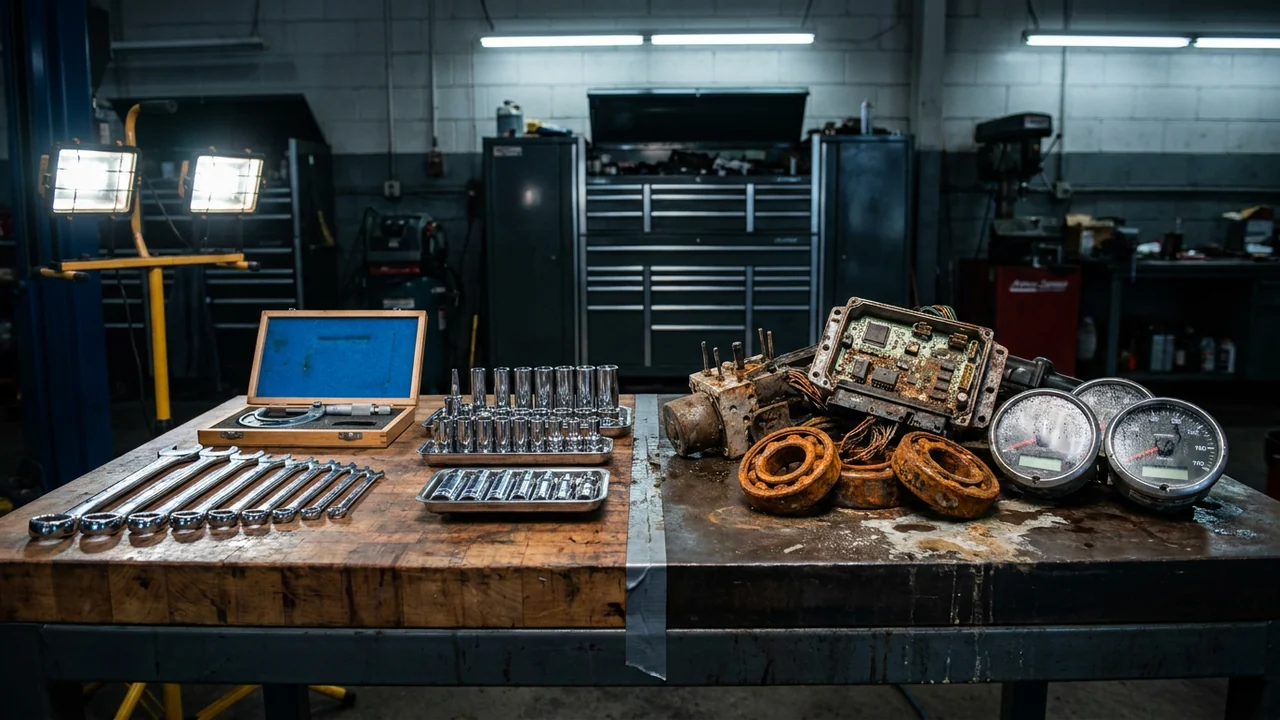
Cleanability triage inside an automotive repair garage or CNC machine shop fails whenever crews apply household rules to industrial tolerances. A 1/2-inch chrome-vanadium wrench coated in soot can emerge from an ultrasonic bath and rust-inhibitor dip performing identically to pre-loss condition. Six inches away inside the same drawer, a Mitutoyo 0.0001-inch micrometer or dial bore gauge exposed to acidic combustion soot or suppression water may suffer microscopic pitting on lapped carbide anvils and internal brass gearing that permanently destroys calibration repeatability.
The same split governs heavy bay and floor machinery. A structural two-post hydraulic lift that saw light smoke or clean water around its base plate may clean and pass safety inspection after seal checks, whereas a lift column subjected to direct radiant fire heat loses steel temper and structural safety factor—making repair unacceptable under liability and ANSI/ALI safety standards. Meanwhile, CNC spindles, servo drives, IGBT inverter welders, and diagnostic scan tablets sit vulnerable to silent circuit-board corrosion creep weeks after a seemingly minor sprinkler event.
Applying engineering-grounded criteria under ANSI/IICRC S320, OEM teardown diagnostics, and circuit-board corrosion protocols prevents premature condemnation of restorable tools while defending non-salvageable calls on compromised precision and life-safety gear.
Auto & Machine Shop Cleanability vs Total-Loss Matrix
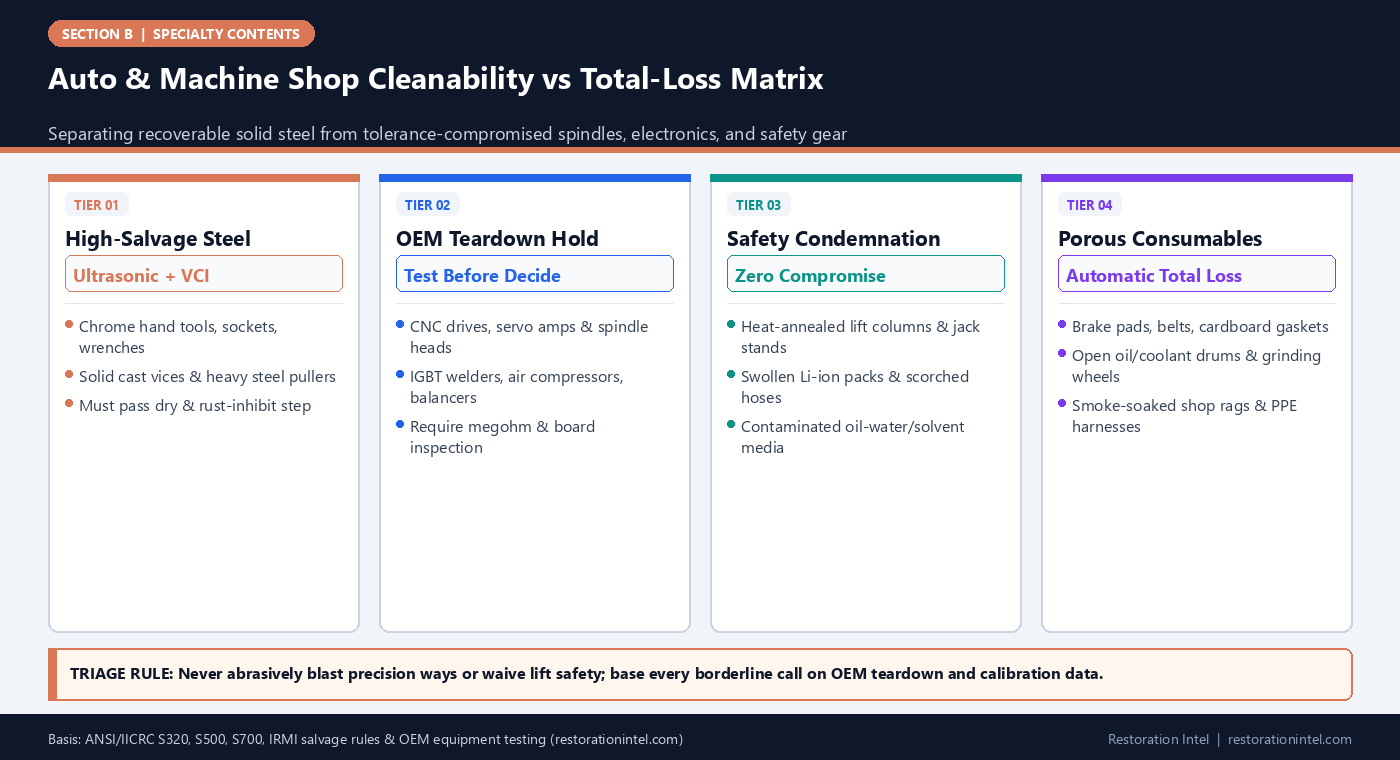
Cleanability vs Total-Loss Triage Guide for Garages & Machine Shops
Practical restorable vs non-salvageable thresholds and required proof for core shop assets.
| Equipment / Tool Category | Restorable Criteria | Total-Loss / Condemnation Trigger | Prohibited Cleaning Method | Required Substantiation Proof |
|---|---|---|---|---|
| Hydraulic Two-Post & Four-Post Lifts | Light smoke film or brief clean water on base; zero heat warp; seals/cables intact | Direct flame/radiant heat on columns or arms; compromised welds; water inside buried cylinders | Abrasive sandblasting on hydraulic piston rods or structural weld heat-straightening | ALI-certified lift inspector structural, hydraulic pressure & safety-latch report |
| CNC Spindles, Ways & Servo Cabinets | Contained enclosure soot without board ingress; immediate VCI protection prevented pitting | Pitted ball screws/linear ways; acidic soot on servo backplanes; thermal bed distortion | Pressure washing, alkaline floor degreasers, or dry rag wiping across precision ground steel | OEM or machine-tool rebuilder teardown, megohm test & laser geometric check |
| Diagnostic Scan Tools & ADAS Rigs | External protective boot smoke only; sealed case kept connectors and boards clean | Moisture/soot inside tablet vents, PCB corrosion, warped optical target mirrors | Aqueous immersion, ozone gas exposure on rubber/plastics, or blind power-on | Authorized vendor bench diagnostic & optical calibration verification |
| Precision Metrology (Micrometers, Bore Gauges, Surface Plates) | Superficial light dust on external frame; zero anvil pitting; passes NIST check | Anvil/spindle corrosion pitting, seized ratchet thimbles, chipped granite reference plane | Ultrasonic acid bath, wire brushing, or Scotch-Brite scouring on lapped measuring faces | Third-party ISO/NIST calibration lab failure or pass certificate |
| Chrome Hand Tools & Pneumatic Impacts | Non-porous steel wrenches, sockets, solid pullers; intact chrome/ratchet internals | Heat-blued temper loss (softened steel), cracked impact housings, seized/rusted air vanes | Strong caustic strippers that hydrogen-embrittle hardened steel or strip chrome | Before/after ultrasonic cleaning log + functional torque/air-tool test |
| Parts Washers, Oil-Water Separators & Consumables | Intact steel tank shell with pump/heater cleanable after hazmat fluid purge | Warped coalescing separator plates, contaminated open coolant/oil drums, soaked brake pads/belts | Flushing solvent residue into municipal drains or reusing water-contaminated lubricants | Environmental pump-out manifest + <a href="https://www.irmi.com/term/insurance-definitions/salvage" target="_blank" rel="noopener">salvage/disposal log</a> |
Hydraulic Lifts, Alignment Racks, and Structural Heat Boundaries
Hydraulic two-post lifts, four-post alignment racks, and heavy-duty scissor lifts carry human lives overhead every workday, which leaves zero room for guesswork on structural salvageability. When a bay suffers light smoke drift or clean roof-leak water around lift base plates, cleaning the steel columns, replacing saturated hydraulic power-pack breather caps, flushing emulsified hydraulic fluid, and inspecting equalizer cables can restore safe operation.
By contrast, direct fire impingement, prolonged radiant heat from a burning vehicle on the lift, or falling roof trusses crosses immediately into safety condemnation. High heat alters the metallurgy of structural lift arms, weakens anchor bolts set in spalled concrete, degrades high-pressure hydraulic hoses, and warps column latch channels. Even if a charred lift still raises under power, no certified lift inspector will sign off on returning heat-affected steel to service.
The triage rule is binary: never allow a contents estimator to call a heat-exposed lift “clean and paint.” Bring in an Automotive Lift Institute (ALI)-certified lift inspector or OEM distributor to perform an engineering evaluation covering column plumbness, concrete anchor pull-out strength, hydraulic cylinder scoring, and cable/latch integrity.
- Heat-exposure hard stop: Blistered powder coat, melted nylon slide blocks, or heat-discolored lift arms require formal structural condemnation review.
- Hydraulic fluid test: Check reservoir sight glasses and sample oil for moisture emulsion before cycling any lift power pack after a sprinkler or flood loss.
- Alignment rack optics: Treat laser/camera alignment heads on four-post racks as precision electronics, separate from the structural steel runway.
CNC Spindles, Ground Ways, and Precision Metrology Tolerances
Machine shops operate in thousandths and ten-thousandths of an inch, meaning a cleaning step that rescues a tractor frame will destroy a CNC machining center. On fire and sprinkler losses, acidic chloride soot (from burning PVC wire insulation and plastics) combines with ambient humidity or suppression water to attack bare cast-iron beds, precision-ground linear guideways, ball screws, and high-speed spindle bearings.
Once micro-pitting forms on a ball screw raceway or inside ceramic-hybrid spindle bearings, ultrasonic washing cannot restore geometric accuracy or vibration-free surface finish. Similarly, aggressive abrasive blasting, wire wheels, or scouring pads never belong near machine-tool ways, lathe bed dovetails, or granite surface plates—removing even half a thousandth of an inch throws the machine out of square.
Metrological instruments—micrometers, vernier calipers, dial test indicators, and gauge blocks—follow the same tolerance law. Any micrometer showing spindle thread drag, anvil pitting, or frame distortion fails calibration under equipment lab and testing criteria and must be triaged as a total loss unless a certified calibration lab restores and certifies it within OEM specs.
- Speed beats scrubbing on bare iron: Stabilize unrusted ways rapidly with approved VCI/water-displacing mist rather than waiting weeks for carrier approval.
- Spindle & ball-screw rule: Water or acidic soot inside sealed spindle cartridges or ball-nut wipers requires OEM spindle-house teardown inspection.
- No abrasives on metrology: Condemn pitted micrometers, corroded gauge blocks, and heat-stressed granite surface plates backed by calibration lab rejection notes.
Diagnostic Scan Tools, Welders, and Circuit-Board Corrosion Creep
Electronic shop assets fail quietly. A Snap-on or Autel diagnostic tablet, an oscilloscope cart, a programmable TIG inverter welder, or an automated tire balancer might boot normally on Day 1 while still damp or lightly dusted with combustion soot. Weeks later, hygroscopic soot salts pull ambient moisture onto copper traces and IGBT power modules, triggering short circuits and erratic sensor errors.
Because diagnostic tools also verify vehicle safety systems—airbags, ABS braking, and ADAS lane-keeping radars—unverified electronics pose unacceptable downstream liability. Never declare a smoke-penetrated diagnostic tablet, ADAS camera rig, or digital torque wrench “restorable with exterior wipe-down.” Either an authorized OEM electronics vendor cleans, de-ionizes, and bench-certifies the unit under warranty, or it moves to the total-loss column.
For heavy electrical shop machinery—TIG/MIG welders, plasma cutters, and variable-frequency drives (VFDs)—require documented teardown inspection, insulation resistance (megohm) testing, and load-bank verification under E-04 diagnostic teardown standards.
- Economic feasibility test: When OEM electronics bench testing plus board-level cleaning approaches replacement ACV, document the cost comparison early.
- Welder & VFD load tests: Do not sign off on inverter welders or CNC drives without megohm insulation checks and load verification.
- ADAS optical fragility: Any heat warping, delamination, or chemical haze on ADAS calibration targets or laser mirrors triggers replacement.
Solvent Tanks, Oil-Water Separators, and Pneumatic Tooling
Fluid-handling equipment and pneumatic bay tools sit in a distinct mechanical tier. Aqueous heated parts washers, mineral-spirits solvent sinks, and oil-water separator interceptors can often be pumped out, decontaminated, fitted with fresh coalescing media plates or heating elements, and returned to service if their structural tanks did not buckle from fire heat. However, the contaminated fluids inside—including open 55-gallon motor-oil drums, transmission fluid totes, and water-soluble CNC coolant reservoirs—are an automatic total loss once fire debris, suppression water, or foam enters the container.
Pneumatic impact wrenches, air ratchets, die grinders, and HVLP collision spray guns require internal inspection rather than external wiping. Suppression water entering an air-line drop carries rust grit straight into precision rotor vanes and HVLP fluid needles. HVLP paint guns used in auto body shops depend on microscopic air-cap tolerances; soot-pitted or over-cleaned brass caps ruin metallic paint atomization.
Follow first-window stabilization rules by purging and oiling salvageable pneumatic tools immediately after air-line moisture intrusion, while condemning porous shop consumables.
- Open fluid drum rule: Treat open coolant, hydraulic, and motor-oil drums exposed to smoke, soot, or suppression water as contaminated waste.
- HVLP spray-gun precision: Test collision paint guns with manufacturer nozzle gauges rather than assuming ultrasonic cleaning preserves atomization.
- Pneumatic vane flush: Flood wet air-tools promptly with pneumatic tool oil after documenting damage—or log rotor seizure for replacement.
Ultrasonic Recovery of Hand Tools vs Condemning Porous Shop Stock
Non-porous chrome-vanadium sockets, combination wrenches, pry bars, steel pullers, and cast-iron vises form the backbone of shop salvage. Provided fire heat did not anneal or blue the steel, multi-stage alkaline ultrasonic tanks, deionized rinses, hot-air drying, and vapor-corrosion inhibitor (VCI) lubrication restore hand tools reliably.
Exercise caution with hardened tools and ratcheting internals: avoid harsh acid descalers that cause hydrogen embrittlement on torque bars, and inspect sealed ratchet heads for lubricant washout. Check rubberized grips and 1,000-volt EV insulated tools individually, because heat-scarred or solvent-softened insulation loses dielectric safety rating.
Porous consumables—boxed brake pads, paper filters, belts, cardboard gasket sets, abrasive grinding wheels (which absorb moisture and can shatter at RPM), shop rags, and nylon hoist slings—are automatic total losses under witness-bin disposal protocols.
- EV insulated tool hard stop: Condemn any 1,000V IEC/ASTM insulated tool showing scorched, nicked, or solvent-softened sleeves.
- Grinding wheel & sling safety: Never salvage water-soaked resin grinding wheels or soot-exposed nylon hoist slings.
- Heat-blued steel check: Pull any socket, torque bar, or jack stand showing rainbow temper discoloration into the total-loss pile.
Practitioner Verification Checklist (B-24)
- Obtain ALI-certified lift inspector evaluation for any hydraulic lift exposed to fire heat, falling debris, or water-intruded cylinders.
- Stabilize unrusted CNC ways immediately with VCI mist; require OEM/rebuilder teardown for wet or soot-exposed spindles and servo drives.
- Route smoke- or moisture-exposed diagnostic scan tools, ADAS targets, and IGBT welders through authorized bench/megohm testing before use.
- Submit exposed micrometers, bore gauges, and granite plates for ISO/NIST calibration check rather than abrasive field cleaning.
- Recover un-annealed chrome hand tools via ultrasonic bath and VCI dip, while condemning heat-blued steel and damaged EV insulated grips.
- Write off porous shop consumables (brake pads, gaskets, grinding wheels, nylon slings, open oil/coolant drums) on witnessed disposal logs.
Standards, Authority References & Related Reading
Primary standards, insurance definitions, and sibling Restoration Intel guides referenced in this brief:
- ANSI/IICRC S320 Standard for Professional Contents Restoration
- ANSI/IICRC S500 Water Damage Standard
- ANSI/IICRC S700 Fire & Smoke Restoration Standard
- OSHA Hazard Communication Standard (HazCom)
- US EPA Hazardous Waste Framework
- IRMI Insurance Glossary: Salvage
- Related Guide: Automotive Repair Shops, Machine Shops & Garages: Scope & Hazard Boundaries
- Related Guide: Automotive Repair Shops, Machine Shops & Garages: Capture, Serial & Provenance Logging
- Related Guide: Automotive Repair Shops, Machine Shops & Garages: Valuation, LKQ Sourcing & Policy Traps
- Related Guide: Automotive Repair Shops, Machine Shops & Garages: Pack-Out, Chain of Custody & Recertification
- Related Guide: Diagnostic Testing and OEM Teardown Protocols: Proving Internal Smoke, Moisture, or Surge Damage
- Related Guide: Electronic Circuit Boards and Corrosion Creep: Why Wet or Soot-Exposed Machinery Fails Weeks After Loss
- Related Guide: Evaluating Equipment Restoration Vendors: Reading Lab Reports, Megohm Testing, and Cleanliness Swabs
.md twin for desk QA and team training.Frequently Asked Questions
When must a hydraulic two-post lift be condemned rather than cleaned after a garage fire?
Any lift column, carriage, or arm exposed to direct flame or radiant heat sufficient to blister coatings, melt slide blocks, or anneal steel—or with compromised concrete anchors or water-contaminated buried cylinders—must be condemned pending ALI-certified inspection.
Can ultrasonic cleaning restore a soot-damaged micrometer or dial bore gauge?
Usually not without recertification. Submerged ultrasonic cleaning can push trapped grit into delicate micrometer threads and internal gears, and any corrosion pitting on lapped anvil faces destroys micron tolerances.
Why are abrasive grinding wheels and nylon hoist slings automatically non-salvageable after a water or fire loss?
Moisture weakens resinoid bonding in abrasive wheels (creating high-RPM shatter risk), while heat, soot acids, or chemicals compromise load-bearing nylon fibers in lifting slings and fall-arrest harnesses.
Are Snap-on or Matco hand tools usually worth cleaning instead of replacing?
Yes, when fire heat did not anneal or blue the steel. Forged chrome-vanadium wrenches and sockets clean reliably in ultrasonic tanks with proper rust inhibition, though sealed ratchets and insulated 1,000V EV tools require internal or dielectric verification.
Why do CNC controllers and diagnostic tablets fail weeks after a minor sprinkler discharge?
Hygroscopic chloride soot and moisture creep across circuit-board solder joints and connector pins over time, causing progressive corrosion and intermittent shorts long after the exterior looks dry.