Direct Answer: Decontaminating chemical, asbestos, or lead-soot exposed contents requires negative-pressure HEPA enclosures verified by differential pressure monitoring, sequential HEPA-vacuum-wet-wipe-HEPA or ultrasonic immersion processing using contaminant-matched chemistry, batch wastewater containment, and post-clean Industrial Hygienist clearance swabs linked to individual item barcodes.
.md twin for estimator QA and carrier file documentation.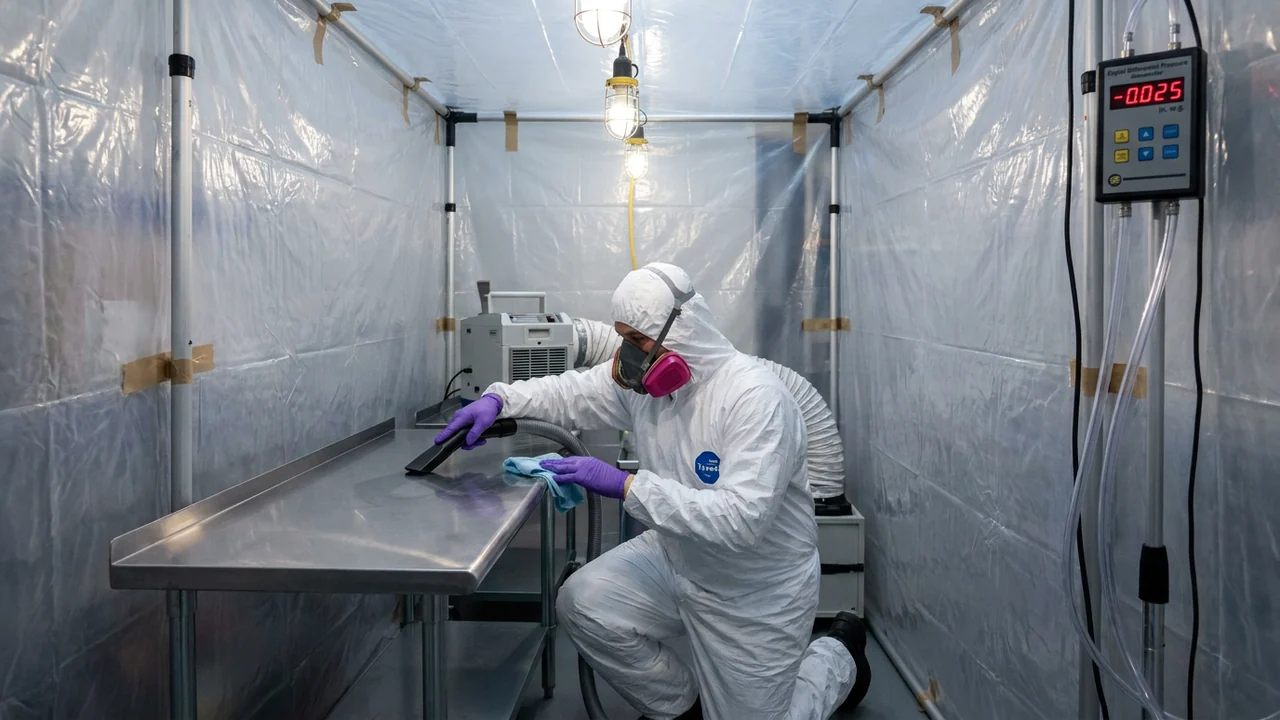
Cleaning contents exposed to asbestos fibers, lead-laden soot, or reactive chemicals is fundamentally different from removing ordinary wood smoke or clean water stains. In standard contents processing, success is judged by visual appearance and odor neutrality. On a hazmat or heavy-metal job, a stainless steel prep table or set of machined tools can look spotless under shop lights while still failing an Industrial Hygienist wipe test by orders of magnitude.
Effective decontamination therefore relies on documented engineering controls and validated cleaning chemistry grounded in ANSI/IICRC S320, ANSI/IICRC S700, and US EPA Indoor Air Quality guidance. Dry rag wiping or uncalibrated shop vacuums aerosolize sub-micron particulates and spread contamination across the entire plant; instead, technicians operate inside negative-pressure poly chambers using H13/H14 HEPA filtration, surfactant or chelating wet wipes, and controlled immersion baths.
Every chemical rinse, filter change, and waste-water drum generated during processing carries regulatory obligations under the EPA Hazardous Waste Framework and state environmental agencies. Contents divisions must never discharge heavy-metal or solvent wash water into municipal floor drains without verified testing and permitting, and must tie every restored batch to post-clean clearance logs before return delivery.
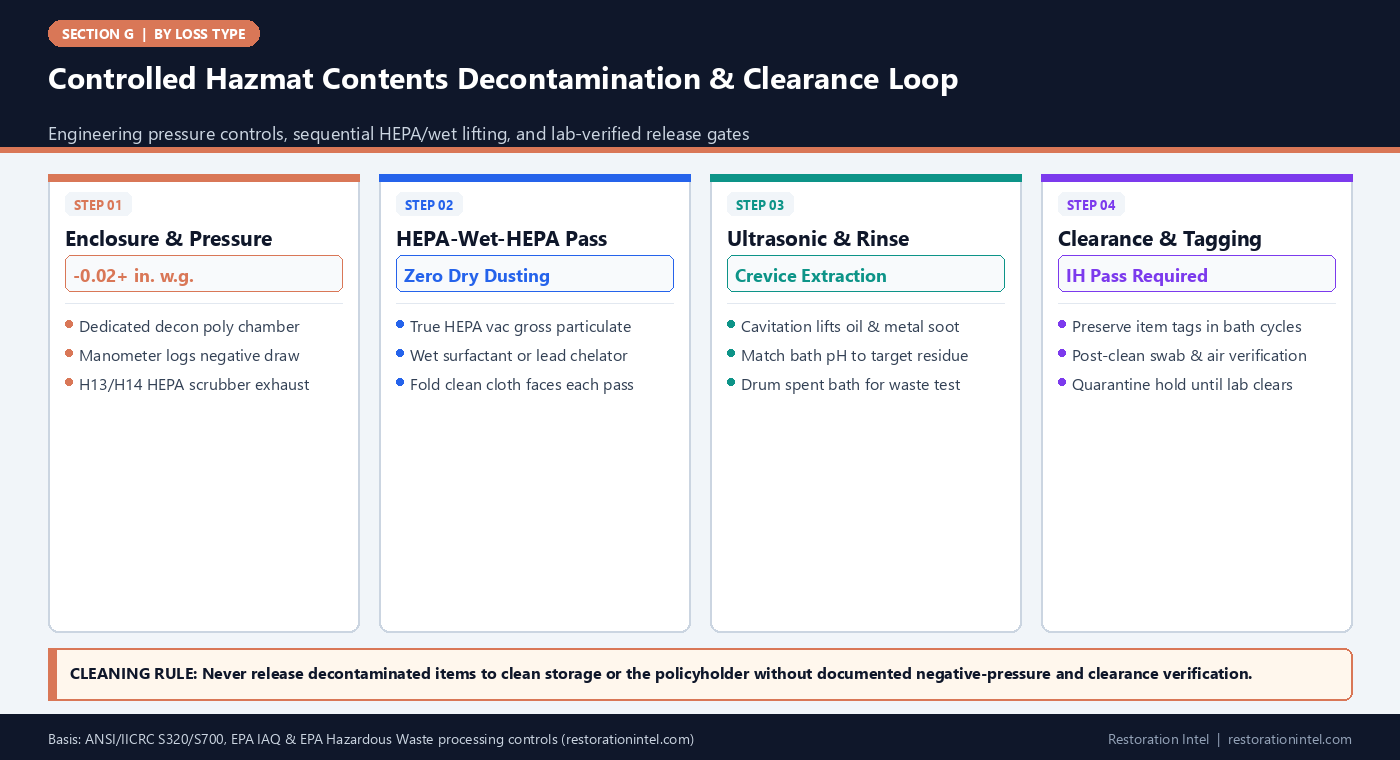
Controlled Hazmat Contents Decontamination & Clearance Loop
Decontamination Process Matrix & Documentation Standards by Method
Technical parameters, cross-contamination safeguards, and mandatory audit records across hazmat and heavy-metal contents processing.
| Decontamination Method | Target Substrate & Residue | Critical Process Parameter | Cross-Contamination & Waste Control | Mandatory Processing Log |
|---|---|---|---|---|
| True HEPA Vacuuming (H13/H14) | Dry friable ACM dust, lead-soot, and loose powder on hard goods | Sealed HEPA unit DOP/filter-checked; gentle brush nozzle without gouging | Exhaust vented inside negative-pressure chamber; bag spent dust as regulated waste | Machine ID, filter check date, operator log, and vacuum-pass timestamp |
| Wet Surfactant / Lead-Chelating Wipe | Non-porous steel, glass, sealed wood, and painted machinery housings | Dampen disposable microfiber; fold into quarters and discard after one pass | Never double-dip dirty cloths into clean solution buckets; drum spent rags | Chemical SDS, dilution ratio, dwell time, and batch operator signature |
| Ultrasonic Cavitation Immersion | Complex machined tools, cookware, gears, and non-porous hardware | Heated bath (typically 120–145°F for metals) with contaminant-matched detergent | Segregate hazmat bath tanks from standard soot tanks; test/drum bath effluent | Bath temperature, cycle minutes, solution lot, and chemical-resistant metal/QR tag |
| Acid/Base Chemical Neutralization | Corrosive battery electrolyte, industrial acid mist, or alkali spills | Verify surface pH before and after buffering rinse; follow with corrosion inhibitor | Capture neutralization runoff in labeled poly drums; check gas off-gassing | Pre- and post-treatment pH readings, neutralizer SDS, and corrosion-protect note |
| Controlled-Temp Drying & Bake-Out | Washed metal assemblies, sealed motors, and moisture-sensitive tooling | Filtered clean warm air inside isolated cabinet; prevent flash rust on bare alloys | Ensure air intake draws from verified clean zone rather than dirty staging bay | Cabinet temperature log, moisture/megohm reading, and visual corrosion check |
| Post-Clean IH Clearance Verification | Representative batch samples across all decontaminated hard-good lots | 100 cm2 wipe templates or micro-vac/TEM cassettes per IH sampling plan | Hold entire batch in clean-quarantine wrap until written lab pass arrives | Lab sample ID linked to item barcodes, numerical result vs threshold, IH sign-off |
Operating Negative-Pressure Decontamination Enclosures and HEPA Filtration Discipline
Opening double-bagged hazmat totes on an open warehouse floor undoes every safeguard built during pack-out. Processing plants handling asbestos, lead-soot, or volatile chemical residues must route contaminated batches into a dedicated negative-pressure decontamination enclosure—built with sealed poly walls, washable stainless benches, and continuous differential pressure monitoring targeting negative 0.020 to 0.025 inches of water gauge (in. w.g.) or stricter per project specs.
Continuous logging on a calibrated digital manometer proves to adjusters, OSHA inspectors, and facility managers that contaminated air never leaked outward into general cleaning lines. Equally important is true HEPA integrity: ordinary consumer ‘HEPA-style’ vacuums bypass fine lead and asbestos particulates around housing gaskets. Only sealed industrial HEPA vacuums tested for filtration efficiency belong inside the decon bay.
When volatile organic solvents or acidic vapors are present, standard particulate scrubbers alone will not capture gas-phase hazards. Process engineers must pair particulate pre-filtration with activated-carbon or potassium-permanganate beds sized for the specific chemical profile and monitor exhaust air continuously.
- Log differential pressure continuously: Export or photograph manometer readings at shift start, mid-shift, and batch completion.
- Separate decon equipment strictly: Label HEPA vacuums, buckets, and ultrasonic tanks for hazmat/lead service only—never share them with clean residential soot lines.
- Maintain clean airlock staging: Keep clean rinse tanks, fresh wipes, and clean wrap outside the dirty wash bench boundary.
Stepwise Mechanical and Chemical Cleaning: HEPA-Wet-HEPA and Ultrasonic Immersion
Validated dry-then-wet lifting follows a disciplined three-pass rhythm often summarized as HEPA-wet-HEPA. First, technicians vacuum loose surface dust slowly using soft-bristle HEPA attachments so dry particulate is captured rather than smeared into microscopic surface scratches. Second, they wet-wipe using disposable cloths pre-moistened with a surfactant or heavy-metal chelating detergent engineered to break electrostatic bonds holding lead and soot.
Crucially, wiping uses a strict one-direction, fold-and-discard motion: wipe once in a straight line, fold the cloth to a clean face, never scrub in circles, and never dip a used rag back into the clean detergent bucket. After final rinsing and drying, a second HEPA vacuum pass removes any residual lint or dislodged micro-particulate prior to clearance swabbing.
For intricate commercial tools, stainless fasteners, or restaurant components with tight seams where cloths cannot reach, ultrasonic immersion baths use high-frequency cavitation bubbles to scrub recessed threads and blind holes. As detailed in Contents Restoration After Fire and Contents Cleaning SLAs by Category, matching bath temperature and pH to both the alloy and the contaminant prevents aluminum etching or hydrogen embrittlement while stripping toxic films.
- Ban dry wiping and compressed air: Dry rags scratch soft coatings and re-aerosolize lead and asbestos dust into the room.
- Use chelating chemistry for heavy metals: Standard degreasers miss lead salts; use validated lead-chelating or TSP-free phosphate alternatives approved for the substrate.
- Protect bare steel immediately: Apply approved vapor-phase or food-safe corrosion inhibitors right after ultrasonic rinsing and thermal drying.
Managing Wash Wastewater, Spent Filters, and Batch Tag Retention Under Hazmat Controls
Every gallon of ultrasonic rinse water, every spent HEPA filter bag, and every bucket of lead-chelating wipe solution concentrates the contaminant pulled off the contents. Pouring hazmat decon effluent into an ordinary shop sink violates environmental discharge laws and creates severe corporate liability. Processing bays must capture liquid waste inside labeled poly drums or totes for analytical testing and licensed disposal or permitted pretreatment.
Custody tracking inside a wet chemical or ultrasonic bay faces a practical hazard of its own: paper barcoded tags dissolve or turn illegible after thirty seconds in heated surfactant baths. Technicians must swap paper stickers at the decon intake bench for chemical-resistant embossed metal tags, laser-etched Tyvek bands, or waterproof QR clips tied directly to each item or perforated ultrasonic basket.
Maintaining uninterrupted ID linkage through cleaning ensures that when an Industrial Hygienist pulls post-clean clearance swabs on Basket #14, every wrench and valve inside that basket can be traced unambiguously back to its original room location and claim line.
- Zero drain dumping: Drum all lead, asbestos, and chemical decon wash water and spent filter media until waste profiling confirms legal disposal.
- Solvent-proof ID tags: Attach stainless wire + chemical-resistant tags before items enter ultrasonic or immersion tanks.
- Separate chemical compatibility in waste: Never mix acidic neutralization rinses with alkaline degreasers or oxidizer wastes inside the same holding drum.
Post-Cleaning Verification: Clearance Swabs, Micro-Visual QA, and Return-to-Service Sign-Off
In hazmat contents restoration, the cleaning crew does not grade its own homework. Once a batch dries and passes internal micro-visual inspection under bright task lighting, items move into sealed clean-quarantine wrapping inside a neutral holding rack while an independent Industrial Hygienist collects post-decon verification samples.
For lead-soot lots, clearance relies on quantitative surface wipes measured against applicable HUD/EPA/occupational surface limits (expressed in micrograms per square foot or 100 cm2). For asbestos-exposed hard goods, verification may use micro-vacuum or wipe sampling analyzed by TEM/PLM alongside enclosure air-clearance cassettes. Chemical losses require target compound swabs or vapor-headspace screening confirming residues sit below health-based action levels.
Only after written laboratory clearance arrives should clean-side technicians apply ‘CLEARED FOR RESET’ seals, generate final post-clean photographs, and schedule pack-back. If any sample fails, the entire associated batch returns through containment for repeat processing or transitions cleanly to non-salvageable re-evaluation.
- Hold batches under quarantine until lab pass: Never pack back items on ‘expected’ clearance before official lab sheets are signed.
- Match batch size to sampling math: Group substrates uniformly by contaminant intensity so one failed wipe does not invalidate unrelated clean lots.
- Archive clearance certificates per claim: Bind manometer logs, chemical SDS sheets, and post-clean IH lab reports into the carrier deliverables packet.
Practitioner Verification Checklist (G-35)
- Process all hazmat, asbestos, and lead-soot exposed goods inside a dedicated negative-pressure poly chamber logged at -0.020 in. w.g. or stronger.
- Execute true H13/H14 HEPA-wet-HEPA or ultrasonic immersion cleaning using disposable quarter-folded wipes and contaminant-matched chemistry.
- Swap paper labels for solvent-proof metal or waterproof QR tags before immersion so item custody never breaks during wet cycles.
- Collect all decon rinse water, spent HEPA filters, and contaminated wipes inside labeled drums for analytical testing and legal disposal.
- Hold processed batches in clean quarantine until independent post-clean Industrial Hygienist clearance swabs verify safe return.
Standards, Authority References & Related Reading
Primary standards, insurance definitions, and sibling Restoration Intel guides referenced in this brief:
- ANSI/IICRC S320 Standard for Professional Contents Restoration
- ANSI/IICRC S700 Fire & Smoke Restoration Standard
- US EPA Indoor Air Quality (IAQ)
- US EPA Hazardous Waste Framework
- Related Guide: Chemical, Hazmat, Asbestos & Lead-Soot Contamination Losses: Non-Salvageable vs Restorable Criteria
- Related Guide: Chemical, Hazmat, Asbestos & Lead-Soot Contamination Losses: Pack-Out Sequencing & Cross-Contamination Containment
- Related Guide: Chemical, Hazmat, Asbestos & Lead-Soot Contamination Losses: Carrier Scope Justification & Total-Loss Defense
- Related Guide: Contents Restoration After Fire: Pack-Out Protocols, Cleaning Methods, and Insurance Inventory
- Related Guide: Contents Cleaning SLAs by Category
.md twin for desk QA and team training.Frequently Asked Questions
Why isn't visual inspection enough after cleaning lead-soot or asbestos-exposed tools?
Microscopic asbestos fibers and lead salts are invisible to the naked eye at concentrations that still exceed regulatory clearance limits. Only laboratory wipe, micro-vac, or air clearance testing confirms decontamination succeeded.
What negative pressure target should a contents decontamination enclosure maintain?
Standard industry practice under containment protocols targets at least -0.020 to -0.025 inches of water gauge (in. w.g.) verified continuously by calibrated digital manometer logging.
How do contents plants keep item barcodes from washing off in ultrasonic chemical baths?
Technicians replace standard paper barcode stickers at the decon bench with solvent-resistant laser-printed bands, embossed aluminum/steel wire tags, or perforated serialized baskets tied to the digital manifest.
Can wash water from cleaning lead-soot or chemical-stained contents go down a municipal floor drain?
No. Heavy-metal and chemical decon effluent is potentially regulated wastewater under EPA and local POTW rules and must be captured in labeled drums for testing and permitted treatment or manifested disposal.