Updated November 14, 2026 — reformatted to Restoration Intel house standard with Print-First PDF brief and Markdown twin.
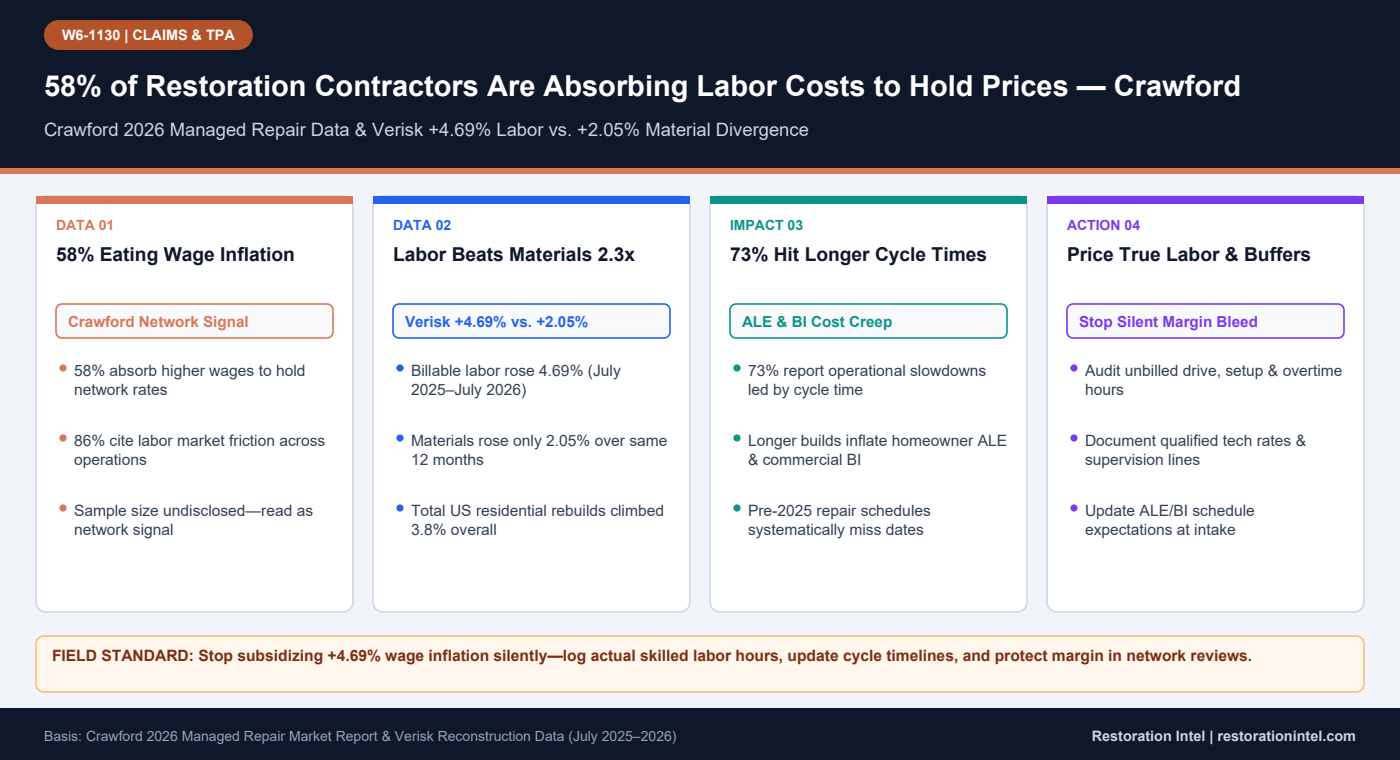
Direct Answer: The number: 58% of restoration contractors are absorbing higher labor costs rather than passing them on, according to the first installment of Crawford & Company’s 2026 Managed Repair Market report, released this week. That’s not a forecast. That’s contractors describing what they’re already doing.
.md twin for Insurance Claims & TPA Governance.
The number: 58% of restoration contractors are absorbing higher labor costs rather than passing them on, according to the first installment of Crawford & Company’s 2026 Managed Repair Market report, released this week.
That’s not a forecast. That’s contractors describing what they’re already doing.
What Crawford found
The report comes from Crawford’s Contractor Connection network — its managed repair contractor base. Key findings from installment one:
- 58% are absorbing higher labor costs to keep pricing consistent
- 86% say the labor market is affecting their business
- 73% report an operational impact — most often longer job cycle times
- Top concerns: rising material costs, economic uncertainty, and labor shortages
Crawford did not disclose how many contractors responded to the survey, so read the percentages as a signal from inside one large network, not a census of the whole industry.
“Contractors are managing significant cost and workforce pressures, yet many are choosing to protect strategic business relationships while continuing to provide the same level of exceptional service to policyholders,” said Lance Malcolm, president of Crawford Network Solutions. He said the findings would help carriers understand contractor economics and find practical ways to support a healthy repair network.
Labor is outpacing materials — by a lot
The survey lines up with Verisk’s reconstruction cost data: combined hourly billable labor costs rose 4.69% between July 2025 and July 2026 — more than double the 2.05% rise in material costs over the same period. Total residential reconstruction costs rose 3.8%, increasing in every state.
That’s the squeeze in one comparison. The thing getting more expensive isn’t the drywall. It’s the people.
What this means on a real job
The absorption can’t last forever. If 58% of contractors are holding prices by eating higher labor costs, that pressure goes somewhere eventually. When contractors start passing costs through, property repair claim severity rises — on top of the reconstruction inflation insurers are already seeing.
Cycle times are the quiet cost. Longer job cycle times don’t just annoy adjusters. Slower repairs mean longer additional living expense periods for homeowners and longer business interruption for commercial clients. If your estimates and schedules still assume pre-2025 timelines, they’re wrong.
Insured values are drifting. With labor driving reconstruction costs up faster than materials, property valuations last reviewed before 2025 may already fall short. Underinsurance usually only shows up once the claim is filed — which is the worst possible time to discover it.
Technology is table stakes now. The report found near-universal tech adoption — 98% of contractors use technology somewhere in the business: estimating and scoping, communications and documentation, project management, and field work like moisture detection and damage assessment. If you’re still estimating on paper, you’re not competing with the 98%.
What’s coming next
This was installment one of three. Two more are scheduled:
- October 21 — how managed repair programs create value
- November 11 — collaboration between contractors and carriers
Both are worth watching. The October installment will show how Crawford frames the value story for managed repair — which matters if you work in or around those programs. The November installment gets at the contractor-carrier relationship directly, which is where the cost-absorption tension either resolves or breaks.
We’ll update this page as the next installments land.
The bottom line
Most contractors are choosing to protect relationships over protecting margins right now. That’s a defensible call — until it isn’t. The operators who come through this stretch best will be the ones who know their true labor cost per job, price cycle times honestly, and don’t let underinsurance become their customer’s surprise.
Sources: Crawford & Company 2026 Managed Repair Market report, installment 1 (via Insurance Business); Verisk reconstruction cost analysis (hourly billable labor vs. material cost data, July 2025–July 2026).
Restoration Intel is an independent operator’s publication. We translate industry data into plain English for restoration contractors. Crawford’s findings are Crawford’s — we’ve summarized them here and linked the original reporting.
58% of Restoration Contractors Are Absorbing Labor Costs to Hold Prices — — Visual Workflow
Field Operational Breakdown & Verification Matrix
Structured operational summary of 58% of Restoration Contractors Are Absorbing Labor Costs to Hold Prices — Crawford mapped to Restoration Intel documentation gates.
| Operational Stage | Field Focus in This Guide | Documentation Requirement | Verification Gate |
|---|---|---|---|
| 1. What Crawford found | The number: 58% of restoration contractors are absorbing higher labor costs rather. | Timestamped photos, measurements & scope notes | Cross-check against primary standard prior to submission |
| 2. Labor is outpacing materials — by a lot | That’s not a forecast. That’s contractors describing what they’re already doing. | Timestamped photos, measurements & scope notes | Cross-check against primary standard prior to submission |
| 3. What this means on a real job | The report comes from Crawford’s Contractor Connection network — its managed repair. | Timestamped photos, measurements & scope notes | Cross-check against primary standard prior to submission |
| 4. What’s coming next | Crawford did not disclose how many contractors responded to the survey, so read the. | Timestamped photos, measurements & scope notes | Cross-check against primary standard prior to submission |
Field Documentation & Scope Verification Standard
To align 58% of Restoration Contractors Are Absorbing Labor Costs to Hold Prices — Crawford with Restoration Intel house standards under Insurance Claims & TPA Governance, field and estimating personnel should maintain an auditable record from first site walk through final carrier sign-off. That record begins by separating verifiable site conditions from assumptions: timestamped wide and close-up photographs, instrument readings paired with calibration or baseline context, and written scope notes tied directly to the line-item or contractual requirement.
When preparing a claim packet, internal SOP, or commercial facility handoff, pair the checklist below with the downloadable Print-First PDF brief and plain-text Markdown twin so estimators, project managers, and desk examiners work from identical scope boundaries without losing provenance between field capture and final review.
Operational consistency across Insurance Claims & TPA Governance assignments also depends on maintaining clean separation between original site observations, insurer policy or municipal code constraints, and subsequent supplemental change orders. Every transition in containment, equipment deployment, clearance testing, or reconstruction sequencing should be logged sequentially with author attribution, date and time metadata, and cross-references to the governing technical manual or carrier guideline so third-party reviewers can audit the decision path without re-inspecting the structure.
Supervisors and quality-assurance leads can use this standardized package format during post-loss file audits, adjuster reinspections, and internal technician training to confirm that intake forms, drying or remediation logs, chain-of-custody records, and closeout certificates remain complete, internally consistent, and ready for immediate human review or automated compliance screening.
Practitioner Verification Checklist
- Confirm scope boundaries and loss classification for: 58% of Restoration Contractors Are Absorbing Labor Costs to Hold.
- Capture timestamped field photos, measurements, and serial/assembly notes before mobilization or tear-out.
- Tie every line item or operational recommendation to primary references (IRMI Insurance Glossary, IRMI Insurance Glossary).
- Verify internal cross-links and preserve all customer intake/compliance forms intact on the canonical page.
- Export and attach the Print-First PDF field brief and verify the sibling Markdown twin (.md) resolves HTTP 200.
Standards, Authority Citations & Related Guides
- IRMI Insurance Glossary: Replacement Cost Value (RCV)
- IRMI Insurance Glossary: Actual Cash Value (ACV)
- IRMI Insurance Glossary: Subrogation
- Related Guide: The 2026 TPA Survival Guide
- Related Guide: The Adjuster Desk: One Standard, Two Chairs
- Related Guide: Two Standards, One Truck: Documentation When the Brand and the Scorecard Disagree
.md twin for carrier and field review.Frequently Asked Questions
What is the core operational takeaway of 58% of Restoration Contractors Are Absorbing Labor Costs to Hold Prices — Crawford?
The number: 58% of restoration contractors are absorbing higher labor costs rather than passing them on, according to the first installment of Crawford & Company’s 2026 Managed Repair Market report, released this week. That’s not a forecast. That’s contractors describing what they’re already doing.
Which industry standards govern insurance claims & tpa governance documentation?
Practitioners should anchor field logs and claim packets to IRMI Insurance Glossary: Replacement Cost Value (RCV) and IRMI Insurance Glossary: Actual Cash Value (ACV), ensuring verifiable measurements and photo provenance.
Where can field and estimating teams access the offline or AI-readable edition?
Each upgraded Restoration Intel guide ships with a 2-page Print-First PDF brief and a plain-text Markdown twin (.md) linked directly inside the article download cards and /llms.txt.