Updated November 14, 2026 — reformatted to Restoration Intel house standard with Print-First PDF brief and Markdown twin.
Direct Answer: The short answer: the machines a restoration crew brings in aren’t random — each one does a specific job in a specific order. Extractors remove standing water, air movers create airflow, dehumidifiers pull the moisture that airflow releases, air scrubbers clean the air during dirty work, and meters prove it’s all.
.md twin for Water Mitigation & Structural Drying.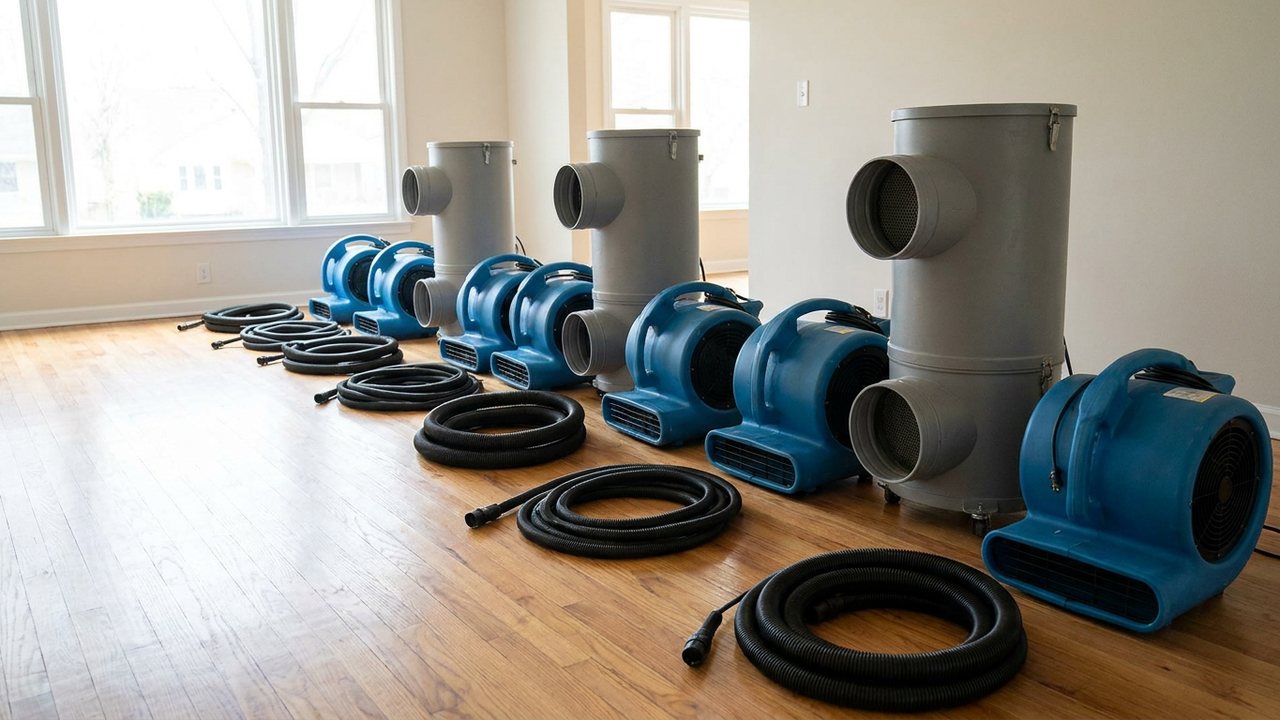
The short answer: the machines a restoration crew brings in aren’t random — each one does a specific job in a specific order. Extractors remove standing water, air movers create airflow, dehumidifiers pull the moisture that airflow releases, air scrubbers clean the air during dirty work, and meters prove it’s all working. If you understand what each machine does, you understand what phase your job is in — and whether it’s being done right.
The drying train: extraction → airflow → dehumidification
Structural drying is a system, and the equipment works as one. Skip a step and the rest underperforms.
Water extractors. First in, first out. Portable extractors and truck-mounted units pull standing water from floors, carpets, and surfaces — the bulk removal that has to happen before anything else. A shop vac moves gallons per hour; a commercial extractor moves tens of gallons per minute. This is why professionals start here and homeowners with a wet-vac are still at it on day three.
Air movers. Those loud, low-profile fans pointed at walls and floors. They don’t dry by themselves — they create high-velocity airflow across wet surfaces, which accelerates evaporation. Placement is the skill: angled at walls to push air into the wall-floor junction, ducted into wall cavities, positioned to create circulation patterns, not just noise. If the crew’s air movers are all pointed at the middle of the room, that’s decoration.
Dehumidifiers. The essential partner to air movers. Evaporation puts moisture into the air; without dehumidification, that moisture just resettles on the next cool surface. Two main types: – Refrigerant (condensing) dehumidifiers — cool coils that condense moisture out of the air. The workhorses of most residential jobs. – Desiccant dehumidifiers — use moisture-absorbing materials, work better in cold conditions (unheated spaces, winter losses) where refrigerant units lose efficiency.
Commercial units pull tens to hundreds of pints per day. Your home dehumidifier from the hardware store is not in the same category — and on a real loss, it isn’t enough.
Air quality equipment
HEPA air scrubbers. Portable filtration units that pull room air through HEPA filters, capturing airborne particles — mold spores during remediation, soot during fire cleanup, dust during demolition. On containment jobs, they’re run as negative air machines: ducted to exhaust outside, they keep the work area under negative pressure so contaminants don’t migrate to clean rooms. If you see plastic containment barriers with a machine humming inside, that’s the system working.
Hydroxyl generators. Used for odor neutralization — fire smoke, for example. They produce hydroxyl radicals that break down odor molecules in the air and on surfaces. Safe for occupied spaces, unlike ozone.
Ozone machines. Powerful oxidizers for severe odor — but they require the space to be unoccupied during treatment (ozone irritates lungs). Legitimate use is controlled and temporary, not “run it and hope.”
Detection and verification
Moisture meters. Pin meters (probes that penetrate the material) and pinless meters (sensors that read through the surface). They answer the question “is it actually dry?” — which eyes and hands can’t reliably answer. A crew that meters before, during, and after drying is documenting the job; a crew that doesn’t is guessing.
Thermal imaging cameras. Show temperature differences that reveal wet areas behind finished surfaces — cold spots where evaporation is happening. Used for mapping the full extent of water intrusion without opening every wall. Detection, not proof — readings get confirmed with meters.
Thermo-hygrometers. Measure air temperature and relative humidity — the psychrometric data that tells the crew whether the drying environment is actually working. Drying is applied psychrometrics; these are the instruments.
Specialty equipment
- Injectidry / cavity drying systems — force dry air into wall cavities, under cabinets, and other trapped spaces without full demolition
- Desiccant drying trailers — for large commercial losses; essentially a dehumidification plant on wheels
- Soda blasting / dry ice blasting — media blasting for soot and mold on framing; removes contamination without saturating the wood
- Ultrasonic cleaning — for contents: high-frequency sound waves in a cleaning bath restore items (electronics, documents, blinds) that hand-cleaning can’t
- Esporta / contents washing systems — commercial-grade laundry for soft contents after fire and smoke
What the equipment tells you about your job
- Lots of air movers + dehumidifiers, few other machines: standard water mitigation, drying phase. Normal.
- Containment plastic + negative air + scrubbers: mold, sewage, or fire work — contamination control is active. Also normal, for that job type.
- Meters out on every visit: the crew is documenting drying progress. Good sign.
- Equipment sitting idle for days with no readings taken: ask what’s happening. Equipment on your property generates daily charges — it should be working or it should leave.
- No meters at all: the job is being run on feel. That’s not a method.
The homeowner’s role
Mostly: stay out of the way and keep the machines running. Don’t unplug dehumidifiers because they’re loud or raising your electric bill (they are, and it’s temporary — and often reimbursable). Don’t move air movers “to a better spot.” Do tell the crew about rooms they haven’t seen, pets, and anything the equipment shouldn’t be near. And ask for the moisture readings — a good crew will show you the numbers without being asked.
Where this comes from
- Equipment function: standard restoration industry practice; drying science per IICRC S500 principles (IICRC S500).
- From the field (labeled): the “what the equipment tells you about your job” section reflects working technician knowledge (third-party, not any single official source).
- Related on Restoration Intel: What Does a Restoration Company Do? · Basement Water Damage · How Much Does Mold Remediation Cost? · How Much Does Water Damage Restoration Cost?
The machines are the method. If you can read the equipment, you can read the job.
Restoration Equipment: What’s All That Stuff in Your House? — Visual Workflow
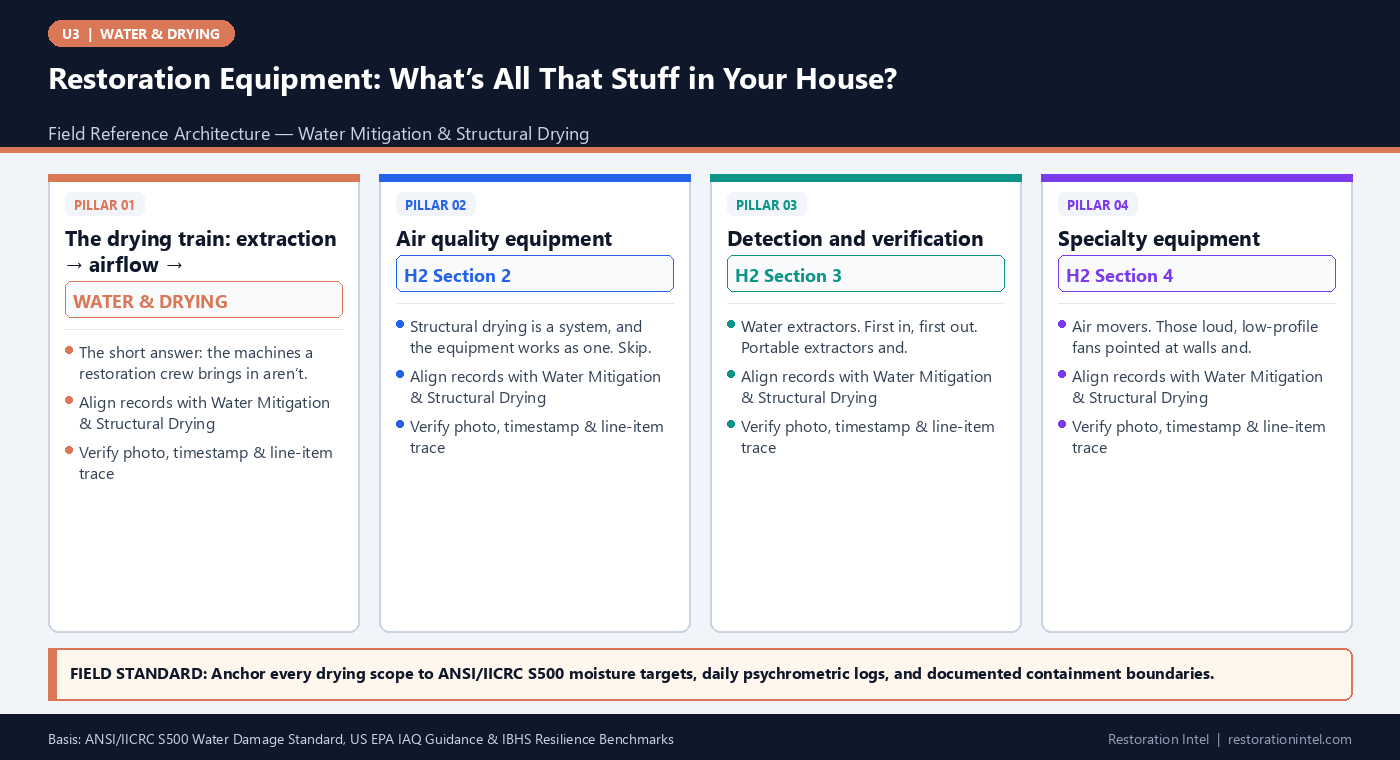
Field Operational Breakdown & Verification Matrix
Structured operational summary of Restoration Equipment: What’s All That Stuff in Your House? mapped to Restoration Intel documentation gates.
| Operational Stage | Field Focus in This Guide | Documentation Requirement | Verification Gate |
|---|---|---|---|
| 1. The drying train: extraction → airflow → | The short answer: the machines a restoration crew brings in aren’t random — each one. | Timestamped photos, measurements & scope notes | Cross-check against primary standard prior to submission |
| 2. Air quality equipment | Structural drying is a system, and the equipment works as one. Skip a step and the. | Timestamped photos, measurements & scope notes | Cross-check against primary standard prior to submission |
| 3. Detection and verification | Water extractors. First in, first out. Portable extractors and truck-mounted units. | Timestamped photos, measurements & scope notes | Cross-check against primary standard prior to submission |
| 4. Specialty equipment | Air movers. Those loud, low-profile fans pointed at walls and floors. They don’t dry. | Timestamped photos, measurements & scope notes | Cross-check against primary standard prior to submission |
Field Documentation & Scope Verification Standard
To align Restoration Equipment: What’s All That Stuff in Your House? with Restoration Intel house standards under Water Mitigation & Structural Drying, field and estimating personnel should maintain an auditable record from first site walk through final carrier sign-off. That record begins by separating verifiable site conditions from assumptions: timestamped wide and close-up photographs, instrument readings paired with calibration or baseline context, and written scope notes tied directly to the line-item or contractual requirement.
When preparing a claim packet, internal SOP, or commercial facility handoff, pair the checklist below with the downloadable Print-First PDF brief and plain-text Markdown twin so estimators, project managers, and desk examiners work from identical scope boundaries without losing provenance between field capture and final review.
Operational consistency across Water Mitigation & Structural Drying assignments also depends on maintaining clean separation between original site observations, insurer policy or municipal code constraints, and subsequent supplemental change orders. Every transition in containment, equipment deployment, clearance testing, or reconstruction sequencing should be logged sequentially with author attribution, date and time metadata, and cross-references to the governing technical manual or carrier guideline so third-party reviewers can audit the decision path without re-inspecting the structure.
Supervisors and quality-assurance leads can use this standardized package format during post-loss file audits, adjuster reinspections, and internal technician training to confirm that intake forms, drying or remediation logs, chain-of-custody records, and closeout certificates remain complete, internally consistent, and ready for immediate human review or automated compliance screening.
Practitioner Verification Checklist
- Confirm scope boundaries and loss classification for: Restoration Equipment: What’s All That Stuff in Your House?.
- Capture timestamped field photos, measurements, and serial/assembly notes before mobilization or tear-out.
- Tie every line item or operational recommendation to primary references (ANSI/IICRC S500 Water Damage Standard, US EPA Indoor Air Quality (IAQ)).
- Verify internal cross-links and preserve all customer intake/compliance forms intact on the canonical page.
- Export and attach the Print-First PDF field brief and verify the sibling Markdown twin (.md) resolves HTTP 200.
Standards, Authority Citations & Related Guides
- ANSI/IICRC S500 Water Damage Standard
- US EPA Indoor Air Quality (IAQ)
- Insurance Institute for Business & Home Safety (IBHS)
- Related Guide: Salvage Is a Window, Not a Service
- Related Guide: IICRC Cat 3 Contents Pack-Out Protocol
- Related Guide: Field Guide: IICRC S500, S520, and S700 Quick-Reference Thresholds for Contents Triage
.md twin for carrier and field review.Frequently Asked Questions
What is the core operational takeaway of Restoration Equipment: What’s All That Stuff in Your House??
The short answer: the machines a restoration crew brings in aren’t random — each one does a specific job in a specific order. Extractors remove standing water, air movers create airflow, dehumidifiers pull the moisture that airflow releases, air scrubbers clean the air during dirty work, and meters prove it’s all.
Which industry standards govern water mitigation & structural drying documentation?
Practitioners should anchor field logs and claim packets to ANSI/IICRC S500 Water Damage Standard and US EPA Indoor Air Quality (IAQ), ensuring verifiable measurements and photo provenance.
Where can field and estimating teams access the offline or AI-readable edition?
Each upgraded Restoration Intel guide ships with a 2-page Print-First PDF brief and a plain-text Markdown twin (.md) linked directly inside the article download cards and /llms.txt.