Direct Answer: Technicians inventory high-density closets, pantries, and linen cabinets accurately by capturing an in-situ shelf context shot, grouping like-tier items into uniform countable bundles on a clear table grid, and recording exact unit counts with standard size/quality cues.
.md twin for estimator QA and carrier file documentation.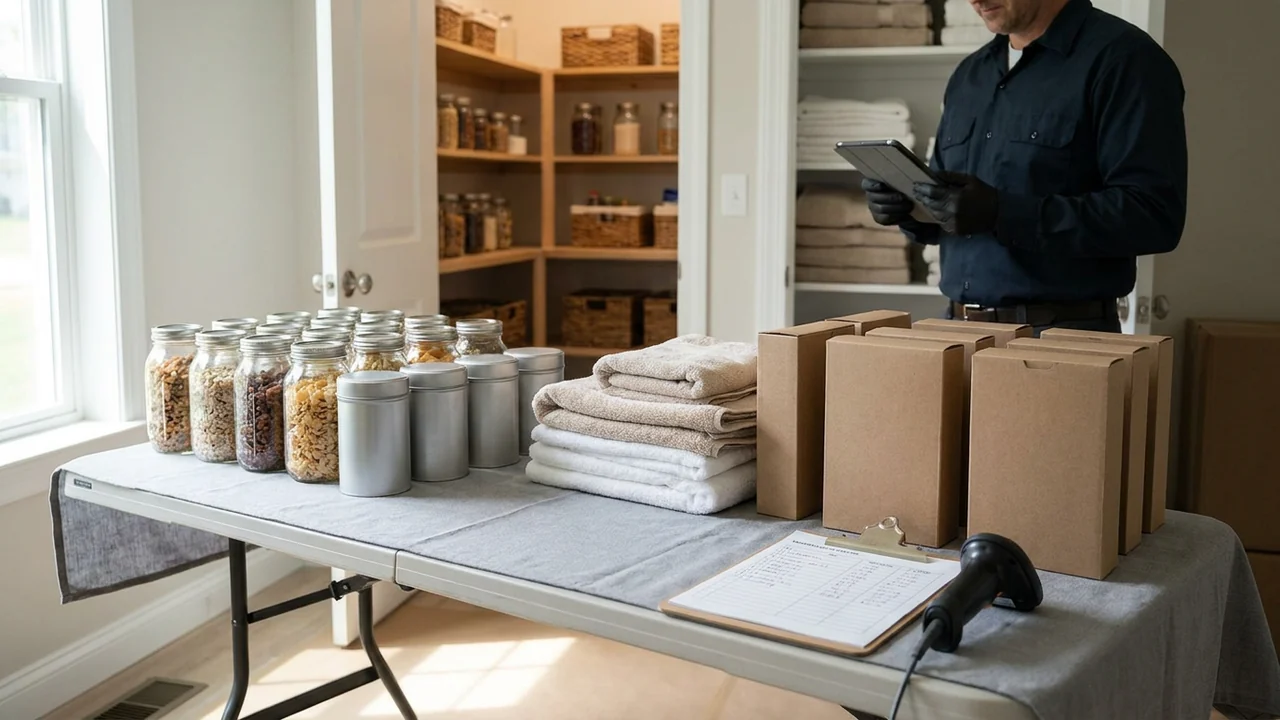
Nothing stalls a pack-out crew faster than treating a fully stocked walk-in pantry or linen closet like a showroom of individual heirlooms. Taking separate close-up photographs of 42 soup cans, 18 spice jars, and 26 folded hand towels turns a two-hour kitchen pack-out into an eight-hour slog, burying estimators under thousands of redundant thumbnails.
On the flip side, writing ‘1 box misc. pantry items’ or ‘closet linens – 1 lot’ into the inventory sheet invites immediate pricing pushback. Without verifiable quantities and quality distinctions, desk adjusters default to low generic allowances—penalizing homeowners who stocked organic specialty goods, heirloom-weight Turkish cotton towels, or high-end cookware accessories.
Under ANSI/IICRC S320 documentation craft and IRMI Replacement Cost Value (RCV) principles, the solution is structured bundling: proving original location in one frame, grouping uniform items into clean countable batches, and speaking or typing clear tier descriptors so every line item prices cleanly as outlined in The Specialty Codes.
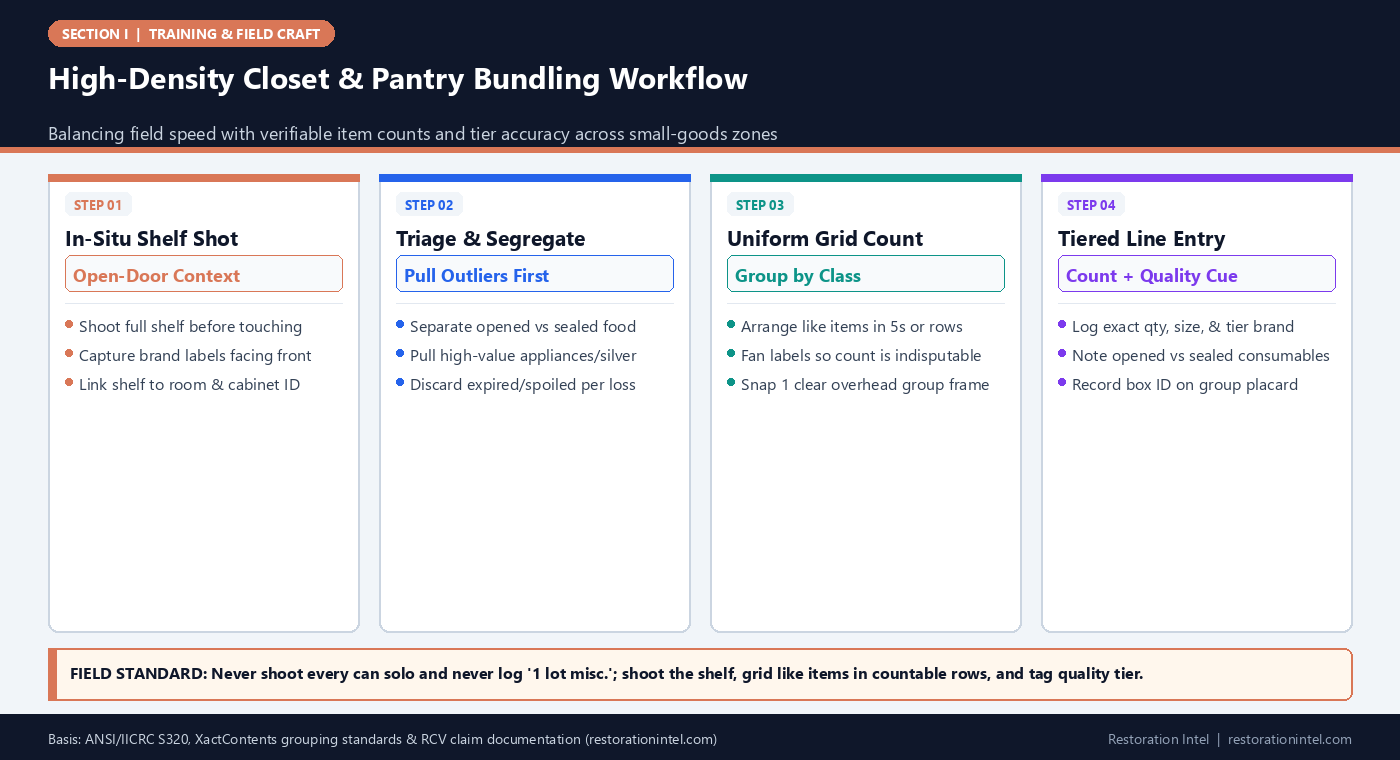
High-Density Closet & Pantry Bundling Workflow
Closet, Pantry & Linen Bundling Rules by Contents Category
Practical grouping thresholds, required photo density, and exclusion triggers for high-count household storage zones.
| Storage Zone / Item Type | Recommended Bundle Unit | Required Photo Sequence | Individual Photo Triggers | Non-Salvageable / Hold Rule |
|---|---|---|---|---|
| Sealed Pantry Cans & Dry Jars | Group by size/tier (e.g., 16 standard cans; 8 specialty sauces) | 1 open-shelf wide shot + 1 flat-lay grid before boxing | Imported olive oils, saffron/specialty spices, gourmet gift sets | Opened packages, puffed cans, and heat/smoke-exposed jars |
| Bath Towels, Sheets & Blankets | Group by fabric & piece type (e.g., 8 bath sheets; 3 queen sheet sets) | 1 closet shelf shot + 1 fanned stack showing tags/labels | Down duvets, silk/bamboo sheet sets, weighted blankets | Cat 2/3 soaked or soot-fused porous textiles without restoration value |
| Hanging Closet Garments | Group by garment class & tier (e.g., 12 cotton dress shirts; 6 denim jeans) | 1 closet-rod wide sweep + grouped wardrobe-box hanger bar shot | Tailored suits, formal gowns, leather/suede jackets, fur, cashmere | Smoke/char damaged synthetics or mold-stained leather evaluated on bench |
| Shoes, Boots & Handbags | Count by pair or tier batch (e.g., 6 pairs athletic sneakers) | 1 floor-rack shot + 1 side-by-side toe/brand-tag photo | Designer leather boots, luxury handbags, custom orthotics | Saturated particleboard shoe trees or delaminated sole adhesives |
| Vanity Toiletries & Medications | Separate opened consumables vs sealed spares; group sealed lots | 1 drawer/cabinet open shot + 1 flat-lay of sealed vs disposal grid | High-end skincare devices, electric toothbrushes, hair tools | Opened cosmetics, liquids, OTC meds, and prescriptions (auto-total/owner hold) |
| Small Kitchen Utensils & Gadgets | Bundle everyday utensils by drawer; keep specialty tools solo | 1 open-drawer overhead grid with handle/blade heads visible | Forged chef knives, copper tools, stand-mixer attachments | Melted plastic handles or rusted non-stainless carbon blades |
The Three-Shot Rule for High-Count Storage Zones
When a technician opens a packed pantry or hallway linen closet, the temptation is either to start pulling items blindly into cartons or to photograph every jar individually. Both instincts hurt the claim file. Pulling items before shooting erases proof of density and storage condition; shooting single cans wastes billable crew hours that carriers cut on audit.
Instead, enforce a clean three-step rhythm on every shelf or drawer. First, capture an in-situ wide shot with the cabinet doors fully open and labels oriented as found, establishing exactly how full the space was before pack-out. Second, clear non-salvageable opened consumables onto a witness tray while placing uniform restorable items onto a clean folding table or counter in neat rows of five or ten.
Third, snap one sharp overhead ‘tabletop grid’ photo where an estimator or desk examiner can literally point and count twelve matching cans or six folded bath towels in three seconds. Pairing that one grid photo with an accurate voice or tablet note gives XactContents reviewers both visual verification and exact unit counts.
- Countable grid rows: Arrange cans, jars, or folded linens in rows of 4 or 5 so total quantity is verifiable at a glance.
- Avoid deep stacking: Never photograph a double-stacked pile where back-row items are hidden behind front labels.
- One placard per batch: Drop a small index card showing Room + Box ID next to the tabletop grid before shooting.
Separating Consumables, Opened Goods, and High-Value Outliers
Pantries and bathroom vanities mix three completely different claim buckets on the same shelf: sealed restorable containers, opened hygienic consumables, and surprisingly expensive specialty items. Dropping an opened bottle of cooking oil, a half-used jar of face cream, and a sealed artisan balsamic vinegar bottle into the same bundled line item guarantees either contamination in transit or a messy coverage dispute later.
Under ANSI/IICRC S700 fire protocols and ANSI/IICRC S500 water protocols, opened dry goods, spices, open beverages, prescription drugs, and open cosmetics exposed to smoke, soot, elevated heat, or contaminated water are hygienically non-salvageable. Pull them immediately onto the witness-bin staging grid before bundling the sealed restorable goods.
At the same time, train crews to spot high-value outliers hiding inside routine closets: forged German chef knives inside a utensil drawer, silk scarves tucked between cotton tee-shirts, or luxury skincare serums beside drugstore soap. Pull outliers out of the group bundle and log them as individual line items with legible brand labels.
- Opened vs sealed split: Never box opened food, spices, or toiletries with sealed inventory; photograph opened items for witness disposal.
- Zero-spill hazard check: Even sealed glass vinegars, oils, and liquids must be bagged inside leak-proof poly liners before entering cartons.
- Outlier pull-out trigger: Any single small item obviously exceeding everyday commodity tier gets separated from the bundle for solo capture.
Describing Quality Tiers Without Inflating Photo Volume
Two bath towels look nearly identical in a thumbnail photo, yet one may be a $10 department-store towel and the other a $65 long-staple Egyptian cotton bath sheet. When crews bundle linens or pantry items into a single photo, the written or spoken descriptor must carry the quality proof that a wide shot cannot show.
Teach technicians to turn one representative garment, towel, or specialty jar so its woven brand tag, thread-count label, or front branding faces the camera inside the group grid photo. While snapping that single group frame, the tech calls out the exact count, item class, representative brand, and condition—for example: ‘Hall Linen Closet, Box L-03: eight heavy white cotton bath sheets, Restoration Hardware brand tag visible, dry smoke-odor only.’
This habit connects directly to A Pack-Out Record Is Not a Priced Inventory: precise tier descriptors eliminate guesswork for estimators pricing Like-Kind-and-Quality replacements and protect the crew from accusations of under-valuing or over-padding bulk boxes.
- Tag-up orientation: Flip the top towel, sheet corner, or hanger tag forward so fabric weight and brand show in the group shot.
- Avoid vague adjectives: Replace ‘nice towels’ or ‘lots of spices’ with ‘8 plush bath sheets, 100% cotton’ or ’24 glass spice jars, McCormick/Penzeys mix.’
- Respect set packaging: Note matched sheet sets (fitted, flat, pillowcases) as complete sets rather than loose single pieces.
Wardrobe Boxes, Closet Rods, and Compression Mistakes
Bedroom and hallway coat closets present their own bundling trap: jamming too many garments onto a wardrobe-box bar or folding soot-dusted wool coats tightly inside flat cartons. Overpacking a wardrobe bar until the metal hanger rail bows causes suits and dresses to crush together, grinding soot particles deeper into collars and setting permanent creases in damp wool.
Log hanging clothes in tidy rod-section bundles—for instance, ‘Master Closet, Rod Left: 14 men’s button-down dress shirts, Brooks Brothers / Ralph Lauren mix, Box W-02’—capturing one clear photo along the hanger rail showing spacing and labels before transferring directly onto the wardrobe bar in the same order. Keep a two-finger gap between shoulders inside each wardrobe carton.
For folded sweaters, knitwear, and delicate linens packed into standard boxes, bundle by material class and dry/wet state. Never mix dark unwashed denim with white cotton sheets inside a damp-loss tote, where dye bleed creates irreversible secondary damage long before the textiles reach the cleaning plant.
- Two-finger bar spacing: Leave breathing room on wardrobe-box hanger rails to prevent crushing shoulders and transferring soot.
- Color & fiber separation: Bag dark bleeding fabrics separately from whites and delicates in water or high-humidity losses.
- Cardboard shoe insert protection: Pair shoes side-by-side heel-to-toe with clean paper between leather uppers rather than dumping loose into sacks.
Practitioner Verification Checklist (I-08)
- Capture an open-door in-situ context photo of every closet shelf, pantry rack, and linen cabinet before removing any items.
- Pull opened food, cosmetics, prescriptions, and high-value outliers before bundling uniform sealed goods or textiles.
- Arrange bundled small goods on a clean prep surface in countable rows of 4 or 5 with representative brand tags facing the camera.
- Record exact unit counts, size/material class, and quality tier in the audio or tablet entry paired to each bundle photo.
- Pack hanging garments in matching rod order with breathing room on wardrobe bars and separate dark/bleeding fabrics from light textiles.
Standards, Authority References & Related Reading
Primary standards, insurance definitions, and sibling Restoration Intel guides referenced in this brief:
- ANSI/IICRC S320 Standard for Professional Contents Restoration
- ANSI/IICRC S500 Water Damage Standard
- ANSI/IICRC S700 Fire & Smoke Restoration Standard
- Verisk XactContents Platform Overview
- IRMI Insurance Glossary: Replacement Cost Value (RCV)
- Related Guide: Audio Narration Training: Coaching Field Crews to Speak Specs Clearly Without Slowing Pack-Out Speed
- Related Guide: Box Packing Geometry & Dish-Pack Engineering: Preventing Transit Breakage Claims During Vault Storage
- Related Guide: Field Drills for Estimating Quality Tiers: Teaching New Techs to Spot Solid Wood, Brand Tiers, and Specialty Materials
- Related Guide: A Pack-Out Record Is Not a Priced Inventory
- Related Guide: The Specialty Codes
.md twin for desk QA and team training.Frequently Asked Questions
How many items can safely go into a single bundled inventory line?
There is no rigid universal cap, provided every item in the bundle shares the same category, quality tier, and damage state and is visibly countable in the companion grid photo—typically 5 to 25 units per clean flat-lay batch.
Should opened pantry spices and dry goods ever be packed for cleaning?
No. Under S700 fire and S500 water hygiene practices, opened food, spices, cooking oils, and open toiletries cannot be verified safe after smoke, soot, or water exposure; document them on the witness-bin grid as non-salvageable.
What if a homeowner insists we photograph every single pantry bottle individually?
Explain politely that structured shelf context plus countable group photos satisfy carrier documentation standards while keeping pack-out hours reasonable, and offer to log any high-value specialty bottles individually.
How do we bundle mismatched kitchen utensils without losing quality proof?
Separate forged chef knives, copper tools, and branded specialty gadgets for individual photos, then lay everyday spatulas, spoons, and peelers flat across a clean counter in one legible overhead shot with exact count.