Updated November 24, 2026 — refreshed with verified 2-page PDF field brief, bespoke workflow diagram, and primary standards references.
Direct Answer: Restoration shops regularly experience 40% to 80% annual field technician turnover due to irregular callouts, heavy physical work, and burnout. Yet retaining great technicians rarely comes down to winning a wage bidding war—most leave because they do not feel seen, developed, or connected to a clear growth path worth the training investment.
.md twin for Restoration Operations & Margin.
Updated October 6, 2026.
Restoration has a turnover problem. Field technician turnover rates at many companies run 40-80% annually. The industry is physically demanding, the hours are irregular, and the work can be emotionally taxing. But the restoration companies with low turnover aren’t just paying more — they’re building environments where people stay for reasons beyond the paycheck.
Why People Leave Restoration Companies
The Head, Heart & Boots podcast, drawing on Clint Pulver’s research, identifies the primary driver of employee departure: they don’t feel seen or invested in. Not always pay. Not always conditions. The technician who leaves after 8 months for a $1.50/hour raise is usually telling you something about what they weren’t getting — development, recognition, a sense that their work mattered beyond the job count.
The Retention Investment Calculation
Most restoration owners think about turnover as an HR inconvenience. The financial reality is different: replacing a field technician costs 50-150% of their annual salary when you account for recruiting time, lost productivity during the 3-6 month ramp period, and the jobs that either don’t get taken or get done below standard. A company with 20 technicians and 60% annual turnover is burning $300K-$700K per year in turnover cost alone.
The Retention Levers That Actually Work
From the Floodlight knowledge base: the most effective retention levers are a visible career path (technician → crew lead → project manager → operations role), consistent mentorship from direct supervisors, recognition that is specific rather than generic (“you handled that customer situation exceptionally” rather than “great job”), and a culture of connection — regular interaction among team members that creates belonging beyond the transactional work relationship.
Frequently Asked Questions
How do you retain technicians when competitors are paying more?
By making total compensation — including the non-monetary elements — better than the alternative. Career development, schedule reliability, management quality, and culture are all forms of compensation. The companies that lose people to $1-2/hour raises are usually the ones where nothing else compensates for the premium.
At what point does a restoration company need an HR function?
When you have 15+ employees, consistent onboarding and documentation become necessary for risk management as much as culture. An HR function — even a part-time one — at this stage pays for itself in reduced compliance risk and better onboarding quality.
How do you create a career path at a small restoration company with limited advancement opportunities?
By being explicit about what the path looks like and what it takes to advance along it. A five-person company can still have a clear progression from apprentice to lead technician to project lead. The path doesn’t need to be long — it needs to be visible and real.
How important is pay transparency for retention?
Increasingly important for younger workers. The restoration companies that are most successful in retention are moving toward clear, documented pay bands rather than individually negotiated wages. Pay bands reduce the perception of favoritism and give employees a clear target to work toward.
Related: Mentorship in restoration · Hiring for restoration · Company culture in restoration.
Employee Retention in Restoration: Why Your Best Technicians Leave and How to Keep Them — Visual Workflow
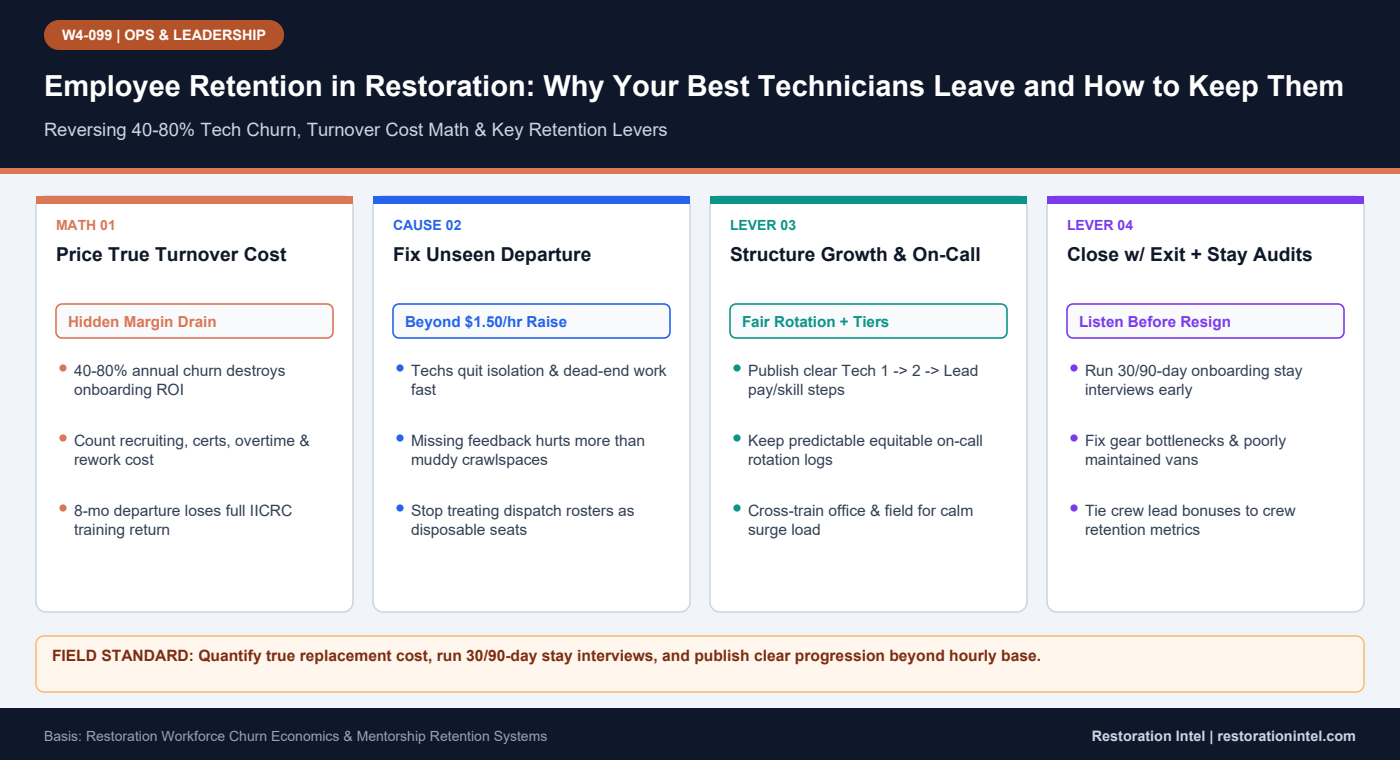
Field Benchmark & Decision Matrix
| Retention Factor | High-Churn Shop Reality | Low-Churn Shop Standard | P&L / Operational Gain |
|---|---|---|---|
| First 90 Days | Thrown into truck on Day 2 w/ zero checklist | 30/60/90 structured onboarding + buddy mentor | Sharply cuts early 3-month resignations |
| Skill Progression | No written path from helper to crew lead | Transparent certification & tier-pay ladder | Retains ambitious learners past 12 months |
| On-Call Sustainability | Same two reliable techs burn out every weekend | Rotating on-call tiers + protected recovery comp | Prevents top-performer resignation waves |
| Tool & Fleet Hygiene | Broken meters, leaking vans & missing PPE | Weekly truck readiness & working calibration kit | Shows basic respect for crew craft daily |
| Recognition & Stay Audits | Silence until tech turns in two-week notice | Quarterly stay conversations & milestone praise | Catches friction early while easily fixable |
Practitioner Operational Takeaways
- Calculate true technician replacement cost (recruiting, lost productivity, wasted IICRC certs, rework, overtime) so retention receives real executive budget.
- Understand why technicians walk away within a year: feeling invisible and stagnant drives exits more often than an extra dollar per hour elsewhere.
- Protect work sustainability with fair, transparent on-call rotations and reliable tools so dedicated staff do not carry disproportionate weekend burnout.
- Pair 30/60/90-day stay check-ins with published skill-to-compensation progression ladders from helper through project management.
Standards & Primary References
- Markdown Twin (.md)
- Company Culture in Restoration: Building Winning Teams
- Mentorship in Restoration: How Loyalty Is Built
- OSHA PPE Standard (29 CFR 1910.132)
.md twin for carrier and field review.