Direct Answer: In estate, assisted-living, and fiduciary losses, restoration PMs must lock chain-of-custody, verify multi-party signature authority, and enforce probate-sensitive pack-out and disposal holds before touching heirlooms or co-mingled resident property.
.md twin for estimator QA and carrier file documentation.
Few contents environments carry higher legal, emotional, and operational risk for a restoration project manager than an active estate residence, a trust-held home, a conservatorship property, or an assisted-living apartment. Unlike a standard single-owner homeowner loss where one insured signs the work authorization and approves what goes into the non-salvageable witness bin, fiduciary and senior-living losses involve overlapping decision-makers, competing family claims, and strict facility rules.
When a pipe bursts in a memory-care suite or smoke sweeps through a home undergoing probate, the restoration crew is no longer just cleaning furniture under ANSI/IICRC S320. Every packed box, vault release, and total-loss condemnation intersects with signature authority, co-mingled ownership between resident and facility, and potential court or trustee oversight. Moving an unmarked heirloom off-site on the verbal say-so of a helpful neighbor or non-signing relative can trigger formal fiduciary disputes even when the restoration work itself was flawless.
Structuring pre-loss baselines—and Day-1 PM custody gates—around verified signature matrices, multi-party ownership tags, and probate-sensitive disposal holds keeps emergency stabilization moving without compromising legal custody. Legal & Fiduciary Disclaimer: Restoration contractors and contents project managers are not attorneys, fiduciaries, or probate officers and must never interpret wills, trust instruments, powers of attorney, or guardianship orders. Always require written signature-authority confirmation from the estate’s legal counsel, court-appointed fiduciary, or facility risk team before authorizing pack-out releases, cross-party deliveries, or non-salvageable disposal.
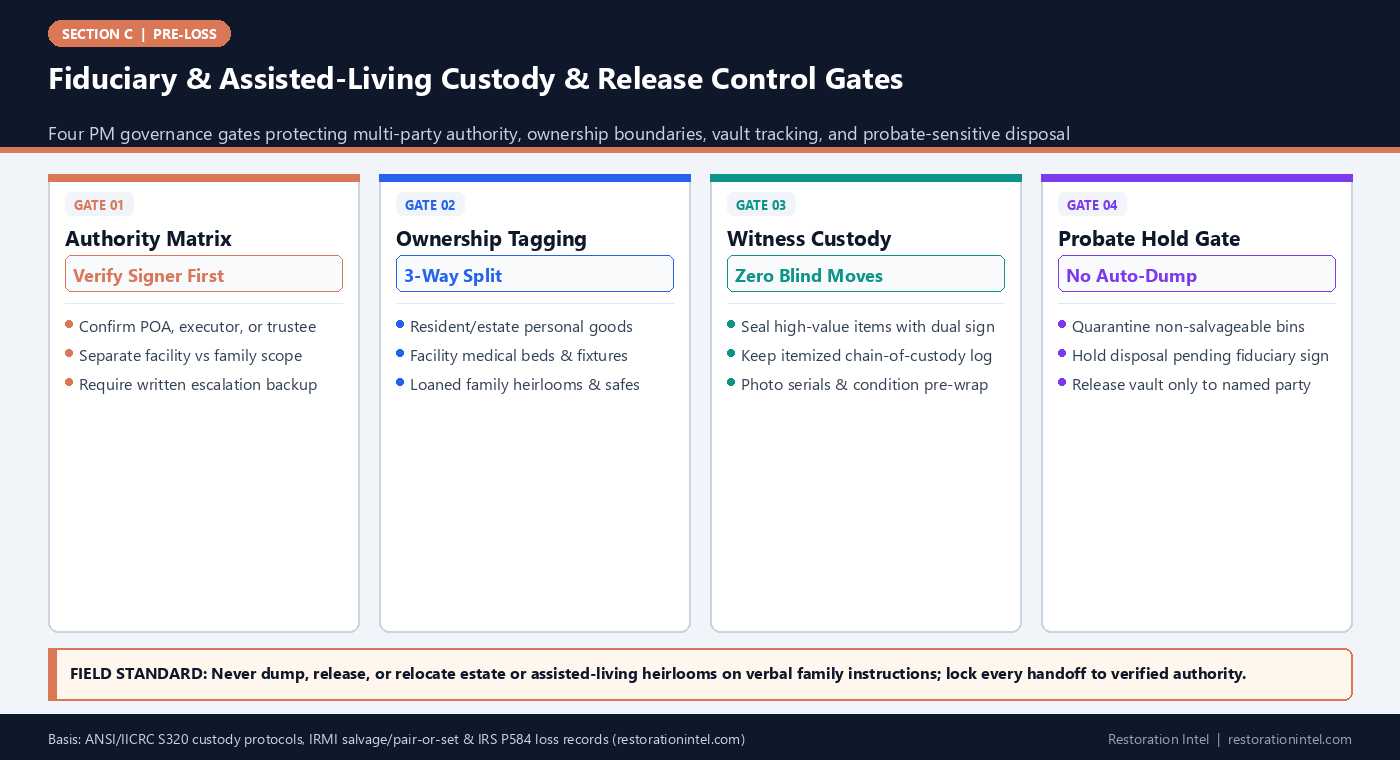
Fiduciary & Assisted-Living Custody & Release Control Gates
Multi-Party Ownership & PM Chain-of-Custody Controls Across Fiduciary Settings
Operational boundaries restoration project managers must establish in pre-loss baselines and enforce during live pack-outs.
| Occupancy / Legal Context | Competing / Overlapping Parties | Primary Custody & Liability Trap | Pre-Loss Baseline Field Required | Live Pack-Out / Release Gate |
|---|---|---|---|---|
| Assisted-Living / Memory Care | Resident, POA/family agent, facility operator, third-party hospice/DME vendor | Packing facility-owned hospital beds/lifts or rented oxygen concentrators as resident goods | Tag facility fixtures & durable medical equipment (DME) separately from resident items | Dual sign-off: facility ops for building/DME + POA for resident pack-out |
| Active Probate / Estate Home | Executor/administrator, multiple heirs, estate attorney, property insurer | Heirs removing items mid-pack-out or disputing whether ruined goods were discarded | Baseline heirloom list tied to executor contact + sealed-room inventory index | Zero non-salvageable disposal without written executor/counsel release |
| Revocable / Irrevocable Trust | Successor trustee, beneficiary occupants, corporate trust officer | Occupant living in trust home signs work order without trustee financial authority | Record corporate/individual trustee contact in C-21 Authority Matrix | Verify trustee approval for off-site vaulting and storage billing |
| Conservatorship / Guardianship | Court-appointed conservator, protected adult, care coordinator | Protected person lacks legal capacity to execute binding pack-out contracts | Flag guardianship/conservatorship status at intake without storing court filings | Contract strictly through verified conservator or legal representative |
| Co-Mingled Family Heirlooms | Resident senior + adult children storing loaned silver, art, or safes on site | Post-loss confusion over whose policy covers loaned items or pair-or-set damage | Tag 'Loaned / Third-Party Heirloom' owner name inside room baseline | Require dual acknowledgment before vault return to any non-resident relative |
Pre-Loss Authority Matrices: Who Can Actually Sign the Pack-Out Release?
On a standard residential loss, the person standing on the porch holding the deed signs the Emergency Services Agreement and vault pack-out authorization. On an estate, trust, or assisted-living loss, the person standing at the doorway is frequently an adult child without Power of Attorney, a grieving relative who is one of four co-heirs, or an assisted-living community manager who only controls the building structure—not the resident’s furniture.
A pre-loss baseline built for fiduciary and senior-living properties fixes this ambiguity before emergency trucks roll. At the front of the dossier, include a non-legal Operational Signature Matrix provided by the family’s attorney, trustee, or facility compliance office: naming the exact legal representative authorized to sign mitigation contracts, the maximum emergency stabilization threshold permitted prior to co-signature, and the backup fiduciary if the primary contact is unreachable.
Restoration project managers should store only the confirmed representative names, roles, and verified contact channels—never raw copies of wills, trust agreements, or sensitive medical guardianship orders inside field tablets. Keeping legal instruments with the fiduciary’s counsel while keeping clear written authorization instructions in the PM file protects privacy and prevents unauthorized work orders.
- Distinguish stabilization from pack-out: Confirm in writing whether emergency water extraction can proceed immediately under facility or fiduciary standing authorization while off-site pack-out awaits formal fiduciary sign-off.
- Verify durable vs. post-death POA: Remember that standard powers of attorney generally terminate upon death; PMs facing a deceased-owner property must pause non-emergency pack-outs until an executor or counsel confirms authority.
- No verbal family overrides: Log every authorization amendment by email or signed digital change order tied to the verified fiduciary.
Separating Resident Personal Property, Facility Assets, and Loaned DME
Assisted-living suites and multi-generational family homes are classic environments for co-mingled ownership. Inside a single assisted-living apartment, the resident owns their armchair, dresser, family silver, and framed portraits; the facility owns the kitchenette appliances, emergency pull-cords, grab bars, and window blinds; and a third-party medical supplier owns the hospital bed, patient lift, or oxygen concentrator.
Without pre-loss ownership tags—or a disciplined Day-1 room audit—harried pack-out crews routinely wrap rented durable medical equipment (DME) onto vault pallets alongside resident clothes, triggering lost-equipment penalties from medical suppliers and delays in resident care relocation. Conversely, leaving a resident’s fragile keepsakes behind during facility drywall tear-out causes avoidable breakage or disappearance.
During pre-loss documentation, assign each item into one of three clear ownership codes: RES-OWNED (resident/estate), FAC-BPP (assisted-living facility property), or DME-LEASED (third-party medical/vendor asset), plus an explicit flag for loaned family heirlooms. That simple schema allows Day-1 PMs to isolate facility and medical assets quickly while preserving strict custody over estate and resident possessions.
- DME vendor labels: Photograph durable medical equipment asset stickers clearly so DME suppliers can retrieve or swap units without entering the restoration vault.
- Heirloom provenance notes: Pair photos of sterling sets, china, and heirloom clocks with simple description notes and IRMI pair-or-set awareness.
- Safe and lockbox boundary: Document locked safes externally and record which fiduciary holds the key or combination rather than opening them unattended.
Witness-Custody Protocols for High-Sensitivity Heirlooms and Jewelry
Even when damage is limited to light smoke odor or clean water wicking, fiduciary jobs carry heightened sensitivity around small high-value items: wedding rings, pocket watches, coin albums, family Bibles, military medals, and cash envelopes tucked inside nightstand drawers. If a single brooch goes missing between emergency pack-out and vault return—as illustrated in Nobody Could Tell Me Where the Rug Was—the restoration contractor faces immediate credibility collapse and potential fiduciary claims.
Project managers on estate and assisted-living sites must enforce a strict two-person witness and sealed-pouch protocol for small high-value and sentimental items. Before anything leaves a dresser drawer, photograph the drawer open in place, invite the verified fiduciary or facility witness (when safely permitted) to sign a dedicated high-value custody sheet, seal non-affected jewelry or vital documents in tamper-evident numbered pouches, and—wherever possible—hand them directly to the verified fiduciary against a countersigned receipt rather than mixing them into general vault boxes.
Items requiring specialty deodorization or cleaning (such as smoke-exposed heirloom linens or framed portraits) travel in individually barcoded containers tracked separately inside the facility intake log under ANSI/IICRC S320 chain-of-custody standards.
- Zero-pocket rule: Crews must never transport loose jewelry, cash, or small keepsakes outside sealed, tamper-evident, dual-logged containers.
- Vital document handoff: Immediately isolate wills, deeds, passports, and stock certificates for direct countersigned transfer to the fiduciary.
- Pre-wrap condition macro: Shoot pre-existing cracks, missing stones, or veneer chips on antique furniture before padding so old wear is never blamed on transit.
Probate-Sensitive Disposal Holds and Multi-Party Pack-Back Releases
The single highest-liability error in an estate or assisted-living restoration job happens at the witness bin, not on the truck. On routine jobs, once an adjuster inspects non-salvageable particleboard or Category 3-soaked upholstery and the homeowner agrees, crews haul debris to the roll-off container. On an estate or contested-family property, discarding any personal possession—even water-swollen photo albums, ruined upholstered chairs, or tarnished keepsakes—without formal fiduciary sign-off can violate probate preservation duties.
Project managers must therefore enforce a Probate-Sensitive Disposal Hold: stage clearly non-salvageable items in sealed, labeled containment totes or a dedicated witness staging zone, capture scale and damage proof aligned with IRMI salvage standards and IRS Publication 584 workbook records, and refuse disposal until both the insurance adjuster review and written fiduciary/counsel authorization are logged.
The same rigor applies at pack-back. Never split vault shipments across multiple relatives’ addresses or release heirloom boxes to a beneficiary who is not the named contract signer unless the verified fiduciary issues written, itemized release instructions identifying exact box barcodes and recipient ID.
- Written witness-bin sign-off: Require itemized photo-sheet approval from the verified fiduciary—not a casual text from a relative—before hauling ruined keepsakes.
- Split-delivery authorization: If assisted-living residents relocate to a new facility or family home during reconstruction, execute a written change-of-delivery-address addendum.
- Vault-release ID check: Log government ID verification and countersigned barcode manifests at every final delivery or warehouse pickup.
Practitioner Verification Checklist (C-24)
- Verify and record written signature authority (executor, trustee, conservator, or active POA) with legal/fiduciary counsel confirmation before off-site pack-out.
- Tag every item at intake or pre-loss by ownership class: resident/estate personal property, facility fixture/BPP, or third-party leased DME.
- Enforce two-person witness logging and tamper-evident sealed pouches for jewelry, vital legal papers, cash, and small keepsakes.
- Quarantine non-salvageable estate or resident items under a strict Probate-Sensitive Disposal Hold until both adjuster and fiduciary sign off in writing.
- Release packed-back boxes or vault transfers only to the verified fiduciary or via written, barcode-specific split-delivery authorization.
Standards, Authority References & Related Reading
Primary standards, insurance definitions, and sibling Restoration Intel guides referenced in this brief:
- ANSI/IICRC S320 Standard for Professional Contents Restoration
- IRMI Insurance Glossary: Pair or Set Clause
- IRMI Insurance Glossary: Salvage
- Restoration Industry Association (RIA)
- IRS Publication 584: Casualty, Disaster, and Theft Loss Workbook
- Related Guide: High-Value Personal Property Sublimits: Identifying Jewelry, Firearms, Silver, and Art Before a Loss
- Related Guide: Pre-Loss Emergency Contact and Vendor Trees Inside the Contents Dossier
- Related Guide: Pre-Loss Privacy & Access Controls: Protecting Sensitive Financial, Medical, and Security Information Inside Baselines
- Related Guide: Before Anything Goes: The NFIP Contents Inventory
- Related Guide: Nobody Could Tell Me Where the Rug Was
.md twin for desk QA and team training.Frequently Asked Questions
Can an assisted-living facility director authorize a pack-out of a resident's personal furniture?
Usually only for emergency life-safety containment or facility-owned fixtures under the residency agreement. Moving and restoring a resident’s personal contents typically requires authorization from the resident, verified POA, or legal fiduciary.
What should a restoration PM do if a homeowner dies after mitigation starts or the home is in probate?
Pause non-emergency pack-outs and any disposal immediately, preserve stabilization and chain-of-custody logs, and obtain written direction from the estate’s appointed executor, administrator, or probate counsel.
How do crews handle rented hospital beds and oxygen equipment during an assisted-living pack-out?
Tag durable medical equipment separately using its vendor asset stickers and coordinate pickup or replacement directly with the DME supplier rather than commingling it in resident restoration vaults.
Why hold non-salvageable estate items instead of discarding ruined furniture right away?
Because probate and fiduciary rules may require preserving physical proof or obtaining formal estate approval before any personal property—even severely damaged heirlooms—is permanently discarded.