Updated November 14, 2026 — reformatted to Restoration Intel house standard with Print-First PDF brief and Markdown twin.
Direct Answer: The short answer: don’t argue the bottom line — compare the two estimates line by line, identify exactly which items differ, and work each difference on its own evidence. Most mismatches come down to a handful of missing items or quantity disagreements, not a fundamental conflict. The escalation path is conversation.
.md twin for Insurance Claims & TPA Governance.
The short answer: don’t argue the bottom line — compare the two estimates line by line, identify exactly which items differ, and work each difference on its own evidence. Most mismatches come down to a handful of missing items or quantity disagreements, not a fundamental conflict. The escalation path is conversation, then supplement, then reinspection, then the policy’s appraisal process. Almost everything resolves in the first two steps if the documentation is there.
First: this is normal, not an attack
Two estimates on the same loss disagreeing is the default state of insurance restoration, not a sign something went wrong. The adjuster wrote theirs from a visible inspection on a single visit. You wrote yours from being in the building, opening things up, and knowing what the work actually takes. Different vantage points produce different scopes.
Here’s the part that simplifies everything: you’re both pricing from the same database. Xactimate’s regional price lists are the shared reference — so the disagreement is almost never about what a line item costs. It’s about which line items belong. That reframes the whole exercise: you’re not haggling over rates, you’re proving scope.
Step 1: compare line by line, not total to total
Get both estimates in writing — itemized, in Xactimate format — and lay them side by side. Ignore the totals completely at this stage. You’re hunting for the specific lines that differ, and they fall into a small number of buckets:
- Missing items. On your estimate, not on theirs. The most common bucket by far.
- Quantity differences. Same item, different quantity — your sketch says one thing, their inspection said another.
- Different items for the same work. They chose one line item, you chose another, for the same repair.
- Coverage disputes. They say it isn’t covered; you say it is. This is a policy question, not an estimating question.
Sort every difference into one of those four buckets before you do anything else. A mismatch that felt like a $14,000 chasm usually turns into a dozen individual items you can work one at a time.
Step 2: work each bucket on its evidence
Missing items: for each one, ask the only question that matters — can I prove the work is necessary and caused by the covered loss? Photo, measurement, reading, note. If yes, it goes into a supplement (see our supplement-or-absorb framework). If no, let it go. Submitting items you can’t prove trains the adjuster to discount everything else you send.
Quantity differences: show your math. Your sketch, your measurements, your photos of the actual space. Quantity disputes are the easiest to resolve because they’re arithmetic — someone measured, and the measurements can be checked.
Different items for the same work: read both descriptions against the photos. One of them describes the actual work better. If it’s yours, say why in a line-item note. If it’s honestly theirs, concede it — conceding the ones you’re wrong about buys credibility for the ones you’re right about.
Coverage disputes: stop estimating and read the policy. Ask the adjuster to point to the specific language or claim determination behind the denial. If the policy genuinely excludes it, no estimate will fix that. If the exclusion doesn’t fit the facts, that’s what the escalation path is for.
Step 3: the escalation ladder
Most mismatches resolve in steps 1 and 2. When they don’t:
- Conversation. A direct, professional call walking through the specific disputed items. Not the total — the items. Most adjusters would rather resolve twelve line items on a call than process a formal dispute.
- Supplement. The documented items go in through the formal supplement process: Xactimate format, cover letter, photo per item, weekly follow-up.
- Reinspection. If new damage was found after the adjuster’s visit, or the disagreement turns on conditions they didn’t see, request a reinspection. Give them something new to look at — going back over the same ground with the same evidence rarely changes the outcome.
- Appraisal. Most policies include an appraisal clause: a binding dispute-resolution process with a neutral umpire. This is the last resort, not the opening move — it’s slow, it costs money, and it poisons the working relationship. But it exists for a reason, and knowing it’s there changes the tone of every earlier step.
What not to do
- Don’t argue the total. “Your number is too low” is not an argument anyone can act on. Twelve specific items with photos are.
- Don’t go adversarial early. The adjuster on this claim is the adjuster on the next ten. Professional, specific, and persistent beats aggressive every time.
- Don’t start disputed work without agreement. Doing the work and then demanding payment for it reverses your leverage. Get the scope agreed first, or accept that you’re working at risk.
- Don’t take it personally. The adjuster’s estimate isn’t a judgment of your competence. It’s a first position built from a two-hour visit. Yours is a first position built from being in the building. The truth is usually assembled from both.
Where this comes from
- From Xactimate (official): the shared-database principle — both sides pricing from Xactware’s regional price lists — is structural to how the platform works, per Xactware’s documentation and training materials.
- From the field (labeled): the line-by-line comparison method, the four-bucket categorization, and the escalation ladder reflect widely published contractor and estimator guidance (third-party, not Xactware-official). The reinspection and appraisal steps describe standard industry and policy mechanisms.
- Related on Restoration Intel: When Do I Supplement and When Do I Just Absorb the Cost? · Which Xactimate Line Items Do Adjusters Actually Approve? · How Do I Write an Estimate in Xactimate?
The mismatch isn’t the problem. The mismatch is the job — resolving it item by item, on evidence, is what estimating for insurance work actually is.
What Do I Do When My Estimate Doesn’t Match the Adjuster’s? — Visual Workflow
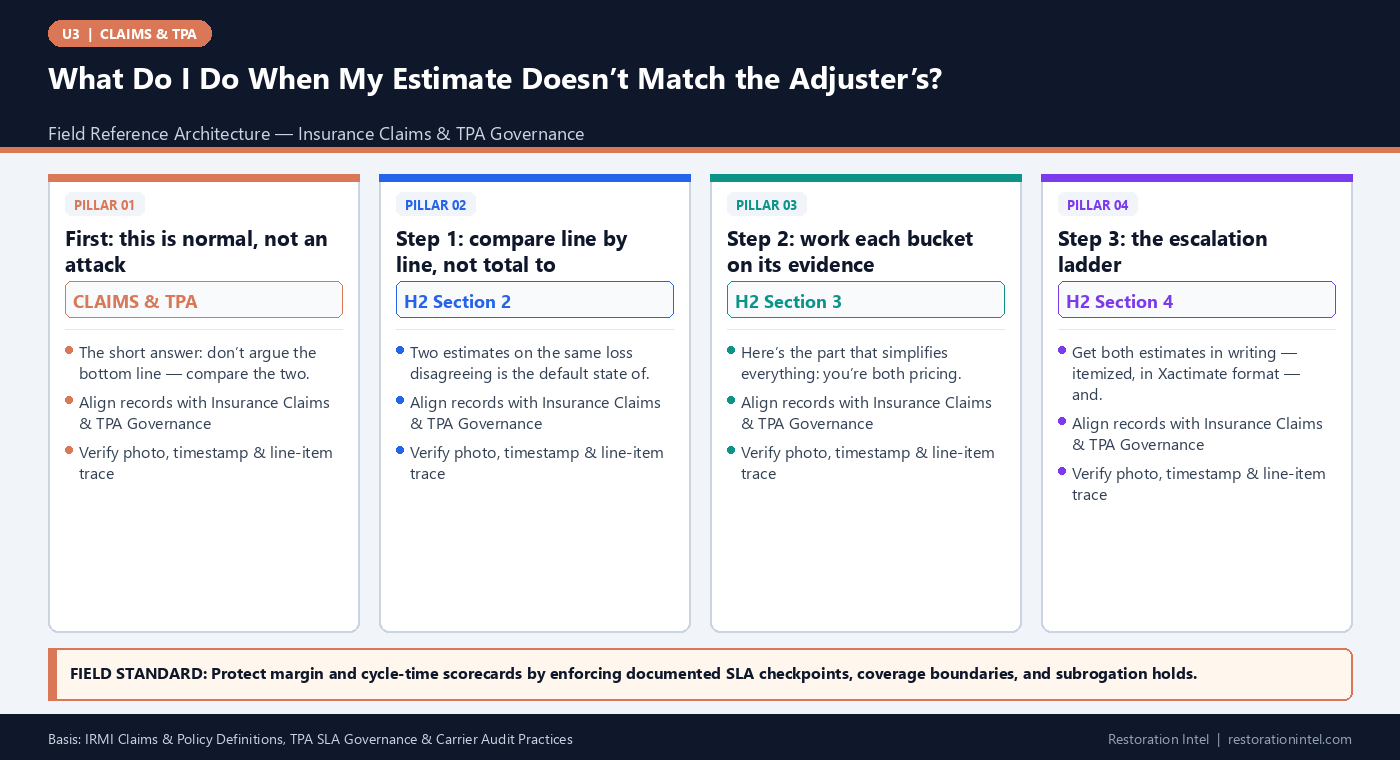
Field Operational Breakdown & Verification Matrix
Structured operational summary of What Do I Do When My Estimate Doesn’t Match the Adjuster’s? mapped to Restoration Intel documentation gates.
| Operational Stage | Field Focus in This Guide | Documentation Requirement | Verification Gate |
|---|---|---|---|
| 1. First: this is normal, not an attack | The short answer: don’t argue the bottom line — compare the two estimates line by. | Timestamped photos, measurements & scope notes | Cross-check against primary standard prior to submission |
| 2. Step 1: compare line by line, not total | Two estimates on the same loss disagreeing is the default state of insurance. | Timestamped photos, measurements & scope notes | Cross-check against primary standard prior to submission |
| 3. Step 2: work each bucket on its evidence | Here’s the part that simplifies everything: you’re both pricing from the same. | Timestamped photos, measurements & scope notes | Cross-check against primary standard prior to submission |
| 4. Step 3: the escalation ladder | Get both estimates in writing — itemized, in Xactimate format — and lay them side by. | Timestamped photos, measurements & scope notes | Cross-check against primary standard prior to submission |
Field Documentation & Scope Verification Standard
To align What Do I Do When My Estimate Doesn’t Match the Adjuster’s? with Restoration Intel house standards under Insurance Claims & TPA Governance, field and estimating personnel should maintain an auditable record from first site walk through final carrier sign-off. That record begins by separating verifiable site conditions from assumptions: timestamped wide and close-up photographs, instrument readings paired with calibration or baseline context, and written scope notes tied directly to the line-item or contractual requirement.
When preparing a claim packet, internal SOP, or commercial facility handoff, pair the checklist below with the downloadable Print-First PDF brief and plain-text Markdown twin so estimators, project managers, and desk examiners work from identical scope boundaries without losing provenance between field capture and final review.
Operational consistency across Insurance Claims & TPA Governance assignments also depends on maintaining clean separation between original site observations, insurer policy or municipal code constraints, and subsequent supplemental change orders. Every transition in containment, equipment deployment, clearance testing, or reconstruction sequencing should be logged sequentially with author attribution, date and time metadata, and cross-references to the governing technical manual or carrier guideline so third-party reviewers can audit the decision path without re-inspecting the structure.
Supervisors and quality-assurance leads can use this standardized package format during post-loss file audits, adjuster reinspections, and internal technician training to confirm that intake forms, drying or remediation logs, chain-of-custody records, and closeout certificates remain complete, internally consistent, and ready for immediate human review or automated compliance screening.
Practitioner Verification Checklist
- Confirm scope boundaries and loss classification for: What Do I Do When My Estimate Doesn’t Match the Adjuster’s?.
- Capture timestamped field photos, measurements, and serial/assembly notes before mobilization or tear-out.
- Tie every line item or operational recommendation to primary references (IRMI Insurance Glossary, IRMI Insurance Glossary).
- Verify internal cross-links and preserve all customer intake/compliance forms intact on the canonical page.
- Export and attach the Print-First PDF field brief and verify the sibling Markdown twin (.md) resolves HTTP 200.
Standards, Authority Citations & Related Guides
- IRMI Insurance Glossary: Replacement Cost Value (RCV)
- IRMI Insurance Glossary: Actual Cash Value (ACV)
- IRMI Insurance Glossary: Subrogation
- Related Guide: The 2026 TPA Survival Guide
- Related Guide: The Adjuster Desk: One Standard, Two Chairs
- Related Guide: Two Standards, One Truck: Documentation When the Brand and the Scorecard Disagree
.md twin for carrier and field review.Frequently Asked Questions
What is the core operational takeaway of What Do I Do When My Estimate Doesn’t Match the Adjuster’s??
The short answer: don’t argue the bottom line — compare the two estimates line by line, identify exactly which items differ, and work each difference on its own evidence. Most mismatches come down to a handful of missing items or quantity disagreements, not a fundamental conflict. The escalation path is conversation.
Which industry standards govern insurance claims & tpa governance documentation?
Practitioners should anchor field logs and claim packets to IRMI Insurance Glossary: Replacement Cost Value (RCV) and IRMI Insurance Glossary: Actual Cash Value (ACV), ensuring verifiable measurements and photo provenance.
Where can field and estimating teams access the offline or AI-readable edition?
Each upgraded Restoration Intel guide ships with a 2-page Print-First PDF brief and a plain-text Markdown twin (.md) linked directly inside the article download cards and /llms.txt.