Direct Answer: Auditing a specialty equipment restoration vendor requires matching every lab report, megohm insulation test, and cleanliness swab to a specific machine serial number, verifying test conditions and baseline control readings, and rejecting vague 'cleaned and tested' invoices lacking pre- and post-treatment measurements.
.md twin for estimator QA and carrier file documentation.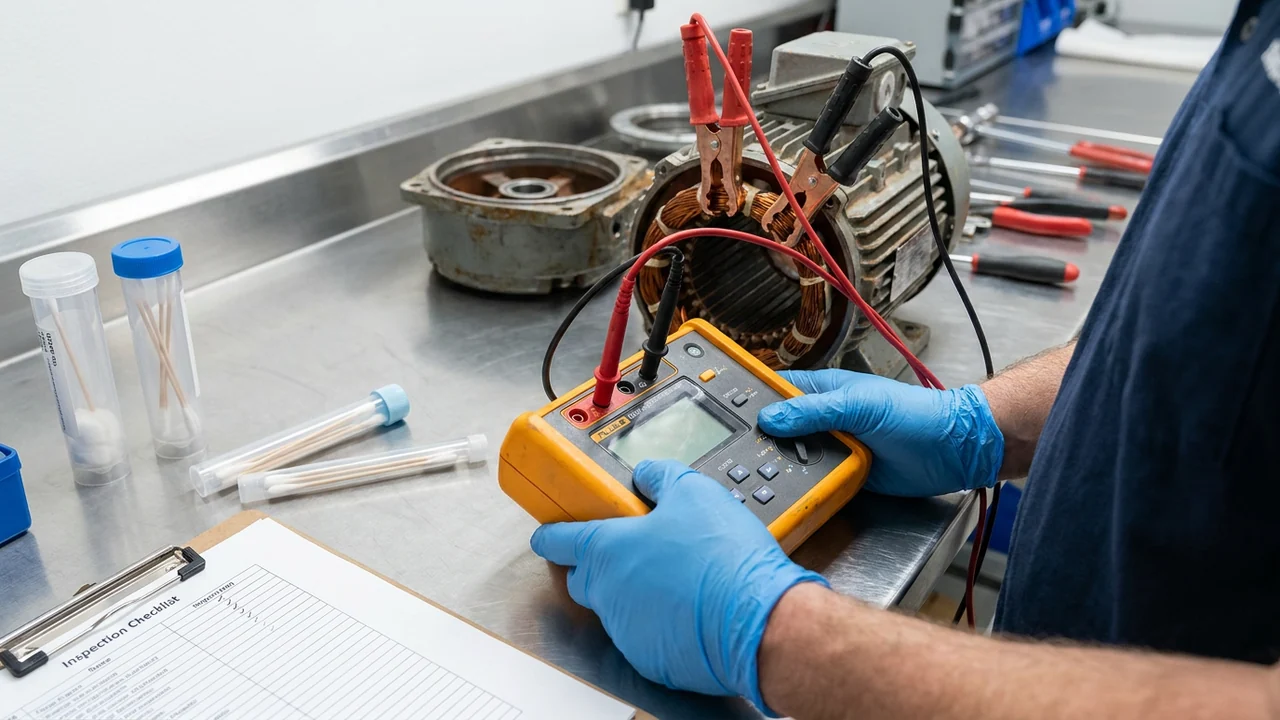
On large commercial fire, water, and electrical claims, specialty equipment restoration vendors routinely submit six-figure proposals and post-restoration clearance packets filled with impressive acronyms—megohm logs, polarization index curves, ATP bioluminescence counts, ion chromatography (IC) chloride numbers, and scanning electron microscopy (SEM) micrographs. Too often, neither the restoration project manager nor the desk adjuster knows how to audit whether those reports prove the machinery is genuinely safe to energize and return to production.
Weak vendor reporting creates opposite risks. A superficial vendor may declare soot-contaminated switchgear ‘restored’ based on a single dry megohm check taken in an air-conditioned room—ignoring chloride residues waiting to corrode contacts once ambient humidity rises, as detailed in Electronic Circuit Boards and Corrosion Creep. Conversely, an aggressive vendor may cite trace background soot swabs from an untouched warehouse wall to condemn millions of dollars in cleanable tooling.
Grounded in ANSI/IICRC S320, ANSI/IICRC S700, and forensic evidence integrity principles from NFPA 921 and NIST OSAC forensic guidance, this brief shows estimators, PMs, and adjusters exactly how to read—and challenge—vendor lab and bench-test deliverables.
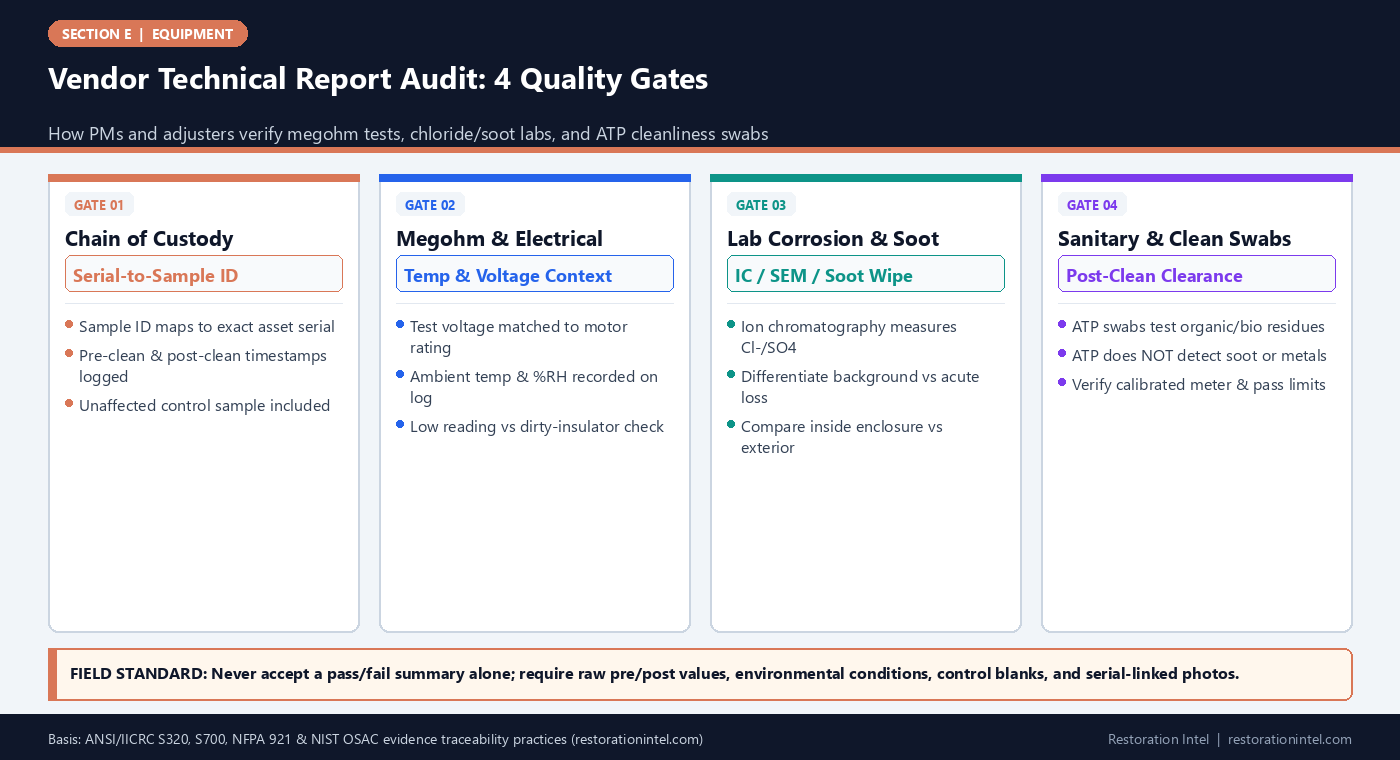
Vendor Technical Report Audit: 4 Quality Gates
Equipment Vendor Test Methods: What Each Report Proves—and Where Audits Catch Errors
Practical audit guide for reading electrical, chemical, and sanitary verification reports submitted by specialty restoration vendors.
| Test / Report Type | What It Actually Measures | Mandatory Metadata for Validity | Common Vendor Error / Red Flag | Audit Action Required |
|---|---|---|---|---|
| Insulation Resistance (Megohm / Megger Test) | DC resistance across motor windings or busbars to ground | Applied DC test voltage, ambient temp/RH, winding isolation state, meter serial | Testing cold/dry machine at low voltage or with VFDs/surge boards still wired in | Verify boards isolated, test voltage matches rating, and pre/post trend |
| Ion Chromatography (IC) Surface Wash | Conductive water-soluble ions (chlorides, bromides, sulfates) | Swab/wash surface area (cm2), blank control swab, unaffected room baseline | Reporting raw ppm without surface area or omitting unaffected control blank | Compare affected interior vs clean baseline control on ug/cm2 basis |
| Micro-Soot / TEM / SEM-EDS Wipe Analysis | Carbonaceous soot morphology and elemental residue | Sample location photo (inside vs outside cabinet), chain-of-custody log | Taking exterior top-cabinet dust samples to condemn sealed internal electronics | Require paired exterior + internal-enclosure sample mapping |
| ATP Bioluminescence Swab | Adenosine triphosphate (living/recent organic biological matter) | Pre-clean & post-clean RLU readings, swabbed zone ID, reagent lot check | Using ATP swabs on fire losses to claim 'zero soot' or sterile electronics | Reject ATP as soot/chemical proof; restrict ATP to food/bio hygiene |
| Vibration / Alignment & Dynamic Load Test | Bearing roughness, shaft runout, and operational amp draw | Baseline OEM tolerances, RPM/load under test, calibration cert date | Running unloaded spin-test briefly and certifying heavy press ready for duty | Require loaded run log, amp balance, and calibration compliance |
Reading Megohmmeter (Insulation Resistance) Logs Without Getting Fooled
Insulation resistance testing—commonly called Megger or megohm testing—is the staple electrical diagnostic on wet, flooded, or soot-exposed motors, transformers, and switchgear. A calibrated megohmmeter applies a controlled DC voltage across isolated conductors and ground to detect moisture, carbon tracking, or conductive contamination bridging winding insulation.
However, a raw megohm number without context is nearly useless. First, insulation resistance drops sharply as winding temperature rises and rises deceptively when a motor is bone-dry in a heated shop despite salt crystals waiting inside slots. Second, testing an entire control panel without disconnecting variable frequency drives (VFDs), PLCs, soft-starters, or surge suppressors can both skew the reading and permanently destroy delicate solid-state semiconductors with high DC test voltage.
When auditing a vendor’s electrical test sheet, check five items immediately: exact equipment serial number, applied DC test voltage matched to equipment voltage class, ambient temperature and relative humidity at test time, confirmation that solid-state components were isolated before testing, and—most importantly—whether pre-cleaning vs post-cleaning/post-drying readings show logical recovery rather than identical copied numbers.
- Polarization Index (PI) value: On larger motors, a timed ratio test (10-minute vs 1-minute reading) reveals trapped moisture inside deep winding insulation better than a 5-second spot check.
- De-energized & isolated rule: Verify the report explicitly notes that VFDs, sensors, and control PCBs were disconnected before applying high-voltage DC.
- Surface vs core check: Ensure damp motors undergo controlled baking/dehydration and re-testing rather than passing while warm only on the outer shell.
Ion Chromatography, Soot Wipes, and Baseline Control Blanks
In commercial fire and smoke claims—especially involving burning PVC conduit, rubber belts, or industrial plastics—surface contamination lab reports often decide whether a multi-hundred-thousand-dollar CNC fleet gets cleaned on site or replaced outright. Ion chromatography (IC) measures water-soluble corrosive anions such as chloride, fluoride, and sulfate collected from a measured surface area, while optical or electron microscopy identifies combustion soot particles.
The single biggest flaw in contested lab packets is missing baseline control data. Coastal plants, salted winter loading docks, chlorinated food-wash rooms, and legacy machine shops naturally carry background salts and carbon dust from forklifts or welding years before the fire. Without a lab-analyzed control blank (an unopened sterile swab from the same batch) and an unaffected control location sample, an adjuster cannot tell whether elevated chloride came from the fire or normal factory operations.
Similarly, check where the swab was pulled. A heavy soot reading wiped off the dusty top of a NEMA-12 sealed cabinet proves the exterior got dirty—it does not prove soot penetrated gasketed drive bays inside. Insist on paired exterior, interior-enclosure, and unaffected-control photos tied to laboratory chain-of-custody numbers aligned with NIST OSAC forensic traceability.
- Area normalization check: Valid surface IC reports express contamination per unit area (e.g., micrograms per square centimeter), not unmeasured swipe totals.
- Method & reagent blanks: Every accredited lab batch must report a clean media blank proving the swab and extraction water were uncontaminated.
- Inside-the-box rule: Require internal cabinet, heatsink, and fan-blade swabs before accepting total-loss arguments on sealed industrial controllers.
ATP Swabs vs Chemical Cleanliness: Avoiding Wrong-Tool Audits
Adenosine triphosphate (ATP) luminometers are handheld meters widely used in food plants, hospitals, and commercial kitchens to score surface hygiene in Relative Light Units (RLU) within seconds. Because ATP meters are fast and inexpensive, some restoration vendors misuse them on non-biological claims—presenting low ATP scores after a structure fire as proof that stainless steel or industrial machinery is free of soot, heavy metals, or chemical residues.
ATP testing detects biological cellular energy from bacteria, food scraps, mold spores, or skin cells; it is completely blind to inorganic carbon soot, acidic chlorides, heavy metals, asbestos fibers, and petroleum hydrocarbons. A machine coated in toxic fire-retardant dust or corrosive chloride film can register a pristine low ATP reading because combustion heat destroyed biological matter while leaving chemical hazards behind.
Audit ATP reports strictly within their valid lane: confirming post-cleaning biological sanitation on food-contact gear after food-grade refurbishment or Category 2/3 microbial decontamination—never as a substitute for chemical ion testing, gravimetric residue wipes, or electrical diagnostics.
- Match test to peril: Use ATP for food/sewage biological cleanliness; use IC, pH, or particle microscopy for fire soot and chemical spills.
- Meter & swab shelf-life: Check reagent expiration dates and calibration logs; expired ATP swabs give falsely low clearance numbers.
- Pre/post pairing: Require both pre-cleaning dirty ATP scores and post-sanitization clearance readings across identical marked zones.
Spotting Red Flags on Vendor Proposals and Clearance Packets
Before approving a specialty equipment vendor’s invoice or submitting their report to a carrier examiner—as outlined in OEM Calibration, Recertification, and Warranty Preservation Costs—run a five-minute packet QA screen. Legitimate specialty restorers welcome transparent technical scrutiny because clean data speeds carrier payment.
Watch for four classic red flags: (1) generic boilerplate test tables where identical megohm or temperature numbers appear across ten different machines; (2) missing instrument serial numbers or expired NIST-traceable calibration certificates; (3) ‘certified clean’ letters issued without serial-specific checklists, replacement-part receipts, or post-clean operational run logs; and (4) scope conflicts where the testing lab also stands to profit from condemning and supplying replacement machinery without independent verification.
If a vendor cannot produce raw lab PDFs, chain-of-custody forms, and serial-tagged bench photos before invoicing, hold release of the packet until documentation gaps are closed. Clean technical packets protect the insured’s warranty standing and give subrogation and adjustment teams rock-solid proof.
- Calibration cert check: Request current calibration certificates for every megohmmeter, micro-ohmmeter, and particle counter cited in the report.
- Raw lab PDF rule: Never rely on a vendor’s re-typed Word summary table; attach the accredited third-party lab report directly.
- Warranty preservation letter: When an OEM requires factory sign-off after restoration, ensure the vendor’s test protocol explicitly meets OEM acceptance criteria.
Practitioner Verification Checklist (E-19)
- Verify every lab sample, megohm reading, and swab ID maps directly to an asset tag and photographed machine serial plate.
- Confirm megohm logs record DC test voltage, ambient temperature/humidity, isolation of solid-state boards, and pre/post-cleaning trends.
- Require accredited laboratory PDFs with reagent blanks, unaffected control samples, and per-area (ug/cm2) units on IC/soot reports.
- Restrict ATP bioluminescence swabs to biological/food-sanitation verification and reject ATP as proof of soot or chemical removal.
- Check test-instrument calibration certificates and attach OEM acceptance letters before closing vendor restoration packets.
Standards, Authority References & Related Reading
Primary standards, insurance definitions, and sibling Restoration Intel guides referenced in this brief:
- ANSI/IICRC S320 Standard for Professional Contents Restoration
- ANSI/IICRC S700 Fire & Smoke Restoration Standard
- NFPA 921 Guide for Fire and Explosion Investigations
- NIST Organization of Scientific Area Committees for Forensic Science
- Restoration Industry Association (RIA)
- IRMI Insurance Glossary: Subrogation
- Related Guide: Diagnostic Testing and OEM Teardown Protocols: Proving Internal Smoke, Moisture, or Surge Damage
- Related Guide: OEM Calibration, Recertification, and Warranty Preservation Costs on Contents Schedules
- Related Guide: Electronic Circuit Boards and Corrosion Creep: Why Wet or Soot-Exposed Machinery Fails Weeks After Loss
- Related Guide: Preventive Cleaning vs Full Refurbishment for Stainless Steel and Food-Grade Processing Gear
- Related Guide: Structuring Multi-Quote Equipment Packets for Large Commercial Contents Adjusters
.md twin for desk QA and team training.Frequently Asked Questions
Why can't a vendor use an ATP swab to prove fire-damaged kitchen equipment is soot-free?
ATP swabs measure biological adenosine triphosphate from food soils and microbes, not inorganic combustion soot, acidic chlorides, or toxic chemical residues. A soot-coated surface can still yield a low ATP score if heat sterilized biological material.
What makes a megohmmeter test report invalid during an insurance audit?
Common disqualifiers include missing test voltage, unrecorded ambient temperature and humidity, failure to isolate VFDs or electronic control boards before testing, expired meter calibration, or identical copied numbers across multiple machines.
Why do chloride ion chromatography reports need an unaffected control sample?
Industrial plants, coastal buildings, and wash-down kitchens carry baseline background salts unrelated to the loss. Comparing interior enclosure swabs against an unaffected control zone and lab blank proves whether elevated chlorides came from the fire event.
Should the project manager accept a vendor's summary spreadsheet instead of the original lab PDF?
No. Always attach the accredited third-party laboratory’s original PDF report with intact chain-of-custody signatures and sample photos alongside any summary table.