Direct Answer: Condition grading inside contents inventories must reflect verified pre-loss physical wear — New, Mint (Like-New), Good (Average), Fair, Poor, or Pre-Loss Damaged — using observable surface, structural, and functional criteria rather than arbitrary technician guesses that skew ACV depreciation by 15 to 40 percentage points.
.md twin for estimator QA and carrier file documentation.
In most estimating platforms — including XactContents — the condition dropdown selected during inventory entry directly modifies the depreciation percentage applied to Replacement Cost Value (RCV) to arrive at Actual Cash Value (ACV). Yet without a written rubric, two technicians standing in the exact same living room will grade the identical five-year-old sofa differently: one marks ‘Average/Good’ and the other marks ‘Fair,’ shifting the insured’s ACV payout on a single room by hundreds of dollars.
Even worse is confusing loss-caused damage (soot, water staining, broken glass from the fire) with pre-loss condition. Under ANSI/IICRC S320 and IRMI depreciation standards, condition grading measures how well the homeowner maintained the item right before the peril struck. This rubric gives field crews and desk estimators six concrete, audit-defensible definitions.
Six-Tier Pre-Loss Condition Grading Rubric
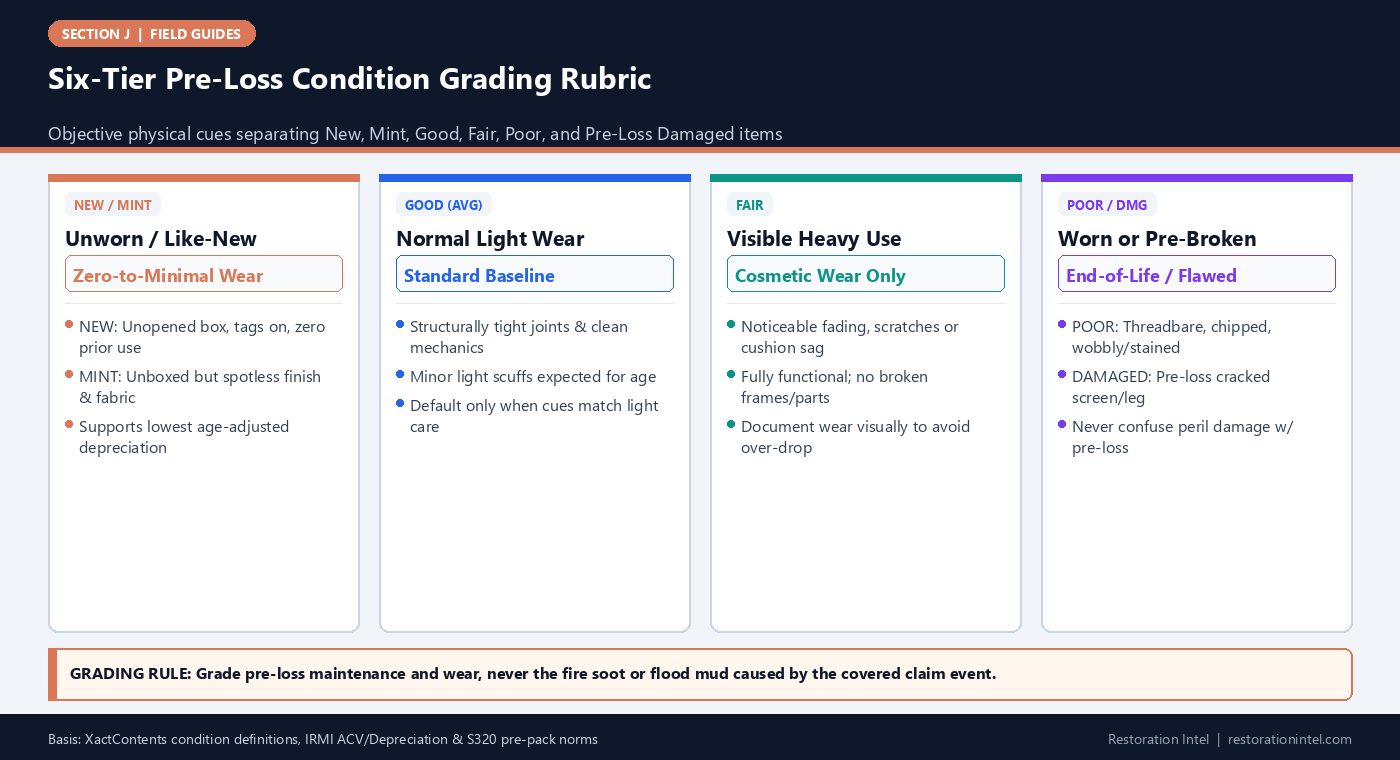
Standard Six-Grade Contents Condition Definitions & Evidence Rules
Apply the condition tier that matches observable pre-loss physical evidence, and attach supporting close-up photos whenever grading above Good or below Fair.
| Condition Grade | Operational Definition | Physical Cues (Furniture / Soft Goods / Tech) | Depreciation Impact | Required Field Proof |
|---|---|---|---|---|
| 1. New | Unused, unopened, or newly purchased with original packaging/tags intact prior to loss | Factory sealed cartons, retail hangtags attached, zero scuffing or assembly wear | Minimal to 0% depreciation (subject to policy rules) | Photo of sealed box, intact hangtags, or recent purchase receipt |
| 2. Mint (Like-New) | Opened and lightly owned, yet indistinguishable from showroom display quality | Crisp upholstery piping, unmarked wood grain, clean stainless/glass, flawless screen | Reduces age-based depreciation below standard table average | Clear close-up of pristine surfaces/cushions proving exceptional care |
| 3. Good (Average) | Well-maintained normal household or office use consistent with chronological age | Tight joinery, intact finish with minor micro-scuffs, fully functional motors/screens | Baseline standard carrier depreciation curve for age | Standard room and asset overview photos showing clean overall upkeep |
| 4. Fair | Visible signs of heavy wear, cosmetic aging, or high duty cycle while remaining fully usable | Sun fading, visible tabletop surface rings, softened sofa cushions, minor paint wear | Increases depreciation above baseline average | Macro of cosmetic wear zones so desk audit matches grade downward |
| 5. Poor | Near end of useful economic life due to severe pre-loss wear, neglect, or heavy staining | Threadbare fabric, peeling veneer, loose wobbly legs, heavy pet scratches/stains | High depreciation approaching salvage/residual value floor | Explicit pre-loss wear photos distinguishing old stains/tears from loss peril |
| 6. Damaged (Pre-Loss) | Pre-existing structural breakage, missing components, or non-working mechanics before the loss | Cracked TV panel prior to fire, broken chair leg, seized motor, missing drawers | Severely limited or $0 incremental loss value unless repaired prior | Close-up of weathered break/old glue/dust inside fracture + owner confirmation |
Separating Pre-Loss Condition From Peril Damage Under Stress
The number-one grading error on disaster sites happens when a technician walks into a smoke-blackened living room, sees soot-streaked armrests and wet cushions, and instinctively clicks ‘Poor’ or ‘Damaged’ in the inventory app. Once exported, that single misclick signals to the desk adjuster that the sofa was already ruined garbage before the fire — slashing the homeowner’s ACV settlement by half.
Condition grading in contents valuation strictly describes pre-loss status. Wipe a small clean test patch if safe, inspect covered drawer interiors, check rear cabinet joints, and ask the homeowner if anything was already broken before the event. When an item is charred beyond inspection, do not guess ‘Poor’ — record condition as `Unverified / Peril-Obscured` and support pre-loss upkeep with family photos or unaffected sibling pieces in the same home.
- Never penalize for soot or flood mud: Soot and water stains are the covered damage being claimed, not pre-loss wear.
- Use unaffected rooms as calibration clues: If the upstairs bedrooms and kitchen show spotless maintenance, a charred downstairs room likely matched that same `Mint` or `Good` upkeep.
- Mark obscured assets explicitly: Tag burned-out electronics or collapsed ceilings as `Pre-Loss Condition Unknown (Peril Destroyed)` rather than defaulting to `Poor`.
Why 'Average/Good' Should Never Be a Blind Keyboard Default
Speed-focused crews often leave every single line item set to `Good` or `Average` by habit. On a 12-year-old heirloom dining table that was refinished last year or a guest bedroom suite used twice a year, slapping `Good` onto the row forfeits legitimate condition credits that lower depreciation on high-value items under effective-age principles.
Conversely, marking genuinely battered garage workbenches or peeling particleboard desks as `Mint` destroys estimator credibility on desk review. When a carrier examiner zooms into a photo showing chewed table legs labeled `Mint,` they audit the entire 400-line schedule line by line.
- Reserve `New` for airtight proof: Only select `New` when factory seals, retail tags, or dated recent receipts back up unused status.
- Document `Mint` visually on Tier-1 items: A two-second close-up of spotless leather stitching or unscratched veneer pays back massive ACV protection.
- Be candid on `Fair` and `Poor`: Honest grading on well-worn basement goods builds trust so adjusters accept `Mint` and `Good` grades on primary living areas without friction.
Standardizing Condition Language Across XactContents and Symbility
Different carrier platforms use slightly different label names — for example, `Above Average / Average / Below Average` versus `Mint / Good / Fair / Poor` — yet the underlying physical proof tiers map cleanly. When exporting field notes into XactContents or Symbility, ensure crews use one unified six-tier vocabulary at capture so office estimators map consistently without guessing what a technician meant by ‘okayish.’
Pairing every non-Average grade with a five-word physical justification (`Mint: refinished 2024, zero scratches` or `Fair: sun-faded left arm`) makes the final schedule self-defending during both carrier desk review and policyholder walk-throughs.
- Train crews on 10 calibration photos: Run a monthly 10-minute photo drill where estimators and techs grade the same 10 items to align inter-rater consistency.
- Log pre-existing damage in notes: Follow pre-pack damage documentation rules on every pack-out piece.
- Audit Tier-1 items (>$500) at QA gate: Confirm every high-value condition tag matches its thumbnail photo before export.
Practitioner Verification Checklist (J-18)
- Grade every scheduled item strictly on verified pre-loss upkeep and wear — never on fire soot, smoke, or floodwater damage caused by the claim event.
- Require photo evidence (sealed box, hangtags, or recent receipt) before assigning the `New` condition grade.
- Capture a tight surface or finish close-up whenever grading a high-value item (`>$500`) as `Mint` to substantiate reduced depreciation.
- Mark heavily charred or collapsed items as `Peril-Obscured / Pre-Loss Unknown` rather than defaulting them to `Poor`.
- Write a concise physical cue (`Fair: worn seat cushions` or `Damaged: pre-loss corner chip`) for every grade outside `Good`.
Standards, Authority References & Related Reading
Primary standards, insurance definitions, and sibling Restoration Intel guides referenced in this brief:
- Verisk XactContents Platform Overview
- IRMI Insurance Glossary: Actual Cash Value (ACV)
- IRMI Insurance Glossary: Depreciation
- ANSI/IICRC S320 Standard for Professional Contents Restoration
- Related Guide: How Useful-Life Depreciation Tables Work — and Where Adjusters and Contractors Misapply Them
- Related Guide: Condition vs Chronological Age: Documenting Pre-Loss Care to Defend Lower Depreciation Percentages
- Related Guide: Field Guide: Verisk XactContents & Symbility Field-Mapping Reference Sheet
- Related Guide: Field Guide: Pre-Pack Inspection of Pre-Existing Damage and Wear-and-Tear Documentation
- Related Guide: Field Guide: Useful-Life Quick-Reference Ranges Across 40 Common Household & Office Categories
.md twin for desk QA and team training.Frequently Asked Questions
Does selecting 'Damaged' condition mean fire or water damage from the claim?
No. In pre-loss inventory grading, ‘Damaged’ means pre-existing breakage or non-functional mechanical failure before the loss happened. Marking fire-damaged furniture as ‘Damaged’ condition can unfairly wipe out ACV recovery.
What is the difference between 'New' and 'Mint' condition?
‘New’ applies to genuinely unused items with factory seals, retail tags, or unopened packaging; ‘Mint’ describes unboxed, lightly owned goods in spotless showroom-like condition with zero visible wear.
How should crews grade an item that is too badly burned to see pre-loss finish?
Do not guess ‘Poor.’ Record the pre-loss condition as obscured by the peril and corroborate household upkeep using family photos, receipts, or undamaged sibling items in adjacent rooms.
Why does honest grading on 'Fair' or 'Poor' items help the rest of the claim?
When adjusters see accurate, candid grading on heavily used garage or basement items, they trust the estimator’s ‘Mint’ and ‘Good’ ratings on primary living-room furnishings and electronics.