Restoration Intel. Operator guide. For the restorer on the loss, and for the hospital facilities director who has to let them in.
You were called for water above a patient room. The facilities director is not asking whether you can dry. They are asking what class of precautions you will work under, and who signed it.
That class is an Infection Control Risk Assessment. In a hospital, the current form is the ASHE ICRA 2.0 matrix, published by the American Society for Health Care Engineering. It is not an IICRC class. S500 and S520 still govern how you dry and how you handle mold. ICRA governs whether you are allowed to open the wall in that building, and how the dust, water, and debris are kept off the patients.
Two questions, then a class
ICRA 2.0 is a short sequence, run before the work, not after the first cut. HFM Magazine walks the same steps. You need the hospital’s own form. The shape is this.
What kind of work is it. Type A is inspection and non-invasive work. One ceiling tile for a look, limited in time, is the example ASHE uses, along with maintenance that does not make dust. Type B is small, short, and low dust. Type C is larger, makes a moderate amount of dust, and includes work that cannot finish in a single shift or a renovation in one room. Type D is major demolition or construction: system replacement, or renovation in two or more rooms.
Who is nearby. Low risk is non-patient space: public halls, offices, mechanical rooms off the unit. Medium is support: waiting, kitchen, sterile processing on the dirty side. High is patient care: rooms, acute units, the emergency department, general pharmacy, imaging. Highest is the places a speck of dust is a clinical event: ICU, oncology, operating rooms, procedural suites, compounding pharmacy, the clean side of sterile processing, invasive imaging.
Match those two on the hospital’s matrix and you get a class of precautions, I through V. If more than one risk group is affected, ASHE says take the higher one. Above, below, and beside the work can raise it too. The class can step down later, when demolition is over and the work gets quieter. It gets reviewed when the work changes. It does not get picked once in the parking lot and forgotten.
The line that changes a restoration job
A ceiling stain in an office might be a small Type B patch. A loss with sewage, mold, asbestos, gray water, or black water is not. ASHE’s matrix says those conditions take Class IV precautions in low and medium risk groups, and Class V in high and highest risk groups.
Read that again before you price a hospital water loss like a hotel room. Category 3 water, a mold finding, or a sewage backup does not stay in the class you would have used for a clean inspection. The hospital’s infection prevention staff assign that class. You do not write it on the estimate and hope.
An infection control permit and approval is required when a Class III comes from Type C work, and for every Class IV and Class V. If you do not have that permit in hand, you are not behind on drying. You have not been cleared to start.
What you own, and what they own
The hospital owns the class. Facilities and infection prevention know the risk group, the HVAC relationships, and which unit is above the ceiling you want to open. Your job is to describe the work honestly: how many rooms, whether you are demoing drywall, whether the water is clean or not, how long the containment will stand, where the air will exhaust.
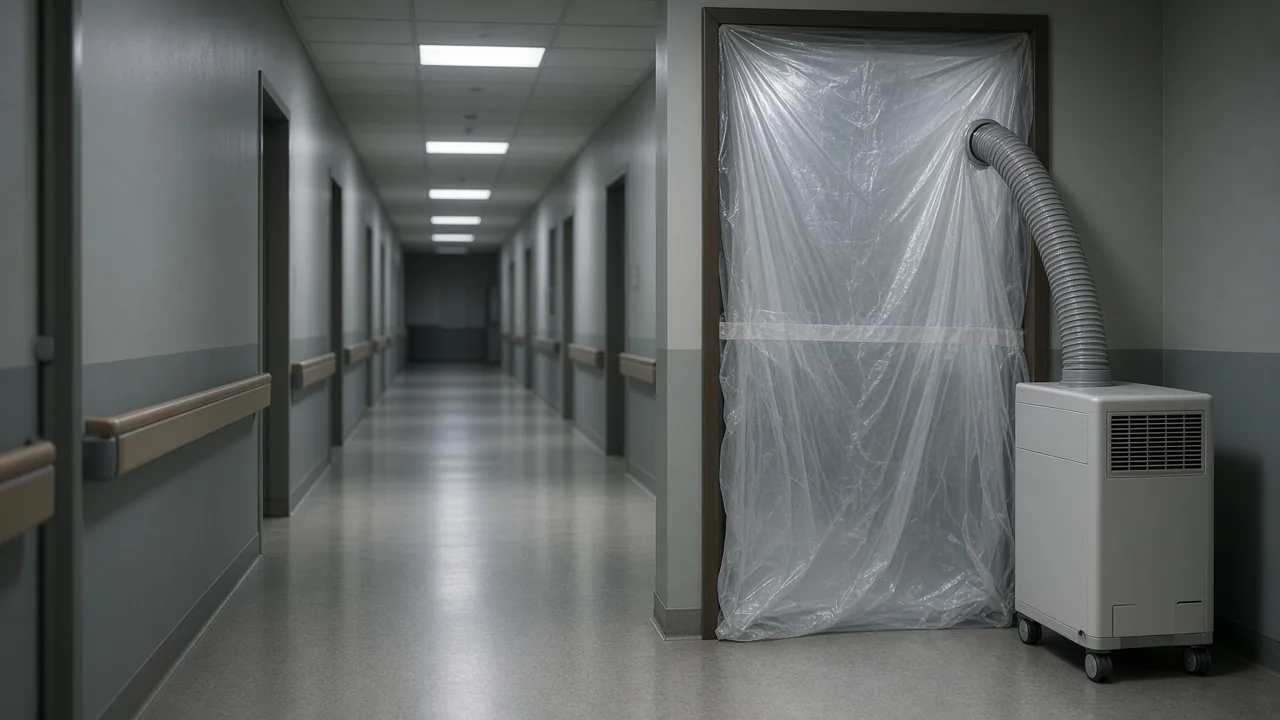
You own the controls the class names. On the classes that apply to a real loss, that means a barrier that actually holds, return and supply diffusers isolated so dust does not ride the HVAC, the work area kept from going positive, debris in a cleanable lidded container that is wiped before it hits the corridor, and a sticky mat when the facility requires one. Class IV and Class V add critical barriers and negative air. Exhaust that dumps into a shared return is not acceptable. If the air cannot go outdoors clear of intakes, it goes through HEPA. The hospital’s permit will say which of those apply. Match the permit. Do not invent a lighter one because the drying goal is in a hurry.
Hours, elevator use, and the path from the work area to the dock are facility rules. A crew that treats the patient corridor as a jobsite hallway will lose the next call, even if the structure dried on time.
How to talk to the facilities director
Use their nouns. Activity type. Patient risk group. Class of precautions. Permit. Surrounding units. Do not open with equipment counts. Open with where the water is, what kind of water it is, and which rooms you have to open.
Then ask three things. What class have you assigned. What does the permit require for barriers and exhaust. Who signs a step-down if the demo finishes and the rest is drying and clean. Write the answers on the job file next to the moisture map. When the adjuster later asks why containment was on the invoice, the permit is the answer.
The split with a normal commercial loss
On a store or an office, you contain for the occupant and for the dust you will make. In a hospital you contain because the occupant cannot leave, and because the dust is an infection-control event, not a cleaning complaint. Commercial in the same building is the dock, the kitchen, the soiled utility, the mechanical room. Residential-style work, if you can call a patient room that, is the finished space where someone is sleeping on the other side of the plastic. One crew does not wander between them without the path the permit named.
Price the class you were assigned. A Class V anteroom, coveralls, and verified negative air are not overhead you absorb to win the dry-out. They are the condition of working. If the class is still blank when you are asked for a number, the honest bid says the number moves when infection prevention signs the permit.
Operator guide, not a hospital’s infection-control permit and not a substitute for the ASHE ICRA 2.0 matrix. The facility’s infection prevention staff assign the class. Confirm it on their form before you open a wall. IICRC S500 and S520 still govern the drying and the mold scope inside whatever class they assign.