You keep a founder’s pattern-recognition by treating it like what it is: a map. Check where it still matches the ground, mark where it doesn’t, and update it in the open — with the founder in the room. Don’t throw the map away. Don’t let anyone navigate a new neighborhood with it unchecked, either.
That’s the work in a second-generation shop right now, because the houses changed.
The walk he could do in his sleep
The shop in this story is a familiar shape. Founded in 1998. Full-service — mitigation and rebuild under one roof. Local, referral-driven, most work inside a 40-mile radius, a lot of it repeat adjuster relationships built over decades.
Dad still owns the building and two dehumidifier fleets bought cash. His daughter is 41 and she’s the GM now. Fourteen techs. One estimator who has been there 19 years. A line of credit renewed every spring.
And Dad can still do the thing nobody else can do as fast.
He walks a water loss, smells the wall cavity, puts a hand where the baseboard meets the drywall, and calls the scope within $800 before a meter comes out of a case. On a 1990s ranch — wood frame, batt insulation, real hardwood or carpet over pad — he’s right often enough that the crew stopped questioning it years ago. The number he says in the living room becomes the number the office works from, because for twenty years that saved everybody time and it was usually true.
That is not ego. That is pattern-recognition earned on thousands of jobs — worth a lot on a Monday when three calls come in before 9 a.m.
The problem is not that the asset went bad. The ground moved under it.
When the houses stopped matching the map
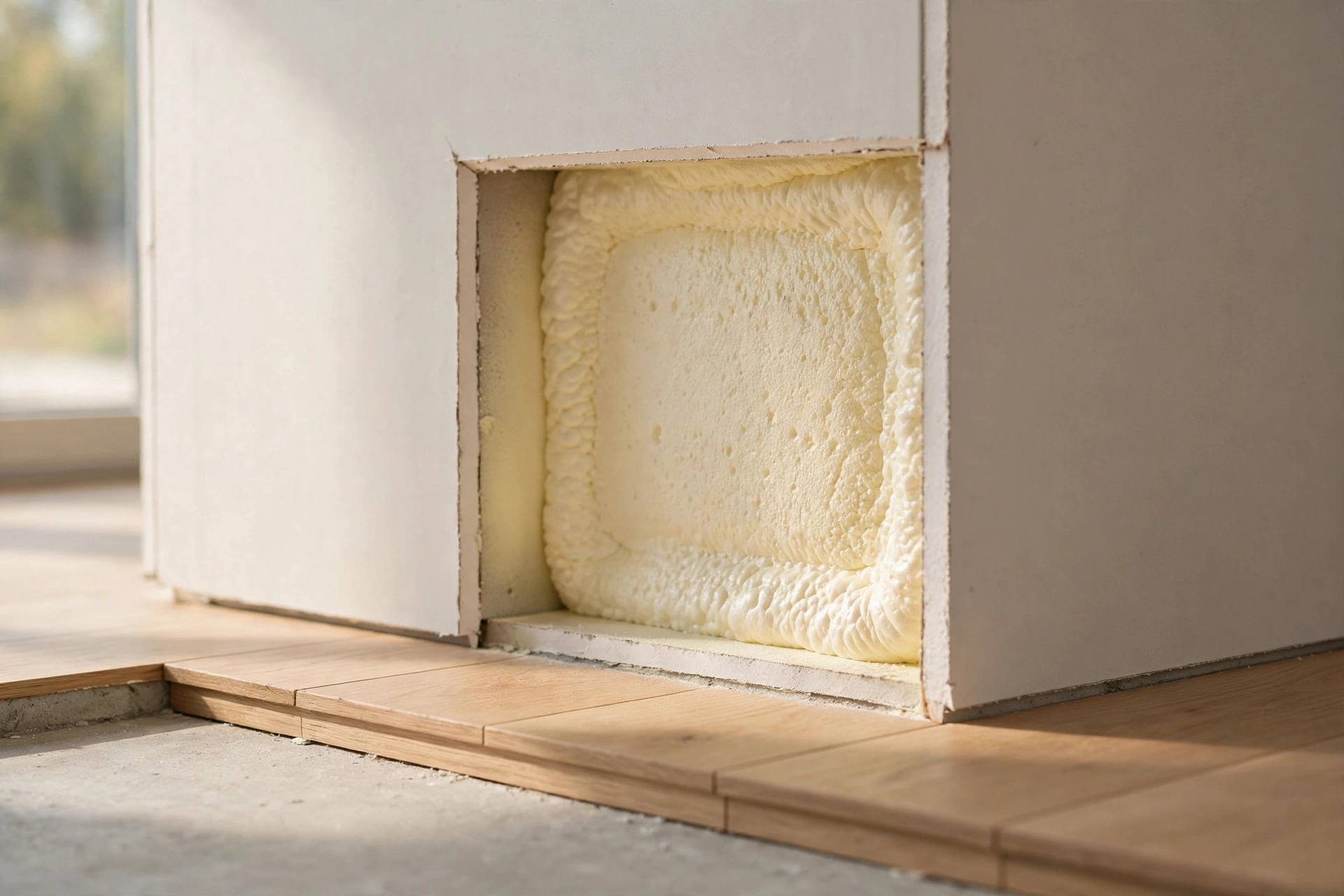
Post-2020 builds don’t dry like the houses he learned on.
Foam-sealed envelopes. Spray insulation that holds moisture in places a ranch would breathe it out. Engineered flooring over slab that looks dry on top while water is traveling underneath in ways the old read doesn’t catch. Tighter houses, different assemblies, different failure paths.
His call started missing — but only there.
Three jobs in one quarter ran 22 to 31% over his gut estimate. Not because the crews were slow. Not because somebody padded hours. Because the scope he saw in the first ten minutes wasn’t the scope that was actually in the wall.
And mitigation’s miss became rebuild’s problem. Missed moisture left behind turned into callbacks, and the callbacks clustered in the same place the variance did: the newer homes. On older stock his numbers held; on newer stock, variance widened job after job in the same direction.
Averaged together, the old houses hide it. Split by build year, it’s a line you can’t unsee. That’s the tell: the man didn’t get worse. The map got old in one specific territory.
The lens: orientation
John Boyd spent his career studying how people make decisions under pressure, and his conclusion was plain: orientation is the decisive layer.
Orientation is the stock of images, patterns, and expectations you filter new information through. It’s fed by heritage, by culture, by prior experience, by new information coming in, and by the analysis and synthesis you do with it. Everything you notice — and everything you miss — passes through that filter first. You don’t see a water loss raw. You see it through the last thousand water losses.
That is why Dad is fast. His orientation is deep and, on the housing stock it was built on, accurate.
Boyd’s other point is the one that hurts: orientation decays. When the world changes faster than the map, you get a concept-reality mismatch. What you expect to find and what is actually there stop lining up. And here’s the part shops learn the hard way — a mismatch like that cannot be patched from inside the concept. The same filter that produced the miss will explain the miss away. It’s the crew. It’s the homeowner. It’s a weird one. Three weird ones in a quarter, all in houses built after 2015, is not weird. It’s the map telling you it needs updating.
Boyd also talked about tempo — not raw speed, but speed relative to the rhythm of the situation. Dad’s ten-minute call is fast. On a new build, fast and wrong is slower than a meter reading and twenty extra minutes, because the callback sets the real tempo.
His image for real learning was a snowmobile: a thing that exists in no one domain, built by shattering pieces of different domains and synthesizing them into something new. Updating an orientation takes that — not more of the same experience, but new inputs: build science on new assemblies, meter data from new-wall jobs, the estimator’s numbers laid against Dad’s calls, recombined into a new map.
One boundary: Boyd wrote a lot about adversaries and deception, and that half does not transfer. A homeowner is not an opponent. This is a cooperative setting. Only the orientation half comes across — but that half is enough.
One Monday, a whiteboard instead of a production meeting
The daughter didn’t argue with her dad about a single job. Arguments about single jobs go nowhere — he has a story for every one of them, and most of his stories are true.
One Monday, instead of a production meeting, she ran an orientation audit.
Last 20 closed jobs. Plotted on the whiteboard by build year, against estimate-to-final variance.
It took ten minutes for the pattern to show itself. Pre-2005 houses: tight cluster, his calls close to final. Post-2015 houses: variance opens up, and it opens up in one direction — over. Same founder, same crews, same estimator. Different housing stock, different result.
No blame landed on Dad in that room, and that wasn’t softness, it was accuracy. His map was right for its era. It built the company. The whiteboard wasn’t a verdict on him; it was a picture of a world that had changed its building practices while the shop’s mental shortcuts stayed put.
Out of that morning came one rule, and it’s worth stealing exactly as written:
Any pre-2005 mental shortcut applied to a post-2015 build gets a second set of eyes and a meter reading before the number is spoken to a homeowner.
Notice what the rule doesn’t do. It doesn’t bench Dad or require a committee on every job. It names the one place the map is known to be thin — old shortcut, new assembly — and puts the check before the number leaves the building, while it’s still cheap. Once you’ve told a homeowner a number, you own it.
In this story’s telling, variance on newer builds narrows within two quarters. Dad’s reads become a checked asset instead of an unquestioned one — the first read, and on new construction, no longer the only read. You route his read through a check where it has proven it can miss, and let it run free where it has proven it doesn’t.
The cost, said plainly

None of this is free, and pretending otherwise is how second-generation shops lose people over a whiteboard.
The founder experiences the audit as a demotion unless it is framed — and actually run — as updating the map he built, not discarding it. That distinction is not a speech. It’s whether he is in the room when the rule gets written, whether his calls still lead on the houses he knows cold, and whether the data is shown as a housing-stock story instead of a him story. Get it wrong and you’ve told the man who owns the building and the equipment that his judgment is now a liability to be managed. He will hear it that way even if you never say those words.
And it doesn’t only land on him. In this story, one senior tech quits over “clipboard management.” From his seat, a shop that ran on trust now wants a second signature on a read he watched work for years. He wasn’t wrong about what changed — the shop did add a check where there wasn’t one. He just didn’t want to work in the shop it was becoming.
Orientation work is succession work, and succession is never free. The cost is a real conversation with the founder about which parts of his judgment now travel with a check attached, and losing the people who preferred the old informality to the new accuracy. A shop that won’t pay it keeps the harmony and keeps the variance. Pick knowingly.
The practice
-
Run the split before you argue. Pull your last 20 closed jobs and plot estimate-to-final variance by build year. If the misses cluster in newer builds, you don’t have a people problem — you have an orientation problem, and now everyone can see it on one board.
-
Write the check as a narrow rule. Name the exact trigger: old shortcut, new assembly. On a post-2015 build, a second set of eyes and a meter reading happen before any number is spoken to the homeowner. Narrow rules get followed; general “be more careful” doesn’t.
-
Keep the founder as first reader. His call still opens the job and still leads outright on the pre-2005 stock where the record says it holds. The update protects his asset in the territory where it misses — frame it that way, and run it that way.
From the Boyd & Toyota series at Restoration Intel — what two old disciplines, tempo and standard work, look like inside a restoration shop.