The difference is who wrote it, where it lives, and whether anyone may change it.
A consultant binder is what someone thought your shop should do in 2016. Toyota’s standard work is the current best known method, written by the people closest to the work, posted where the work happens, and revised when a better method is proven. One is built to pass an audit. The other makes variation visible so you can improve. If crews are quietly re-trained in week two to forget week one, you don’t have a standard. You have two — and only the unwritten one is true.
The binder in the office
Picture a shop a lot of owners will recognize. Twenty-two people, family-owned, full-service on paper. Mitigation is the real engine. Rebuild is mostly subbed out.
In the office sits the operations binder. One hundred and forty pages. Laminated tabs. Written by a consultant after a bad audit year, when documentation felt like protection. The owner paid for it, initialed it, and meant it at the time.
Nobody works from it now.
The actual best method for containing a kitchen and setting drying lives somewhere else: in a group text thread that scrolls away, in two lead techs’ notebooks, and in habit. Ask how to build containment and you will get a good answer — just not the same answer twice.
That is not a people problem. It is what happens when authorship is taken from the crew. The binder was forced down from above, even with good intentions. Toyota meant the opposite. Taiichi Ohno put it plainly: “Where there is no standard, there can be no kaizen.” Standards should not be forced down, but set by the production workers themselves. Without a true standard you cannot see if you improved, got worse, or just got lucky.
Same kitchen, two different jobs

The symptom shows up on a normal loss, not a disaster.
A Category 2 kitchen loss. Water under cabinets, wet toe-kicks, flooring to protect. One crew sets containment in two and a half hours. Another crew, same shop, same kind of job, takes five.
Neither crew is lazy. They are running two different sequences, making different calls on zipper placement, how much poly to leave, and what gets set before drying equipment goes in.
Then the drying logs come back in different formats. The estimator cannot compare the jobs cleanly. Was one kitchen drier faster, or does it just look that way on paper? Are you billing for time you needed, or time your sequence wasted?
Documented and real standard split years ago. Training follows one. Production follows the other. A new hire lives in the gap.
Week one, they learn the binder. Week two, a lead says the sentence every owner should hear as an alarm: “Forget that page. Do it this way.”
From then on, the hire learns the real lesson — the book is not to be trusted. And the leads become the standard, in two different heads, unavailable when they are sick or on another job.
What Toyota actually meant by standard work
Standard work is not a thicker binder. It is thinner and alive.
In Toyota’s use, it has three elements. First, takt time — the pace the work has to meet, figured as available time divided by demand. It is not a wish or a quota invented in a meeting. It gets recalculated when conditions change — roughly every 10 days — because demand and available time do not sit still.
Second, work sequence — the order a good operator actually does the work in.
Third, standard in-process stock — the minimum material and work in progress needed to keep that sequence running without hunting, waiting, or improvising a substitute.
Write those three down honestly and you have something a crew can run and a lead can improve. Leave one vague and you are back to habit.
The sheet itself is expected to change. The chart was traditionally kept in pencil because revision was expected. Not tolerated. Expected. When a better method is proven, the standard moves. Until then, you run the standard you have — not your personal favorite that day — so when something goes wrong, or surprisingly right, you know what changed.
That is genchi genbutsu applied to paperwork: go and see the actual place and the actual thing. Do not revise a containment standard from a desk. Revise it in a kitchen, or in a warehouse taped out to be one, with poly in your hands.
A wet Tuesday in the warehouse
So take that kitchen job out of the binder and put it on the floor.
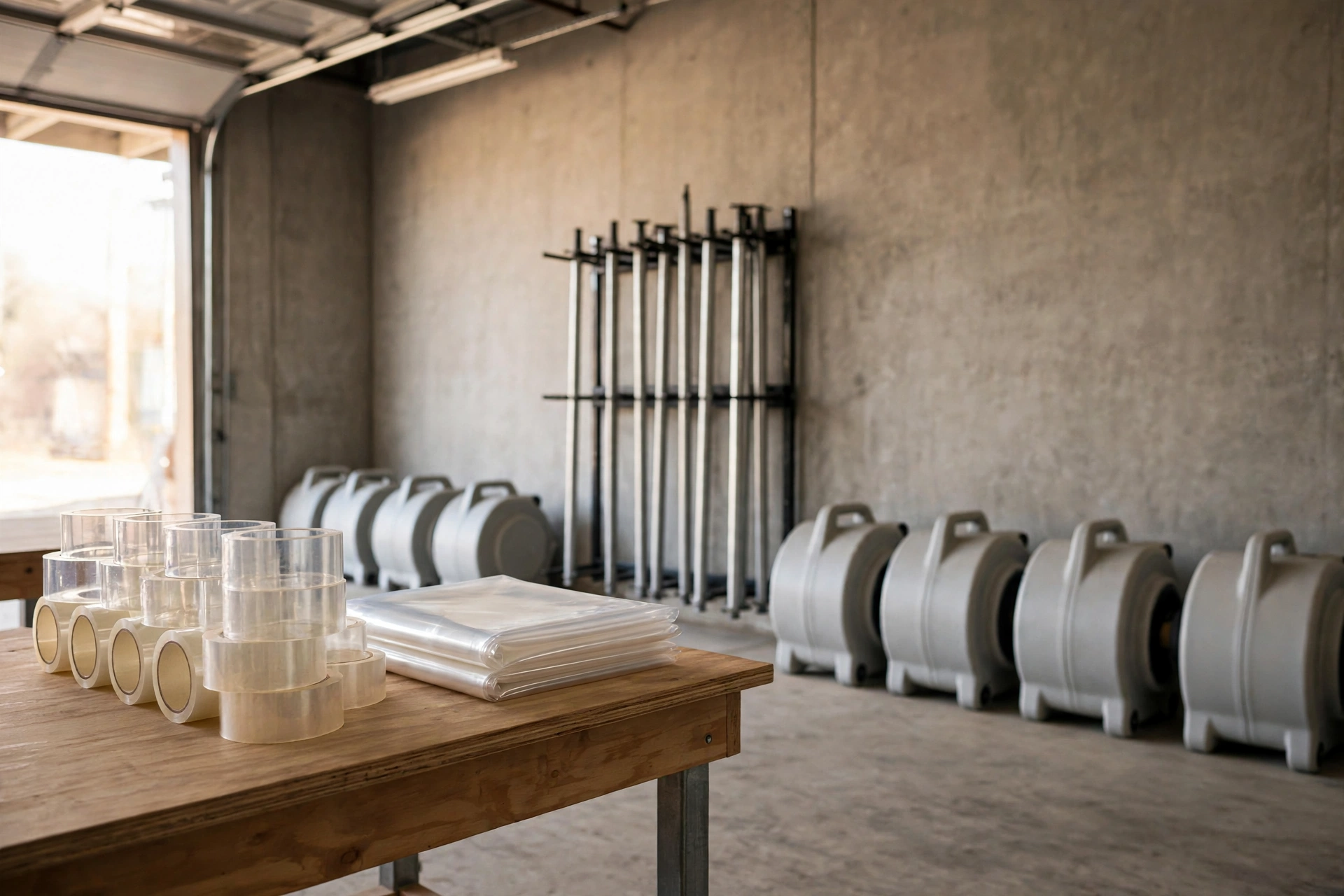
It is a wet Tuesday, the board already full before the second coffee. Instead of another meeting about consistency, the owner clears a bay. Two lead techs and the newest hire tape out a kitchen footprint on the warehouse floor — cabinets along one line, doorway here, fridge there.
They run the containment sequence three ways. Not on paper. With actual poly, tape, and poles. One lead builds the zipper where he always builds it. The other moves it a foot and changes when it goes in. The new hire asks why a step happens before the floor protection instead of after, and neither lead has a good answer except that it always has.
They time each variant. They argue. That argument is the work. Zipper placement stops being an opinion when you watch a tech carry equipment through it four times. Sequence stops being a preference when one order leaves a man idle holding poly while the other keeps all three hands moving.
The winner is not the fastest trick. It is the sequence they can repeat, teach, and explain — times noted, materials counted, order fixed.
Then they make the thing the binder never was: one page. Photos of the layout and finished containment. The sequence in order. The times they actually hit. The stock that has to be on the trailer to run it without a supply run. That page gets taped inside the trailer door, where the work starts — not filed in the office where the work never happens.
And the binder page it replaces is thrown away in front of everyone. That tells the crew this is not an extra standard stacked on the old lie. The old page is dead. This page is the standard until someone proves a better one, and then it will be replaced the same way.
What changes — and what it costs
Within a few weeks, setup time converges. Not because everyone got heroic, but because everyone is running the same sequence, so slow spots have nowhere to hide. When a job runs long, you can ask: did we run the standard and the job was different, or did we leave it and pay for it? Both answers teach you something. Before, neither was available.
The one page becomes the training tool. A new hire learns it on the trailer door and is checked against the same page the lead is running. There is no week-two whisper.
Revisions become normal. Friday, not once a year. Someone tries a cleaner way to stage drying, times it, shows the other lead, and if it holds, the page changes in pencil first, then in print when it has earned it. Improvement stops being a consultant project and becomes a regular habit owned by the people who live with the result.
Now the cost, without softening it.
Leads now own documentation labor they used to dodge. Timing a variant, taking photos, writing a clear sequence, keeping the page current — that is real work, landing on the people already carrying the hardest jobs. If the owner will not give them time on the clock to do it, the standard will die the way the binder did, only faster.
The owner must surrender authorship. Her initials come off the standard. The crew’s go on. That sounds small until it is your company and your binder you paid for being tossed in front of your own techs. If she takes authorship back the first time a lead writes a sequence she would have written differently, the crew will learn that in a day and stop bringing her improvements.
And the first month is slower. Every “we’ve always done it this way” has to be tested instead of assumed, and testing takes longer than arguing. Jobs do not stop while you sort this out. You will tape floors and rewrite pages on days when you are already tired. That is the price. Pay it, and you get a standard that is true. Skip it, and you keep a binder that looks complete and teaches new hires to ignore you.
The practice
On Monday, start with one job type only — kitchen containment and drying setup, or your most repeated job:
- Tape it out on the warehouse floor with the two leads who disagree most. Time three real variants with real material, and pick the repeatable winner, not the fastest one-off.
- Write that winner on one page — sequence, times, standard stock — with photos, and tape it inside the trailer door. Throw the binder page it replaces away in front of the crew.
- Train the next hire from that page only, and run it unchanged until someone proves a better method with a timed trial.
- Revise on Friday: 20 minutes, pencil in hand. If a change is proven, the crew initials it and the page changes that day.
From the Boyd & Toyota series at Restoration Intel — what two old disciplines, tempo and standard work, look like inside a restoration shop.