Direct Answer: Accurate clinic capture logs every medical and dental device down to its FDA Unique Device Identifier (UDI), serial plate, modular sub-assemblies, lease sticker, and maintenance history while maintaining zero protected health information (PHI) in camera frames or voice narrations.
.md twin for estimator QA and carrier file documentation.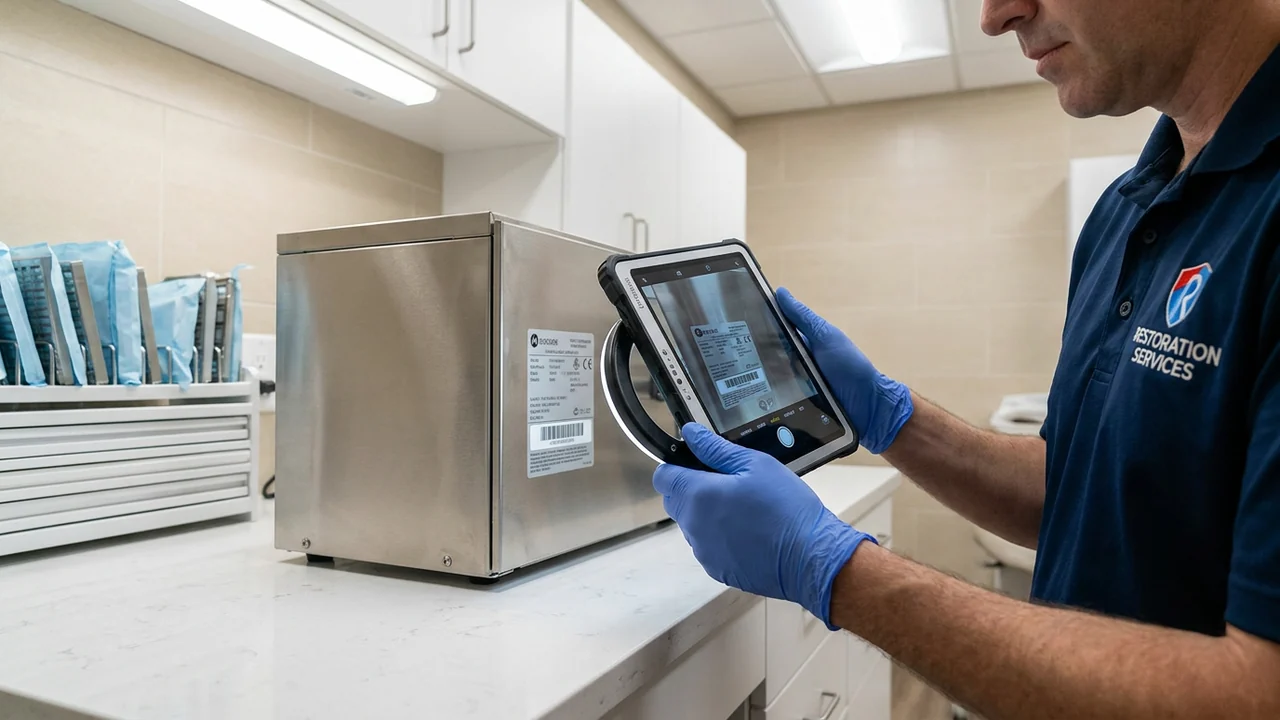
In a residential pack-out, missing a blender’s sub-model number costs the claim twenty dollars. In a dental or outpatient medical clinic, writing “Dental Chair — Operatory 1” or “Steam Autoclave — Sterilization Room” without the exact model revision, FDA Unique Device Identifier (UDI), handpiece configuration, and serial plate can cost ten thousand dollars or stall settlement for months. Manufacturers such as A-dec, Midmark, Planmeca, Carestream, and Tuttnauer sell seemingly identical housings across vastly different option packages, software licenses, and voltage configurations.
Clinic capture faces a second constraint absent from retail or warehouse losses: every photograph and audio file must remain completely free of HIPAA-protected patient identifiers. A single reflection of an appointment monitor in a glossy autoclave door or a sticky note with a patient phone number taped to an operatory cabinet forces manual redaction—or worse, a privacy incident report—before the claim file can be shared with an adjuster or OEM dealer.
By combining ANSI/IICRC S320 room-by-room discipline with E-03’s rating-plate capture standards and XactContents asset structuring, field leads build audit-ready clinical schedules in a single sweep. Compliance Disclaimer: This capture guide addresses property claim documentation only and is not legal HIPAA counsel or FDA regulatory guidance; follow the practice Privacy Officer’s redaction rules and OEM inspection restrictions before energizing or moving clinical devices.
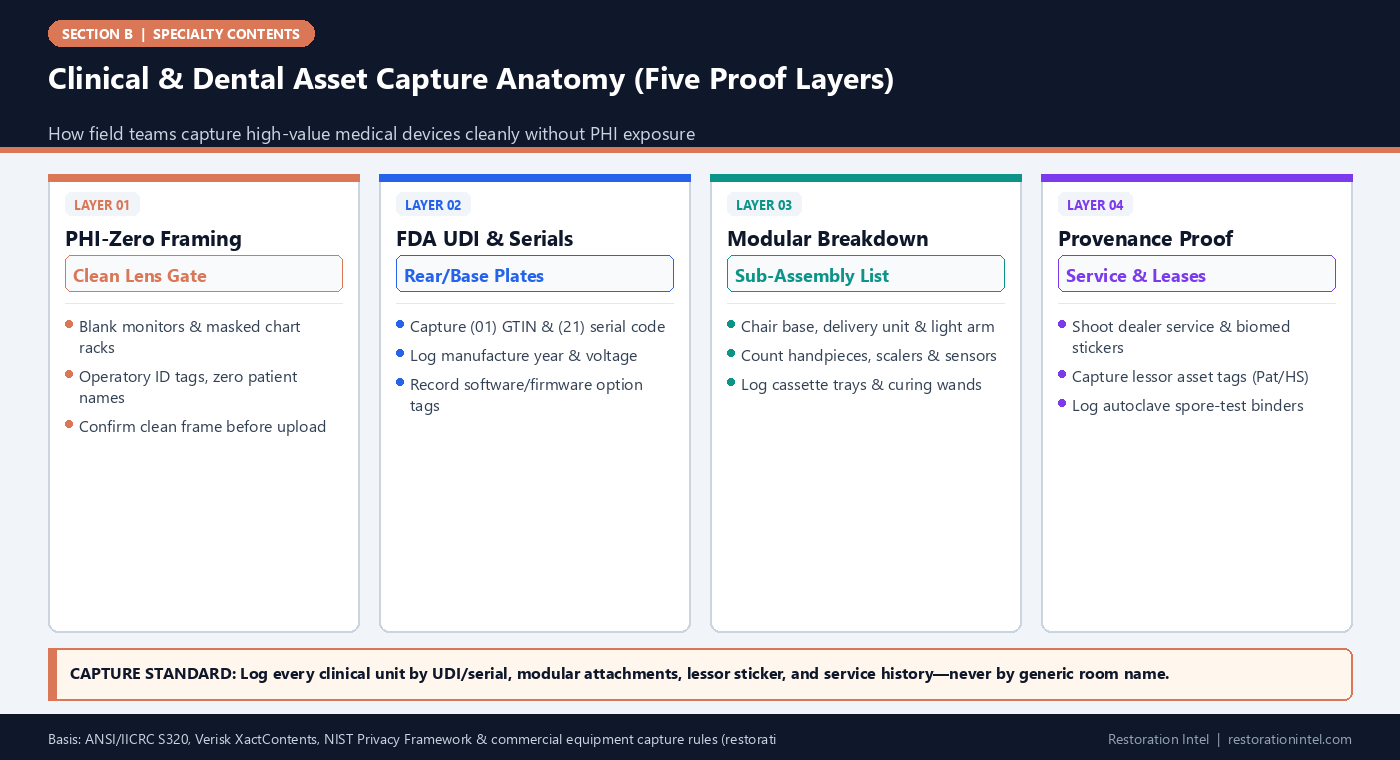
Clinical & Dental Asset Capture Anatomy (Five Proof Layers)
Medical & Dental Equipment Capture & Serial Location Reference
Where field crews locate critical identification plates, option codes, and hidden sub-components across common clinical suites.
| Equipment Assembly | Typical Rating Plate / UDI Location | Hidden Sub-Components Often Missed | Critical Provenance / Lease Clues | Target Capture Angles |
|---|---|---|---|---|
| Dental Operatory Chair & Delivery Unit | Lower chair hydraulic base rear shroud; underside of delivery tray head | Air/water syringes, electric micromotor handpieces, scaler tips, monitor mount | Dealer install sticker (Patterson/Henry Schein/Benco) + last PM tag | Full operatory wide, chair base plate macro, delivery head underside |
| Steam Autoclave / Washer-Disinfector | Rear chassis panel, inside chamber door rim, or side service panel | Internal printer module, water-distiller unit, cassette racks, data logger USB | Annual biological spore-test logbook & biomed calibration sticker | Front door seal, interior chamber staining, rear UDI/serial plate |
| CBCT / Panoramic X-Ray System | Lower column base behind trim or rear of rotating gantry mast | Cephalometric arm, acquisition workstation PC, licensed 3D reconstruction dongle | State radiation registration decal & annual medical physicist test sticker | Column serial tag, workstation tower tag, room wall mount & lead glass |
| Intraoral Scanners & CAD/CAM Mills | Cart spine backplate, scanner wand base, and mill rear compressor bay | Autoclavable scanner tips, calibration phantoms, milling bur magazines, vacuum base | Subscription/software license tier & financing lessor badge | Cart wide shot, wand serial macro, tip count & calibration block |
| Exam Tables, Vital Monitors & Defibrillators | Beneath seat pan frame, rear battery bay, or monitor carrying handle recess | SpO2/NIBP cuffs, wall mount transformers, AED pads/batteries, rolling stand | Biomedical safety inspection sticker (annual electrical leakage pass date) | Front screen/housing, rear serial + biomed tag, accessory bin count |
| Central Vacuum, Compressors & Lab Freezers | Motor housing shroud, tank weld plate, or upper-right freezer side panel | Amalgam separator cartridges, air dryer columns, digital min/max alarm probes | Service contract phone label & installation contractor date tag | Utility closet wide shot, electrical whip/plumbing, compressor nameplate |
Enforcing Zero-PHI Discipline Across Photos and Voice Narration
Modern capture workflows rely heavily on rapid smartphone photography, 360-degree room scans, and AI-assisted audio narration. In a clinical suite, speed without privacy discipline creates immediate compliance exposure. Patient intake counters hold insurance card photocopies, laboratory counter trays display specimen labels, and treatment-room monitors stay logged into electronic health record (EHR) dashboards after an emergency evacuation.
Before taking a single overview shot, run the privacy clearance checklist established in B-02’s scope boundaries and J-07’s privacy guide. Verify that monitors are dark or draped, chart pass-through windows are closed, and appointment schedules are bagged by clinic staff. If a technician spots stray patient paperwork inside a drawer during capture, close the drawer immediately, summon the clinic’s liaison to remove the document, and retake the clean frame rather than relying on post-production blurring.
Voice narration must follow the same discipline: describe physical hardware, room identifiers, and visible peril damage only—never read aloud patient names, clinician notes, or prescription labels.
- Reflective-surface check: Watch for glossy X-ray monitors, stainless autoclave doors, and glass cabinetry reflecting open reception schedules behind the photographer.
- Clean-room numbering: Assign standardized zone IDs (e.g.,
OP-01,STERIL-01,LAB-01,MECH-01) matching the clinic’s floor plan. - Immediate delete-and-reshoot rule: If PHI accidentally enters any raw frame, delete the raw image from device and sync cache immediately under Privacy Officer oversight.
Capturing FDA UDI Barcodes, Serial Plates, and Option Packages
Medical and dental equipment pricing swings dramatically based on factory configuration and software licensing. Two panoramic dental imaging units with identical chassis shells can differ by $35,000 depending on whether the unit includes a cephalometric arm, a larger field-of-view CBCT sensor, or specific 3D implant-planning software seats. Similarly, a mid-tier hydraulic dental chair with integrated electric micromotors, ultrasonic scaler routing, and fiber-optic illumination costs far more than a bare air-driven base.
Following E-03’s rating-plate standards, capture crisp macro shots of the manufacturer’s regulatory data plate using an indirect LED inspection light to prevent flash glare on brushed foil labels. Record the full model number, serial number, manufacture date, electrical rating, and—on modern FDA-regulated devices—the Unique Device Identifier (UDI) string containing the Device Identifier (01) and Production Identifier (21).
Never rely solely on front-panel branding. Photograph the back of workstation towers, software license dongles plugged into imaging PCs, and dealer-applied configuration stickers inside delivery-unit swing arms so estimators can price the exact installed feature set.
- Macro lighting discipline: Angle a pocket LED at 30–45 degrees across metallic or worn thermal stickers so serial digits stay legible without blown-out glare.
- License & dongle proof: Photograph USB hardware security keys, software version splash stickers, and workstation service tags attached to CBCT or CAD/CAM carts.
- Do not power on wet gear: Never plug in a water- or soot-exposed medical device solely to read a digital serial screen; pull physical chassis labels instead.
Decomposing Modular Operatories and Small-Instrument Ecosystems
The largest hidden dollar leakage in clinic captures happens when field crews treat an entire operatory or sterilization center as one or two bulk line items. Inside a single dental operatory, high-value small instruments and modular attachments often represent 25% to 40% of the room’s total replacement value: electric high-speed handpieces ($1,200–$1,800 each), piezo ultrasonic scalers, LED curing lights, intraoral cameras, digital phosphor plates or CMOS sensors, and anodized surgical cassette kits.
Create a strict top-down capture order inside every clinical room. First capture the room overview, then log the major fixed/semi-fixed assembly (chair, delivery unit, light, monitor arm), then open each drawer and cassette rack sequentially to count and photograph loose handpieces, burs, surgical forceps, and sensor holders on a clean, high-contrast mat.
Tag each modular piece back to its parent operatory ID in XactContents so adjusters can verify that twenty high-speed handpieces across five operatories are distinct serialized instruments rather than duplicate photos of the same tray.
- Handpiece serial sweep: High-speed, implant-surgical, and endodontic handpieces carry laser-etched serial numbers near the coupler collar—capture grouped rows with serials facing up.
- Sensor & scanner tip counts: Separate fragile digital X-ray sensors and autoclavable intraoral scanner tips onto labeled foam mats with exact size counts (Size 0, 1, 2).
- Cassette & bur-block bundling: Photograph open surgical cassettes beside closed lid labels so estimators can match exact instrument counts per kit.
Logging Maintenance Provenance, Calibration Logs, and Lease Stickers
In commercial property claims, pre-loss condition and effective age drive depreciation negotiations. A seven-year-old autoclave or CBCT unit that received quarterly preventive maintenance, recent gasket/valve rebuilds, and annual state radiation physics testing deserves a much lower depreciation percentage than a neglected machine of the same chronological age—a principle anchored in D-15’s depreciation defense packet.
Field capture teams should actively hunt for provenance proof right inside the clinic: dealer service tags adhered to equipment side panels, biomedical electrical-safety inspection stickers showing test dates, radiation-control registration certificates, and sterilization spore-test binders (verifying no patient names appear on log pages). Also scan for asset-finance decals from medical leasing companies such as Patterson Finance, Henry Schein Financial Services, or bank equipment lessors.
Capturing lease tags on Day 1 prevents the ownership disputes covered in E-08’s leased-equipment protocol and ensures the clinic’s equipment invoices, warranty extensions, and dealer service records are requested while the practice manager still has portal access.
- Biomed & physics stickers: Photograph every inspection decal showing inspection date, technician company, and pass status.
- Lessor identification: Log lease tag IDs and lender names separately from clinic-owned assets so loss-payee checks never delay payouts.
- Maintenance binder request: Ask the practice manager to export the last 24 months of dealer service invoices from their distributor portal (Schein/Patterson/McKesson) for the claim packet.
Inventorying Consumables, Implants, and Sterile Supply Closets
Medical and dental clinics hold tens of thousands of dollars in compact consumables inside central supply closets: titanium dental implants, bone-graft biologics, composite resin compules, impression tips, sutures, local-anesthetic boxes, and pre-packaged sterile kits. Because individual boxes look small, rushed crews either overlook them or lump an entire supply wall into one vague “medical supplies” allowance.
Capture supply shelving bay by bay, reading box labels (manufacturer, SKU/REF number, lot, expiration date, and sealed vs. opened status) clearly into audio or spreadsheet logs. Separate expired or pre-loss open packs transparently from intact, unexpired sterile stock so carrier examiners see honest, verifiable quantities aligned with D-12’s commercial stock valuation rules.
Document the physical peril exposure on each shelf—water-line height on lower boxes, soot fallout on upper open-top bins, or heat-compromised seals—before anything is discarded or moved, preparing a seamless handoff into B-04’s cleanability triage.
- REF & LOT visibility: Frame high-value implant, biologic, and suture boxes so catalog REF numbers and expiration dates are readable.
- Sealed vs opened split: Flag factory-sealed boxes separately from partially used trays; adjusters scrutinize open-box counts heavily.
- Peril-contact proof: Photograph moisture wicking on cardboard cartons, warped Tyvek sterile pouches, and soot wipe tests on shelf edges.
Practitioner Verification Checklist (B-03)
- Confirm PHI-free framing before every room sweep—monitors blanked, chart racks covered, and patient schedules removed by clinic staff.
- Capture macro LED-lit photos of rear/underside rating plates, serial numbers, manufacture dates, and FDA UDI barcodes on all major clinic units.
- Break modular dental/medical stations into distinct lines for chair bases, delivery heads, lights, monitors, handpieces, sensors, and cassettes.
- Photograph biomedical safety tags, radiation physics decals, dealer service stickers, and third-party equipment lease badges.
- Document supply closets by bay with catalog REF numbers, sealed-vs-opened counts, expiration dates, and visible water/soot contact evidence.
- Request 24-month dealer purchase and PM service exports from the practice manager to back up provenance and effective-age claims.
Standards, Authority References & Related Reading
Primary standards, insurance definitions, and sibling Restoration Intel guides referenced in this brief:
- ANSI/IICRC S320 Standard for Professional Contents Restoration
- Verisk XactContents Platform Overview
- NIST Privacy Framework
- OSHA 1910.1030 Bloodborne Pathogens Standard
- Restoration Industry Association (RIA)
- Related Guide: Medical & Dental Clinics: Scope & Hazard Boundaries
- Related Guide: Medical & Dental Clinics: Cleanability vs Total-Loss Triage
- Related Guide: Rating-Plate, Serial Number, and Asset-Tag Capture Standards for Commercial Equipment Claims
- Related Guide: Leased, Financed, and Vendor-Consigned Equipment: Handling Third-Party Ownership on a Contents Inventory
- Related Guide: Stock, Consumables, and Perishables Valuation in Commercial BPP Claims: Wholesale Cost vs Selling Price
- Related Guide: Constructing a Contents Depreciation Dispute Packet That Desk Examiners Respect
.md twin for desk QA and team training.Frequently Asked Questions
Why isn't photographing the front brand logo of a dental chair or CBCT enough?
Manufacturers sell multiple feature tiers, sensor sizes, software licenses, and electrical configurations under the same outer shell. Without the rear model/serial plate, FDA UDI, and option tags, estimators cannot defend true Like Kind and Quality pricing.
What if a patient chart or EHR screen accidentally shows up in a pack-out photo?
Stop capture immediately, have the clinic Privacy Officer verify what appeared, purge the unredacted raw frame from local and cloud caches, and reshoot after physical masking or removal.
Should restoration crews power on smoke- or water-exposed imaging systems to read firmware versions?
No. Energizing wet or soot-contaminated electronics risks shorting power supplies and worsening corrosion. Record physical chassis stickers and let an authorized OEM engineer test electronics safely.
How should high-speed dental handpieces and surgical cassettes be logged?
Lay handpieces on a clean contrast mat with laser-etched serials visible, group by operatory ID, and photograph open surgical cassettes alongside lid tags so every instrument is accounted for.
Why capture biomedical and radiation inspection stickers during Day-1 walkthroughs?
Current inspection stickers prove the equipment was actively calibrated and well-maintained immediately prior to the loss, supporting lower depreciation and faster adjuster approval.