Direct Answer: Safe pack-out and return of medical and dental contents requires sequential pre-pack decommissioning (PHI, biohazard, and medical-gas isolation), dual-sign-off tamper-evident chain of custody, climate-controlled clean-zone vaulting, and mandatory written OEM or biomedical recertification before any restored device returns to patient care.
.md twin for estimator QA and carrier file documentation.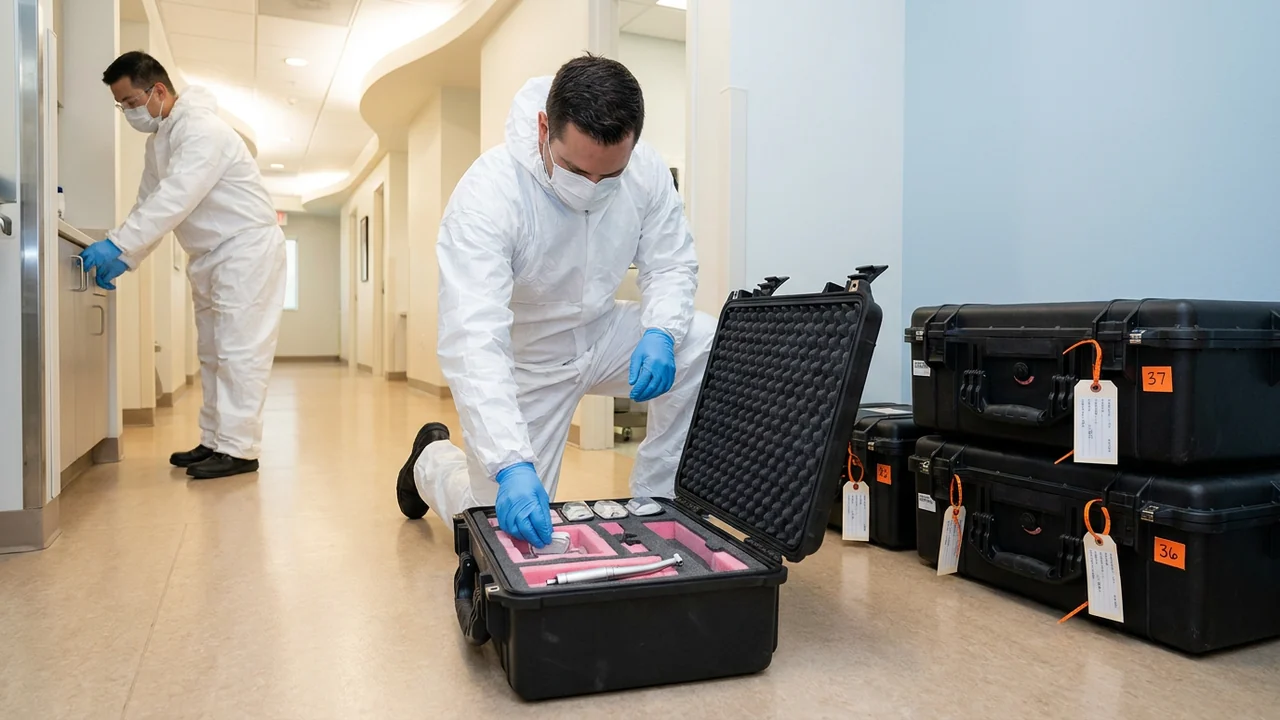
Moving a living room sofa to a climate-controlled warehouse is logistics. Moving an $80,000 CAD/CAM milling center, serialized surgical cassettes, or a microprocessor-driven steam autoclave across town—cleaning them without voiding clinical compliance, tracking every cable and water line, and putting an accredited clinic back into patient service—is precision custody engineering. A single missing power supply adapter, an undocumented crate seal, or a reconnected dental chair lacking waterline biofilm clearance can keep an entire practice closed for extra weeks while business-interruption clocks burn.
Under ANSI/IICRC S320, commercial healthcare pack-outs demand strict separation from general residential fire vaults, rigorous disconnection mapping (I-12), and verifiable custody records (J-04). Just as critically, restoration contractors clean housings and restore environments—they do not certify medical devices for clinical use.
Every restored clinic asset that touches patient care or diagnostic imaging must pass through a formal biomedical or OEM recertification gate (E-05) before re-commissioning. Clinical & Safety Disclaimer: Restoration contractors do not certify medical or dental equipment for patient safety, radiation compliance, or clinical sterility. Final recertification, electrical-safety testing, waterline microbial testing, and clinical release must be signed by authorized OEM engineers, qualified biomedical equipment technicians (BMETs), and practice clinical leadership.
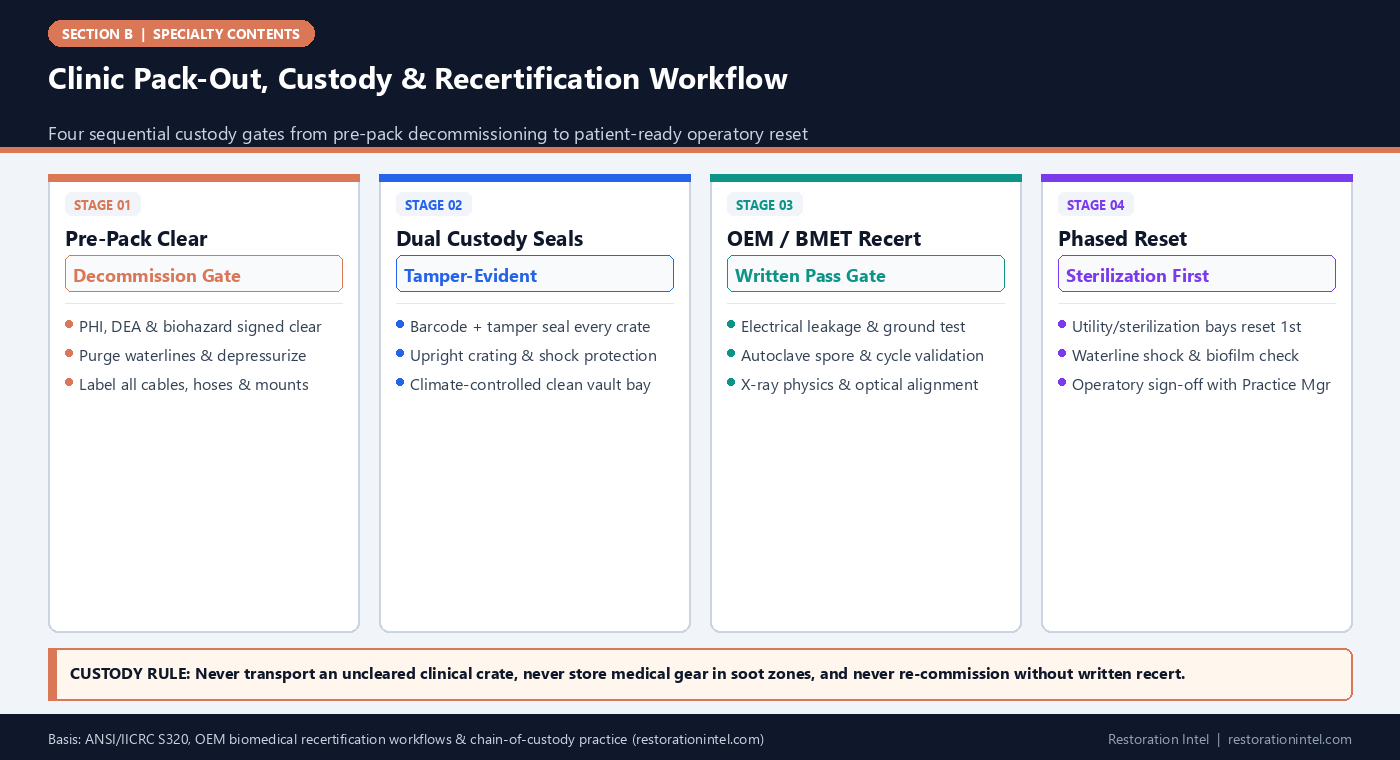
Clinic Pack-Out, Custody & Recertification Workflow
Medical & Dental Pack-Out, Custody & Recertification Matrix
Required pre-pack prep, packaging specs, and post-restoration verification gates across clinical asset groups.
| Clinical Asset Group | Pre-Pack Decommissioning Step | Transport & Vaulting Standard | Mandatory Recertification Gate | Reset Commissioning Order |
|---|---|---|---|---|
| Dental Chairs & Delivery Units | OEM/dental tech disconnects air/water/vacuum whips; purge lines; bag cushions | Blanket-wrap upright on custom skid; zero stacking atop hydraulic arms | Dental tech leak check, air/water pressure calibration & waterline biofilm test | Phase 2 (after central vacuum/compressor utility check) |
| Autoclaves & Ultrasonic Cleaners | Drain reservoirs completely, cool pressure chamber, secure door latch | Foam-in-place or upright heavy-duty crate; desiccant pack in climate bay | BMET electrical safety test + validated biological spore-test pass cycles | Phase 1 (Central Sterilization priority) |
| CBCT, X-Ray & Surgical Lasers | OEM engineer locks gantry/mirror heads, disconnects HV cables & removes dongles | OEM-spec shock-mounted wood crate with tilt/shock watch indicators | OEM reassembly, optical/collimation calibration & state radiation physics test | Phase 3 (after lead-wall & dedicated power clearance) |
| Reusable Stainless Instruments | Clinic/bio-clear pre-rinse; count by cassette; exclude sharps/disposables | Sealed rigid labeled bins; segregated clean-processing ultrasonic station | Ultrasonic clean, corrosion audit, re-pouching & clinic autoclave spore verify | Phase 1 (paired with sterilization bay startup) |
| Workstations, Scanners & Carts | IT confirms PHI backup/encryption; map USB dongles & power bricks (I-12) | Anti-static bubble wrap, upright monitor boxes, locked high-security rack | IT boot test, DICOM/EHR network verify & BMET ground-leakage check | Phase 2 (concurrent with operatory wiring) |
| Waiting Room & Admin Furniture | Clear reception drawers of all patient forms; photo existing wear | Breathable poly or padded blanket wrap in clean commercial vault aisle | Visual cleanliness & zero-odor inspection by PM and Practice Admin | Phase 4 (final patient-facing finish) |
Pre-Pack Decommissioning: Utility Purge, Cable Mapping, and Clearance
Jumping straight into wrapping dental chairs or unplugging medical carts without an organized decommissioning sequence guarantees damaged couplings, spilled bio-fluid reservoirs, and tangled resets. Before restoration technicians touch mechanical assemblies, coordinate the practice’s dental/biomedical service vendor to depressurize air/water umbilicals, drain autoclave and ultrasonic reservoirs completely, and lock moving X-ray or microscope heads in transit position.
Simultaneously, enforce I-12’s cable-mapping discipline on every operatory workstation, intraoral scanner cart, and nurse-station monitor rack. Tag every power brick, proprietary USB sensor cable, foot pedal, and Ethernet drop with matching color-coded asset labels before unplugging—and capture a close-up photo of rear port layouts.
Finally, execute a written pre-pack clearance sign-off confirming the boundaries from B-02: zero paper PHI charts, zero open sharps or regulated waste, and zero DEA pharmaceuticals are inside packed containers.
- Reservoir & line drain proof: Residual water left inside autoclave boilers or dental chair lines leaks during vault transport and freezes in cold docks.
- Proprietary power bricks stay married: Bag each device’s DC transformer, foot switch, and dongle directly inside a zip pouch taped to the parent chassis.
- OEM lock-pins on optics: Never roll an unlocked surgical microscope or articulated imaging arm onto a liftgate without OEM transit pins installed.
Tamper-Evident Chain of Custody and Clean-Zone Vault Segregation
Healthcare administrators—and commercial property underwriters—expect tighter custody accountability than standard household moves. Every clinic crate, instrument bin, and wrapped operatory cart must carry a scannable barcode or QR tag tied to its room of origin (J-04), paired with numbered tamper-evident plastic seals on high-value instrument cassettes, scanners, and IT workstations.
Inside the restoration facility, segregate clinical assets inside a dedicated climate-controlled, low-particulate zone. Never store cleaned dental handpieces, exam tables, or sterile-room cabinetry in the same warehouse aisle as off-gassing residential smoke sofas or ongoing ozone/hydroxyl treatment bays. Cross-contaminating clinical equipment with residential protein-fire odor ruins both patient confidence and clean-room validation.
For heavy or high-precision imaging assemblies (such as mobile C-arms or CAD/CAM mills), use shock-mounted pallets with adhesive tilt and impact indicators so any transit mishandling is immediately visible rather than discovered months later at calibration.
- Seal numbers on manifest: Record the exact tamper-seal serial number on the digital pack-out log whenever sealing handpiece, sensor, or IT totes.
- Strict vault zoning: Maintain physical separation and dedicated HEPA air filtration between clean clinical storage and active soot-deodorization bays.
- Climate & RH telemetry: Log warehouse temperature and relative humidity daily (<50% RH) to prevent corrosion creep on stored medical electronics.
Processing Protocols That Respect Medical-Grade Surfaces and Tolerances
Cleaning medical and dental hardware requires strict material compatibility checks under ANSI/IICRC S320. Harsh alkaline degreasers used on kitchen appliances can etch anodized aluminum handpiece sleeves, craze polycarbonate autoclave shrouds, or strip anti-reflective coatings from surgical microscope lenses. Always check OEM IFUs (Instructions for Use) and approved disinfectant/cleaner lists before applying chemistry to any clinical device.
Do not run delicate motorized handpieces or electronic optical sensors through aggressive immersion tanks unless explicitly approved by the manufacturer. Instead, send precision handpieces, curing wands, and ultrasonic scaler heads to OEM or authorized dental handpiece repair depots for internal turbine cleaning, bearing replacement, lubrication, and torque verification.
For reusable stainless-steel instruments and metal trays, documented ultrasonic cleaning with neutral-pH enzymatic detergent followed by deionized water rinse, lint-free drying, and corrosion inspection restores metallurgy cleanly—ready for the clinic’s own validated autoclave sterilization cycle upon reset.
- Follow OEM IFUs on chemistry: Avoid ammonia, bleach, or high-pH soot removers on touchscreens, medical vinyl, and anodized aluminum.
- Zero immersion of motorized electronics: Route motorized dental handpieces and electronic apex locators to authorized repair labs rather than shop dunk tanks.
- Batch cleanliness verification: Document visual inspection, odor check, and ATP or cleanliness swabs where requested by clinic infection-control staff.
The Biomedical & OEM Recertification Gate Before Patient Care
The defining milestone of a clinical contents restoration is not warehouse completion—it is written clinical recertification. Before any restored autoclave, dental unit, patient monitor, or imaging unit is cleared for patient care, an authorized OEM engineer or qualified Biomedical Equipment Technician (BMET) must inspect, test, and sign off on safety and calibration performance under E-05.
Typical recertification tests include electrical ground-resistance and chassis leakage current checks, autoclave temperature/pressure calibration plus biological spore testing, dental unit waterline shock treatment and heterotrophic plate-count (HPC) water quality testing, and state-mandated radiation output surveys on repaired or relocated X-ray equipment.
Build these recertification vendor fees directly into the restoration and claim scope from Day 1—never treat them as an afterthought that surprises the practice owner or triggers late supplemental arguments with the adjuster.
- Pre-approve recert budgets: Include OEM/BMET bench inspection, calibration, and radiation survey quotes inside the initial restoration work order.
- Capture every certificate: Archive signed electrical-safety, spore-test, and physics-survey PDFs in the claim packet as proof of restored pre-loss utility.
- Refusal escalation rule: If a device fails recertification during reset testing, trigger immediate total-loss conversion per B-04.
Phased Operatory Reset and Joint Practice-Manager Sign-Off
Practices recover revenue fastest when pack-back follows clinical workflow rather than random truck unloading. Sequence the reset in four deliberate waves: first, mechanical/compressor rooms and central sterilization; second, primary dental or exam operatories with IT workstations; third, imaging bays pending physicist clearance; and fourth, reception and waiting-room furnishings.
Have the restoration crew chief, dental/biomedical installer, and practice administrator walk each completed room together using the original Day-1 serial manifest and cable-map photos. Verify seal numbers are intact on instrument totes, test power and suction connections with the qualified installer, and secure dated sign-off on the chain-of-custody closeout form.
That disciplined closeout eliminates post-reset “missing handpiece” disputes, proves compliance to state health inspectors, and closes the claim file cleanly for both contractor and insurer.
- Sterilization & utilities first: A clinic cannot open operatories until central vacuum, air compression, and autoclaves pass validation.
- Seal-break reconciliation: Break tamper seals on instrument and IT totes in the presence of the Practice Manager against the Day-1 count sheet.
- 30-day warranty watch: Encourage the clinic to report any delayed electronic anomaly promptly so corrosion-creep supplements are documented immediately.
Practitioner Verification Checklist (B-06)
- Coordinate licensed dental/biomedical techs to purge waterlines, drain autoclave boilers, and lock optical heads before crating.
- Tag and photograph all power bricks, sensor cables, USB dongles, and foot controls prior to disconnecting clinic workstations.
- Apply numbered tamper-evident seals and room-tagged barcodes to every clinical tote, confirming zero PHI, sharps, or DEA drugs inside.
- Store packed clinical assets in a dedicated climate-controlled, low-particulate vault bay isolated from residential smoke-deodorization zones.
- Schedule and document written BMET/OEM electrical-safety, sterilization spore, waterline biofilm, and X-ray physics recertification before patient use.
- Execute a phased reset (utilities and sterilization first) with joint Practice Manager seal reconciliation and final custody sign-off.
Standards, Authority References & Related Reading
Primary standards, insurance definitions, and sibling Restoration Intel guides referenced in this brief:
- ANSI/IICRC S320 Standard for Professional Contents Restoration
- Restoration Industry Association (RIA)
- OSHA 1910.1030 Bloodborne Pathogens Standard
- OSHA 1910.132 Personal Protective Equipment Standard
- Related Guide: Medical & Dental Clinics: Scope & Hazard Boundaries
- Related Guide: Medical & Dental Clinics: Cleanability vs Total-Loss Triage
- Related Guide: Medical & Dental Clinics: Valuation, LKQ Sourcing & Policy Traps
- Related Guide: OEM Calibration, Recertification, and Warranty Preservation Costs on Contents Schedules
- Related Guide: Electronics Disconnection & Cable Mapping: Labeling AV Racks, Home Workstations, and Clinic Desks Before Unplugging
- Related Guide: Field Guide: Chain-of-Custody Form Elements & Pack-Out Sign-Off Template
.md twin for desk QA and team training.Frequently Asked Questions
Can a restoration company recertify a cleaned autoclave or dental X-ray for patient care?
No. Restoration contractors clean exteriors and restore environments; only authorized OEM engineers, qualified BMETs, and licensed radiation physicists can test and recertify medical devices for clinical use.
Why must clinic equipment be stored separately from residential fire contents in the vault?
Clinical gear is sensitive to cross-contaminated smoke odors, off-gassing particulates, and ozone treatments. Dedicated clean-zone climate-controlled vaulting protects both sterility prep and practice confidence.
What goes wrong most often during medical or dental pack-backs?
Missing proprietary power supplies, unlabeled sensor cables, cracked optical housings from unlocked transit arms, and resetting waiting-room furniture before central sterilization and compressor rooms are functional.
Why test dental unit waterlines after a water or smoke loss?
Stagnant waterlines during facility shutdowns promote rapid microbial biofilm growth; flushing, shocking, and verifying heterotrophic plate counts protects patients before operatories reopen.
How do tamper-evident seals protect the restoration contractor during clinic pack-outs?
Recording numbered seal IDs on the Day-1 manifest and breaking them jointly with the Practice Manager at reset proves no instruments, cassettes, or IT dongles were opened or lost in transit.