Direct Answer: Restoration crews entering research or clinical laboratories must halt at Environmental Health & Safety (EHS) clearance gates covering Biosafety Level (BSL-1 through BSL-4) placards, OSHA HazCom chemical/solvent hazards, radioactive/laser zones, and -80°C ultra-low specimen freezers—never unplugging active cold storage or touching unmanifested reagents.
.md twin for estimator QA and carrier file documentation.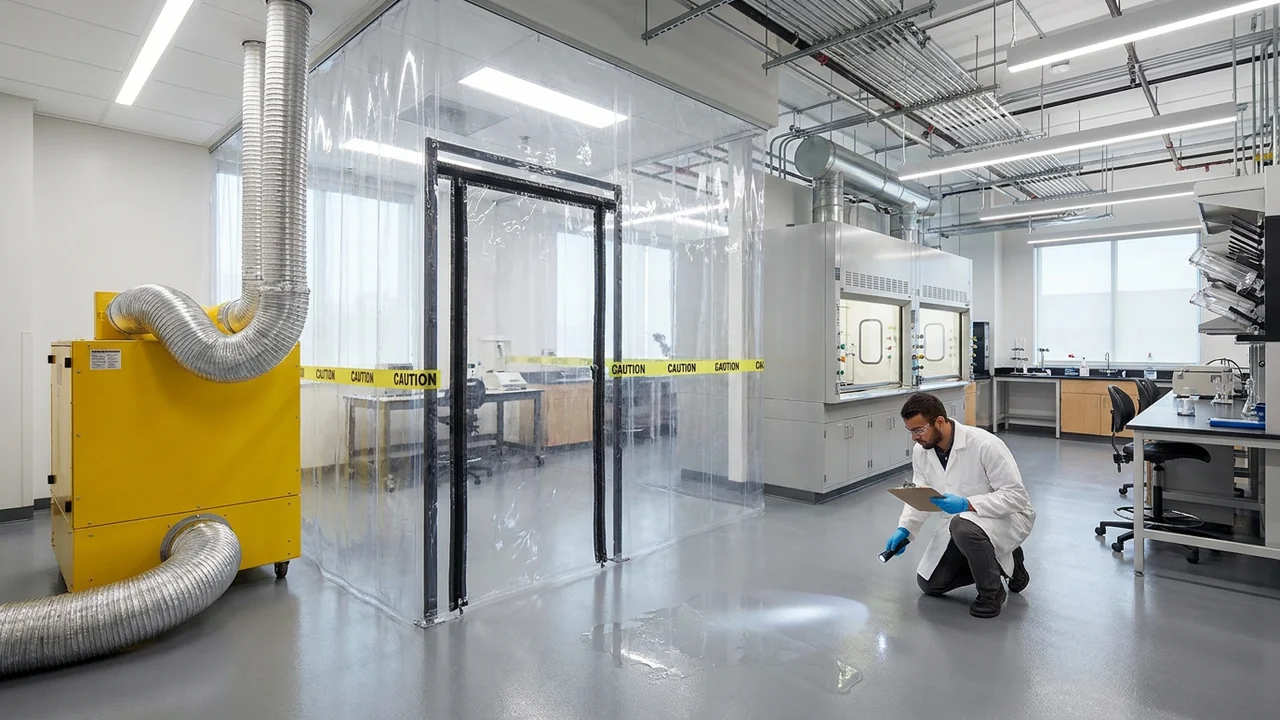
Few commercial environments punish improvised restoration work faster than a university research lab, biotech R&D suite, pharmaceutical QC bay, or CLIA-certified clinical diagnostic laboratory. Behind a single card-access corridor sit pressurized specialty gas manifolds, flammable solvent cabinets, active chemical fume hoods, Class II biosafety cabinets, liquid nitrogen dewars, radioactive isotope workstations, and ultra-low temperature (-80°C) freezers holding decades of irreplaceable biological specimens.
Unlike a standard office or warehouse where mitigation crews immediately shut off subpanels and start pulling wet items into hallways, blindly cutting power or moving lab gear can destroy millions of dollars in frozen cell lines, release toxic vapors, or violate federal biosafety and hazardous-waste regulations. Under ANSI/IICRC S320, OSHA HazCom, and EPA Hazardous Waste rules, contents specialists operate strictly under facility Environmental Health & Safety (EHS) and Principal Investigator (PI) clearance boundaries.
This brief establishes the Day-1 scope lines for research and clinical laboratories, setting up the downstream laboratory workflows in B-08 through B-11. Safety & Regulatory Disclaimer: This brief provides restoration boundary and insurance workflow guidance only; it is not EHS, OSHA, CDC/NIH Biosafety, NRC radiation, or CLIA/FDA compliance advice. Never enter posted biohazard, chemical-spill, or radiation zones without formal EHS clearance, qualified hazmat specialists, and site-specific PPE authorization.
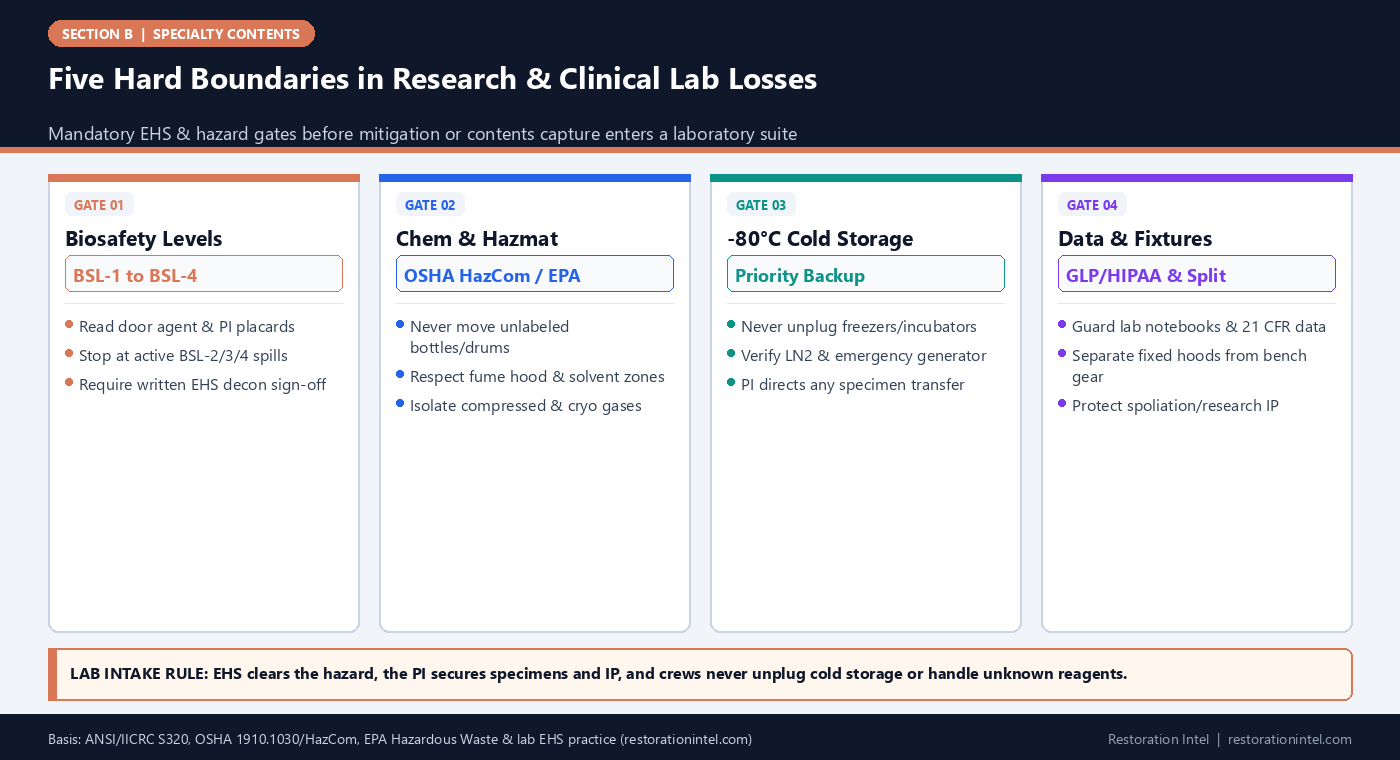
Five Hard Boundaries in Research & Clinical Lab Losses
Laboratory Zone & Hazard Boundary Matrix (Research & Clinical)
Pre-entry clearance boundaries separating restoration teams, institutional EHS officers, and specialty hazmat/biomed vendors.
| Laboratory Zone / Hazard | Primary Regulatory or Physical Threat | Restoration Crew Hard-Stop | Required Pre-Entry Clearance / Action | Downstream Workflow Impact |
|---|---|---|---|---|
| BSL-2 / BSL-3 / Select Agent Suites | Infectious aerosols, bloodborne pathogens, CDC/NIH containment breach | Zero entry past posted BSL-2 spill or any BSL-3/4 airlock | Written EHS decontamination & negative-pressure verification | Delays pack-out until bio-decon crew releases room |
| Chemical Fume Hoods & Solvent Cabinets | Flammable, corrosive, pyrophoric, or acutely toxic reagent vapors | Never open solvent drums, touch unlabeled vials, or turn off hood exhaust | Lab EHS / licensed hazmat chemist packs or stabilizes chemicals (G-31) | Hoods stay Building/TIB; bench instruments wait for air clear |
| -80°C Freezers, CO2 Incubators & LN2 Dewars | Irreplaceable research specimens, oxygen-depletion asphyxiation (LN2) | Never unplug, tilt, or relocate active freezers without PI present | Deploy emergency backup power or coordinate PI dry-ice/LN2 transfer | Prevents catastrophic research-loss liability |
| Radioisotope & High-Power Laser Bays | Ionizing radiation contamination & Class 4 optical/beam hazards | Zero wipe-down or movement inside posted radiation/laser benches | Radiation Safety Officer (RSO) swipe survey & interlock lockout | Protects crews; isolates wipe-testable surfaces |
| CLIA / GLP / GMP Validation & Specimen Records | HIPAA patient requisitions, FDA 21 CFR Part 11 audit trails, trade secrets | No wide photos of open lab notebooks, sample barcodes, or assay screens | PI / QA Officer locks paper notebooks & secures digital instrument PCs | Maps into B-08 capture & J-07 privacy rules |
| Fixed Casework, RO/DI Loops vs Benchtop Gear | Acid-resistant plumbing, vacuum headers vs $50K–$500K analytical rigs | Do not unplumb acid-waste traps, DI water loops, or ducted biosafety hoods | Classify casework/hoods (Building/TIB) vs HPLC/MS/PCR (BPP/Scheduled) | Feeds B-10 valuation & landlord/tenant splits |
Biosafety Levels (BSL-1 to BSL-4) and Pre-Entry EHS Clearance
Every regulated biological laboratory posts door placards identifying its Biosafety Level (BSL-1 through BSL-4), the infectious agents handled inside, required Personal Protective Equipment (PPE), and emergency contacts for the Principal Investigator and institutional Environmental Health & Safety (EHS) office. A fire sprinkler discharge or pipe burst inside a BSL-2 clinical microbiology bay or a BSL-3 containment suite can overturn sample racks, flood biosafety cabinet plenums, and break containment seals.
General contents restoration crews must treat posted BSL-2 active spill zones and all BSL-3/BSL-4 facilities as absolute hard-stops. Under OSHA 1910.1030 and OSHA 1910.134 respiratory rules, restoration technicians lack authorization to decontaminate live pathogens, open damaged biosafety cabinets, or remove biohazard autoclave bags.
Require a signed EHS Bio-Clearance Memo before any mitigation or contents team enters the lab to inspect benches or log serials. Where licensed biohazard remediation vendors must decontaminate first, document the staging delay cleanly so carrier examiners understand the mandatory regulatory sequence.
- Read the door placard first: Photograph the exterior BSL door sign before requesting entry so safety protocols and contacts are logged on Day 1.
- Never open biosafety cabinets (BSCs): Damaged Class II BSCs may trap pathogens inside HEPA plenums requiring formal paraformaldehyde/vapor-H2O2 decon by certified certifiers.
- Written EHS sign-off: Obtain dated written release from EHS or the Biosafety Officer confirming biological hazards are neutralized before contents capture begins.
Chemical, Solvent, Cryogenic, and Radiation Stabilization Gates
Research and analytical chemistry labs store incompatible reagents side by side in corrosive cabinets, flammable lockers, benchtop carboys, and fume hoods. Water or fire heat can burst glass bottles, dissolve paper labels into illegible pulp, or mix acids with cyanides and oxidizers. Additionally, liquid nitrogen (LN2) storage rooms and compressed specialty gas racks (hydrogen, silane, argon, carbon monoxide) create severe asphyxiation or explosion risks if ventilation fans fail.
Following G-31’s chemical/hazmat triage rules and J-16’s hazmat stabilization standards, restoration crews must never touch unlabeled containers, sweep up unknown crystalline powders, or shut down laboratory fume-hood exhaust fans without EHS coordination. Under EPA Hazardous Waste regulations, moving damaged or expired lab chemicals across public roads requires licensed lab-pack hazmat manifests.
In university or hospital facilities housing radioisotope benches or Class 3B/4 laser tables, require a Radiation Safety Officer (RSO) wipe survey and laser interlock verification prior to physical inventory.
- Do not turn off fume hoods: If utility power permits, keep chemical fume-hood exhaust running while EHS stabilizes open glassware and solvent vapors.
- Oxygen monitoring near LN2: Never enter enclosed cryo-storage closets after a power or HVAC failure without verifying ambient O2 sensors are normal.
- Licensed lab-pack boundary: Chemical reagent disposal and inventory of spilled hazmat belong to EHS-approved hazmat chemists, not general pack-out crews.
Protecting -80°C Ultra-Low Freezers, Incubators, and Live Specimens
In both academic research and clinical trials, the building and the analytical hardware are frequently worth far less than what sits inside the -80°C ultra-low temperature (ULT) freezers, -20°C reagent vaults, CO2 cell incubators, and liquid nitrogen dewars. Years of longitudinal clinical samples, frozen stem-cell lines, or proprietary biotech strains can spoil permanently within hours if power drops or if an unknowing mitigation crew unplugs a “noisy” freezer to plug in an air scrubber.
Establish an absolute “Cold-Chain Red-Tag Rule” on arrival: inspect every ULT freezer, blood-bank fridge, and incubator immediately for active power, digital temperature readouts, and alarm lights—without opening the doors. Alert the Principal Investigator and facility engineering immediately if temperatures are climbing so backup generator spider-boxes, dry ice, or PI-directed specimen transfers occur within the salvage window.
Remember that restoration contractors never take custody of biological specimens, clinical blood samples, or proprietary reagents; our job is preserving environmental power/access while the lab’s scientific staff executes emergency specimen relocation.
- Zero unplugging without PI sign-off: Tag dedicated freezer outlets with bright red “DO NOT UNPLUG — CRITICAL COLD STORAGE” markers at Day-1 arrival.
- Do not open freezer doors: Opening a warm -80°C door during a power outage dumps thermal mass rapidly; read exterior digital displays or alarm logs instead.
- Extra Expense power priority: Coordinate emergency generator circuits for active ULT freezers ahead of non-critical room drying.
Regulated Data, Trade Secrets, and Specimen Chain-of-Custody Boundaries
Clinical diagnostic labs operating under CLIA and HIPAA, as well as pharmaceutical GLP/GMP labs governed by FDA 21 CFR Part 11, maintain strict custody rules over both physical specimens and experimental records. Open lab notebooks, chromatograph printouts, clinical requisition slips, and instrument-control PCs sitting beside HPLC or mass-spectrometry stacks contain sensitive patient identifiers or high-value patentable intellectual property.
Apply J-07’s HIPAA and trade-secret privacy rules and the NIST Privacy Framework before beginning overview photography. Instruct technicians never to photograph open laboratory notebooks, whiteboard formulation notes, or specimen tube racks displaying patient barcodes.
If a fire or equipment malfunction is under subrogation or regulatory investigation—for instance, a lithium-ion battery or autoclave origin inside an R&D bay—hold the origin bench untouched under spoliation-preservation rules until forensic engineers inspect.
- Trade-secret & IP masking: Ask the Lab Director to cover whiteboards, lock paper research notebooks, and secure assay printouts prior to room scanning.
- Leave validated PCs untouched: Instrument-control computers running GLP/GMP software cannot simply be swapped or wiped without invalidating regulatory audit trails.
- Spoliation check on origin bays: Preserve electrical panels and failed bench equipment in place if carrier origin-and-cause experts are investigating.
Separating Plumbed Lab Infrastructure From Movable Analytical Instruments
Once EHS clears the room and specimens are secured, scope engineers must untangle what belongs to the laboratory building versus what belongs to the tenant’s scientific equipment schedule. Laboratories combine heavy fixed infrastructure—ducted chemical fume hoods, epoxy-resin island casework, acid-neutralization drain loops, centralized reverse-osmosis/deionized (RO/DI) water piping, and manifolded specialty gas lines—with portable or benchtop analytical instruments such as liquid chromatographs (HPLC), mass spectrometers, PCR thermocyclers, and analytical balances.
Apply E-02’s classification matrix and J-14’s tenant-landlord split to photograph every utility manifold, snorkel exhaust drop, and vibration-isolation marble table before pack-out begins. Separate fixed building/TIB lab infrastructure cleanly from plug-and-bench scientific instruments so downstream capture in B-08 prices every asset under its correct coverage bucket.
- Snorkel & gas-whip photos: Document flexible gas whips and quick-disconnect exhaust snorkels on mass specs and atomic absorption units to prove BPP removability.
- Anti-vibration balance tables: Separate heavy marble analytical balance tables from building millwork when movable.
- Handoff to B-08..B-11: Carry the signed EHS Clearance & Zone Map directly into B-08’s serial and provenance capture.
Practitioner Verification Checklist (B-07)
- Inspect and photograph exterior BSL-1/2/3/4 door placards and halt entry until institutional EHS issues written decontamination and air-quality clearance.
- Tag all -80°C ULT freezers, CO2 incubators, and LN2 dewars immediately on arrival so crews never unplug cold storage or open doors during power interruptions.
- Keep chemical fume hoods running where safe and leave spilled, broken, or unlabeled reagents strictly to EHS-approved hazmat chemists.
- Obtain Radiation Safety Officer (RSO) swipe clearance and laser interlock verification before entering isotope or high-power laser bays.
- Enforce trade-secret, GLP/21 CFR, and HIPAA masking on lab notebooks, specimen barcodes, and instrument-control PCs before photo capture.
- Document utility tie-ins separating fixed lab casework, fume hoods, and RO/DI loops (Building/TIB) from movable benchtop analytical equipment (BPP).
Standards, Authority References & Related Reading
Primary standards, insurance definitions, and sibling Restoration Intel guides referenced in this brief:
- ANSI/IICRC S320 Standard for Professional Contents Restoration
- OSHA 1910.1030 Bloodborne Pathogens Standard
- OSHA 1910.134 Respiratory Protection Standard
- OSHA Hazard Communication Standard (HazCom)
- US EPA Hazardous Waste Framework
- NIST Privacy Framework
- Related Guide: Research & Clinical Laboratories: Capture, Serial & Provenance Logging
- Related Guide: Research & Clinical Laboratories: Cleanability vs Total-Loss Triage
- Related Guide: Research & Clinical Laboratories: Valuation, LKQ Sourcing & Policy Traps
- Related Guide: Research & Clinical Laboratories: Pack-Out, Chain of Custody & Recertification
- Related Guide: Fixed Building Machinery vs Scheduled Business Equipment vs Loose Tools: Policy Classification Matrix
- Related Guide: Chemical, Hazmat, Asbestos & Lead-Soot Contamination Losses: First-24-Hour Contents Triage & Stabilization
- Related Guide: Field Guide: HIPAA, FERPA, and Trade-Secret Privacy Rules During Commercial & Clinic Pack-Outs
.md twin for desk QA and team training.Frequently Asked Questions
Can a standard contents crew enter a BSL-2 or BSL-3 laboratory immediately after a sprinkler discharge?
No. Crews must hold at the door placard until the facility’s Environmental Health & Safety (EHS) or Biosafety Officer confirms biological hazards are contained or decontaminated in writing.
What is the highest-priority Day-1 action in a laboratory water or power-loss event?
Verifying active power and backup cooling on -80°C ultra-low temperature freezers, incubators, and LN2 dewars—and alerting the Principal Investigator immediately before biological specimens thaw.
Who handles spilled or water-damaged laboratory chemicals and unknown bottles?
Institutional EHS teams or licensed hazmat lab-pack contractors. Under OSHA HazCom and EPA hazardous-waste rules, restoration technicians must not handle, consolidate, or transport chemical reagents.
Are chemical fume hoods and epoxy lab benches Building or BPP?
Ducted fume hoods, plumbed acid-waste sinks, and fixed RO/DI water loops typically fall under Building or Tenant Improvements and Betterments (TIB), whereas benchtop instruments connected via plugs or flexible gas whips typically sit under BPP—subject to lease terms.
Why can't crews pack or move lab-instrument control computers like ordinary office PCs?
Computers paired with HPLC, mass spectrometry, or CLIA diagnostic instruments often run licensed GLP/21 CFR Part 11 validation software and hold proprietary assay data; IT and QA officers must supervise imaging, backup, and disconnection.