Direct Answer: Field crews separate low-voltage technology into Business Personal Property (BPP) contents versus building fixtures or tenant improvements by documenting mounting permanence, structural wiring integration, life-safety code mandates, and lease ownership terms before disconnecting any rack, terminal, or sensor.
.md twin for estimator QA and carrier file documentation.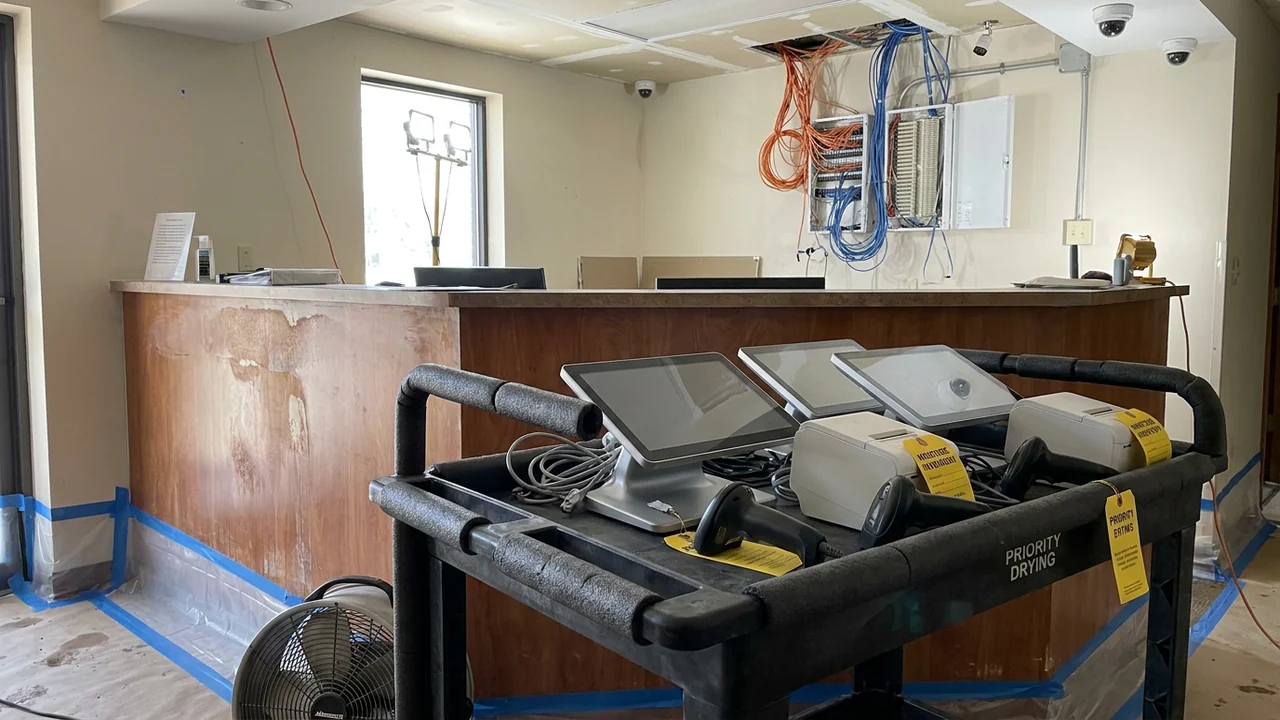
Modern retail stores, clinics, restaurants, and warehouses run on tightly woven low-voltage ecosystems where countertop point-of-sale (POS) terminals, kitchen display screens, network video recorders (NVRs), wireless access points, badge readers, and smart HVAC controllers sit within feet of each other. After a fire, sprinkler discharge, or roof leak, lumping all low-voltage hardware onto a single generic electronics sheet guarantees classification disputes between the building carrier, the tenant’s Business Personal Property (BPP) desk examiner, and landlord representatives.
Under ANSI/IICRC S320 and standard commercial claim workflows tracked inside XactContents and Xactimate, field documentation must capture both the physical attachment method and the operational boundary of every device. Plug-and-play countertop terminals, receipt printers, cash drawers, and portable tablets generally behave as movable contents, whereas recessed plenum cabling, hardwired fire-alarm communicators, and structural door strikes typically follow building or leasehold-improvement pathways.
Notice on scope and non-UPL boundary: exact coverage classification between Building, Tenants’ Improvements and Betterments (TIBs), and BPP depends on policy endorsements, lease clauses, and carrier coverage determinations. This operational guide supports accurate physical triage and evidence assembly only; it does not constitute legal advice, policy interpretation, or coverage representation.
Low-Voltage & POS Triage: Contents vs Building Fixture Split
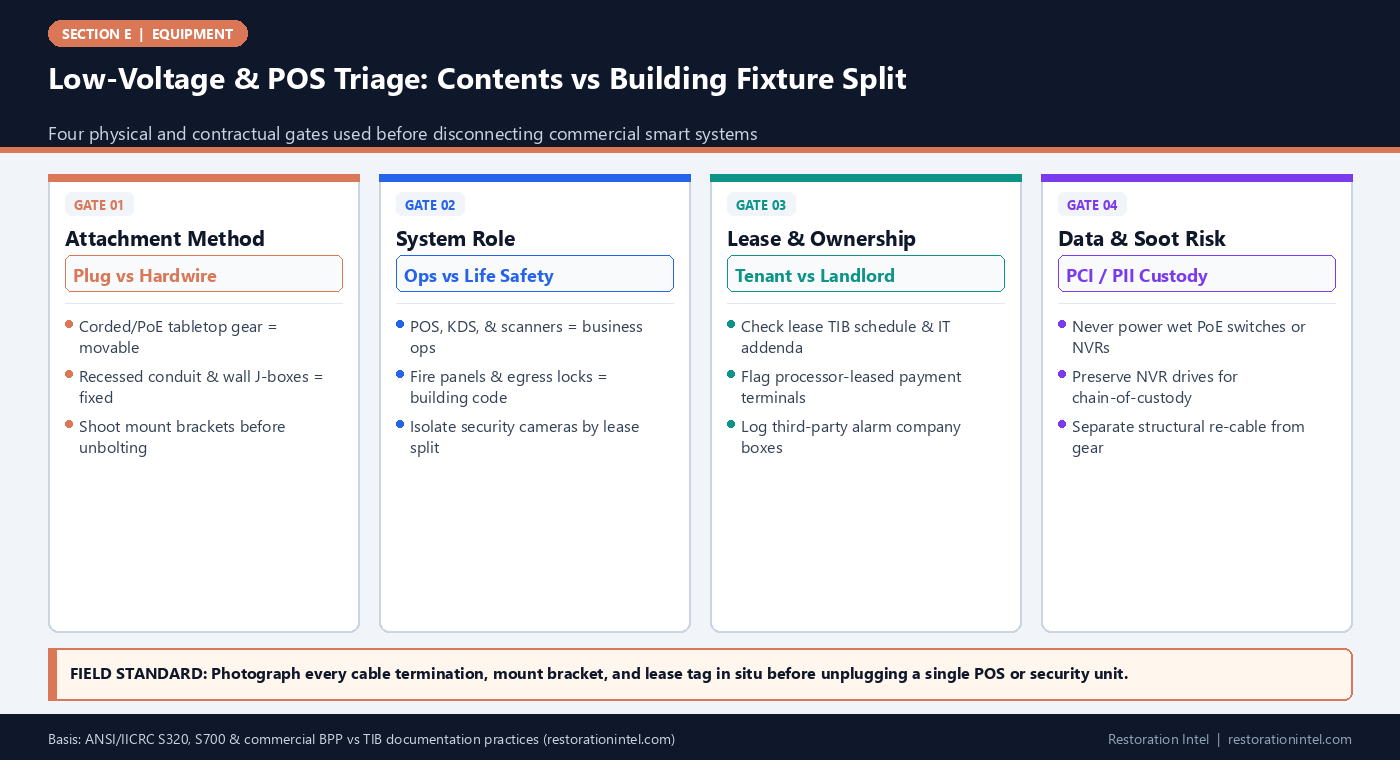
POS, Security & Low-Voltage Classification Reference for Field Triage
Physical and ownership indicators field crews document to support accurate split between contents schedules and building/TIB estimates.
| System Component | Typical Physical Attachment | Common Claim Bucket | Primary Damage Mechanism | Required Field Documentation |
|---|---|---|---|---|
| Countertop POS Terminals, Scanners & Cash Drawers | Corded AC/USB/Ethernet resting on counter or swivel stand | BPP Contents (or vendor-leased) | Soot ingestion via cooling vents; water shorting | Rating plate, merchant processor asset sticker, and cable map |
| Payment Pin-Pads & Cellular Failover Modems | Counter stand or plug-in adapter; often processor-owned | Third-Party / Leased Equipment | Tamper-mesh lockout after moisture or thermal exposure | Merchant agreement reference and tamper-seal condition photo |
| Wall-Mounted Network Racks, Switches & Patch Panels | Lag-bolted wall cabinet with Cat6 punch-downs | Split: Rack/Switches (BPP) vs Cabling (Building/TIB) | Acidic smoke corrosion on RJ45 pins and fan bearings | Open-rack front/rear shots separating switches from plenum cable |
| IP Security Cameras & NVR/DVR Recorders | Ceiling/wall screw mounts on PoE drops; NVR in locked rack | BPP or TIB depending on lease terms | Lens hazing, moisture in housing, board corrosion | Mounting surface photo, drive serials, and privacy custody log |
| Access-Control Card Readers & Electric Door Strikes | Mortised into door frames and hardwired to controller | Building Fixture or Tenant Improvement | Water wicking inside frame; relay board surge | Door-frame mortise photo and controller enclosure schematic |
| Fire-Alarm Panels, Pull Stations & Life-Safety Strobes | Hardwired in EMT conduit tied to building riser | Building Coverage (Life-Safety) | Thermal/smoke contamination or code-mandated replacement | Panel door label and AHJ inspection tag; never pack out |
Separating Movable Hardware From Hardwired Infrastructure in the Field
The fastest way to trigger a stalled commercial contents review is to let pack-out technicians yank every black box off a back-office wall without recording how each device connected to the building. Low-voltage installations blur physical boundaries because a single network closet frequently houses a tenant-owned POS server, an ISP-owned fiber gateway, a landlord-owned building automation controller, and a fire-alarm dialer sharing the same plywood backboard.
Before touching a screwdriver or wire cutter, document the entire wall elevation and under-counter raceway in wide, medium, and close-up frames as outlined in Fixed Building Machinery vs Scheduled Business Equipment vs Loose Tools and the Commercial Tenant vs Landlord Split Reference. Record whether a monitor or kitchen display screen hangs on a removable VESA bracket plugged into a standard duplex receptacle or sits recessed inside custom millwork wired through concealed conduit.
Crucially, never sever structured Cat6, coax, or shielded alarm runs inside walls during contents pack-out. Unplug patch cords at the keystone jack or switch port, apply numbered wrap tags to both ends, and leave the in-wall cabling for the reconstruction and low-voltage electrical scope. That clean physical handoff keeps hardware replacement on the contents side and re-termination and plenum re-pulling cleanly isolated for the building estimate.
- Backboard mapping: Number every enclosure on a utility wall with removable painter’s tape before disconnecting patch cables.
- Plug-vs-conduit rule: Distinguish removable power/PoE patch cords from EMT conduit, armored whip, and recessed junction boxes.
- Life-safety freeze: Leave building fire-alarm control panels, sprinkler flow switches, and egress mag-locks untouched for licensed life-safety contractors.
Merchant-Leased Terminals, Alarm Providers, and Third-Party Ownership
Retail and hospitality counters frequently hold hardware that the insured business neither owns outright nor insured under standard owned-BPP assumptions. Credit-card EMV pin-pads, beverage-dispenser telemetry units, cellular backup routers, and proprietary delivery-tablet hubs are routinely provided under merchant processing contracts, franchise agreements, or third-party security leases.
Listing a vendor-owned payment terminal as full owned-RCV property without flagging the vendor contract invites carrier audit flags and double-recovery questions. Conversely, ignoring leased gear omits the contractual replacement fee the merchant vendor will bill the insured once a fire-damaged terminal fails tamper-check inspection.
Capture close-ups of merchant asset stickers, alarm-company decals, and barcode serials using the methods in Rating-Plate and Asset-Tag Capture Standards. Pair each line item in the preliminary schedule with a clear ownership note so the estimator and adjuster can route owned hardware to BPP, third-party equipment to contractual-liability or leased-property sublimits, and landlord systems to the building file.
- Tamper-mesh awareness: Modern payment terminals permanently brick their cryptographic keys when exposed to heat, moisture, or casing prying—never attempt field disassembly.
- Provider decals: Photograph alarm-monitoring and ISP property tags on modems, ONTs, and cellular communicators before return or disposal.
- Software & licensing split: Separate physical hardware replacement from SaaS POS subscriptions or re-provisioning labor on the estimate narrative.
Smoke, Water, and Surge Damage on Low-Voltage Smart Gear
Low-voltage smart systems rarely fail only from visible flame or pooled water. Under ANSI/IICRC S700, combustion aerosols and halogenated plastics deposit acidic chlorides across fine-pitch surface-mount boards inside fan-cooled PoE switches, POS receipt printers, and NVR power supplies. Even after a light protein or synthetic smoke event, micro-corrosion bridges solder pads weeks after the room smells clean.
Water losses create a parallel hazard in Power-over-Ethernet (PoE) networks. When sprinkler water or pipe-burst runoff enters ceiling-mounted access points, smart thermostats, or outdoor-rated cameras via unsealed conduit drips, energizing the PoE switch can send fault current back into upstream ports and damage healthy core hardware. Always power down affected switches and document causation chains as detailed in Electrical Surge vs Direct Water Contact Causation Documentation.
For cleanable enclosures versus corroded boards, never apply household contact cleaners or compressed shop air blindly. Isolate non-energized hardware in anti-static bags or breathable totes, record ambient conditions, and route high-value servers or multi-port controllers to qualified electronics restoration specialists for bench evaluation.
- Zero-power triage: Cut breaker and PoE injector power before touching wet cameras, ceiling sensors, or damp POS counters.
- Ventilation soot check: Inspect intake grilles on thermal printers, fanless POS terminals, and UPS battery backups for fine ash draw-in.
- Optical & acoustic sensors: Smoke haze and alkaline drywall dust degrade barcode laser optics, touchscreens, and smart microphone arrays permanently.
Data Security, PCI Compliance, and NVR Chain-of-Custody
Packing out POS back-office towers, local time-clock servers, and surveillance NVRs carries legal and compliance exposure that goes far beyond hardware replacement value. Devices may store unencrypted customer records, employee payroll data, clinical scheduling files, or surveillance footage of the loss event itself—including footage relevant to origin-and-cause or subrogation review.
Before removing any storage-bearing device from a commercial loss site, confirm chain-of-custody authorization with the business owner’s IT administrator and, if origin is under investigation, verify with the project manager whether a preservation hold applies. Never wipe, reformat, or boot a smoke-damaged server on site without written owner IT direction, and protect hard drives from electrostatic shock and magnetic fields during transport.
When hardware is condemned for scrap or manufacturer swap, document whether the owner’s IT team pulled solid-state drives or received certified data-destruction sign-off prior to haul-off. Including a dedicated IT custody column in the equipment schedule protects both the restoration firm and the insured from compliance disputes.
- Evidentiary footage hold: Flag intact NVR/DVR units immediately on fire or burglary-related losses so loss-moment video is not overwritten or discarded.
- Drive-pull logging: Record drive serial numbers if the insured’s IT vendor removes SSDs/HDDs before restoration pack-out.
- Anti-static packaging: Transport circuit-bearing POS and network modules in ESD-safe wraps rather than loose corrugated boxes.
Practitioner Verification Checklist (E-15)
- Photograph full wall racks, counter wiring, and mounting brackets in situ before unplugging any POS, security, or smart-system device.
- Label both cable ends with matching tag IDs and leave in-wall plenum wiring and EMT conduit in place for building/low-voltage trades.
- Separate movable BPP hardware from hardwired life-safety panels, door strikes, and landlord/tenant-improvement cabling on the inventory.
- Document merchant-processor stickers, ISP decals, and third-party alarm ownership tags to prevent owned-vs-leased claim errors.
- Maintain zero-power isolation on wet or soot-exposed PoE switches and log IT chain-of-custody for NVRs, POS servers, and storage drives.
Standards, Authority References & Related Reading
Primary standards, insurance definitions, and sibling Restoration Intel guides referenced in this brief:
- ANSI/IICRC S320 Standard for Professional Contents Restoration
- ANSI/IICRC S700 Fire & Smoke Restoration Standard
- Verisk Xactimate Estimating Platform
- Verisk XactContents Platform Overview
- IRMI Insurance Glossary: Replacement Cost Value (RCV)
- Restoration Industry Association (RIA)
- Related Guide: Fixed Building Machinery vs Scheduled Business Equipment vs Loose Tools: Policy Classification Matrix
- Related Guide: Rating-Plate, Serial Number, and Asset-Tag Capture Standards for Commercial Equipment Claims
- Related Guide: Electrical Surge vs Direct Water Contact on Shared Motor/Control Panels: Causation Documentation
- Related Guide: Tenant Improvements and Betterments vs Contents: Pre-Loss Lease Boundary Mapping for Commercial Tenants
- Related Guide: Field Guide: Commercial Tenant vs Landlord Split Quick-Reference Table
.md twin for desk QA and team training.Frequently Asked Questions
Are wall-mounted TVs, menu boards, and security cameras considered contents or building fixtures?
It depends on mounting permanence, concealed hardwiring, and lease or policy definitions. Countertop screens and plug-in brackets often classify as BPP contents, while recessed hardwired displays and building-integrated security grids frequently fall under building or tenant improvements—document attachment clearly for adjuster review.
Should restoration crews pull Cat6 cables out of ceiling plenums during a contents pack-out?
No. Unplug patch cords at the switch or wall jack, label both ends, and leave structural in-wall or plenum cabling intact for licensed low-voltage contractors on the reconstruction scope.
Why do payment pin-pads get totaled even when the outer plastic looks clean?
Commercial EMV payment terminals contain internal tamper-detection meshes and moisture sensors that permanently lock out cryptographic keys upon heat, soot, or liquid intrusion, and merchant processors typically prohibit field refurbishment.
Who handles hard drives inside a smoke-damaged POS server or surveillance NVR?
Coordinate directly with the insured’s IT lead and project manager before powering on or removing drives, preserving NVR footage if loss origin is under review and logging drive custody before pack-out or disposal.