Updated November 24, 2026 — refreshed with verified 2-page PDF field brief, bespoke workflow diagram, and primary standards references.
Direct Answer: Residential restoration is largely reactive, triggered when a homeowner calls during an active emergency. Commercial restoration is proactive and pre-sold: whoever built trust with the facility manager, mapped site utilities via an Emergency Readiness Plan (ERP), and secured first-call status months before the loss wins the building without a panic-bid fight.
.md twin for Commercial Restoration & Pre-Loss.
Updated October 6, 2026.
Residential restoration is largely reactive — the phone rings when something goes wrong. Commercial restoration is proactive — the relationships and trust are built before the loss, and the company that wins the work is usually the one that was in the room first.
This distinction changes everything about how sales works. The Floodlight Consulting Group’s Commercial Sales MasterCourse, developed by Chris Nordyke, is one of the most comprehensive commercial restoration sales frameworks in the industry. This guide synthesizes the core methodology.
Route Mapping: The Foundation of Commercial Sales
Commercial sales in restoration starts with geography and density, not cold calling. Route mapping is the process of identifying the specific properties, facilities, and decision-makers in a defined territory and building a systematic coverage plan for that territory.
A well-built route has three elements: target property types matched to your company’s strongest verticals (hospitality, healthcare, education, multi-family), decision-maker identification by property type (the GM at a hotel, the Director of Facilities at a healthcare system, the property manager at a multi-family portfolio), and a call frequency that matches relationship development cycles — typically monthly touchpoints for warm accounts, quarterly for cold ones.
Vertical-Specific Value Propositions
The mistake most restoration sales teams make in commercial: leading with what they do rather than what the client needs. Every commercial vertical has a different loss management profile, a different decision-making structure, and a different definition of “bringing order to chaos.”
For hospitality: the GM cares about minimizing room downtime and protecting brand standards. The Chief Engineer cares about IICRC compliance and documentation. The Portfolio Manager cares about cost control and consistency across properties. Your value proposition must speak to all three — and it must change depending on who you’re in the room with.
For healthcare: compliance, infection control documentation, and minimizing disruption to patient care. For education: working within school calendar constraints and managing public accountability. For multi-family: fast response, minimal displacement, and portfolio-wide consistency.
The Emergency Readiness Plan (ERP)
The ERP is the most effective commercial sales tool in restoration. It is a pre-loss document that maps the property’s utilities, documents contacts, establishes communication protocols, and pre-authorizes the restoration company to begin work without waiting for adjuster approval.
ERPs are valuable to the property owner (faster response, lower total loss cost) and to the restoration company (preferential position when a loss occurs). The sales motion is simple: offer to build the ERP for free as a service, conduct the walkthrough, document the property, and deliver a professional document. You’ve now created a relationship and a pre-authorization that competitors don’t have.
Pain-Solution Selling and the Silent Phase
The most effective commercial restoration salespeople lead with questions, not presentations. Pain-solution selling means identifying the specific operational pain that your prospect experiences around property loss — and then demonstrating that you have a solution to that specific pain.
The silent phase technique: after asking a discovery question, stop talking. Let the prospect fill the silence. The information they volunteer in those moments is almost always more valuable than anything you could have scripted. Most salespeople are uncomfortable with silence; the ones who master it learn what the prospect actually cares about rather than what they assumed the prospect cared about.
Frequently Asked Questions
How do you get the first commercial account when you have no track record?
Start with a vertical where you have a personal connection, a referral, or demonstrated expertise. Build one excellent relationship in that vertical — serve them exceptionally, document the results, and use that case study to enter adjacent accounts. Commercial restoration runs on reputation and trust; the first account is always the hardest.
What is the typical sales cycle for a commercial restoration account?
For smaller commercial accounts (retail, small office): 2-4 months of relationship development before a first job. For mid-market commercial (hospitality, multi-family): 6-12 months. For large commercial or institutional accounts: 12-24 months. The relationship investment is proportional to the account value.
How do you differentiate from competitors in commercial restoration sales?
Through consistency, proactive communication, and the ERP program. Most restoration companies differentiate on price or response time — both are table stakes and easily matched. The companies that win long-term commercial accounts differentiate on the depth of the relationship, the quality of documentation, and the reliability of experience across multiple losses.
Should restoration companies focus on commercial or residential sales?
Both, but with different strategies and different salespeople. Commercial requires patience, relationship building, and a professional sales process. Residential is largely inbound and referral-based. The margin profiles differ — commercial tends toward larger jobs with more complexity, residential toward higher volume with faster cycle times. Companies that build both channels are most resilient.
Restoration Sales and Marketing: The Commercial Sales Consulting Playbook — Visual Workflow
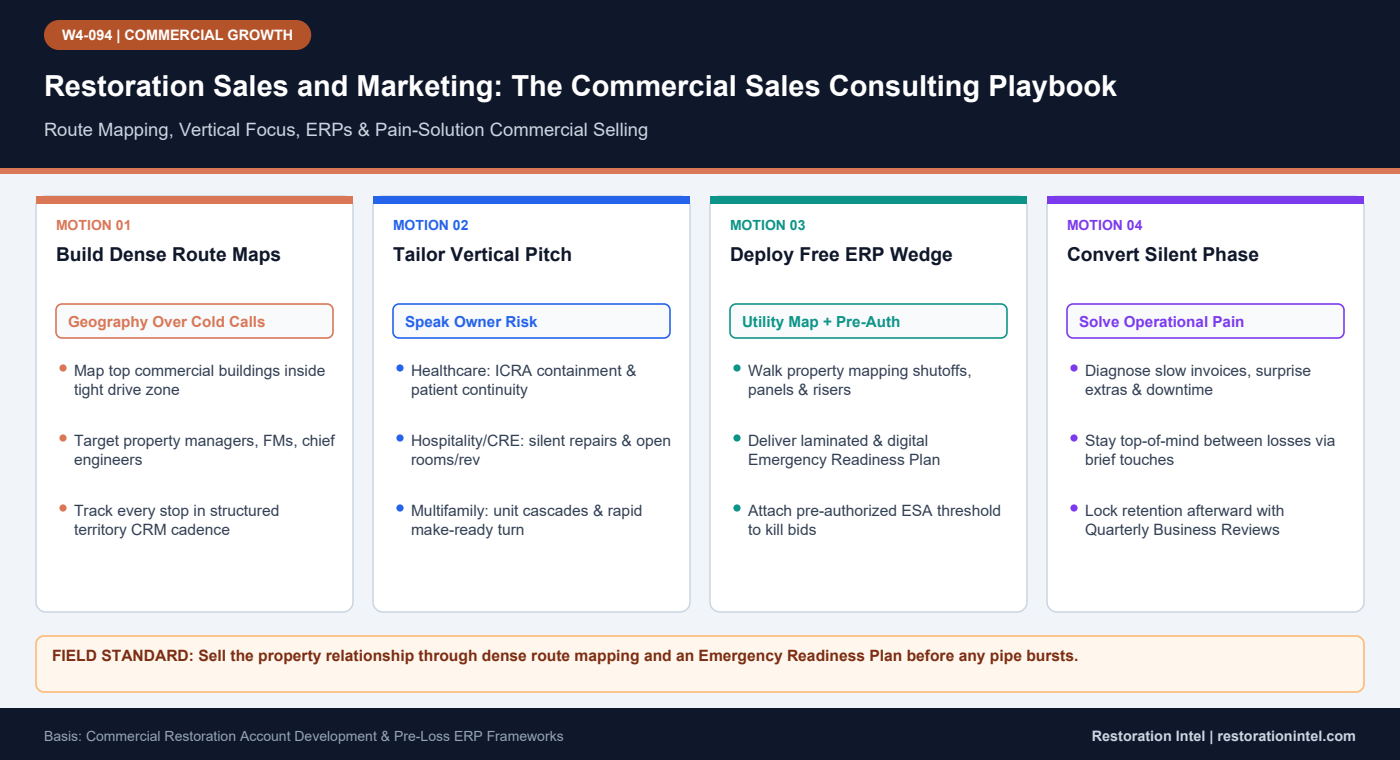
Field Benchmark & Decision Matrix
| Commercial Sales Stage | Proactive Sales Action | Decision-Maker Pain Addressed | Winning Commercial Asset |
|---|---|---|---|
| 1. Route Mapping | Cluster 50-100 high-value local facilities on loop | Eliminates sparse windshield waste & random calls | Targeted account territory tracker & call log |
| 2. Vertical Discovery | Ask about past vendor gaps (BI, noise, slow close) | Uncovers hidden frustration w/ current national | Vertical-tailored capability 1-pager (CRE/Med) |
| 3. ERP Site Walkthrough | Photograph shutoff valves, risers & panel schedules | Gives chief engineer/FM real zero-cost operational aid | Completed site-specific Emergency Readiness Plan |
| 4. Agreement Close | Pair ERP delivery w/ signed pre-loss ESA + NTE | Eliminates 2 a.m. vendor-approval board paralysis | Executed Emergency Services Agreement in CMMS |
| 5. Silent-Phase Touch | Quarterly 10-min safety update + annual QBR check | Prevents post-loss vendor amnesia before rebid | Long-term preferred-vendor multi-building list |
Practitioner Operational Takeaways
- Stop treating commercial growth like residential lead chasing—build disciplined geographic territory routes targeting local facility managers and property portfolios.
- Lead with vertical-specific outcomes (hospital compliance, hotel room downtime, multifamily turn speed) rather than generic claims about trucks and drying fans.
- Use a complimentary physical walkthrough and Emergency Readiness Plan (ERP) mapping water/gas/power shutoffs as your primary wedge into commercial accounts.
- Follow ERP installation with recurring touchpoints and QBRs so your company remains embedded inside the property's CMMS and vendor list year-round.
Standards & Primary References
- Markdown Twin (.md)
- Emergency Readiness Plans: Commercial Conversion Tool
- How Facility Managers Choose a Restoration Vendor
- Commercial QBRs That Prevent Vendor Rebids
.md twin for carrier and field review.