Updated November 24, 2026 — refreshed with verified 2-page PDF field brief, bespoke workflow diagram, and primary standards references.
Direct Answer: Scaling a restoration company is fundamentally different from top-line revenue growth: revenue can climb while net profit drops, quality frays, and the owner works longer hours. True scaling requires documenting intake, estimating, and production systems first—so added technicians, trucks, or commercial verticals generate higher cash value with proportionally less owner intervention.
.md twin for Restoration Operations & Margin.
Updated October 6, 2026.
Scaling a restoration company is not the same as growing revenue. Revenue can grow while profitability erodes, while quality drops, and while the owner works more hours than before. True scaling means building a company that generates more value with proportionally less owner involvement — which requires systems, leadership, and financial discipline in equal measure.
Owners who get stuck at “me plus a van” usually don’t have a lead problem. They have a them problem — the same gap Phillip Rosebrook Jr. works on at Business Mentors and on Restoration Edge: a company that still needs the owner in every room cannot scale.
The Systems-First Approach
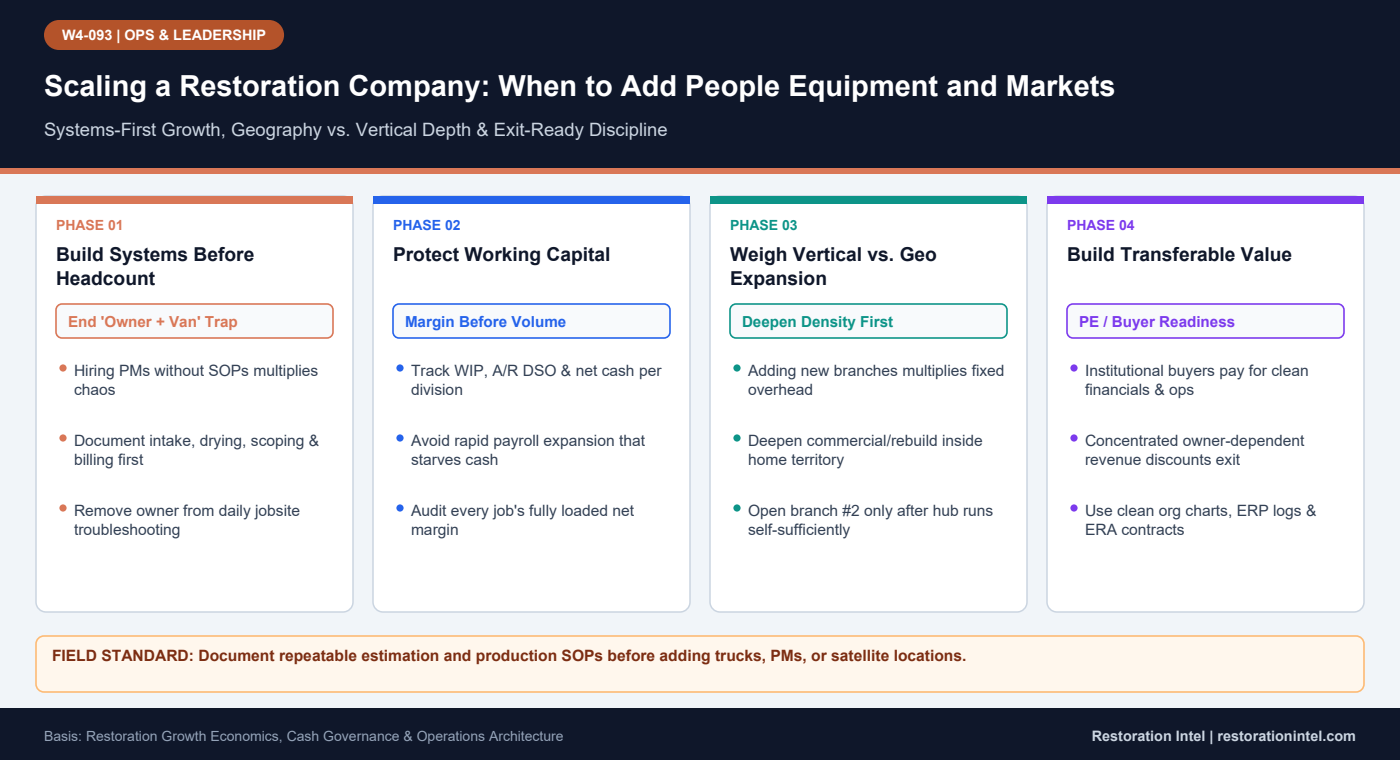
The most common scaling failure in restoration: hiring before building the systems those new hires will operate within. A new project manager without a documented estimating process invents their own. A new crew lead without clear protocols creates their own standards. The result is inconsistency that compounds as the company grows — and an owner who spends more time correcting deviation than managing growth.
The systems-first approach inverts this: document your best processes before scaling, then hire people to operate those documented processes. The documentation phase is uncomfortable for action-oriented owners — it feels like delay. In practice, it is the fastest path to scale.
Geographic Expansion vs. Vertical Deepening
Restoration companies face a fundamental strategic choice in scaling: expand geographically (new markets, new offices) or deepen vertically (add commercial to a residential operation, add contents to a mitigation-only operation). Geographic expansion multiplies complexity; vertical deepening leverages existing relationships and market position. For most companies below $10M revenue, vertical deepening generates better returns than geographic expansion.
The Private Equity Landscape
PE investment in restoration has accelerated significantly over the past decade. Understanding what PE buyers value — EBITDA, documentation, management depth, customer diversification — is valuable for owners who intend to sell, but also for owners who don’t. The discipline required to be an attractive acquisition target is identical to the discipline required to be a well-run business.
Frequently Asked Questions
At what revenue level does a restoration company need a dedicated operations manager?
The threshold varies, but most restoration companies need an operations layer — someone other than the owner overseeing daily field execution — somewhere between $1.5M-$3M revenue or 8-15 employees. The signal is when the owner cannot maintain visibility into all active jobs while also doing business development and financial management.
How do you maintain quality when scaling rapidly?
Through documented protocols enforced consistently, QC processes (job site audits, documentation reviews) that scale with production volume, and a culture where quality standards are non-negotiable regardless of job volume pressure.
Is franchising a viable scaling strategy for restoration?
It is a viable strategy but a different business model. Franchising generates royalty revenue rather than job margin, requires significant infrastructure to support franchisees, and creates reputational exposure across locations you don’t directly control. The restoration companies that franchise successfully do so from a foundation of documented systems that can be replicated reliably.
How does scaling change the owner’s day-to-day role?
In a well-scaled restoration company, the owner transitions from doing work to designing systems, from managing projects to managing leaders, and from selling jobs to building relationships and strategy. This transition is uncomfortable for owners who derive satisfaction from the technical and operational work — but it is the necessary path to a business that doesn’t require their daily presence.
Related: Cash flow management · Leadership pipeline · Exit planning.
Scaling a Restoration Company: When to Add People Equipment and Markets — Visual Workflow
Field Benchmark & Decision Matrix
| Growth Lever | Premature Growth Trap | Systems-First Requirement | Margin / Equity Impact |
|---|---|---|---|
| Adding Crew / PMs | New hires invent conflicting file & scope rules | Written playbooks for dispatch, drying & Xactimate | Compounds quality & protects ~15-25% net |
| Equipment Expansion | Buying excess vans/desiccants ahead of demand | Track utilization % vs. rental flexibility for CAT | Preserves liquidity during slow seasonal troughs |
| Geographic Branch | Cloning broken HQ chaos into second county | Home market stable w/ ops lead & clean A/R first | Avoids dual-location cash burn & dilution |
| Vertical Deepening | Chasing unfamiliar industrial/hazmat blindly | Add commercial ERAs & rebuild inside local radius | Raises revenue per mile w/o branch fixed rent |
| Financial Governance | Confusing invoiced WIP backlog w/ cash in bank | Weekly cash forecast, DSO limits & job costing | Prevents scaling-induced insolvency & boosts exit |
Practitioner Operational Takeaways
- Never hire additional project managers or crews to fix operational bottlenecks—document estimating, daily drying, and closeout systems first.
- Favor deepening high-margin verticals (commercial ERAs, multifamily, full reconstruction) inside your current footprint before opening distant satellite branches.
- Watch working-capital lag aggressively during growth spurts: rapid mitigation expansion requires cash reserves to fund payroll while carrier A/R clears.
- Build management independence and auditable recurring ERA revenue intentionally—the exact attributes buyers and private equity reward.
Standards & Primary References
- Markdown Twin (.md)
- Commercial Restoration Job Costing: Margin Floors
- How Independent Contractors Win Storm Work
- SBA Business Growth & Financial Planning
.md twin for carrier and field review.