Direct Answer: Economic feasibility fails when the cost to pack, transport, clean, deodorize, and return an item approaches or exceeds its depreciated Actual Cash Value or replacement cost—requiring estimators to compare total restoration cost against ACV and RCV before packing low-value or heavily worn goods.
.md twin for estimator QA and carrier file documentation.
One of the most expensive misunderstandings in contents restoration happens when a crew packs out every single item in a home without checking valuation economics first. Imagine spending $145 in labor, box materials, transit, ultrasonic cleaning, ozone deodorization, and vault storage to restore a six-year-old mid-range toaster oven whose brand-new RCV is $110 and whose depreciated ACV is $45.
Even if the technician cleans the toaster oven impeccably under ANSI/IICRC S320, the carrier desk reviewer will reject the restoration invoice as economically unfeasible—and the contractor risks uncompensated labor or a sour dispute with the insured. Navigating the restore-vs-replace threshold requires understanding the exact financial tug-of-war between total restoration cost, Replacement Cost Value (RCV), and depreciated Actual Cash Value (ACV), especially when policies diverge on which benchmark governs.
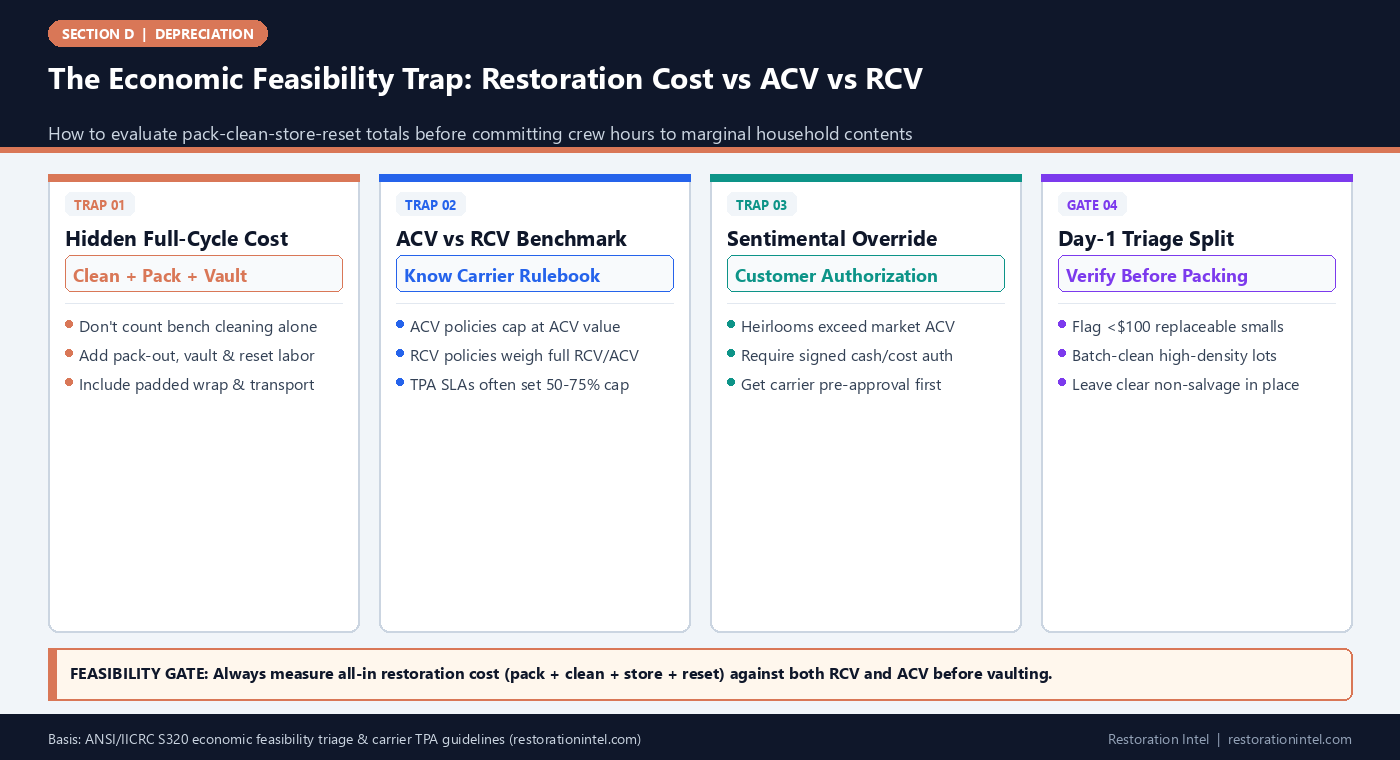
The Economic Feasibility Trap: Restoration Cost vs ACV vs RCV
Restore-vs-Replace Economic Feasibility Decision Matrix
Worked comparison showing how all-in restoration costs interact with RCV, ACV, and carrier authorization rules.
| Item & Pre-Loss State | Estimated RCV | Depreciated ACV | All-In Restore Cost (Pack + Clean + Reset) | Economic Feasibility Verdict |
|---|---|---|---|---|
| 6-Yr Mid-Grade Microwave (Smoke) | $160 | $64 | $140 (labor + box + deodorize) | Non-feasible (119% above ACV / 88% of RCV) — document & total-loss |
| Solid Walnut Dining Table (Light Soot) | $3,800 | $2,850 | $520 (pad, transport, refinish/clean) | Highly feasible (18% of ACV / 14% of RCV) — restore immediately |
| 1-Yr High-End Wool Area Rug (Cat 1 Water) | $2,400 | $2,160 | $480 (extraction, submersion wash, dry) | Highly feasible (22% of ACV) — send to specialty rug plant |
| 8-Yr Promotional Particleboard Bookcase | $180 | $54 | $135 (wrap, haul, wipe, return) | Non-feasible (250% of ACV) — replace rather than pack |
| Family Heirloom Christening Gown / Photos | $150 material | $75 | $320 specialty textile conservation | Sentimental exception — require written carrier/insured approval |
Why All-In Restoration Cost Often Surpasses Bench Cleaning Alone
The classic feasibility error happens when a crew lead looks at a 30-minute cleaning task ($35 of technician time) and concludes an item is cheaper to clean than replace. In reality, cleaning never happens in isolation inside a pack-out job. Moving that item off-site incurs box material, packing labor, digital inventory logging, truck transit, climate-controlled vault storage across weeks or months, bench cleaning, deodorization, unwrapping, and final delivery reset.
When you sum the full lifecycle cost per unit, a single low-value kitchen gadget or plastic shelving unit easily accumulates $95 to $150 in restoration and handling charges. Comparing only bench-cleaning minutes against retail price systematically understates true claim cost and triggers inevitable desk-audit pushback when the total contents restoration bill lands at 90 percent of replacement value.
- Calculate true lifecycle unit cost: Include allocated packing, box/pad materials, handling, cleaning, deodorization, and reset hours.
- Evaluate batch economics separately: Dense small goods (ceramic dishes, glassware) cleaned in fast basketed dish-pack lots can stay feasible even when single units wouldn’t.
- Respect TPA percentage ceilings: Many carrier and TPA agreements cap restoration cost at 50 to 75 percent of RCV or ACV unless pre-authorized.
The ACV Trap vs RCV Policy Rules on Restorable Property
Policy valuation basis changes the feasibility math sharply. On an ACV-only policy, the carrier’s maximum obligation for a ruined item is its depreciated ACV—say $200 on an older sofa. Paying $450 to pack, re-web, deodorize, and return that sofa leaves the carrier paying more than twice what a total-loss cash settlement would have cost, creating immediate denial risk unless the adjuster explicitly authorized restoration up front.
Even on RCV policies with HO 04 90, carriers watch the spread between restoration cost and ACV carefully because if an item is restored successfully, they owe the full restoration invoice immediately without holding back recoverable depreciation. Conversely, if an item with $1,200 RCV and $400 ACV is totaled, the carrier pays $400 upfront and pays the remaining $800 only if the insured actually buys a replacement. Understanding both sides of that desk calculation lets contractors present transparent cost-benefit comparisons that get signed off before trucks roll.
- Check ACV-only policies with extreme care: Never pack-and-clean marginal goods on ACV-only claims without written adjuster threshold approval.
- Surface marginal items in a Triage Table: Present items where restoration sits between 50% and 90% of ACV for fast adjuster choice.
- Account for insured ALE urgency: Rapid on-site or rush-clean restoration sometimes justifies slightly higher cost if it avoids weeks of temporary-living delays.
Sentimental Items, One-of-a-Kind Goods, and Written Exceptions
Financial feasibility formulas break down completely on items carrying irreplaceable personal or historical meaning: wedding albums, children’s artwork, military medals, handwritten recipes, or heirloom quilts. On paper, a 40-year-old hand-stitched quilt might price at $250 RCV and $100 ACV, while specialty smoke conservation costs $450.
Per ANSI/IICRC S320 ethical care standards, contractors should never unilaterally discard sentimental items just because they fail ACV math—nor silently run up a $450 conservation bill assuming the carrier will pay blindly. Flag sentimental exceptions during walkthrough, obtain written carrier allowance (if granted under policy) or signed customer self-pay authorization for the excess delta, and document both signatures cleanly.
- Create a separate ‘Sentimental / Non-Economic’ triage flag: Keep family heirlooms out of automated total-loss disposal piles.
- Secure dual sign-off on cost overages: Document either adjuster written waiver or insured direct-pay authorization before specialty conservation.
- Preserve fragile items during triage: Even if the insured pays out-of-pocket for conservation, safe initial stabilization prevents irreversible loss.
Building a Pre-Pack Economic Gate That Protects Crew Margin
The right time to catch the economic feasibility trap is on day one in the home—not thirty days later at the warehouse bench after twenty hours of labor are already sunk. Training crew leads to run a rapid mental screen (‘Would all-in pack + clean + vault + return exceed 60% of this item’s replacement value?’) stops thousands of dollars of unbillable busywork before a single box is taped.
For borderline bulk categories—plastic food containers, low-end small appliances, weathered particleboard shelving, and opened cosmetics—leave items safely staged in place, shoot crystal-clear identification and damage photos for the contents RCV/ACV schedule, and obtain written disposal sign-off per Contents Cleaning SLAs by Category and IICRC Cat 3 protocols.
- Run room-level pack/total-loss triage before boxing: Save packing hours for high-value furniture, electronics, textiles, and batch-feasible dishware.
- Never dispose without photo + witness sign-off: Leaving non-feasible goods on total-loss still requires full inventory proof before landfill haul-off.
- Pair cleaning quotes with ACV/RCV snapshots: Show the adjuster side-by-side restoration cost vs replacement cost on high-ticket borderline items.
Practitioner Verification Checklist (D-13)
- Calculate full lifecycle restoration cost (pack, box materials, transit, cleaning, storage, and reset) rather than bench cleaning alone.
- Compare estimated all-in restoration cost against both RCV and depreciated ACV—especially on ACV-only or heavily worn items.
- Flag low-dollar consumables, plasticware, and particleboard furniture on site for total-loss photo documentation instead of packing.
- Isolate sentimental heirlooms from economic total-loss lists and secure written adjuster waiver or insured self-pay sign-off before conservation.
- Verify TPA or carrier restoration-to-replacement percentage thresholds (commonly 50-75%) in writing prior to cleaning borderline goods.
Standards, Authority References & Related Reading
Primary standards, insurance definitions, and sibling Restoration Intel guides referenced in this brief:
- ANSI/IICRC S320 Standard for Professional Contents Restoration
- IRMI Insurance Glossary: Actual Cash Value (ACV)
- IRMI Insurance Glossary: Replacement Cost Value (RCV)
- Restoration Industry Association (RIA)
- Related Guide: RCV vs ACV Fundamentals in Contents Claims: How Replacement Cost, Depreciation, and Holdbacks Actually Work
- Related Guide: Apparel, Footwear, and Soft-Goods Depreciation Without Blanket Arbitrariness
- Related Guide: Debris Removal, Haul-Off, and Landfill Fees for Total-Loss Contents: Where Valuation Ends and Mitigation Begins
- Related Guide: Contents Cleaning SLAs by Category
- Related Guide: IICRC Cat 3 Contents Pack-Out Cleaning Protocol
.md twin for desk QA and team training.Frequently Asked Questions
What is the economic feasibility trap in contents restoration?
It occurs when the total cost to pack, transport, clean, store, and return an item approaches or exceeds its depreciated ACV or replacement value, leading carriers to deny or cut the restoration invoice.
Should restoration feasibility be measured against RCV or ACV?
Both matter, depending on the policy and carrier guidelines. On ACV-only policies, restoration usually must stay below ACV; on RCV policies, many carriers and TPAs use 50% to 75% of RCV or ACV as a pre-approval gate.
What happens when an heirloom costs more to clean than its replacement ACV?
Estimators should flag it as a sentimental exception, request a written carrier allowance if available, or obtain signed homeowner authorization to pay the excess conservation cost out of pocket before proceeding.
How can crews avoid packing non-feasible items on day one?
Train crew leads to screen low-value plastics, particleboard furniture, and heavily worn small appliances against all-in pack-clean-reset cost during walkthrough, documenting them for total-loss instead of boxing them.