Direct Answer: On November 3, 2026, Tygart Media ran a Reverse-MCP intake and billing test inside a private TEST copy of TruNorth Ops provided by founder Jason Gilstrap. Across 9 storm inputs, 3 ROMs, and 3 daily T&M sheets ($3,902.50), the fact gate blocked phantom jobs and stopped cleanly at the manager signature.
By Will Tygart · Restoration Intel Field Operations Desk · Published November 28, 2026 (documenting the November 3, 2026 TruNorth Ops TEST sandbox verification)
| Field Test Stage | Measured Input / Surface | Exact Read-Back / Outcome | Operational Gate |
|---|---|---|---|
| Run 1: Mirror Job | UI job form, documented CSV price list, Encircle import | 18 / 18 fields matched sample job verbatim | TEST sandbox only; zero live shop writes |
| Run 2: Edit & Daily Sheet | Guarded Est. Days edit (7 -> 9) + computed daily sheet | Daily sheet matched $465.50 to the exact cent | Image upload refused PDF & voice with on-screen reason |
| Run 3: Frozen Packets | Trio-checked new job + guarded update JSON packets | Expected-before guard passed; PDF receipts clean | Caught 3 executor prose typos against delivered PDF |
| 9-Input Storm Drill | 1 storm pulse + 8 field inputs (2×8 fan-out, 65.5 s, $0.01028) | 4 jobs (26-00006-HQ to 26-00009-HQ), 2 updates, 4/4 spot re-reads | Trap 1 (dual addr) = 0 jobs; Trap 2 (earthquake) -> Other |
| 3 Tick-Sheet ROMs | Whitaker, Edmond ($24k auth withheld), Quail Creek | $2,378 (54%), $8,418 (51%), $8,879 (53%) margins | Estimator overrode ticked air movers (17v10, 13v8) |
| Wave 3: 3-Day T&M | Three consecutive Edmond daily field report sheets | $1,769.00 + $886.00 + $1,247.50 = $3,902.50 total | All 3 submitted PENDING at human manager signature |
Why Storm Intake Breaks Under Free-Form AI
Anyone who has manned a restoration dispatch phone during a freeze or windstorm knows what arrives in the first two hours: half-typed homeowner texts, an adjuster email missing a claim number, a technician’s voice memo from a crawlspace, a third-party administrator dispatch update, and a storm pulse alert. Letting a generic AI assistant free-write straight into job management software turns messy intake into phantom jobs, invented loss-type codes, and broken billing rates.
During our Meta Global AI Developer Hackathon build, we tested an inverted architecture called Reverse MCP. Instead of giving the model open-ended tools, verified facts sit inside a staging queue (the Hopper) until shaped through a destination-locked 16-field Tip and checked afterward by live read-back. Thank you by name to Jason Gilstrap, founder of TruNorth Ops, who handed us personal admin credentials to a private TEST sandbox of his restoration software—with zero custom API built for us—so we could measure how the pattern behaves against a real contractor tool.
Runs 1 through 3: Mapping Surfaces, Refusals, and Frozen Packets
Before pushing a single storm input, we mapped TruNorth Ops surface by surface. That preparation immediately surfaced two lessons every restoration software buyer should know:
- Mirror Job & Cent-Exact Sheet Read-Back: Run 1 created one mirror job matching the template across 18 of 18 fields verbatim. Run 2 executed a guarded update (Est. Days 7 to 9 with a logged reason), uploaded a job photo, and verified a computed daily sheet reading back at $465.50 to the exact cent.
- Tips Bind Per Surface, Not Per Vendor: A second CSV export surface inside the same software declared a different column layout than the first. Meanwhile, the job photo uploader refused both a PDF and a voice memo with an explicit on-screen error message. In fact-gated systems, a clear refusal with a reason is a usable receipt.
- Frozen Packets Catch Prose Drift: In Run 3, two JSON packets (new job + guarded update with an expected-before check) ran clean—while the post-run PDF check caught three numbers the executor’s own narrative prose had garbled. Receipts beat narration every time.
The 9-Input Storm Drill: Two Planted Traps, Both Caught
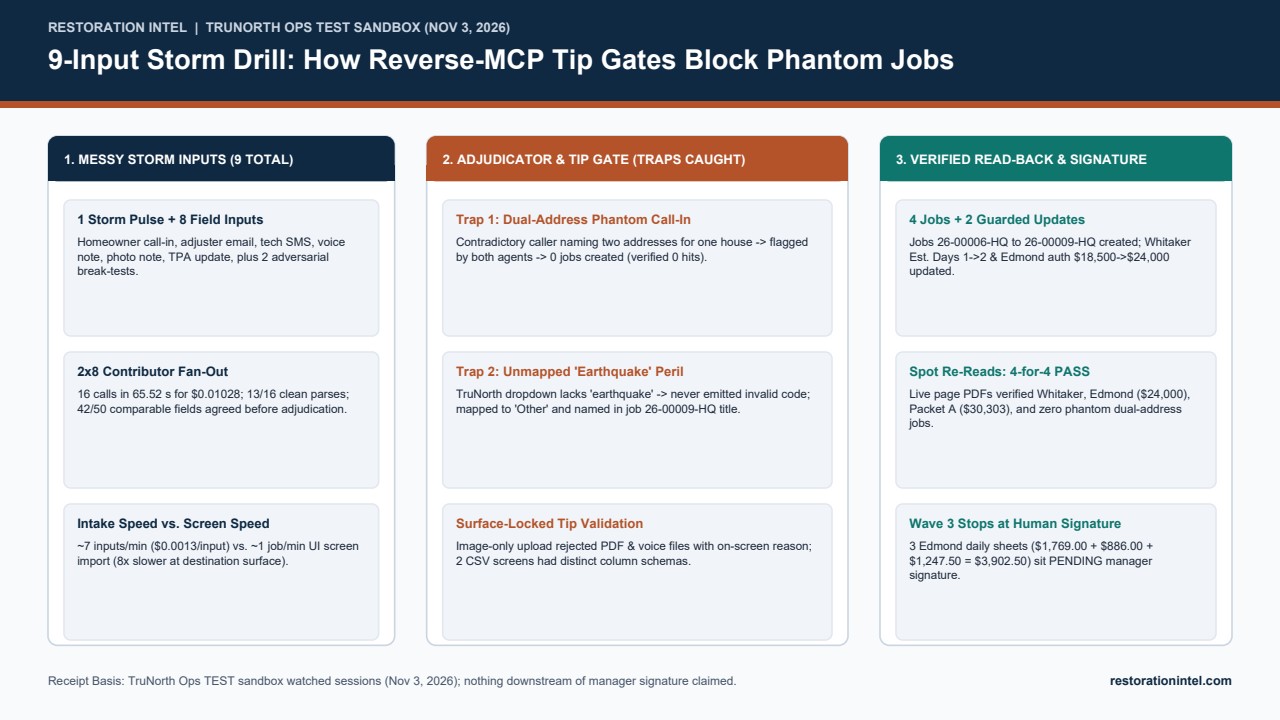
To test storm surge reliability, we paired a Restoration Intel storm pulse with eight realistic mock field inputs—including two deliberate break-tests—and pushed them through a 2-agent independent contributor fan-out (16 calls in 65.52 seconds for $0.01028) followed by max-effort adjudication:
Trap 1 (Contradictory Call-In): One caller gave two different street addresses for the same loss. Both fan-out agents flagged the contradiction, the Adjudicator upheld the block, and zero jobs were created—confirmed by live search (0 matches).
Trap 2 (Unmapped Loss Type): An input named an earthquake loss, a category TruNorth Ops’ dropdown does not contain. Rather than fabricating a code or failing silently, the Tip mapped the classification to Other and explicitly named the earthquake peril in job title 26-00009-HQ. Four jobs were created (26-00006-HQ through 26-00009-HQ) alongside two guarded updates (Whitaker Est. Days 1 to 2; Edmond authorization $18,500 to $24,000), and four independent spot re-reads of live PDFs passed 4-for-4.
Three Tick-Sheet ROMs & Where the 8x Bottleneck Lives
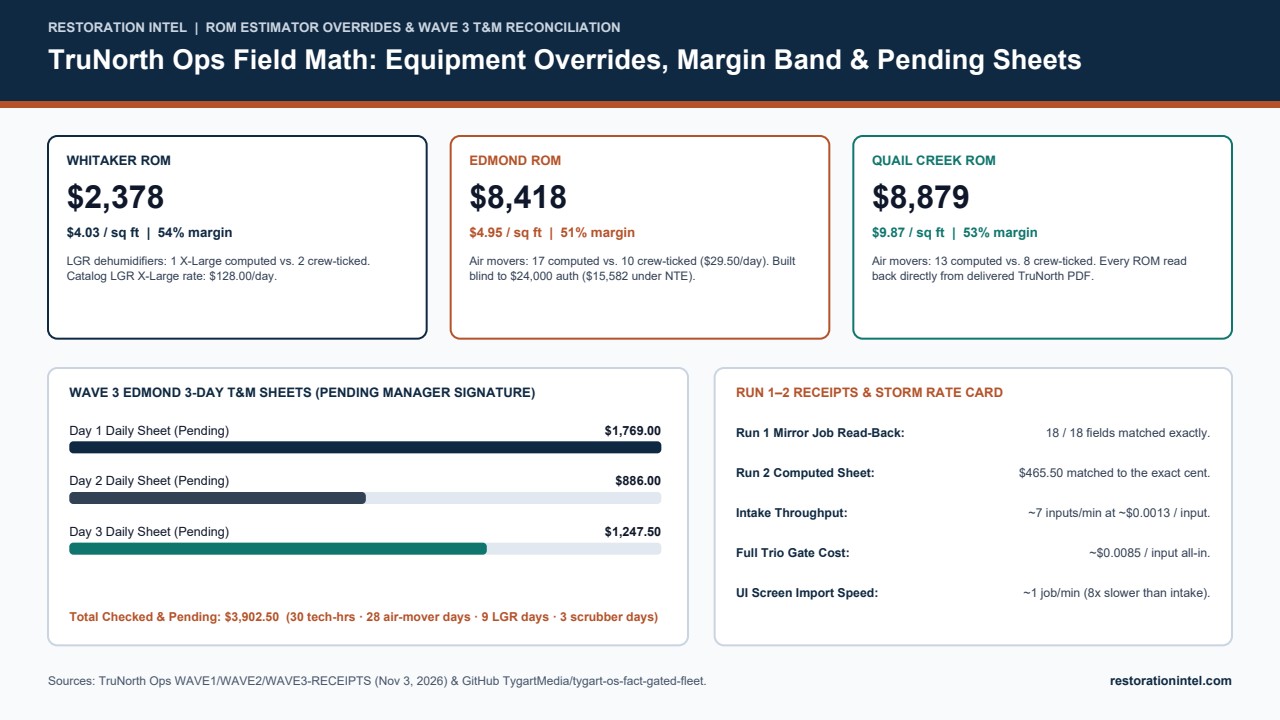
Next, we fed field drying tick sheets into TruNorth’s Rough Order of Magnitude (ROM) estimator for three jobs: Whitaker ($2,378, $4.03/sq ft, 54% margin), Edmond ($8,418, $4.95/sq ft, 51% margin), and Quail Creek ($8,879, $9.87/sq ft, 53% margin). Crucially, the Edmond ROM was built without ever showing the estimator the adjuster’s $24,000 authorization—landing $15,582 under NTE on its own math.
Reading the delivered PDFs back revealed the estimator’s embedded domain logic overriding crew tick counts: Edmond computed 17 air movers vs. 10 ticked ($29.50/day), Quail Creek computed 13 vs. 8 air movers, and Whitaker selected 1 X-Large LGR dehumidifier ($128/day) vs. 2 ticked. That kind of operator judgment stays invisible unless your pipeline verifies delivered PDFs rather than guessing inputs.
Just as importantly, timing the run settled where the real bottleneck sits during a catastrophe event: AI intake processed roughly 7 inputs per minute at ~$0.0013 per input (~$0.0085/input all-in through the checking gate), while pushing jobs through the browser screen ran roughly 1 job per minute. The destination screen leg is roughly 8x slower than AI intake—which reinforces why unbundling estimator workflows and locking Hour-Zero storm scopes depend on structured data shapes, not faster chatbots.
Wave 3 & 312-Page Restoration Readiness: Stopping at the Human Signature
Across Wave 3, three consecutive days of Edmond field reports generated three checked daily T&M sheets—$1,769.00 + $886.00 + $1,247.50 = $3,902.50—reconciling exactly across 30 technician hours, 28 air-mover unit-days, 9 LGR unit-days, and 3 air-scrubber unit-days. All three sheets stopped PENDING at the manager-signature step. By TruNorth Ops’ own design, checked documentation moves into billing only when a named human signs off.
We saw the same physical boundary across our contents restoration readiness research and a 312-page Restoration Intel blind emblem round-trip: while structure recovered 312/312 and palette recovered 311/312 (99.7%), blind vision identified fine equipment classes (dehumidifier vs. heater or air mover) only 5 of 10 times. Combine that with 43 restoration software and TPA profiles and field paper-trail standards, and the operational rule is clear: automate intake, fact-gating, and read-back—and keep a licensed human on the final signature.
Frequently Asked Questions
How did Reverse-MCP storm intake prevent phantom jobs on TruNorth Ops?
Every messy field input passed through an independent two-agent fan-out and max-effort Adjudicator gate before reaching the Hopper. When a contradictory caller gave two different street addresses for one house, both agents flagged the conflict and emitted zero jobs (verified 0 hits on live search).
What happened when the storm drill received an unmapped earthquake loss type?
Because TruNorth Ops’ loss-type dropdown does not include earthquake, the destination-locked Tip refused to invent or emit an invalid code, mapped the classification to Other, and named the earthquake peril explicitly in job title 26-00009-HQ.
Did AI billing automation auto-approve or send final invoices during Wave 3?
No. Across three consecutive days of Edmond T&M sheets ($1,769.00 + $886.00 + $1,247.50 = $3,902.50 covering 30 tech-hours and 40 equipment unit-days), all three sheets stopped PENDING at TruNorth Ops’ manager-signature gate with zero downstream invoices issued.
Where is the storm bottleneck—AI token speed or restoration software screens?
Measured during the November 3 field test, intake parsed roughly 7 inputs per minute at ~$0.0013 per input while screen-driven entry ran roughly 1 job per minute—making the destination UI screen approximately 8x slower than AI intake.