Direct Answer: In wind, hail, and roof-breach losses, non-salvageable vs restorable triage depends on four technical thresholds: structural impact fracture from fallen framing, water category and saturation duration through attic assemblies, irreversible embedded glass or alkaline plaster etching, and verified cleaning cost versus like-kind-and-quality replacement value.
.md twin for estimator QA and carrier file documentation.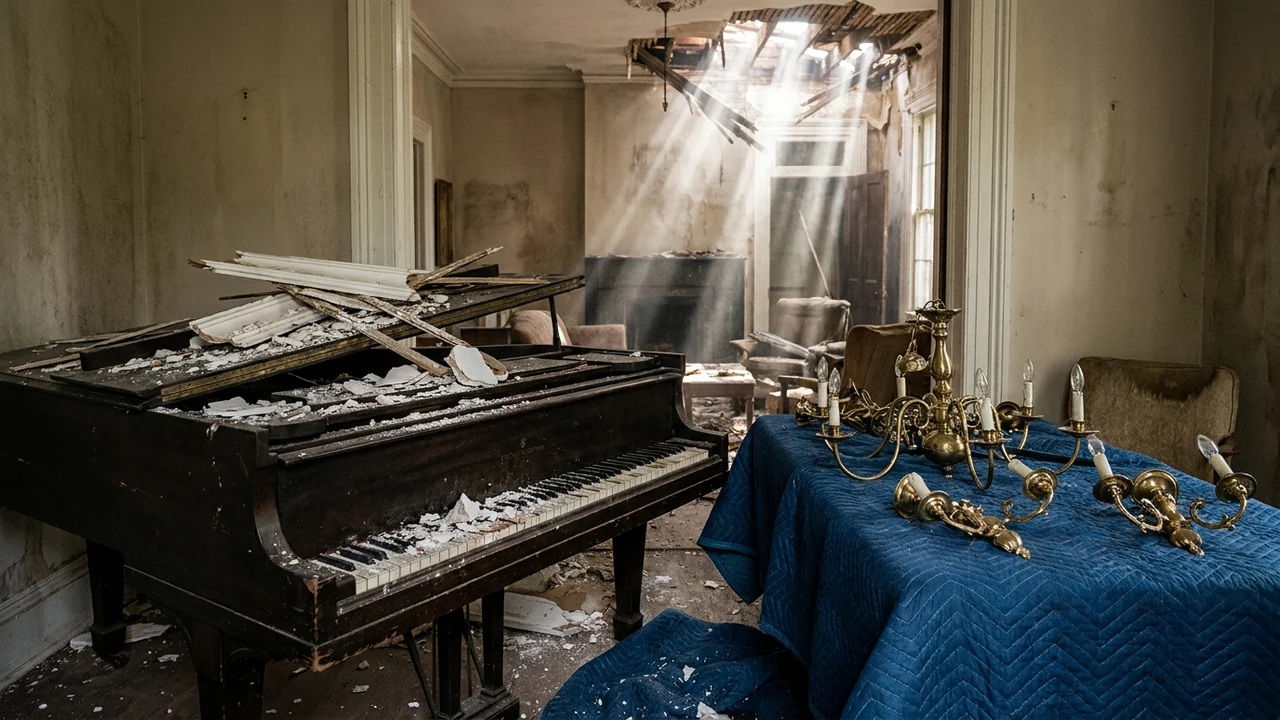
Determining what can be restored and what must be declared non-salvageable after a roof breach or ceiling collapse is never a simple wet-versus-dry call. A solid walnut dining table battered by fallen rafters presents mechanical impact and veneer delamination issues, while the upholstered chairs beside it may hold microscopic tempered-glass splinters driven by a failed bay window alongside muddy attic insulation runoff. Treating those items with a generic water-damage checklist misclassifies both restorable assets and genuine total losses.
Under ANSI/IICRC S320 and the ANSI/IICRC S500 Water Damage Standard, restorable versus non-salvageable decisions rest on material porosity, contaminant hazard, structural integrity, and economic feasibility. Porous items soaked by Category 2 or Category 3 attic runoff, particleboard furniture swollen past fastener tolerances, and open-cell foam cushions laced with shattered window shards routinely cross technical or safety non-salvage thresholds even if exterior fabric looks superficially intact.
At the same time, many storm-affected contents look catastrophic on day one while remaining technically restorable. Heavy plaster dust on solid hardwood, brushed metals, glazed ceramics, and tightly woven synthetics often cleans completely when dry HEPA extraction precedes solvent or detergent treatment, provided crews isolate the items before secondary mold or finish clouding sets in. Evaluating structural, hygienic, and IRMI salvage economics line by line protects policyholders from unsafe returns and carriers from inflated replacement schedules.
Non-Salvageable vs Restorable Decision Gates After Storm Breaches
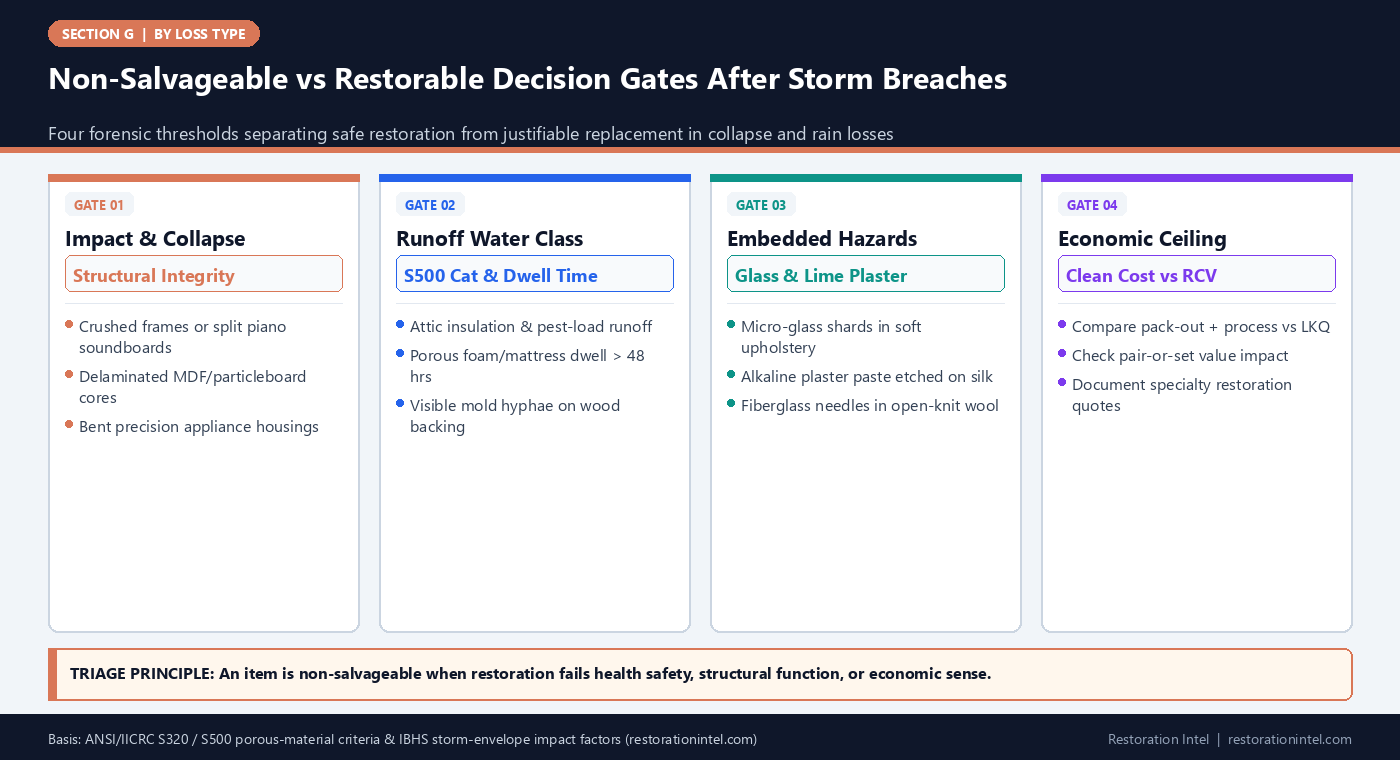
Storm-Breach Contents Triage Criteria: Restorable vs Non-Salvageable Benchmarks
Practical line-item classification across common household and commercial asset categories exposed to roof failure, ceiling collapse, and window blowout.
| Asset Category | Typical Storm Damage Profile | Restorable Conditions | Non-Salvageable Triggers | Verification Test |
|---|---|---|---|---|
| Particleboard / MDF Casegoods | Rainwater pooling on top surfaces and wicking up kickplates | Brief surface misting dried within 12 hrs with zero seam swelling | Swollen edges, bubbling laminate, loosened cam-locks, or mold on backer board | Pin moisture check & edge caliper inspection |
| Solid Hardwood Furniture | Plaster chunks, scratch gouges, rainwater blush, fallen lath | Intact structural joinery; surface scratches or moisture blush amenable to refinishing | Split load-bearing frames, warped drawer boxes, or repair exceeding replacement cost | Joinery flex check & master refinisher quote |
| Upholstered Sofas & Mattresses | Attic-runoff rain, shattered window glass, wet plaster paste | Dry plaster dust only on removable tight-weave covers with zero glass intrusion | Category 2/3 saturation into foam/batting, embedded glass shards, or > 48 hr wet dwell | UV/core moisture probe & glass-shard safety check |
| Electronics & Appliances | Windblown rain through window vents, fine gypsum dust in fans | Dry external dust only with confirmed zero moisture ingress on internal boards | Rainwater or corrosive alkaline plaster paste on PCBs, motors, or compressor relays | Authorized bench inspection & corrosion check |
| Pianos & Fine Musical Gear | Roof breach drip onto lids, lath impact on keys, humidity swing | Exterior finish marring or dry dust with intact soundboard, pinblock, and felts | Cracked soundboard/bridges, swollen action felts, rusted strings, or mold inside case | Certified piano technician acoustic & structural report |
| Paper Files, Books & Art | Saturated boxes beneath collapsed ceiling, mud/tar drip | Dry dust on dust jackets or lightly damp edges freeze-dried within 24-48 hrs | Pulp dissolution, ink bleed, stuck coated pages, or Category 3 bio-contamination | Page-separation check & conservation triage |
| Apparel, Linens & Rugs | Wet insulation chunks, ceiling dust, rainwater puddle wicking | Washable fabrics with Cat 1/light dust exposure processed via validated Esporta/laundry | Dry-clean-only silks etched by lime plaster, fiberglass-impregnated knits, or rot/bleed | Fiber label check & test-wash viability log |
Evaluating Structural Impact and Swollen Engineered Wood Substrates
Ceiling collapses inject brute mechanical force into rooms that water alone never reaches. Falling ceiling joists, double-layer wet drywall, wood lath, and heavy plaster medallions strike table aprons, piano lids, glass-front china cabinets, and computer monitors at high momentum. During triage, estimators must separate superficial finish abrasion from hidden structural fractures in mortise-and-tenon joints, chair spindles, and internal appliance chassis.
Engineered wood products—medium-density fiberboard (MDF), particleboard, and thin wood veneers glued over composite cores—fail predictably when exposed to roof-breach rainwater. Even a few hours of standing water wicking along raw bottom edges or screw holes causes irreversible cellulose expansion that breaks glue bonds and compromises structural stability. Unlike solid timber, swollen particleboard cannot be clamped back to pre-loss dimensions.
Solid hardwood furniture follows a higher restoration threshold because joinery can often be reglued and water-blushed lacquer stripped and refinished. However, when falling structural debris splits carved legs, cracks curved crests, or shatters marble inlays on antique pieces, restoration feasibility depends on qualified artisan repair bids compared against verified replacement value.
- Inspect undersides and back panels: Most MDF/particleboard failures begin at unfinished rear panels and kickplates sitting in pooled water.
- Test structural racking: Gently check dining chairs, bed frames, and casegoods impacted by ceiling debris for hairline split tenons before tagging them clean-only.
- Separate veneer lift from finish blush: White moisture blush in lacquer is often restorable; buckled substrate beneath veneer typically mandates panel replacement or total loss.
How Attic-Runoff Water Categories and Dwell Time Govern Porous Soft Goods
One of the sharpest technical divides on wind and hail claims involves whether rainwater entering through a damaged roof qualifies as clean water. Under ANSI/IICRC S500, water classification reflects the source and path of travel, not just the cloud it fell from. Rainwater passing across weathered asphalt shingles, bird or squirrel droppings, aged blown-in cellulose, fiberglass batts, and decades of settled attic dust picks up suspended solids, chemical leachates, and microbial spores.
When that contaminated runoff saturates mattresses, open-cell sofa cushions, box springs, or dense wool area rugs, restoring the interior core to a sanitary, odor-free pre-loss state becomes technically unreliable—especially once wet dwell time exceeds 24 to 48 hours in unconditioned storm-damaged rooms. Because porous foam and cotton batting cannot be inspected internally without destructive cutting, S320 and S500 caution against attempting superficial surface extraction on heavily saturated Category 2 or Category 3 soft goods.
As outlined in Salvage Is a Window, Not a Service, elapsed time before mitigation directly shifts an item’s status. A lightly dampened sofa extracted and dehumidified within six hours may remain restorable, whereas the identical sofa left beneath a tarped-too-late roof breach for four humid days crosses into irreversible microbial colonization.
- Document the runoff pathway: Photograph attic insulation, roof decking, and dirty ceiling stain lines to establish why rainwater lost Category 1 status.
- Treat mattresses conservatively: Multi-layer quilted mattresses saturated by roof-cavity runoff or fiberglass debris are almost universally non-salvageable for hygiene.
- Track ambient dwell hours: Record the exact gap between storm date of loss, emergency dry-in, and first contents extraction to defend dwell-time total-loss calls.
Micro-Glass Shards, Fiberglass Insulation, and Alkaline Plaster Etching
Wind and hail losses create specialized physical hazards that mimic cleanable dust at first glance. When hail or wind-driven tree limbs shatter double-pane windows or tempered skylights, thousands of needle-sharp glass fragments scatter into open drawers, bedding, upholstered cushions, and woven rugs. Even industrial HEPA vacuuming cannot guarantee 100 percent extraction of microscopic slivers embedded deep inside tufted sofa cushions, children’s plush toys, or loosely woven knitwear.
Fiberglass and mineral-wool attic insulation dumped during a ceiling collapse poses a parallel hazard. Broken glass fibers interlock mechanically with wool sweaters, fleece blankets, and open-weave draperies, causing persistent skin irritation even after standard wet laundering. Items carrying embedded glass splinters or heavy insulation matting where removal cannot be verified safe for human contact should be classified non-salvageable on occupant-safety grounds.
Lime and gypsum plaster dust introduces chemical damage on top of physical abrasion. High-pH lime plaster combined with rainwater humidity permanently spots silk lampshades, tarnishes unlacquered brass chandeliers, clouds anodized aluminum, and stiffens fine leather hides, moving delicate surfaces beyond standard cleaning tolerances.
- Zero-tolerance glass rule for bedding & seating: Flag pillows, mattresses, and deep-tufted cushions hit by shattered window glass as non-salvageable safety hazards.
- Test delicate fabrics for alkaline burn: Check silk, wool, and leather exposed to wet plaster slurry for stiffness, dye migration, or irreversible pH spotting.
- Inspect ventilation intakes: Desktop computers, audio receivers, and kitchen small appliances coated in damp plaster or fine glass dust require internal bench clearance before reuse.
Applying the Economic Feasibility Ratio Without Cutting Corners
Even when an item passes structural and safety thresholds, ANSI/IICRC S320 requires restoration teams to weigh total restoration cost against replacement value. On storm claims, full restoration cost is never just bench-cleaning labor; it includes hazard containment, HEPA pre-vac, pack-out wrap, transport, specialized cleaning or refinishing, climate-controlled storage during roof/ceiling reconstruction, and return delivery.
A mass-market laminated bookcase, inexpensive flat-pack desk, or entry-level microfiber recliner coated in wet plaster and fiberglass frequently accrues $350 to $600 in pack-out, processing, and storage charges against a $250 to $450 replacement cost. Pushing low-value commodity items through expensive plant processing wastes claim funds and frustrates both adjusters and property owners.
Conversely, heirloom dining suites, commercial office equipment, fine art, and custom draperies built with solid frames and high replacement baselines justify specialty conservation bids. Pairing realistic restoration quotes with transparent replacement benchmarks from the IBHS resilience and property-loss perspective keeps triage credible across every tier of the claim.
- Calculate all-in restoration cost: Combine pack-out labor, cleaning/refinishing, vault storage during rebuild, and pack-back before comparing to RCV.
- Use the 60-75% economic gate: When verified restoration approaches or exceeds roughly two-thirds of current LKQ replacement, flag the line for adjuster total-loss review.
- Respect sentimental exceptions explicitly: Document when an owner requests specialty conservation on a family heirloom whose economic cost exceeds market ACV, and secure written sign-off.
Practitioner Verification Checklist (G-26)
- Inspect impact-struck wood furniture, instruments, and appliances for hidden structural cracks, delaminated substrates, and electrical moisture ingress.
- Document roof-cavity runoff pathways (insulation, shingle grit, framing voids) before classifying porous soft goods as restorable.
- Designate bedding, cushions, and porous fabrics contaminated with shattered window glass or dense fiberglass insulation as safety non-salvageable.
- Perform alkaline plaster-etching and dye-bleed spot checks on leather, silk, wool, and unlacquered metals before committing to full plant cleaning.
- Compare all-in pack-out, cleaning, and rebuild-era storage costs against verified current LKQ replacement pricing for every borderline item.
Standards, Authority References & Related Reading
Primary standards, insurance definitions, and sibling Restoration Intel guides referenced in this brief:
- ANSI/IICRC S320 Standard for Professional Contents Restoration
- ANSI/IICRC S500 Water Damage Standard
- Insurance Institute for Business & Home Safety (IBHS)
- IRMI Insurance Glossary: Salvage
- Related Guide: Wind, Hail, Roof Breach & Structural Collapse Losses: First-24-Hour Contents Triage & Stabilization
- Related Guide: Wind, Hail, Roof Breach & Structural Collapse Losses: Damage Evidence & Forensic Photography Rules
- Related Guide: Wind, Hail, Roof Breach & Structural Collapse Losses: Cleaning Methodology & Processing Documentation
- Related Guide: Wind, Hail, Roof Breach & Structural Collapse Losses: Carrier Scope Justification & Total-Loss Defense
- Related Guide: Salvage Is a Window, Not a Service
.md twin for desk QA and team training.Frequently Asked Questions
When does rainwater from a hail-damaged roof render a mattress or sofa non-salvageable?
When roof runoff has passed through attic insulation, decking, and structural cavities (carrying Category 2 or Category 3 contaminants), when wet dwell time exceeds 24-48 hours, or when shattered window glass is embedded in the cushioning.
Can solid wood furniture hit by fallen plaster and ceiling lath be restored?
Often yes, provided the structural frame and joinery are intact and finish gouges or moisture blush can be professionally stripped and refinished at less cost than like-kind replacement.
Why are low-cost particleboard bookcases usually written off after a roof leak?
Particleboard and MDF cores swell permanently when water wicks into raw edges or fastener joints, destroying structural rigidity and delaminating surface veneers.
How should technicians triage electronics exposed to windblown rain through a broken window?
Unplug them immediately without powering on, photograph water entry or plaster dust around cooling vents, and route high-value units for certified bench inspection rather than guessing functionality in the field.