Updated November 24, 2026 — Verified Field Reference Edition.
Direct Answer: Carriers are deploying automated workbench triage like Benekiva's Kiva assistant—reported to trim carrier cycle times by up to 84 percent—to score first notice of loss packets before an examiner reads them; shops that omit moisture maps, dimensions, or plain cause narratives get flagged immediately.
.md twin for AI Governance & Field Technology.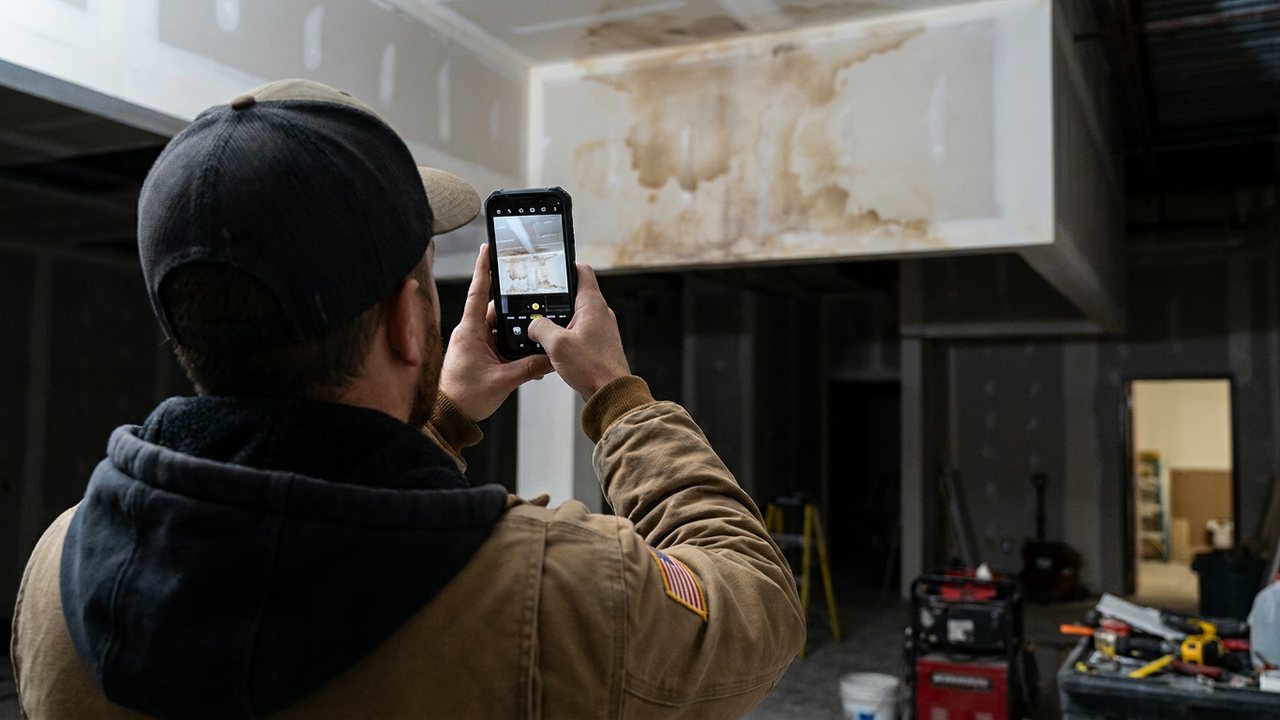
Your first notice of loss used to be read by a person. Now it’s increasingly pre-read by software — on the carrier’s side, flagging gaps before the examiner even opens the file.
Benekiva, a claims technology vendor for insurance carriers, just launched Kiva, an AI assistant that lives inside the examiner’s workbench. Its stated job: flag incomplete information before a claim moves forward and surface what needs attention next. Benekiva calls it “another set of eyes” supporting the examiner’s judgment, not replacing it. The company also claims its platform cuts carriers’ claims cycle times by up to 84%.
Kiva is one product from one vendor. But it’s the shape of what’s coming everywhere: the completeness check on your FNOL is becoming systematic, instant, and unforgiving. Here’s what that means for your operation.
What actually changed
Before: whether a thin FNOL got bounced depended on which examiner picked it up, how experienced they were, and how buried they were that week. A sharp examiner caught the missing moisture readings; a slammed one let it slide until the supplement.
Now: the check is designed to run on every file, every time, before the human even looks. Missing photos, no cause-of-loss narrative, vague measurements — flagged immediately and consistently, with no bad day or good mood changing the outcome.
This doesn’t mean the examiner is gone. Benekiva is explicit that Kiva supports judgment rather than substituting for it. It means the triage layer — the part that used to run on human inconsistency — now runs on software consistency. Your file gets graded before it gets read.
The new bar: complete on first submission
The shops that will feel this first are the ones running on “we’ll fill in the gaps later.” That workflow assumed a human would carry the file forward with partial information and circle back. Software doesn’t circle back. It flags.
A first-submission-complete FNOL package now means:
- Photos that tell the story alone. Wide, medium, tight on every affected area. If the examiner — or the AI — can’t reconstruct the loss from the photos, they’re incomplete.
- Measurements, not adjectives. “Large area of wet drywall” gets flagged. Dimensions, square footage, and moisture readings with locations don’t.
- A cause-of-loss narrative in plain language. What happened, when, what was affected. Two paragraphs that a non-technical reader can follow.
- Moisture mapping on water losses. Readings, locations, dates. This is the single most commonly missing element and the easiest for software to check for.
- Policyholder contact and access notes. Who to call, how to get in, whether the building is occupied. The unglamorous fields are the ones AI checks first.
None of this is new advice. What’s new is that it’s now enforced — by systems built to check every file instead of some of them.
Speed cuts both ways
Benekiva’s 84% cycle-time claim is their marketing number; treat it as direction, not fact. But the direction is real: carrier processing is getting faster, and that speed applies to rejections and deficiency notices too.
For the contractor who submits complete documentation, this is genuinely good news — faster approvals, fewer callbacks, shorter time from FNOL to work authorization. For the contractor submitting thin files, the friction arrives sooner and more often. The gap between the two shops is about to get wider, and it’s going to show up in cash flow.
The opportunity nobody’s talking about
Examiners are about to love the easy files more than ever. As completeness checks become systematic — every file scored before the human touches it — the clean submissions float toward the top of the queue naturally. No relationship-building required, no favors asked.
That makes FNOL completeness a competitive advantage, not just compliance. The contractor who systematizes it — a checklist, a template, a non-negotiable photo protocol — becomes the path-of-least-resistance vendor. Over time, faster approvals can turn into preferred status without a single lunch meeting.
Meanwhile, the shops still running on half a form and a phone call are about to discover what systematic friction feels like.
What to do Monday morning
- Audit your last ten FNOLs against the five-element list above. Count how many would pass a software completeness check on first submission. Be honest.
- Build the checklist into the job, not after it. The tech at the loss should be capturing the complete package before leaving the site — not reconstructing it from memory two days later.
- Photo protocol first. It’s the highest-leverage fix: wide-medium-tight, every room, every elevation, before any demo begins. If you fix nothing else, fix this.
- Stop treating the FNOL as paperwork. It’s the first impression your file makes, and now that impression is being formed by software. Write it like it matters, because the grading has already started.
The carriers aren’t waiting for you to catch up. Their AI is already in the workbench.
Sources
- Benekiva press release via PR Newswire, Oct. 7, 2026: “Benekiva Introduces Kiva, an AI-Enabled Claims Assistant Built to Support Claims Professionals” — https://www.prnewswire.com/news-releases/benekiva-introduces-kiva-an-ai-enabled-claims-assistant-built-to-support-claims-professionals-302900646.html
Carrier AI Is Now Grading Your FNOL. Here's the Playbook. — Visual Workflow
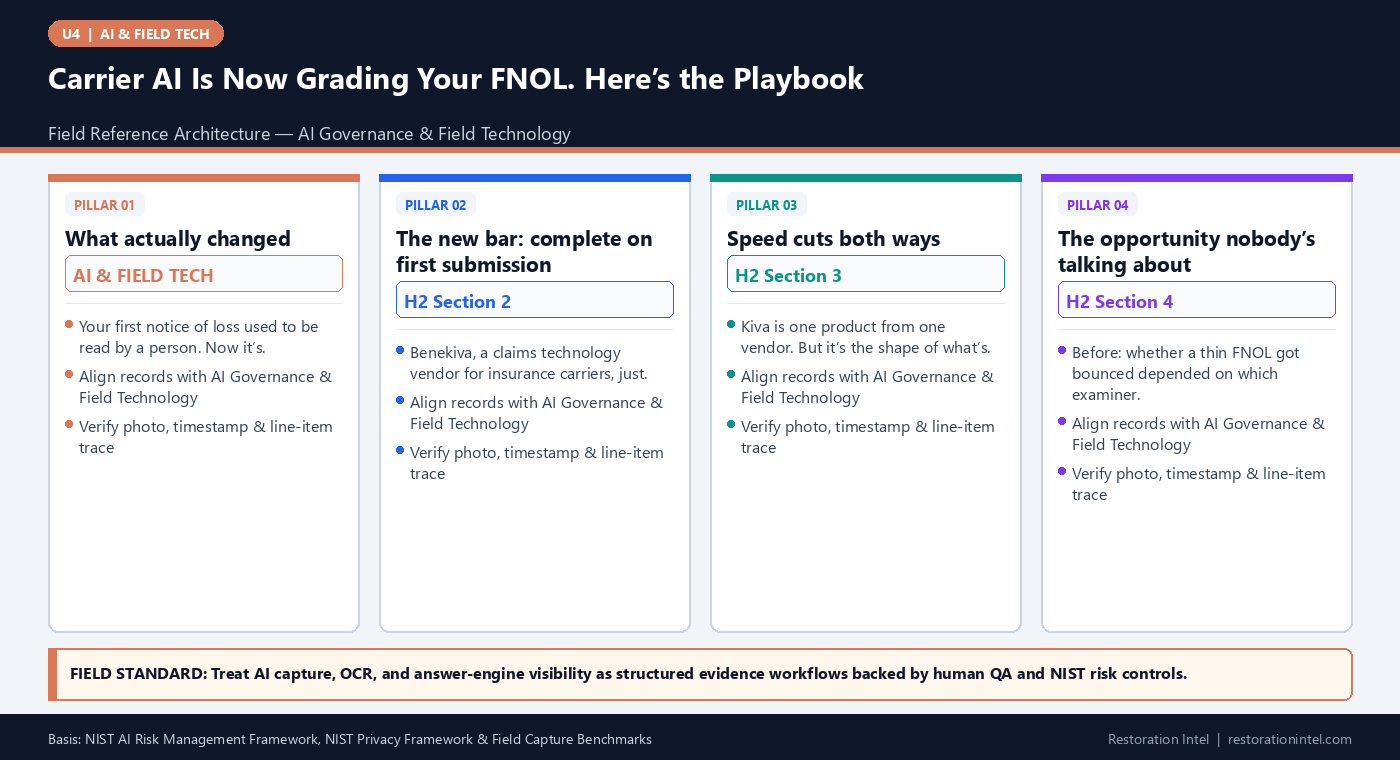
Field Benchmark & Decision Matrix
| FNOL Component | Legacy Human Tolerance | Automated AI Triage Check | First-Submission Pass Standard |
|---|---|---|---|
| Cause of Loss Note | Short phone summary fixed later | Parses event, date & affected assemblies | 2-paragraph plain-language cause narrative |
| Photo Documentation | Unlabeled mixed camera roll | Flags missing room coverage or context | Wide, medium, tight labeled per affected zone |
| Area Measurements | ‘Large wet drywall’ prose | Checks numeric SF/LF & room counts | Exact dimensions & sketch quantities attached |
| Moisture Mapping | Uploaded at job closeout | Flags water claims missing baseline readings | Initial meter readings, locations & dry standard |
| Missing-Item Kickback | Caught weeks later on supplement | Flagged pre-examiner in initial workbench | Pre-send completeness audit before upload |
Practitioner Operational Takeaways
- Assume software—not a slammed desk examiner—performs the first completeness audit on every FNOL and mitigation packet you upload.
- Replace vague scope adjectives with exact dimensions, room labels, and moisture-meter locations paired with an unaffected dry standard.
- Write a clean two-paragraph cause-of-loss narrative linking source, timing, and affected materials so automated summaries do not misclassify peril.
- Complete wide, medium, and tight photo sets on initial arrival so carrier triage tools route the claim forward instead of bouncing it.
Standards & Primary References
- Markdown Twin (.md)
- Benekiva Introduces Kiva AI Claims Assistant
- NIST AI Risk Management Framework
- Undocumented Mitigation Gets Stripped
Frequently Asked Questions
Does carrier workbench AI replace the human claims examiner?
No. Vendors like Benekiva state Kiva supports examiner judgment by pre-screening files for missing documents, incomplete narratives, and next actions before human review.
Why do 'fill it in later' FNOL workflows fail faster under AI triage?
Human examiners varied by workload and occasionally advanced thin packets; automated completeness checks flag missing moisture logs, dimensions, and photos consistently on every file.
What four elements make an FNOL packet pass automated pre-screening on day one?
Labeled wide/medium/tight photos, exact room measurements instead of adjectives, a two-paragraph plain cause-of-loss narrative, and initial mapped moisture readings.
.md twin for carrier and field review.