Published November 14, 2026. By Will Tygart · Restoration Intel Editorial Desk.
Direct answer. Uploading intimate residential walkthroughs and commercial clinic video to cloud AI exposes PII, family photos, financial records, security codes, and HIPAA protected health information — requiring strict zero-training-retention contracts, automated PII redaction, and clear vendor security governance.
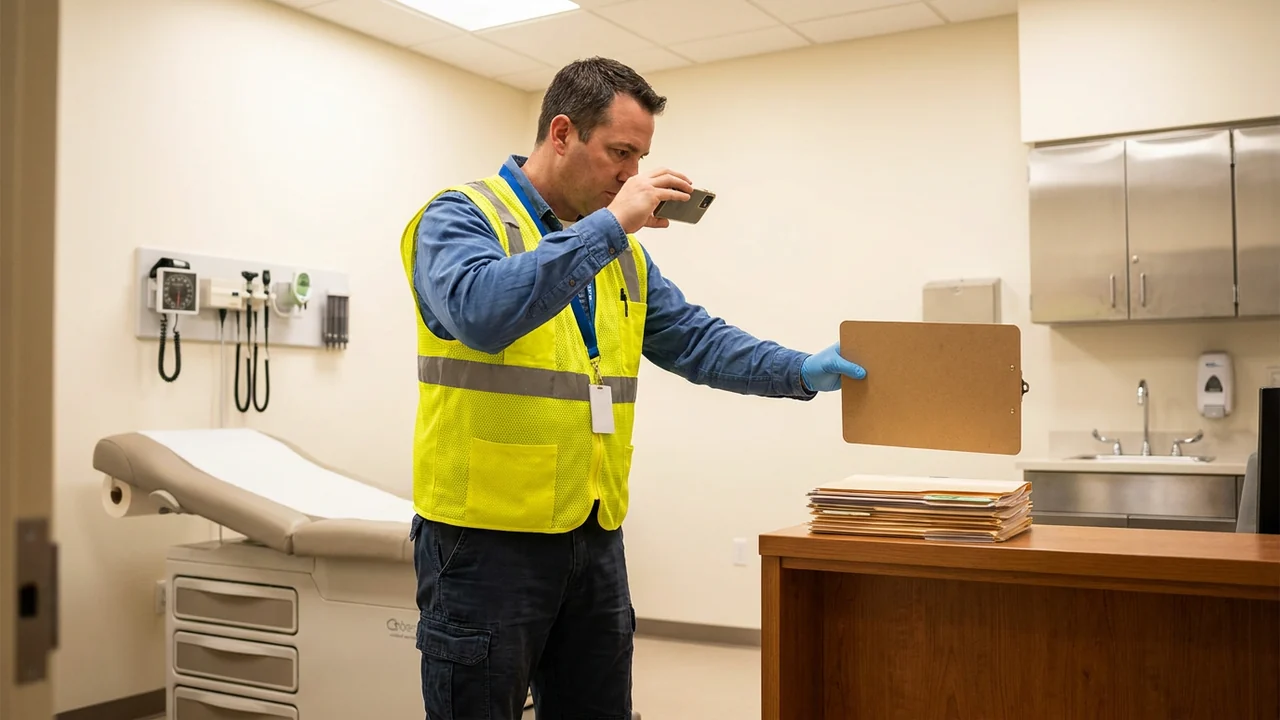
A residential pack-out technician walks down a hallway filming bedrooms, open nightstand drawers, home offices, and medicine cabinets. On commercial healthcare jobs, cameras cross dental operatories, exam counters, wall scheduling whiteboards, and prescription storage. Unlike generic warehouse barcode counts, full-room video and high-resolution stills capture everything visible in the background.
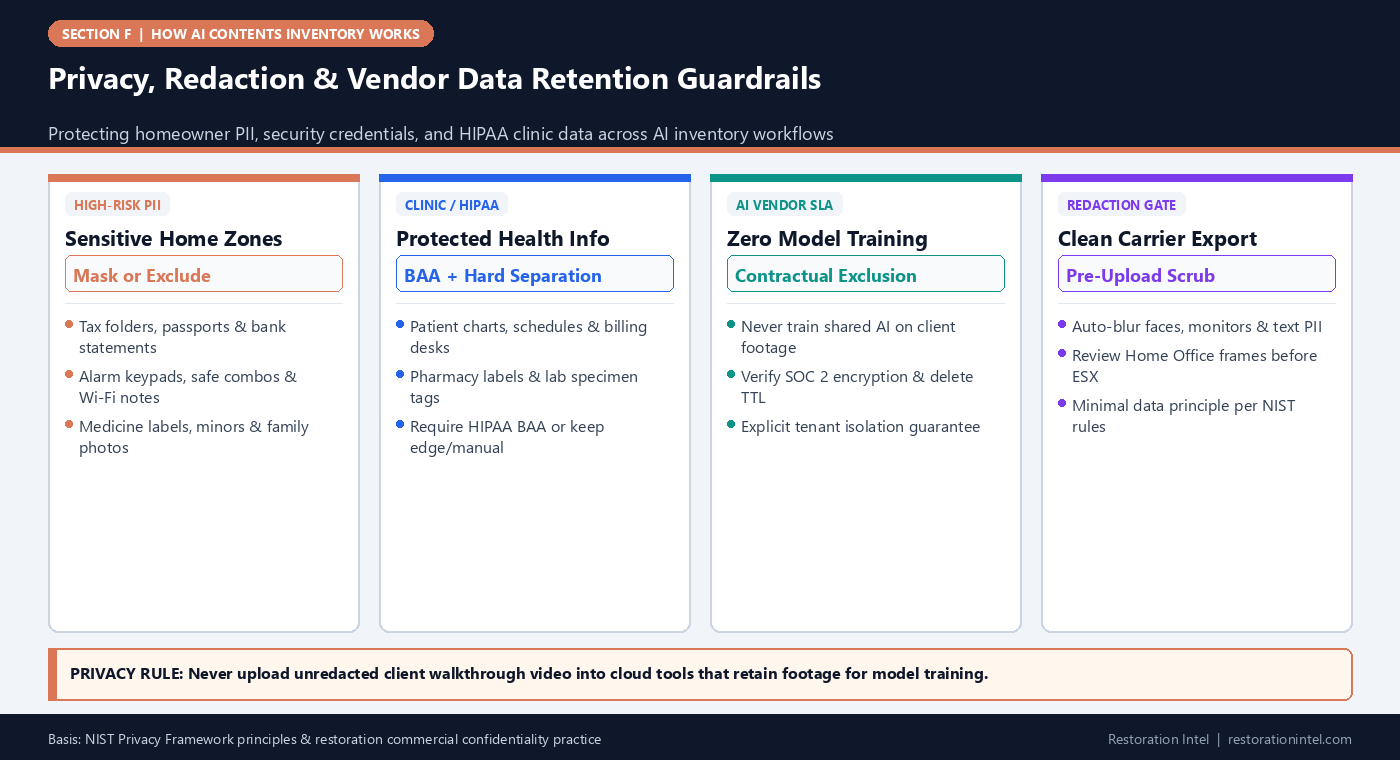
Shipping raw walkthrough footage into third-party cloud models introduces two distinct legal and reputational exposures: leaking sensitive personal or regulated records across shared carrier portals, and allowing outside software vendors to store or train future public AI models on policyholder homes and commercial clinics.
Sensitivity Risk Tiers & Redaction Rules in Contents Capture
| Content Exposed on Site | Privacy / Regulatory Risk | Technical & Crew Redaction Step | Contractual Vendor Requirement |
|---|---|---|---|
| Home Office Tax Docs / Bank Files / Passports | Identity theft & policyholder breach complaint | Fold/close loose desk binders or frame contents wide without macro paper text; apply blur masks | Zero third-party sharing + carrier export blur review |
| Prescription Bottles & Medical Records (Home) | Sensitive personal medical PII leaked into carrier claim packet | Group pill bottles out of line shots or blur Rx labels tightly before export | Strict retention TTL & access-controlled claim storage |
| Clinic / Dental Charts, Patient Screens & Labels | Federal HIPAA Protected Health Information (PHI) exposure | Require clinic staff to clear charts/screens first; capture equipment serials tightly; NO general cloud upload without executed BAA | Signed HIPAA Business Associate Agreement (BAA) or strict non-cloud local workflow |
| Alarm Panels, Safe Combos & Security Layouts | Physical property vulnerability inside insurer/subcontractor archives | Never photograph sticky-note passwords, alarm keypad codes, or safe combination notes | Tenant-encrypted cloud vaults + role-based employee access |
| Proprietary Industrial / Trade Secret Gear | Commercial R&D / NDA breach in lab/factory losses | Execute NDA boundary sweep with plant manager before filming tooling jigs | Contractual prohibition on AI model weight training (`Zero Training Retention`) |
Auditing AI Vendor Terms on Model Training and Data Retention
Consumer software licenses frequently include broad clauses allowing providers to retain uploaded images and audio clips indefinitely to ‘improve and train automated models’. In property insurance restoration — where footage records inside private bedrooms, gun safes, medical offices, and distressed businesses — allowing raw policyholder media to enter shared training pools creates unacceptable liability.
Grounded in data-minimization concepts in the NIST Privacy Framework, require written enterprise SLA guarantees specifying zero secondary training on customer footage, clear data deletion windows upon claim closure, encryption in transit/at rest, and sub-processor transparency.
- Verify HIPAA reality early: Do not assume a general residential property app maintains a signed Business Associate Agreement (BAA) — verify before walking into a single medical or dental clinic.
- Check audio tracks too: Voice memos recorded near distressed homeowners often capture family names, policy disputes, or personal phone numbers; strip stray chatter cleanly.
Practical Site Habits That Eliminate 90% of Privacy Scrubbing
Automated face and license-plate blurring helps, yet disciplined crews prevent most leaks before pressing record. During pre-capture walkthroughs, turn glowing computer monitors off or flip open patient schedules face-down (after documenting non-salvage conditions discreetly if damaged), ask homeowners to secure jewelry boxes/passports when safe, and frame rating plates tightly so open financial desks aren’t swept unnecessarily.
Controlling Downline Carrier & Subcontractor Access
Even clean AI pipelines fail privacy expectations if teams email uncompressed public cloud links across twenty subcontractor inboxes. Enforce role-based portal permissions and confirm exported PDF contact sheets carry only claim-relevant thumbnails rather than raw unredacted family walkthrough reels.
Field Execution Checklist
- Obtain written vendor contract clauses banning AI model training on client photos, video, and audio (`Zero-Training Guarantee`).
- Confirm HIPAA BAA compliance before uploading any healthcare, dental, or clinical footage to cloud servers — or switch to local/manual workflow.
- Keep alarm keypads, sticky-note passwords, passports, and bank statements out of macro shots and redact visible text PII.
- Enable automatic face/screen/license-plate redaction filters and inspect Home Office tabs prior to external carrier submission.
- Delete temporary capture media safely from crew devices once server sync and job archival conclude.
Related Restoration Intel Guides & Reference Standards
- Companion Brief (F-16): How to Evaluate Any AI Contents Inventory Vendor: 12 Verification Questions Beyond Marketing Demos
- Companion Brief (A-11): Photo-to-Line-Item Traceability Standards for Carrier Audit Readiness
- Companion Brief (F-01): How AI Contents Inventory Works End-to-End: From Field Capture to Carrier-Ready Schedule
- Companion Brief (F-14): Offline Queueing, Edge Compression, and Sync Reliability in Flooded Basements and Rural Dead Zones
- Internal Guide: The 2026 TPA Survival Guide
- Primary Authority: NIST Privacy Framework
- Primary Authority: NIST AI Risk Management Framework
- Primary Authority: ANSI/IICRC S320 Standard for Professional Contents Restoration
Frequently Asked Questions
Can AI vendors train future models on my company's residential loss photos?
Only if their Terms of Service allow it — demand explicit written zero-training and tenant-isolation clauses before adopting enterprise tools.
What must restoration teams check before using cloud AI inside a medical or dental clinic?
Verify whether Protected Health Information (patient charts, whiteboards, prescription labels, screen names) appears anywhere and confirm a signed HIPAA BAA covers your vendor pipeline.
Does redacting family portraits or tax folders hurt claim proof?
No. Masking personal names, prescription identifiers, or framed faces satisfies carrier documentation while protecting client privacy.
Should crews record homeowners talking during emotional loss walkthroughs?
Avoid recording sensitive personal discussions inside inventory voice tracks; capture concise asset descriptions clearly on separate capture passes.
.md twin (data-privacy-redaction-model-retention-home-clinic-footage.md).