Published November 14, 2026. By Will Tygart · Restoration Intel Editorial Desk.
Direct answer. Every invoiced or scheduled contents line item above de minimis lot thresholds needs an unbroken, timestamped link from wide room context to item identity and peril damage proof — preventing bulk-line carrier disallowances and unverified-disposal disputes.

Nothing stalls a large contents settlement faster than a carrier audit folder containing 1,400 unindexed `IMG_4812.JPG` files alongside a 500-row Excel schedule. Even if every single item genuinely sat inside that burned house, asking an adjuster to hunt manually through raw photo dumps invites suspicion, fatigue, and blanket line reductions.
Photo-to-line-item traceability converts raw job-site photography from a passive archive into structured claim proof. Every scheduled entry — whether cleanable pack-out or total-loss non-salvage — inherits a direct, verifiable visual chain showing where the object stood, what tier/brand it represented, and why the loss peril forced the scoped action.
Minimum Photo Traceability Requirements by Schedule Action
| Line Disposition | Required Photo Links | Where Must Proof Be Shot? | Common Audit Failure | Carrier Consequence |
|---|---|---|---|---|
| Pack-Out & Cleanable Hard/Soft Goods | Room overview + open box/group tray + pre-clean condition | On-site prior to wrapping; arrival check if damaged | Only wrapped box exterior photographed | Cleanability labor or transit damage disputed |
| High-Value / Tier 1 Assets (>$500) | Room context + full front view + close rating/maker plate | In room location prior to move | Glare-clipped label or missing brand tag | Price cut down to generic entry-level LKQ |
| Total-Loss Non-Salvageable Items | Room context + close peril damage (char/swelling/cat 3 mark) + serial | IN PLACE prior to removal or haul-out | Items hauled to roll-off dumpster before macro shot | Outright disallowance of total-loss replacement lines |
| Approved Bulk Lots (<$25 Smalls) | Open drawer/shelf/container overview showing entire visible layer | In room drawer/shelf open 75%+ | Closed box lid photo with claimed item counts | Bulk lot rejected as unsubstantiated |
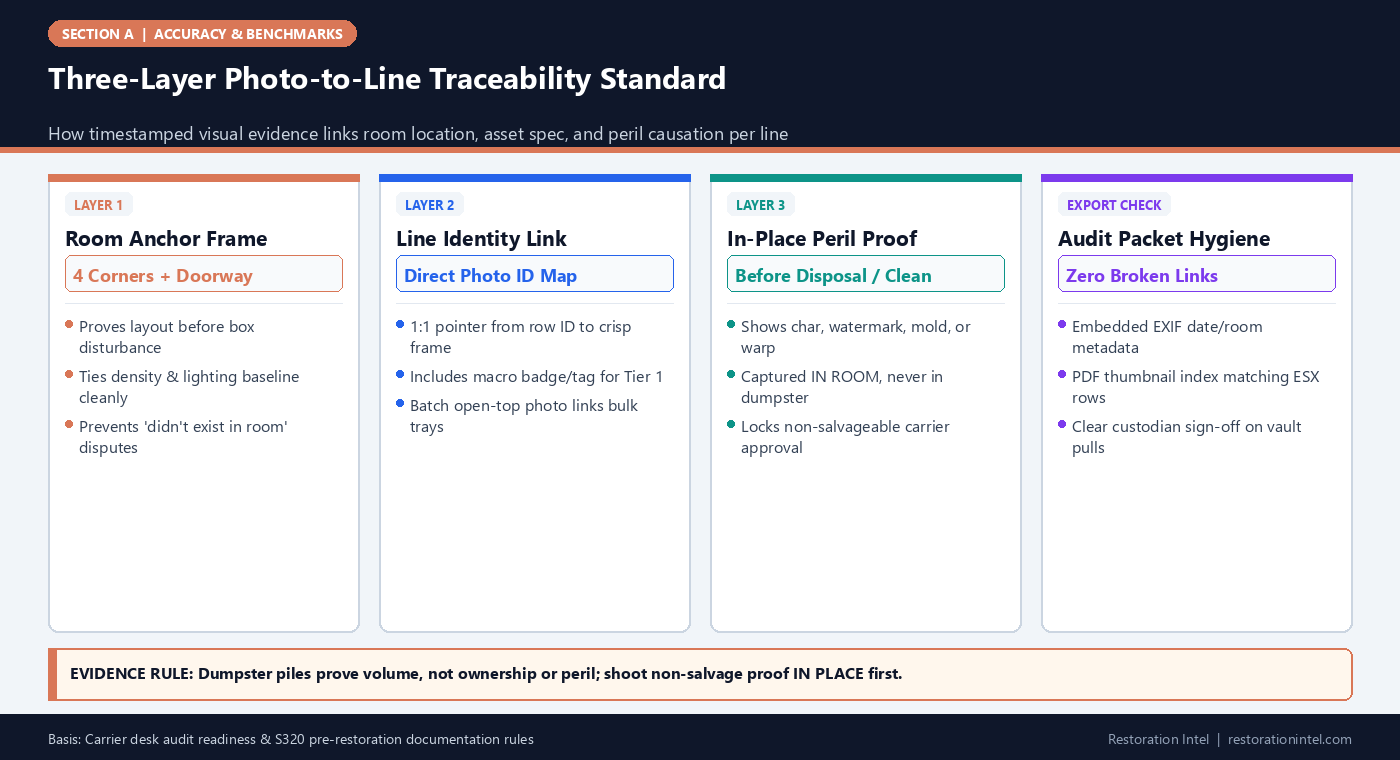
The Fatal Trap of Post-Disposal Dumpster Photos
During chaotic emergency flood and fire stabilizations, crews naturally clear ruined sofas, soaked mattresses, and collapsed particleboard fast to make space for drying equipment. Too often, someone shoots three wide pictures of a filled roll-off dumpster on day two and assumes that qualifies as total-loss documentation.
Carriers routinely reject dumpster photos because compressed debris piles hide brand identity, original quantity, and pre-loss room placement. As emphasized across TPA contents file hygiene rules, non-salvageable evidence must be captured in place before items cross the threshold.
- Tag-and-shoot workflow: Carry contrasting paint markers or numbered disposal cards; place the line number beside the ruined asset in situ before demo crews pull it.
- Preserve EXIF metadata: Never strip timestamps via compressed messaging apps (SMS/WhatsApp) — transfer native files cleanly into your job repository.
Naming and Indexing Photos for Instant Examiner Navigation
Whether exporting natively through XactContents, Symbility, or a companion PDF schedule, every line item number in your CSV/ESX should reference explicit image IDs or embedded contact sheets sorted by room. If an examiner opens Line 142 (`Kitchen — Espresso Machine`) and clicks straight into three crisp images showing countertop placement, brand fascia, and thermal smoke blistering, approval takes ten seconds.
Adding a clean room-index table at the top of large photo supplements — grouping Bedroom 1, Pantry, and Garage into clearly labeled sections — saves carrier desk staff twenty minutes of blind scrolling and signals disciplined operational management before they scrutinize a single price line.
- Include a concise photo caption tying Line Number + Room + Disposition (`Line 142 | Kitchen | Non-Salvage Heat Warp`) on PDF contact sheets.
- Check export file payload weight before upload so embedded thumbnails remain razor-sharp without timing out carrier claim portals.
Handling Private Rooms and HIPAA/PII Boundaries During Linking
Traceability never excuses careless exposure of sensitive client records. When shooting residential home offices, prescription counters, or medical clinics, exclude family social security forms, open laptop screens, and patient charts from line-linked galleries or blur personal fields before packaging carrier packets — a discipline detailed further in our brief on data privacy and redaction.
Field Execution Checklist
- Shoot 4-corner room orientation anchors before moving a single box or piece of damaged furniture.
- Require an explicit photo ID or contact-sheet link for every scheduled row above $25 before exporting packets.
- Verify every non-salvageable total-loss item has sharp IN-PLACE peril damage proof prior to haul-out or demolition.
- Transfer native camera files directly rather than texting through lossy messaging apps that strip timestamps.
- Scrub visible PII, family medical bottles, or clinic PHI from exterior frames before uploading to carrier portals.
Related Restoration Intel Guides & Reference Standards
- Companion Brief (A-04): Brand and Model Identification Accuracy: Where Field Capture Fails Under Loss Conditions
- Companion Brief (A-08): First-Pass Adjuster Acceptance Rate: Defining the Industry Metric That Actually Drives Cash Flow
- Companion Brief (F-15): Data Privacy Redaction Model Retention Home Clinic Footage
- Internal Guide: Contents Cleaning SLAs by Category
- Internal Guide: A Price Tag on a Lost Item Is Worth Nothing
- Primary Authority: ANSI/IICRC S320 Standard for Professional Contents Restoration
- Primary Authority: Verisk XactContents Platform Overview
- Primary Authority: Verisk Property Claims Solutions
- Primary Authority: NIST Privacy Framework
Frequently Asked Questions
Do carriers require individual photos for every $5 household item?
No. Open-drawer or shelf overview photos clearly showing the density and type of grouped commodities are standard, while individual proofs focus on Tier-1 assets and non-salvageable replacements.
Why do WhatsApp or iMessage transfers hurt photo audit readiness?
Consumer messaging apps recompress images heavily, often blurring small rating-plate text and stripping original capture timestamps needed for clean timeline verification.
What proves an electronic item failed without visible fire char?
Pair physical site placement photos (waterline/soot halo) with serial number close-ups and an authorized technician bench diagnostic or megohm/corrosion teardown report.
How many photos per room is excessive?
Quality beats bloat: 4 room anchors, crisp close-ups on Tier-1 serials/damage, and clean open-container trays beat 300 blurry duplicate bursts.
.md twin (photo-to-line-item-traceability-standards-carrier-audit.md).