Published November 14, 2026. By Will Tygart · Restoration Intel Editorial Desk.
Direct answer. Modern AI contents inventory systems run a six-stage pipeline — field media ingestion, visual detection and speech alignment, OCR/spec enrichment, spatial-temporal deduplication, carrier taxonomy + LKQ pricing lookup, and confidence-routed human QA — before exporting structured schedules to XactContents, Symbility, or CSV.

Marketing decks often present AI contents software as single-click magic: record a room walk, push a button, collect an approved check. In reality, turning chaotic residential or commercial property damage footage into a carrier-defensible estimate involves a multi-stage engineering pipeline where each step depends on clean handoffs from the stage before it.
Understanding the full architecture helps restoration leaders avoid two opposite traps highlighted in The $7,986 Hiding in Your Xactimate and A Price Tag on a Lost Item Is Worth Nothing: pricing automation without physical custody linkage solves half a claim, while blind trust in unverified object detection creates desk-review rework.
Stage-by-Stage AI Contents Inventory Pipeline Breakdown
| Pipeline Stage | Primary Technical Input | Core System Output | Where Real-World Errors Enter | Required Human Control |
|---|---|---|---|---|
| 1. Field Media Ingestion | Walkthrough video, macro stills, room tags, voice notes | Timestamped local/cloud media bundle by room | Basement LTE drops, rushed camera pans, sealed closets | Confirm local upload parity & open closed doors |
| 2. Vision & ASR Parsing | Decoded keyframes + transcribed technician speech | Raw object detections (`chair`, `blender`) + audio hints | Occlusion depth, dark corners, overlapping background noise | Spot-check messy pantries & spoken unit counts |
| 3. Attribute & OCR Enrichment | Zoomed patches, rating-plate crops, brand logos | Draft brand, model string, material & quality guess | Flash glare over metal stickers; 0/O and 8/B OCR swaps | Verify Tier-1 appliance/tool serials against photo |
| 4. Deduplication Clustering | Visual embeddings + frame sequence + timestamps | Consolidated unique item list without double counting | Relocated hallway items; split-shift morning/afternoon reshoots | Run pre-export duplicate sweep by serial & room border |
| 5. Taxonomy & LKQ Pricing | Enriched item specs + depreciation/carrier tree rules | Mapped XactContents/Symbility code + RCV/ACV draft | Third-party reseller spikes or default ‘Average’ tier downgrades | Approve outliers & attach authorized retail comps |
| 6. HITL QA & Custody Export | Confidence scores + photo links + box barcode IDs | Carrier-ready ESX/CSV + PDF photo contact sheet | Disconnected pack-out vault custody numbers vs line list | Enforce First-Pass QA release checklist before send |
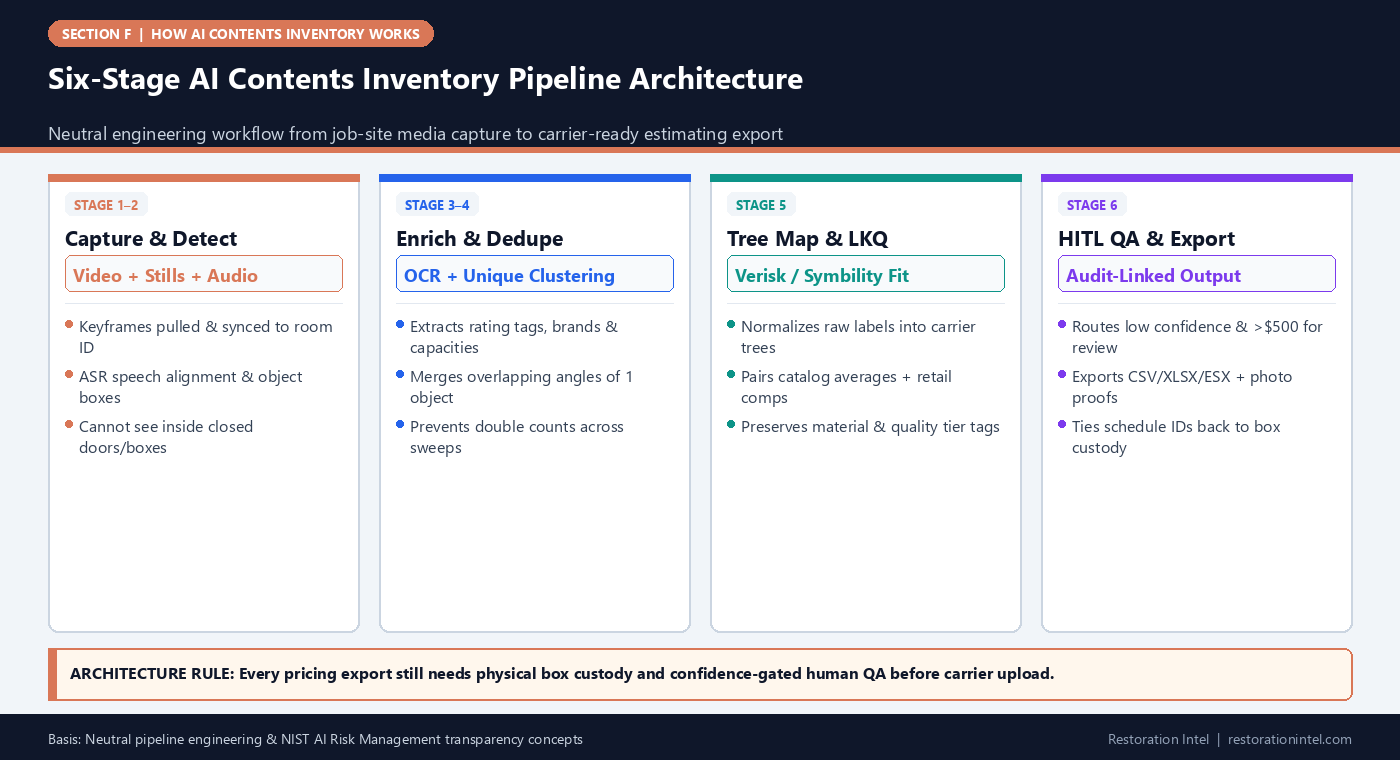
Why AI Pipelines Depend Heavily on Capture Order
Automated software cannot reconstruct surfaces the camera never observed. If a technician walks through a kitchen filming only waist-high counters at walking speed, no downstream neural model can see inside lower pot drawers, behind tall pantry cereal boxes, or on the underside nameplate of an espresso machine.
Teams getting strong mileage out of AI capture treat the technician as a disciplined camera operator: sweep four room corners slowly, open every cabinet door on camera, voice-narrate quantities and hidden materials concisely, and pause to snap sharp macro stills on high-value serial plates.
- Capture-time discipline shrinks office QA: Spending two extra minutes stabilizing room walks routinely cuts fifteen minutes of estimator guessing later.
- Never swap pricing speed for box custody: As A Price Tag on a Lost Item Is Worth Nothing explains, pricing software must hand clean item IDs cleanly to vault/box custody ledgers.
Where Human-in-the-Loop QA Sits in Production Workflows
Aligned with governance principles inside the NIST AI Risk Management Framework, production restoration teams never push raw, uninspected model outputs directly to an adjuster desk. High-confidence everyday lines (standard kitchenware, linens, bedroom chairs) clear rapidly, while confidence thresholds route sublimit items, illegible serials, high-dollar equipment, and dense bulk lots straight to estimator review.
Separating reliable automation from risk-gated human sign-off keeps turnaround fast without sacrificing carrier audit trust.
Evaluating Export Compatibility Before Changing Operations
A pipeline only finishes when structured schedules land cleanly inside XactContents, Symbility, or carrier claim packets without losing room names, depreciation categories, or photo traceability. Before adopting any system, verify round-trip export integrity using an internal blind room audit.
Field Execution Checklist
- Audit every stage from Field Ingestion -> Detection -> OCR -> Dedupe -> Tree/LKQ -> HITL QA independently rather than judging demos overall.
- Enforce open-cabinet and paused-macro capture habits on site because vision models cannot invent occluded interiors.
- Preserve tight photo-to-line URLs or contact sheets all the way through XactContents/Symbility export.
- Keep physical barcode/vault custody integrated cleanly alongside AI item pricing so warehouse accountability stays unbroken.
- Gate every carrier submission on estimator sign-off covering low-confidence flags, Tier-1 serials, and pricing outliers.
Related Restoration Intel Guides & Reference Standards
- Companion Brief (F-02): Computer Vision Object Detection in Messy Loss Rooms: Capabilities and Hard Physical Limits
- Companion Brief (F-08): Taxonomy Mapping: Translating Raw AI Object Labels Into XactContents and Carrier Category Trees
- Companion Brief (F-10): Confidence Scoring and Human-in-the-Loop (HITL) Escalation Thresholds in AI Contents Workflows
- Companion Brief (F-13): Verisk XactContents, CoreLogic Symbility, and Spreadsheet Export Mechanics: Where AI Integrations Actually Break
- Internal Guide: A Price Tag on a Lost Item Is Worth Nothing
- Internal Guide: The $7,986 Hiding in Your Xactimate
- Primary Authority: NIST AI Risk Management Framework
- Primary Authority: Verisk XactContents Platform Overview
- Primary Authority: Symbility Claims Support Portal
- Primary Authority: ANSI/IICRC S320 Standard for Professional Contents Restoration
Frequently Asked Questions
Does AI contents software replace the contents estimator?
No. It shifts estimator labor from repetitive typing and photo sorting toward reviewing low-confidence lines, verifying high-dollar LKQ matches, and defending total-loss triage.
Can AI inventory tools inspect closed boxes automatically?
No. Responsible pipelines flag closed boxes and opaque totes as sealed containers requiring human inspection or explicit box-lot labeling rather than guessing hidden contents.
What formats do carriers require from AI exports?
Adjusters typically ingest structured XactContents-compatible imports, Symbility line formats, or formatted CSV/XLSX schedules paired with linked PDF/image evidence sheets.
Why do two AI demos perform differently on clean vs cluttered rooms?
Clean living rooms showcase ideal bounding boxes, while messy loss scenes expose occlusion, dark low-light noise, motion blur, and taxonomy edge cases.
.md twin (how-ai-contents-inventory-works-photo-to-priced-schedule.md).