Direct Answer: True antiques, original fine art, rare collectibles, precious-metal bullion, and appreciated items do not lose economic value through ordinary physical wear and should carry zero standard depreciation—though recovery hinges on documented provenance, independent appraisals, and strict policy sublimits or scheduled floaters.
.md twin for estimator QA and carrier file documentation.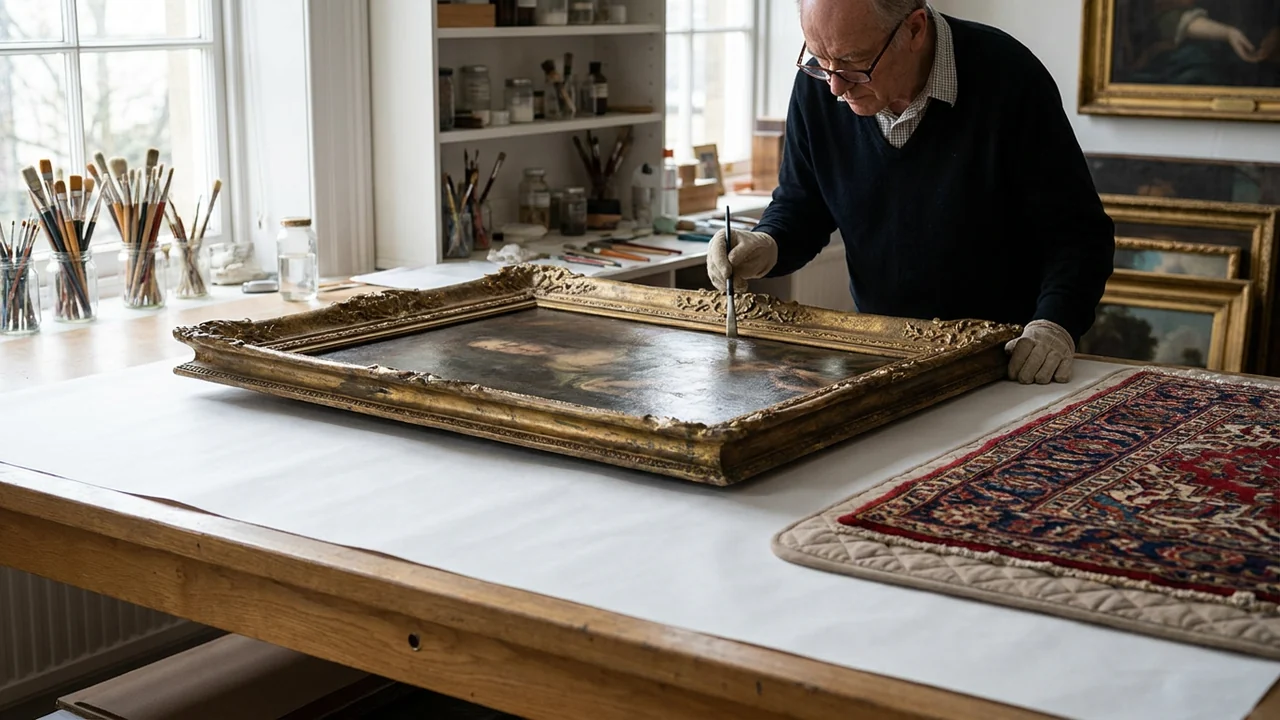
Putting an 1890s Chippendale chest, an original oil landscape, a graded vintage watch, or a tube of gold bullion through a standard useful-life depreciation table produces instant absurdity. If software divides 130 years of age by a 25-year furniture lifespan, it tries to value a museum-grade antique at zero dollars—ignoring the reality that age and scarcity drove its market value up rather than down.
Yet claiming ‘zero depreciation’ casually is equally dangerous if an estimator labels every old garage dresser an ‘antique’ without proof. In property claims under ISO HO 00 03, HO 04 90, and commercial fine-arts floaters, zero-depreciation categories follow completely different valuation rules—shifting from retail RCV-minus-wear to fair market value, comparable auction results, bullion spot pricing, or agreed scheduled value. Understanding both the zero-depreciation principle and the strict sublimits attached to these classes protects claim accuracy from intake through appraisal.
Zero-Depreciation Valuation Rules & Policy Cap Reality
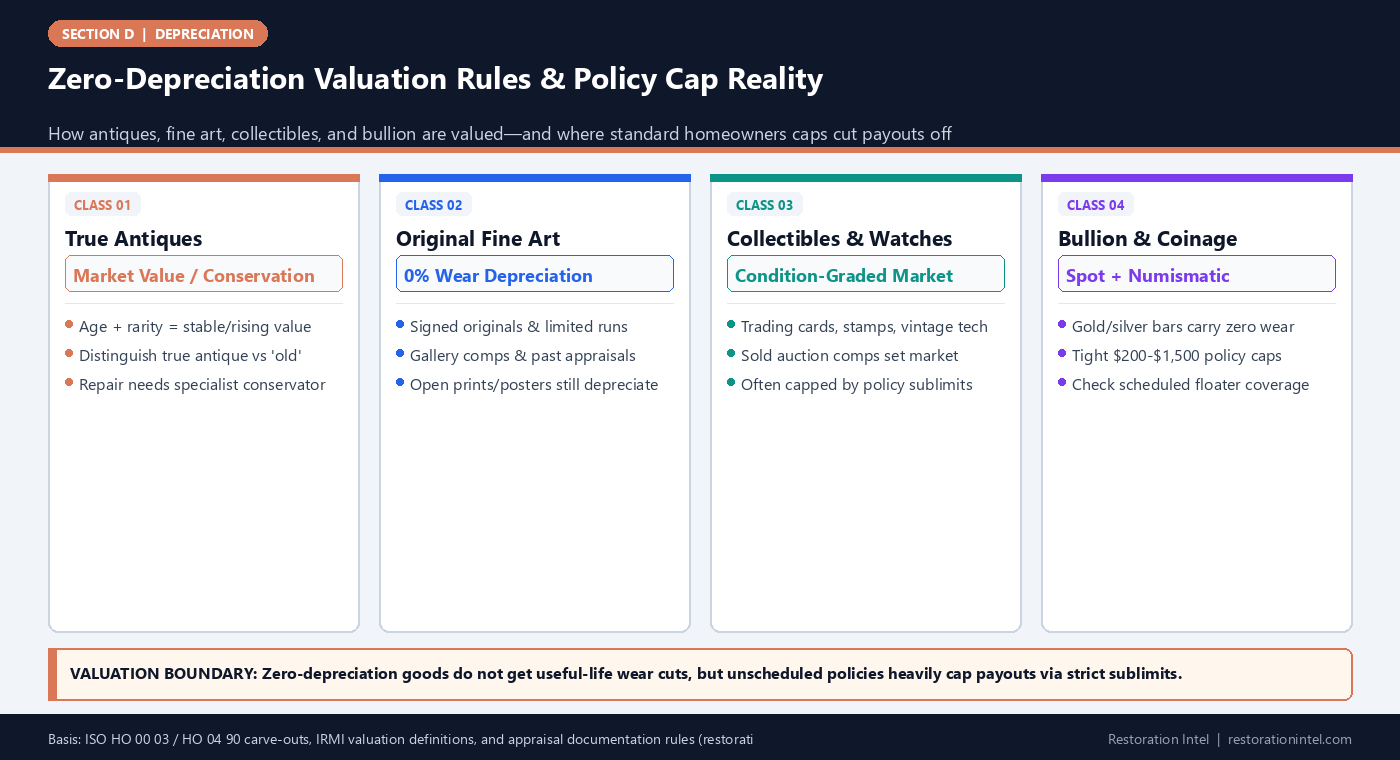
Valuation Method and Policy Exposure Across Zero-Depreciation Property Classes
How non-depreciating categories are substantiated and where unendorsed homeowners policies restrict recovery.
| Property Category | Why Standard Depreciation Fails | Accepted Valuation Basis | Typical Unscheduled Policy Risk | Required Proof File |
|---|---|---|---|---|
| True Antiques (Typically 100+ yrs or documented period piece) | Patina and historical age preserve or enhance market demand | Fair Market Value / qualified antique appraisal or auction comps | Excluded from HO 04 90 RCV; settled at market value only | Maker marks, joinery photos, provenance, realized auction comps |
| Original Fine Art & Sculpture | Artistic value depends on artist market, not physical wear | Gallery appraisal, artist catalog, or scheduled agreed value | Low theft/loss visibility if unscheduled; high conservation costs | Signature close-up, certificate of authenticity, pre-loss appraisal |
| Rare Collectibles (Coins, Comics, Memorabilia, Wine) | Scarcity and grade drive price; physical utility is secondary | Sold auction prices (Heritage/PCGS/eBay Sold) for exact grade | Strict sublimits on money, numismatics, or memorabilia | Slab/grade numbers, provenance, realized—not asking—prices |
| Precious Metal Bullion & Coins | Elemental metal weight does not deteriorate physically | Daily metal spot price on loss date + verified fabrication premium | Very low HO 00 03 special limits (often $200 money/bullion) | Purchase invoices, assay certificates, vault/safe photos |
| High-Horology / Vintage Watches & Jewelry | Certain heritage references appreciate above original MSRP | Secondary dealer comps or scheduled personal articles floater | Standard HO theft caps ($1,500 jewelry) unless scheduled | Serial/reference numbers, box/papers, jeweler appraisal |
Why Useful-Life Depreciation Does Not Apply—and What Replaces It
Physical depreciation measures the decline in remaining useful life caused by consumption, wear, and technological obsolescence. An original oil painting hanging on a parlor wall, a 19th-century solid mahogany secretary desk, a graded 1952 baseball card, and a 10-ounce gold bar are not consumed by daily operation. Under IRMI depreciation principles and IRS Publication 547 market-value concepts, items whose economic worth stems from scarcity, artistry, or metal content suffer zero standard age depreciation.
However, ‘zero depreciation’ does not mean ‘blank check’ or automatic new-replacement pricing. Because true antiques and original artworks are one-of-a-kind or out of production, standard policies—including HO 04 90—specifically exclude antiques, fine arts, memorabilia, and collectors items from new Replacement Cost settlement, paying Fair Market Value (or Scheduled Agreed Value if endorsed) instead.
- Distinguish ‘antique’ from ‘used old furniture’: A 35-year-old mass-produced oak bookshelf is used furniture subject to condition/lifespan valuation, not a non-depreciating antique.
- Use realized sold comps, never asking prices: Online auction asking prices prove nothing; completed, verified sales of identical grade/artist establish market value.
- Never confuse decorative prints with fine art: Mass-produced framed posters and open-edition giclee decor still depreciate under standard wall-decor schedules.
The Sublimit Shock: Why Scheduled Floaters Change Everything
When estimating zero-depreciation goods, checking policy sublimits and Scheduled Personal Property endorsements is mandatory before spending hours gathering valuations. An unendorsed ISO HO 00 03 policy imposes severe special limits on specific categories: commonly $200 on money, bank notes, bullion, gold, and silver; $1,500 on securities, accounts, and stamps; and $1,500 on theft of jewelry, watches, and furs.
If an insured holds $45,000 in gold coins under an unendorsed homeowners policy without a scheduled floater, arguing about spot premiums will not move recovery past the $200 policy cap. Conversely, when fine art or heirloom watches carry a Scheduled Personal Property endorsement or commercial Fine Arts Floater, recovery often shifts to Agreed Value—meaning zero depreciation and zero deductible.
- Audit declarations for scheduled riders first: Look for ‘Scheduled Personal Property’, ‘Valuable Articles’, or commercial Inland Marine floaters.
- Watch peril-specific sublimits: Some sublimits (such as jewelry or silverware) apply primarily to theft rather than fire or water—read the exact clause.
- Coordinate specialist conservators early: Under fine-art policies, partial damage often pays conservation cost plus documented loss-in-value (diminution) rather than total loss.
Custody, Stabilization, and Conservation vs Ordinary Cleaning
Restoration field crews face acute liability when handling fine art, antiques, and collectibles. Running ordinary alkaline degreasers, ozone chambers, or aggressive ultrasonic baths over historic oil varnish, shellac French polish, gilding, or vintage paper memorabilia can destroy 90 percent of collector value in five minutes—even though the dirt appears gone.
Per ANSI/IICRC S320 specialty-contents standards, suspected fine art, antiques, and rare collectibles must be segregated immediately, documented in place, and triaged by a credentialed art/object conservator rather than standard house-wash crews. Custom wood crating and climate-stable vaulting prevent secondary cracking or warping while appraisal proceeds.
- Zero-touch rule on suspected valuables: Do not wipe soot off historic canvases, antique clocks, or gilt frames without conservator sign-off.
- Preserve fragments and provenance boxes: Damaged shards, original certificates, watch boxes, and graded slabs remain essential for market valuation.
- Verify diminution of value coverage: Even after expert conservation, repaired collectibles may suffer permanent market-value loss covered under specialty floaters.
Building an Appraisal-Grade File for Desk Adjusters
Desk examiners routinely reject ‘Zero Depreciation’ overrides when an estimator simply types ‘Antique’ into a spreadsheet cell without supporting evidence. To pass audit cleanly, every zero-depreciation line needs a concise three-part packet: physical authentication photos (signatures, hallmarks, joinery, serial/slab numbers), provenance or purchase history, and an independent third-party valuation.
For items under $2,500, three comparable realized auction or dealer sales of identical edition and condition often satisfy desk review. For items above $2,500—or contested fine art and heirloom pieces—engaging an accredited personal property appraiser (ISA, ASA, or AAA) early prevents prolonged stalemate and positions the file cleanly if the claim enters formal appraisal.
- Separate schedule tab for specialty/zero-dep items: Keep fine art, bullion, and antiques cleanly segregated from standard household RCV/ACV tables.
- Cite objective auction databases: Record lot numbers, sale dates, dimensions, and condition grades from verifiable sales.
- Retain damaged goods for inspection: Never dispose of allegedly total-loss fine art or antiques without written adjuster and insured sign-off.
Practitioner Verification Checklist (D-11)
- Review policy declarations immediately for Scheduled Personal Property riders, Inland Marine floaters, and special category sublimits.
- Segregate true antiques, original fine art, collectibles, and bullion onto a separate valuation schedule with 0% physical depreciation.
- Segregate mass-produced decorative prints and ordinary ‘old’ furniture onto standard depreciation schedules so zero-dep credibility stays intact.
- Enforce a strict no-cleaning hold on suspected fine art and antiques until a qualified conservator inspects and approves handling.
- Attach provenance photos (signatures, hallmarks, slab IDs) and realized auction sales or accredited appraiser reports for every zero-dep claim.
Standards, Authority References & Related Reading
Primary standards, insurance definitions, and sibling Restoration Intel guides referenced in this brief:
- IRMI Insurance Glossary: Depreciation
- IRMI Insurance Glossary: Actual Cash Value (ACV)
- IRS Publication 547: Casualties, Disasters, and Thefts
- ANSI/IICRC S320 Standard for Professional Contents Restoration
- Related Guide: Furniture Valuation and Depreciation: Solid Wood vs Veneer, Upholstery Grade, and Custom Joinery
- Related Guide: How Gift Items, Inherited Goods, and Missing Receipts Are Valued and Depreciated
- Related Guide: Sublimit Allocation Strategy When Total-Loss Specialty Items Exceed Policy Caps
- Related Guide: Field Guide: Art, Mirror, and Marble Slab Crating & Edge-Protection Specs
- Related Guide: The Specialty Codes
.md twin for desk QA and team training.Frequently Asked Questions
Do antiques and fine art depreciate on an insurance contents schedule?
No. True antiques, original fine art, rare collectibles, and bullion do not lose value from physical wear and should not be run through useful-life depreciation tables. Instead, they are valued at Fair Market Value or Scheduled Agreed Value.
What makes an item a true antique vs simply old used furniture?
Generally, true antiques possess documented historical period craftsmanship, rarity, or collector demand (commonly 100+ years old or recognized mid-century/design icons), whereas ordinary 20- to 40-year-old mass-market furniture remains standard depreciated property.
Why do unendorsed homeowners policies pay so little for gold bullion or rare coins?
Standard HO 00 03 policies contain strict special limits—commonly $200 for money, bullion, gold, and silver—unless the policyholder purchased a Scheduled Personal Property endorsement or separate floater.
Should restoration crews clean smoke off oil paintings or antique frames during pack-out?
No. Standard restoration chemicals and dry-cleaning sponges can strip historic varnishes and destroy collector value. Fine art and antiques should be documented in place and routed to a credentialed conservator.