Direct Answer: When total-loss jewelry, firearms, silverware, cash, or home-business equipment exceed Coverage C special limits of liability, practitioners maximize lawful recovery by strictly separating capped items from uncapped personal property, proving whether peril exceptions apply (such as fire vs theft caps), and verifying policy wording on deductible and depreciation ordering.
.md twin for estimator QA and carrier file documentation.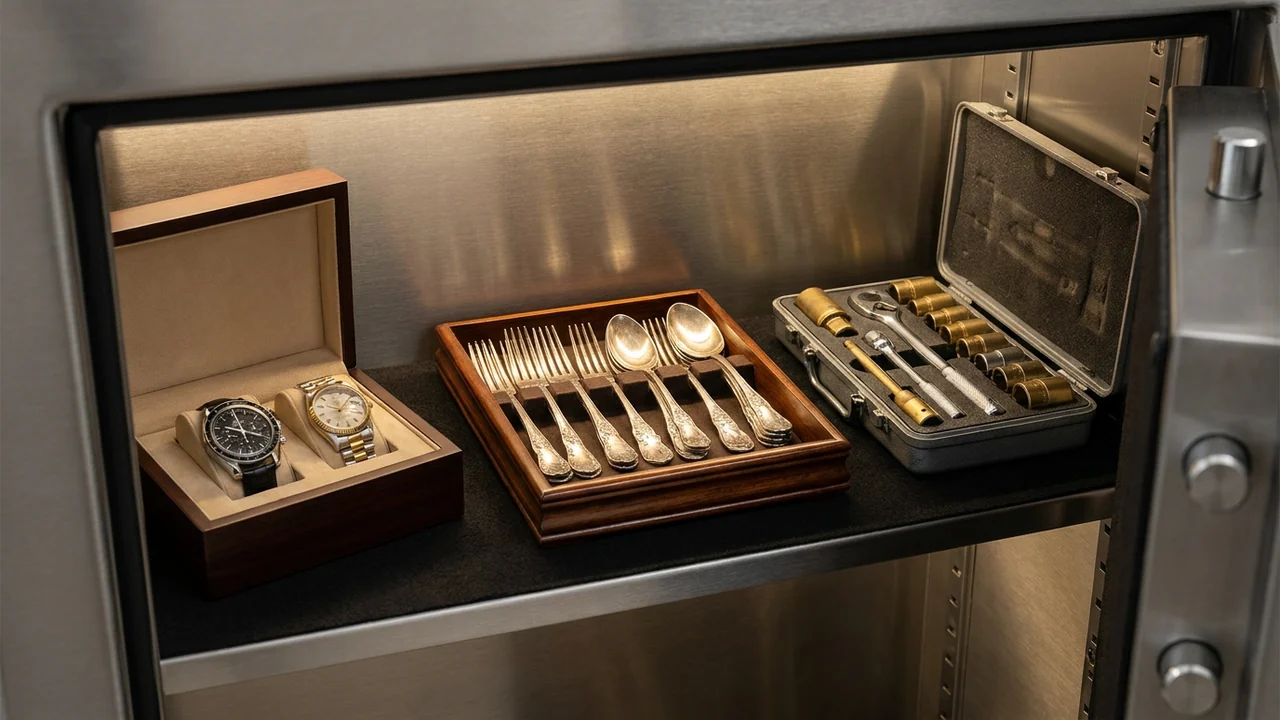
Every standard homeowners policy hides a set of narrow dollar ceilings inside Coverage C called Special Limits of Liability. Even when a home carries $250,000 in total personal property coverage, standard unendorsed ISO forms cap specific categories—such as money and bullion, watercraft, trailers, jewelry/watches/furs (often for theft), firearms and related equipment, silverware/goldware, and business property on or away from the residence premises—at tight flat ceilings.
On a major fire or water loss, clumsy classification can cost a policyholder thousands of dollars even within completely legitimate coverage bounds. When an estimator dumps a homeowner’s hobby workshop tools into ‘business property,’ tags sterling-plated serving bowls as ‘silverware,’ or ignores whether a sublimit applies *only to theft* versus *all perils*, the desk system truncates payouts automatically. Disciplined sublimit allocation inside claims valuation workflows ensures every dollar stays in its rightful policy bucket.
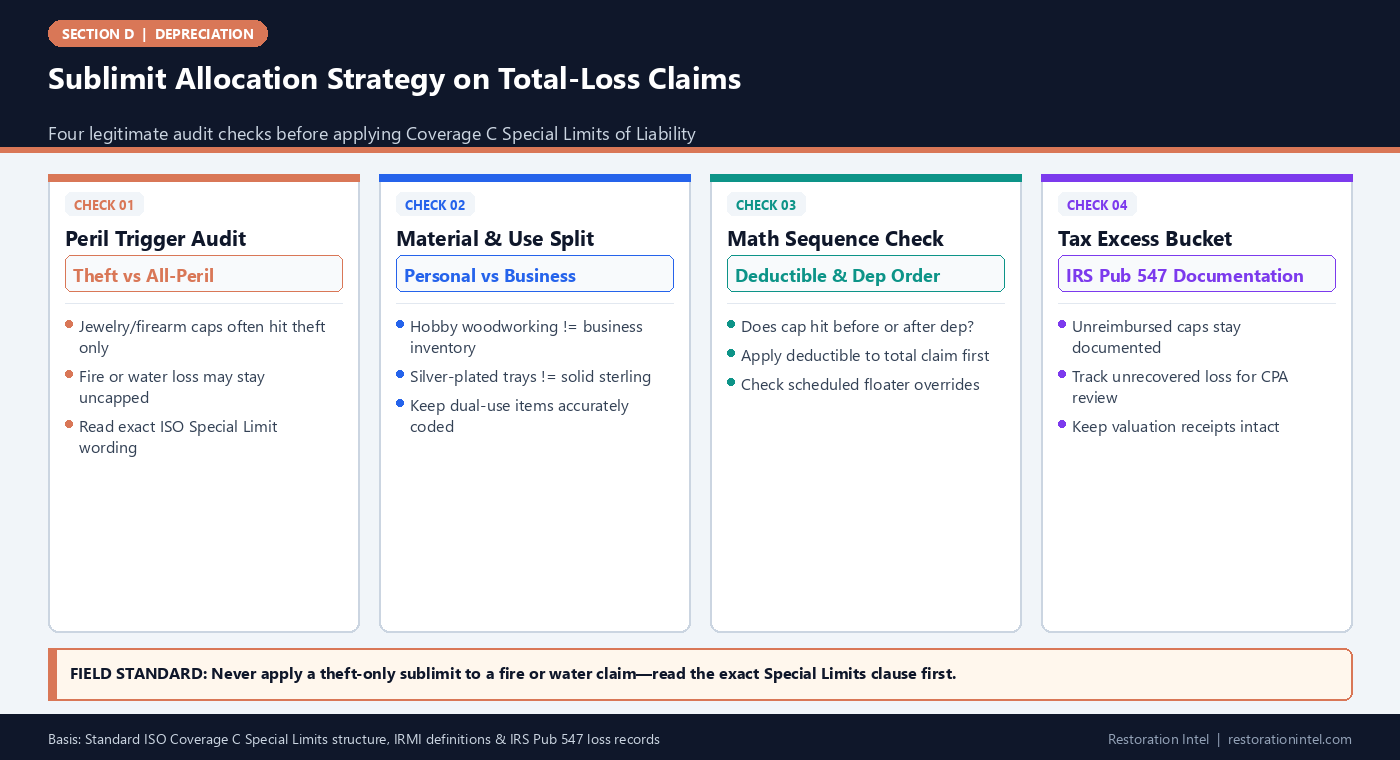
Sublimit Allocation Strategy on Total-Loss Claims
Common Coverage C Special Limits & Misclassification Traps
Typical policy cap behaviors and the exact classification checks estimators must run before finalizing total-loss schedules.
| Sublimit Category | Typical Peril Scope | Common Misclassification Error | Correct Allocation Check | Secondary Recovery Path |
|---|---|---|---|---|
| Jewelry, Watches, Furs, Precious Stones | Usually theft only in standard ISO HO-3 (check endorsements) | Applying theft sublimit automatically on a house fire or pipe burst | Confirm peril trigger; unscheduled fire losses often remain uncapped up to Cov C | Scheduled Personal Property floater or endorsement override |
| Firearms & Related Equipment | Typically theft only in base ISO form (varies by carrier) | Pulling safes, hunting jackets, or optical scopes not mounted under firearm cap | Separate gun safes, apparel, and general optics per exact policy definition | Check firearm rider or state-specific endorsement |
| Silverware, Goldware, & Pewterware | Usually theft only; includes hollowware & flatware | Coding stainless steel flatware or silver-plated trays into sterling cap | Verify hallmarks ('Sterling' / .925 vs EPNS / stainless) before tagging | Appraisal + scheduled silverware endorsement if active |
| Business Property on Premises | All covered perils (typically $2,500 base ISO cap) | Tagging personal home-office monitors, hobby tools, or DIY gear as business BPP | Verify primary use: employer-issued vs personal vs sole-proprietor trade stock | Separate commercial BOP/BPP policy or home-business endorsement |
| Money, Bank Notes, Bullion, Coins | All covered perils (typically $200 base ISO cap) | Lumping numismatic collector coins with general cash or unendorsed bullion | List exact face value vs numismatic collector proof separately | Check IRS Pub 547 casualty documentation for excess unrecovered loss |
| Watercraft / Trailers / Auto Audio | All covered perils (typically $1,500-$2,500 caps) | Putting standalone marine life jackets or garage tools under watercraft cap | Restrict cap strictly to craft, furnishings, motors, and unattached vehicle parts | Check auto comprehensive or dedicated marine policy |
Peril-Specific Caps vs All-Peril Caps: The First Line-Item Filter
One of the highest-impact mistakes in contents estimating is treating every special sublimit as if it applies to every cause of loss. In standard ISO HO 00 03 wording, Coverage C Special Limits are split into two distinct groups: limits that apply regardless of peril (such as money/bullion, securities, watercraft, trailers, and business property) and limits that apply *only to loss by theft* (traditionally jewelry, watches, furs, firearms, and silverware).
Of course, individual carriers frequently modify ISO defaults with proprietary package endorsements—some impose an all-peril cap on jewelry or electronics, while enhanced endorsements raise caps substantially. Never guess from memory. Before flagging a box of watches or a gun collection as capped on a smoke or water loss, inspect the exact policy form and endorsements with the desk adjuster.
- Verify the endorsement stack: Package endorsements (often called Premier, Gold, or Special Personal Property) routinely double or triple base ISO sublimits.
- Check scheduled floaters: Items listed on a Scheduled Personal Property endorsement drop out of Coverage C caps entirely and settle under their agreed-value or scheduled limits.
- Watch loss-of-use vs property caps: Never allow an examiner to apply a theft-only sublimit to fire, lightning, smoke, or sudden water discharge unless the policy explicitly says ‘all perils.’
Boundary Discipline: Keeping Uncapped Household Goods Out of Sublimit Buckets
When a software taxonomy tag automatically routes an item into a capped category, collateral items frequently get dragged over the cliff with it. A classic example is home-office equipment: if an insured works remotely for a corporate employer using a personal ergonomic chair, dual monitors, and a personal desk, those furnishings are ordinary personal property—not ‘property used primarily for business purposes’ owned by the insured’s commercial enterprise, unless specific policy language captures employer-loaned gear.
The same boundary friction happens in garages and dining rooms. A homeowner’s weekend woodworking lathe and miter saw are hobby tools, not business inventory, unless the insured operates a commercial cabinet shop for compensation. Similarly, stainless flatware and silver-plated serving pieces do not belong inside a sterling silverware sublimit unless the policy expressly includes plated ware.
- Document hobby vs trade use: Note explicitly when shop tools, cameras, or musical instruments are personal non-commercial property.
- Check hallmark stamps: Photograph ‘Stainless,’ ‘EPNS’ (electroplated nickel silver), or ‘.925’ marks to keep non-precious goods uncapped.
- Separate accessories accurately: Verify whether the policy defines ‘firearms and related equipment’ broadly or narrowly before bundling generic optics and cases.
Deductible, Depreciation, and Sublimit Ordering Math
Even when a sublimit undeniably applies, how depreciation and the policy deductible interact with the cap can swing final cash payout significantly. Suppose an insured loses $6,000 (RCV) / $4,500 (ACV) of home-business photography equipment subject to a $2,500 Coverage C business-property sublimit, alongside $30,000 in general household losses and a $1,000 policy deductible.
Under standard ACV/RCV policy construction, the deductible applies once to the *total* covered loss—not separately inside the sublimit—and when ACV already exceeds the $2,500 cap ($4,500 > $2,500), the insured recovers the full $2,500 cap without an extra depreciation haircut pulling them below $2,500. Watch out for spreadsheets that mistakenly apply 30 percent depreciation *after* capping the line at $2,500, turning a $2,500 policy limit into a $1,750 payout.
- Apply depreciation before the cap: Calculate RCV -> Depreciation -> ACV on the full schedule first, then compare total category ACV/RCV against the sublimit ceiling.
- Never double-deduct the deductible: Apply the claim deductible once at the total summary sheet level rather than subtracting it from a capped sublimit bucket.
- Avoid arbitrary allocation games: Keep every line in its truthful category; legitimate boundary enforcement is accurate accounting, never shifting business goods fraudulently into personal lines.
Handling Uninsured Excess Losses and Clean Client Reporting
Even with rigorous boundary enforcement, total-loss fires routinely leave genuine specialty property sitting above policy caps—such as $9,000 of unscheduled coin collections against a $200 limit or $12,000 of sole-proprietor studio gear against a $2,500 home-business cap. Stopping documentation on those excess items once the cap is hit can hurt the policyholder outside the claim.
Always complete full valuation documentation for capped items and show the gross RCV/ACV alongside the policy-capped payable amount on a separate summary schedule. Under IRS Publication 547 principles (particularly for federally declared disasters or business casualty losses), or in third-party subrogation recovery against a negligent party, documented uninsured losses remain vital records long after the primary carrier pays its sublimit.
- Full inventory even above cap: Record every lost item’s full RCV, ACV, and proof so total uncompensated loss is provable for subrogation or CPA review.
- Check commercial or umbrella/rider gaps: Prompt the insured to check whether employer equipment policies, separate business policies, or credit-card purchase protections cover excess items.
- Present a clear sublimit waterfall: Show Gross Category Value, Policy Sublimit Cap, Net Payable, and Uninsured Excess side-by-side on the final summary.
Practitioner Verification Checklist (D-21)
- Pull the declarations page and Coverage C Special Limits schedule to confirm exact dollar caps and whether each cap applies to theft-only or all perils.
- Audit software-tagged sublimit items to remove misclassified personal hobby tools, stainless/plated tableware, and non-business home office gear.
- Compute depreciation on full item value *before* applying the sublimit ceiling so caps are not artificially reduced twice.
- Verify that the claim deductible is applied once to the aggregate loss rather than subtracted separately from a sublimit bucket.
- Document 100 percent of gross specialty item values even above policy caps to preserve subrogation and tax casualty records.
Standards, Authority References & Related Reading
Primary standards, insurance definitions, and sibling Restoration Intel guides referenced in this brief:
- IRMI Insurance Glossary: Actual Cash Value (ACV)
- IRMI Insurance Glossary: Replacement Cost Value (RCV)
- Verisk Property Claims Solutions
- IRS Publication 547: Casualties, Disasters, and Thefts
- Related Guide: Zero-Depreciation Categories: Antiques, Fine Art, Collectibles, Bullion, and Appreciated Goods
- Related Guide: Stock, Consumables, and Perishables Valuation in Commercial BPP Claims: Wholesale Cost vs Selling Price
- Related Guide: Personal Property Replacement Cost Endorsements (HO 04 90) vs Actual Cash Value Default Policies
- Related Guide: Field Guide: High-Sensitivity Legal Exclusions — Firearms, Medications, Cash, Jewelry, and Passports
- Related Guide: The Adjuster Desk: One Standard, Two Chairs
.md twin for desk QA and team training.Frequently Asked Questions
Do jewelry and firearm sublimits apply to fire and water losses?
Often no on standard unendorsed ISO homeowners forms, where jewelry, watches, furs, firearms, and silverware sublimits apply specifically to theft. However, many carrier-specific forms and endorsements modify this, so always check the exact policy wording.
Should depreciation be subtracted before or after applying a policy sublimit?
Depreciation should be calculated against the true item value first. If the resulting ACV (or RCV) still meets or exceeds the policy sublimit, the insured is generally entitled to the full sublimit rather than a sublimit reduced further by depreciation.
What if an insured has $15,000 in home-business gear destroyed but only a $2,500 Coverage C cap?
First verify whether any items are actually personal/hobby goods rather than business property, and check if a separate business policy or home-business endorsement exists. Document the full $15,000 loss clearly even if the homeowners payout caps at $2,500.
Why document item values above a known policy cap?
Unreimbursed losses above policy sublimits can still matter in third-party subrogation recoveries or—when eligible under federal rules such as federally declared disasters—for casualty loss records under IRS Publication 547.