Direct Answer: Furniture depreciation depends heavily on hidden structural construction—solid kiln-dried hardwood with dovetail joinery routinely lasts 25 to 40+ years, whereas particleboard veneer and bonded leather wear out in 5 to 10 years—requiring field photos of underside frames, drawer joints, and upholstery tags to defend accurate LKQ and depreciation tiers.
.md twin for estimator QA and carrier file documentation.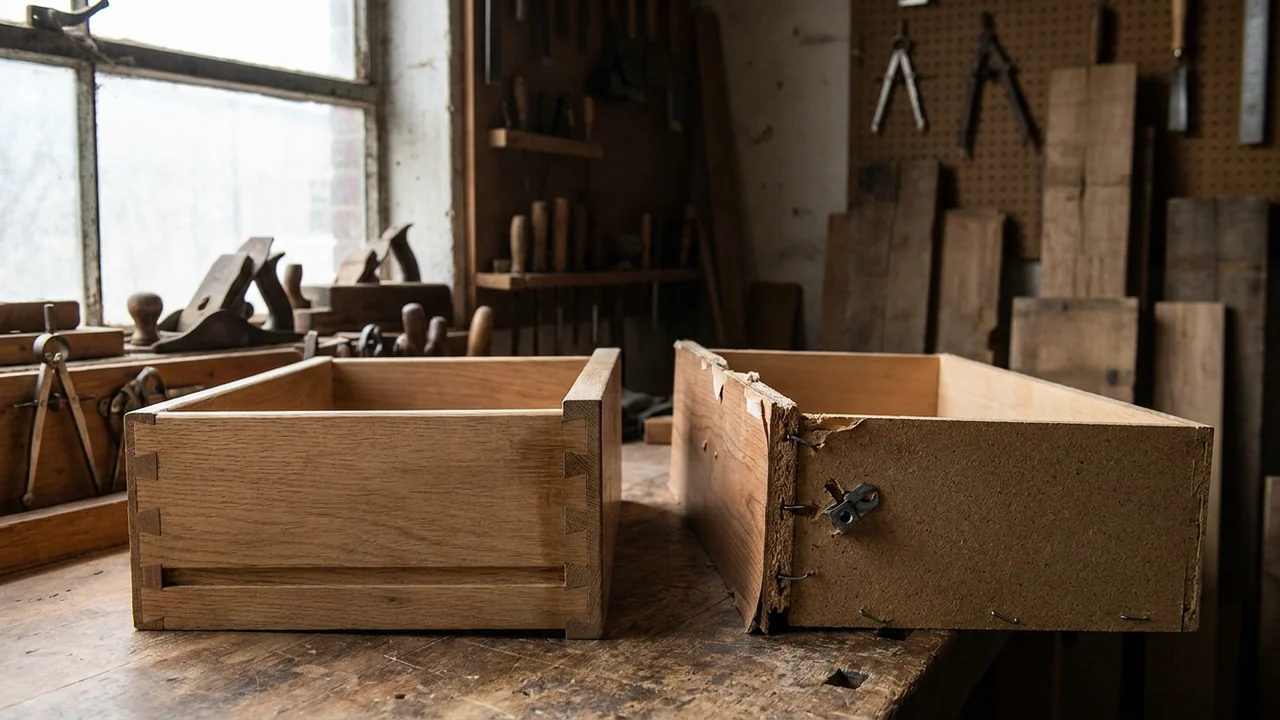
To an untrained eye on a wide room photograph, a $380 flat-pack laminate dresser and a $3,600 American-made solid cherry chest look almost indistinguishable once covered in soot. When schedules describe both simply as ‘5-Drawer Wood Dresser,’ carrier desk examiners almost always price the lower-tier retail comp and apply an aggressive 10-year depreciation curve.
Furniture represents one of the highest-dollar categories in both residential losses and executive commercial offices. Separating solid hardwood from engineered particleboard, top-grain aniline leather from bonded faux leather, and eight-way hand-tied upholstery from stapled sinuous-wire frames transforms both LKQ replacement pricing and useful-life depreciation. Capturing construction anatomy takes less than thirty seconds per major piece during an ANSI/IICRC S320 walkthrough and prevents tens of thousands of dollars in misvaluation.
Furniture Construction Grades: Lifespan & LKQ Separation
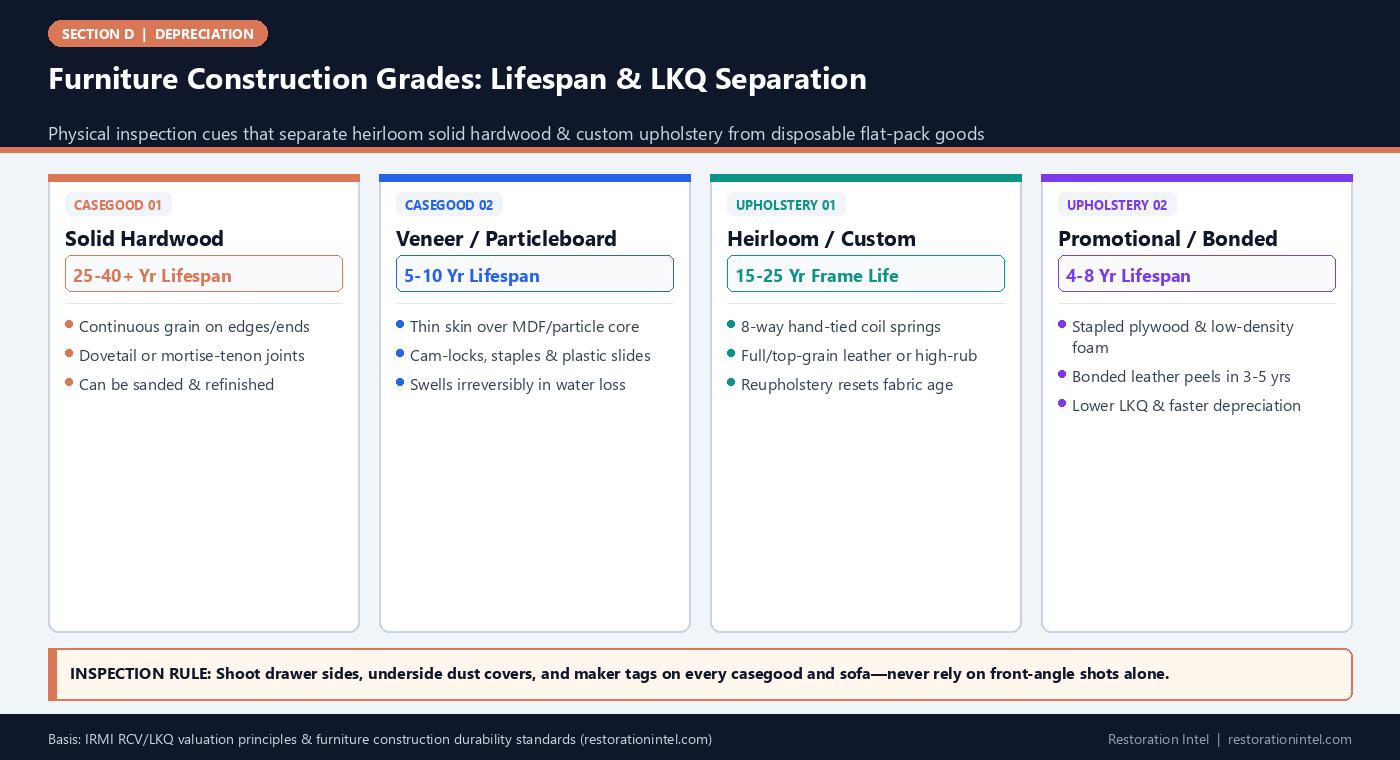
Furniture Material & Joinery Audit Matrix for RCV and Depreciation
Construction markers that justify distinct useful-life denominators and LKQ retail tiers during desk review.
| Furniture Tier | Structural & Material Markers | Realistic Useful Life | Water / Fire Restorability | Mandatory Proof Photos |
|---|---|---|---|---|
| Heirloom / Bench-Made Solid Wood | Dovetail drawers, mortise/tenon, solid plank tops, maker burn-in | 25 to 45+ years | Often restorable via refinishing unless warped/charred | Open drawer corner + underside maker stamp + edge grain |
| Quality Wood Veneer over Hardwood Core | Clean wood veneer over plywood/poplar, solid wood trim | 15 to 22 years | Moderate; veneer lifts on standing water | Drawer construction, back panel thickness, maker label |
| Flat-Pack / Particleboard Laminate | Cam-lock fasteners, paper foil or thin melamine over MDF | 5 to 10 years | Usually total loss on water saturation (swells) | Visible core edge, cam-lock hardware, retail sticker |
| Custom / 8-Way Hand-Tied Upholstery | Kiln-dried hardwood frame, coil springs, top-grain/performance cloth | 15 to 25 yrs frame; 10-15 yrs cover | Frame restorable; fabric depends on smoke/cat level | Law label, zippered cushion core, underside spring deck |
| Promotional / Bonded-Leather Seating | Plywood/OSB cleats, webbing, polyurethane/bonded leather | 4 to 8 years | Frequently uneconomical vs low ACV | Law tag, peeling/surface close-up, staple construction |
| Custom Architectural Joinery / Built-Ins | Site-scribed millwork, stone inlays, integrated lighting | 25 to 40+ years | Coordinate Building vs BPP/Contents policy lines | Dimensions tape photo + joinery detail + millwork bid |
Why Wood Species and Joinery Control Both RCV and Lifespan
The retail spread between mass-market flat-pack furniture and bench-made solid wood furniture easily spans 8x to 12x for pieces of identical exterior dimensions. A 72-inch dining table built of kiln-dried white oak or walnut with floating breadboard ends, mortise-and-tenon aprons, and hand-rubbed oil finish belongs in a completely different economic universe from a printed-grain hollow-core table.
That structural difference equally transforms depreciation math. Solid wood furniture is inherently renewable: minor scratches can be hand-rubbed out, joints can be re-glued, and tops can be stripped and refinished decades after purchase. Particleboard furniture with paper-foil laminate cannot be sanded or meaningfully repaired once chipped or water-swollen, giving it a much shorter useful life. Documenting dovetail joints, solid-plank edges, and maker medallions forces accurate LKQ matching and stops 10-year flat-table over-depreciation.
- Look at the end-grain: True solid planks show continuous grain wrapping over the edge; veneer shows a thin seam or uniform repeating print.
- Open every flagship drawer: English or French dovetails with solid wood bottoms signal higher durability than stapled fiberboard boxes.
- Capture underside maker marks: Burned-in stamps, brass plaques, or factory stencil codes often survive inside drawers or beneath tabletops.
Upholstery Grades: Frame Longevity vs Fabric and Foam Wear
Upholstered sofas, sectionals, and armchairs actually consist of two assets with different lifespans: the structural frame/suspension and the outer cover/cushion fill. An eight-way hand-tied hardwood frame from a respected upholstery house routinely lasts 20 to 30 years and is built to be re-upholstered, whereas high-traffic microfiber or foam cushion cores may show wear after 7 to 12 years.
By contrast, bonded leather (ground leather scraps glued to a polyurethane backing) frequently peels and delaminates within 3 to 5 years of normal living-room use, regardless of how shiny it looked in year one. Recording the federal law tag, cushion core zipper label (down-wrapped spring vs plain polyfoam), and leather/fabric grade prevents desk examiners from equating custom linen or aniline leather with promotional polyester.
- Photograph the under-cushion law tag: Lists manufacturer, fill materials, and plant registration numbers useful for exact LKQ verification.
- Note re-upholstery or new foam dates: Replacing cushions or fabric resets cover wear even when the hardwood frame is older.
- Distinguish leather grades cleanly: Full-grain/top-grain aniline leather ages gracefully with patina; split/bonded leather breaks down quickly.
Custom Joinery, Built-Ins, and Stone-Top Tables
Custom cabinetry, freestanding library shelving, live-edge slab tables, and natural stone dining tops (marble, travertine, soapstone) rarely appear inside off-the-shelf retail catalogs. Attempting to match a custom 10-foot walnut conference table or hand-inlaid sideboard to a generic retail furniture SKU violates IRMI LKQ standards.
When standard catalog SKUs fail, obtain two written quotes from comparable custom woodworkers or architectural millwork shops detailing board-foot species, finish schedule, hardware grade, and delivery/rigging. Equally important on stone-topped or built-in pieces is verifying coverage placement—checking whether attached credenzas or island units sit under Coverage A/Building or Coverage C/BPP—and tracking crating requirements carefully.
- Measure with a visible scale: Photograph length, width, slab thickness, and custom inlay details with a tape measure in frame.
- Get two custom shop bids: Independent millwork quotes defeat ‘unsubstantiated custom estimate’ pushback at desk review.
- Separate natural stone tops: Marble and granite table tops carry zero physical rot/wear depreciation on the slab itself unless chipped pre-loss.
Water vs Smoke Restorability on Casegoods and Upholstery
Accurate construction grading also protects contractors during restore-vs-replace triage. Particleboard and MDF furniture exposed to standing water swells at joints permanently and cannot be restored structurally, making immediate non-salvageable documentation appropriate. Conversely, solid hardwood casegoods exposed only to light smoke or brief surface moisture are often prime candidates for professional cleaning, deodorization, and French-polish touch-up—provided restoration cost remains safely below depreciated ACV.
Documenting wood species and joinery on day one lets estimators advise the adjuster quickly on which heirloom pieces justify skilled cabinetmaker restoration vs which laminated pieces belong straight on the replacement schedule, supporting clean triage as outlined in Contents Cleaning SLAs by Category.
- Test moisture & finish reactivity early: Blushed lacquer on solid wood can often be reversed; swollen MDF seams cannot.
- Document pre-loss finish rings or scratches: Honest baseline photos prevent claims that restoration techs caused old wear.
- Check pair-and-set matching on dining sets: Losing two discontinued chairs out of an eight-chair custom set raises matching issues.
Practitioner Verification Checklist (D-10)
- Capture four standard views on major furniture: full front, open drawer joinery, underside/back maker label, and fabric/leather close-up.
- Classify every wood piece explicitly as solid hardwood, hardwood-core veneer, or particleboard/MDF laminate before pricing.
- Verify sofa and chair upholstery grade via law tags and cushion-core inspection (down/coil vs polyfoam, top-grain vs bonded leather).
- Substantiate custom joinery, live-edge slabs, or bespoke cabinetry with dimensional photos and two local custom fabricator quotes.
- Separate non-depreciating stone slab tops and heirloom solid wood lifespans (25-40+ yrs) from short-lifespan flat-pack defaults.
Standards, Authority References & Related Reading
Primary standards, insurance definitions, and sibling Restoration Intel guides referenced in this brief:
- IRMI Insurance Glossary: Replacement Cost Value (RCV)
- IRMI Insurance Glossary: Depreciation
- ANSI/IICRC S320 Standard for Professional Contents Restoration
- Verisk XactContents Platform Overview
- Related Guide: How Useful-Life Depreciation Tables Work — and Where Adjusters and Contractors Misapply Them
- Related Guide: Like Kind and Quality (LKQ) Replacement Matching: Rules for Discontinued Brands and Obsolete Models
- Related Guide: Zero-Depreciation Categories: Antiques, Fine Art, Collectibles, Bullion, and Appreciated Goods
- Related Guide: Pairs-and-Sets Clauses in Contents Claims: Matching China, Suits, Sectional Pieces, and Modular Systems
- Related Guide: Contents Cleaning SLAs by Category
.md twin for desk QA and team training.Frequently Asked Questions
Why shouldn't solid wood furniture use the same 10-year depreciation table as flat-pack furniture?
Solid kiln-dried hardwood with dovetail or mortise-and-tenon joinery lasts 25 to 45+ years and can be refinished repeatedly, whereas particleboard veneer cannot be refinished and typically wears out within 5 to 10 years.
How can a field technician quickly prove a piece of furniture is high-end solid wood?
Photograph open drawer dovetails, continuous end-grain on table edges, solid back panels, and any burned-in maker stamp or brass plaque underneath or inside drawers.
Does re-upholstering an older quality sofa affect its depreciation?
Yes. Re-upholstery and cushion-core replacement reset the effective age of the fabric and foam, leaving only minimal wear on the long-lived hardwood frame.
How are custom-built tables or architectural cabinetry priced for RCV?
When no retail SKU matches dimensions, species, and craftsmanship, estimators should document exact measurements and attach two written bids from qualified custom woodworkers or millwork shops.