Direct Answer: Commercial Business Personal Property (CP 00 10) generally values damaged merchant stock at replacement wholesale cost—not retail selling price—unless sold-stock or manufacturer selling-price clauses apply, while Business Income coverage separately addresses lost retail profit margin.
.md twin for estimator QA and carrier file documentation.
After a fire, sprinkler discharge, or roof collapse in a retail store, restaurant, or distributor warehouse, business owners almost always ask why their commercial inventory schedule is priced at wholesale vendor invoice cost instead of the retail price tags hanging on the shelves. To a merchant staring at $200,000 in ruined retail merchandise, receiving $110,000 in wholesale stock valuation feels like an arbitrary haircut.
In commercial property insurance under the ISO Building and Personal Property Coverage Form (CP 00 10), that distinction is structural, not arbitrary. BPP indemnifies the physical replacement cost of Stock—meaning landed wholesale cost plus inbound freight—so the business can restock its shelves, while lost retail markup and net profit belong separately under Business Income (BI) coverage if triggered. Mixing wholesale stock, shop consumables, and FDA/health-condemned perishables into one sloppy spreadsheet invites major coinsurance errors, double-recovery rejections, and audit delays.
Commercial BPP Valuation Splits: Stock, Consumables & Perishables
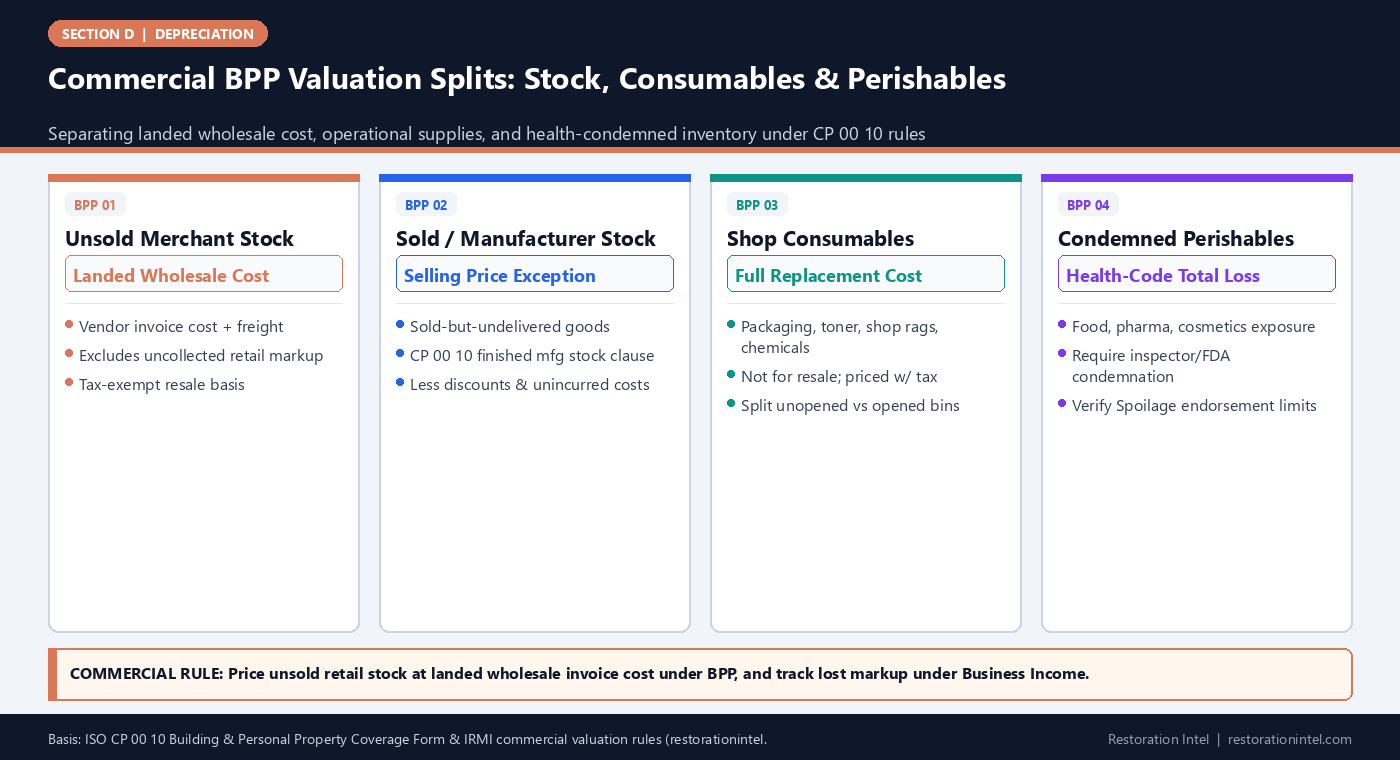
Commercial Inventory Valuation Basis Under ISO CP 00 10 Frameworks
How different commercial BPP goods are valued, taxed, and separated from Business Income claims.
| Commercial Inventory Type | Standard BPP Valuation Basis | Depreciation / Obsolescence Risk | Sales Tax & Freight Treatment | Required Accounting Proof |
|---|---|---|---|---|
| Unsold Retail / Distributor Stock | Current wholesale replacement cost (not retail tag) | Slow-moving / dead-stock markdowns or seasonal obsolescence | Include inbound vendor freight; exclude resale sales tax | Vendor purchase invoices, ERP SKU cost export, POS count |
| Stock Sold But Not Delivered | Net selling price less unincurred delivery/discounts | Minimal if binding sale existed pre-loss | Follow contract invoice terms | Signed sales order, invoice, and pick-ticket timestamp |
| Finished Manufacturer Goods | Selling price under CP 00 10 optional/built-in mfg stock rule (check form) | Check unincurred selling expenses & discounts | Deduct unincurred freight/commissions per policy wording | Bill of materials, production log, wholesale price list |
| Business Consumables & Packaging | Current supplier replacement cost for unused stock | Minimal physical wear on sealed boxes; check bulk shelf life | Include sales tax & shipping if business pays tax on supplies | Supplier invoices + shelf count of sealed vs open units |
| Perishable Food, Wine & Pharmaceuticals | Wholesale invoice cost (subject to Spoilage / off-prem power terms) | Expiration dates near loss reduce ACV/market value | Include cold-chain freight; exclude retail menu price | Health dept / FDA hold notice, temp logs, cold-chain invoices |
Why Unsold Stock Is Priced at Wholesale Cost—and When Selling Price Applies
Under the principle of indemnity, paying a retailer full retail shelf price for unsold inventory destroyed in a fire would put the business in a better financial position than if the loss had never happened: the merchant would collect 100 percent of retail markup immediately without paying sales staff commissions, credit card merchant fees, or waiting months for customers to walk through the door. Therefore, ISO CP 00 10 generally values undamaged-turned-damaged merchandise at the cost to replace it at wholesale—including inbound freight, customs duties, and receiving handling—at the time of loss.
Two narrow exceptions exist inside standard commercial forms and endorsements. First, stock that was already sold under a binding transaction but destroyed before delivery to the buyer is typically valued at the agreed selling price less any unincurred discounts and expenses. Second, manufacturers—or policyholders carrying a Manufacturer’s Selling Price endorsement—can often value finished proprietary manufactured goods at net selling price less unincurred selling costs, because manufacturing created the economic value rather than mere retail markup.
- Never mix BPP and Business Income: Retail profit margin on lost sales belongs in the Business Income calculation, never added onto BPP stock lines.
- Include landed cost fully: Wholesale unit cost alone underpays if you omit inbound LTL freight, tariffs, import duties, and vendor pallet fees.
- Document dead-stock vs active SKUs: Adjusters audit commercial stock for obsolete or unsalable seasonal goods; clean ERP turn-rate logs prove active demand.
Handling Shop Consumables, Packaging, and Work-in-Progress
Businesses do not hold only items meant for resale. Restaurants, medical clinics, print shops, and auto repair bays hold tens of thousands of dollars in operational consumables: thermal paper, corrugated shipping cartons, sterile nitrile gloves, specialty inks, cleaning solvents, and small parts bins. Unlike resale stock, consumables are typically taxed at purchase and used internally.
Estimators must separate operational consumables from resale inventory and from capital equipment/tools. Opened partial containers (half-empty 55-gallon chemical drums or opened reams) require realistic fractional quantity counts, whereas sealed master cases carry 100 percent unit count and full landed replacement cost. Keep Work-in-Progress (WIP) fabrication materials—raw lumber, cut fabric, or partially assembled custom orders—isolated with job-cost sheets showing direct material plus incurred shop labor.
- Separate taxability cleanly: Resale inventory is generally tax-exempt; internal shop consumables usually include sales tax.
- Use fractional estimates transparently: Log opened supply containers honestly (e.g., 50% remaining) to protect overall schedule credibility.
- Track WIP incurred labor: Raw materials plus documented bench hours spent prior to loss represent true WIP replacement value.
Perishables, Health-Department Condemnation, and Spoilage Limits
In hospitality, grocery, floral, and pharmacy losses, a minor smoke haze or brief power outage can ruin entire walk-in coolers even when physical packaging looks spotless from the outside. Health inspectors and FDA regulations routinely mandate zero-tolerance disposal of exposed or temperature-abused food, pharmaceuticals, and sterile cosmetics.
However, commercial policies treat perishables carefully. First, determine the cause of loss: direct fire/smoke inside the building falls under standard BPP, whereas off-premises utility power failure causing freezer spoilage typically requires a specific Utility Services / Spoilage endorsement—often carrying a tight sublimit. Second, always obtain written condemnation or destruction orders from the local health inspector, veterinarian, or manufacturer quality-assurance rep before dumping stock into a roll-off container.
- Never dump perishables without proof: Photograph temperature data loggers, broken cold seals, and lot expiration dates alongside official condemnation notices.
- Verify Spoilage vs direct peril coverage: Power-outage spoilage frequently sits under a separate endorsement cap from direct fire/water BPP.
- Audit expiration dates honestly: Expired pre-loss perishable stock has zero recoverable value; clean FIFO date logs prove freshness.
Coinsurance Exposure and ERP Reconciliation Before Submission
Commercial BPP claims carry a danger rarely seen in homeowners claims: the Coinsurance clause (commonly 80, 90, or 100 percent). If a business carries $150,000 of BPP limits when total actual value at the location (furniture, fixtures, equipment, plus peak seasonal stock) equals $300,000 under an 80 percent coinsurance requirement, the carrier applies a severe proportional penalty to every dollar paid.
Before submitting a massive commercial stock schedule, reconcile physical counts against the client’s POS/ERP inventory ledger and recent balance-sheet COGS records—consistent with IRS Publication 547 recordkeeping standards. Reconciling physical salvage plus destroyed counts against opening inventory minus sales proves nothing was invented and protects the business during forensic accounting review.
- Run pre-loss book-to-physical math: Opening inventory + verified purchases – Cost of Goods Sold = expected inventory on loss date.
- Check peak season / reporting form endorsements: Seasonal retailers may carry Peak Season endorsements increasing limits during Q4.
- Separate tenant stock from consigned goods: Identify property of others in the insured’s care/custody against policy coverage caps.
Practitioner Verification Checklist (D-12)
- Confirm on CP 00 10 whether stock is valued at wholesale replacement cost, sold-stock net price, or covered by a Manufacturer’s Selling Price clause.
- Price unsold retail stock strictly at landed wholesale cost (vendor invoice + inbound freight/duties) without retail profit markup or resale tax.
- Segregate internal business consumables (taxable, non-resale) and Work-in-Progress job sheets onto separate schedule tabs from merchant stock.
- Obtain written health-department condemnation orders, temperature logs, and expiration-date photos before disposing of perishable stock.
- Reconcile physical damaged inventory counts against ERP/POS purchase and COGS records and check BPP coinsurance / peak-season limits.
Standards, Authority References & Related Reading
Primary standards, insurance definitions, and sibling Restoration Intel guides referenced in this brief:
- IRMI Insurance Glossary: Replacement Cost Value (RCV)
- IRMI Insurance Glossary: Actual Cash Value (ACV)
- IRS Publication 547: Casualties, Disasters, and Thefts
- ANSI/IICRC S320 Standard for Professional Contents Restoration
- Related Guide: Sales Tax, Shipping, and Crating in RCV and ACV Contents Settlements
- Related Guide: Sublimit Allocation Strategy When Total-Loss Specialty Items Exceed Policy Caps
- Related Guide: Field Guide: Commercial Tenant vs Landlord Split Quick-Reference Table
- Related Guide: Field Guide: Emergency Food & Perishable Stock Loss Documentation Checklist (Residential & Commercial)
- Related Guide: The Adjuster Desk: One Standard, Two Chairs
.md twin for desk QA and team training.Frequently Asked Questions
Why doesn't commercial BPP pay full retail price tag value for damaged store inventory?
Because paying retail selling price on unsold goods would reimburse unearned profit before any sale occurred. CP 00 10 values unsold stock at landed wholesale replacement cost, while lost retail profit is addressed separately under Business Income coverage.
When can commercial stock be valued at selling price instead of wholesale cost?
Standard commercial policies typically allow selling-price valuation (less unincurred expenses and discounts) for stock already sold under a binding agreement awaiting delivery, or for finished manufactured goods when a Manufacturer’s Selling Price rule applies.
What documentation is required before discarding smoke- or power-damaged food and pharmaceuticals?
Take timestamped photos of lot/expiration dates and cooler temperature logs, complete an itemized count, and obtain a written condemnation or destruction notice from the local health authority or manufacturer QA rep before disposal.
How do shop consumables differ from resale stock on a BPP schedule?
Consumables like packaging, chemicals, and office supplies are used internally rather than resold, so they are priced at current supplier replacement cost including applicable sales tax rather than tax-exempt wholesale stock rates.