Direct Answer: Desk examiners approve depreciation revisions fastest when a dispute packet isolates only the materially distorted lines, organizes each challenge into a standardized three-part proof block (original vs revised basis, objective condition or effective-age evidence, and policy/LKQ citation), and strips out emotional rhetoric or blanket percentage demands.
.md twin for estimator QA and carrier file documentation.
Blanket pushback—such as emailing an examiner to demand a flat 15 percent depreciation reduction across a 500-line contents schedule—almost always fails. Desk examiners work inside audit guidelines that require line-level justification before overriding default depreciation tables in XactContents or carrier claim systems. When a rebuttal mixes valid technical errors with unsupported complaints, the entire supplement gets bounced.
A well-constructed depreciation dispute packet flips the dynamic from adversarial negotiation to verification. By grouping challenges into clear error categories—misclassified useful-life category, uncredited effective-age rebuilds, distorted year-one curves, or missing working-condition floors—contractors and public adjusters give the examiner the exact audit trail needed to sign off on revised ACV settlements on the first re-review.
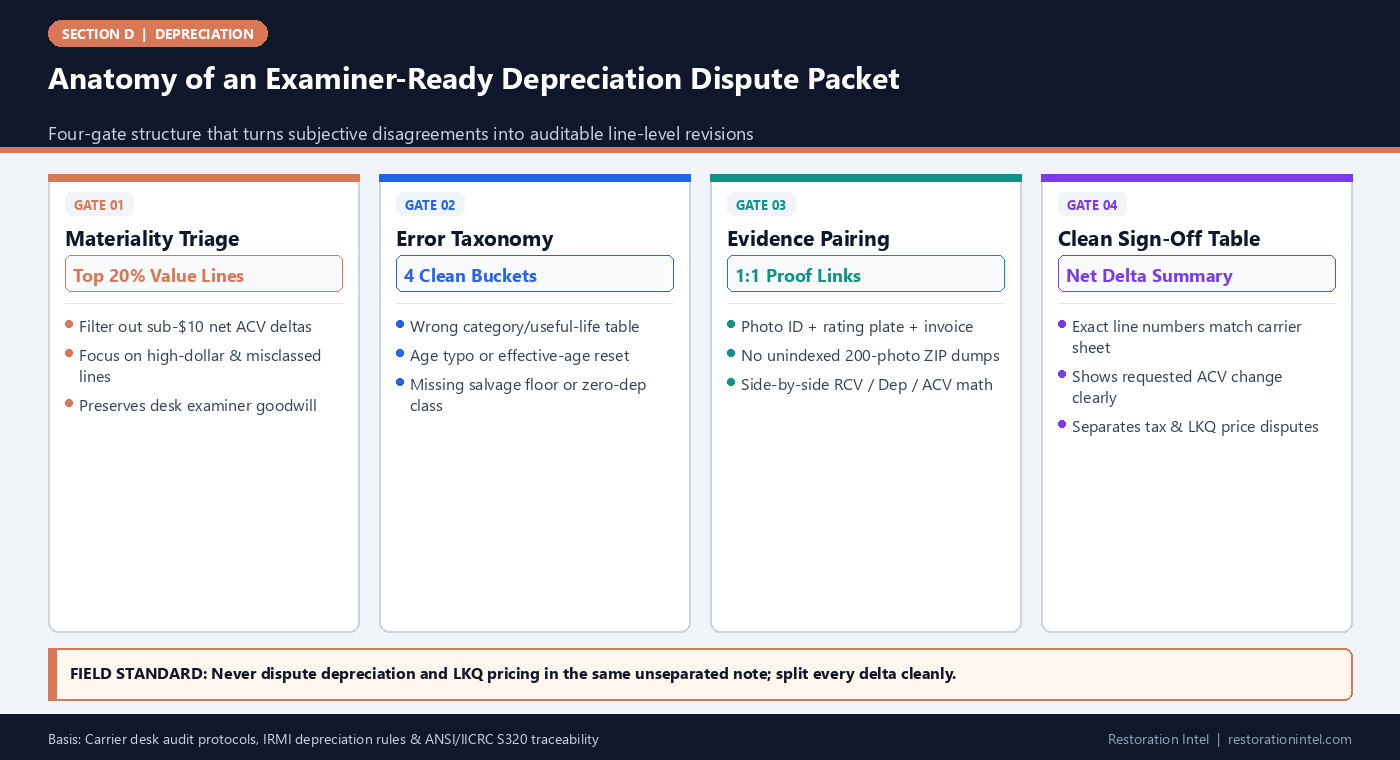
Anatomy of an Examiner-Ready Depreciation Dispute Packet
Five Valid Depreciation Dispute Grounds & Required Proof
Every line challenged in a dispute packet should map cleanly to one of these five auditable categories.
| Dispute Ground | Typical Examiner Error | Primary Proof Required | Math Correction Method | Rejection Risk If Missing |
|---|---|---|---|---|
| Category / Lifespan Misassignment | Solid hardwood table placed in particleboard or short-life misc bucket | Joinery/underside stamp photos, brand catalog spec sheet | Re-map to correct useful-life table (e.g., 15-20 yr solid wood) | Adjuster treats furniture as generic medium-grade |
| Age Transcription or Date-Code Error | 10-year age entered as default when appliance serial decodes to 3 years | Rating-plate photo + OEM serial year-code breakdown | Update chronological age to verified manufacture/install date | Default estimated age stands unchecked |
| Uncredited Rebuild / Maintenance | Reupholstered chair or rebuilt motor depreciated from original shell year | Paid shop invoice + close-up pre-loss condition photos | Substitute documented effective age for chronological age | Examiner views rebuild claim as unverified hearsay |
| Zero-Depreciation Class Overlooked | Antique chest, fine art, or heirloom sterling depreciated at 50% | Provenance notes, maker marks, appraisal, IRS Pub 547/584 context | Set depreciation to 0% or switch to market-value support | Treated as ordinary used household goods |
| Active-Use Asset Driven Near Zero | Functioning 15-year-old range or tool set depreciated at 90-100% | Scene photos showing installed/active use + S320 triage log | Apply documented working-condition depreciation ceiling | Line treated as non-functional pre-loss scrap |
Separating Depreciation Disputes From Price and Scope Disputes
The fastest way to stall a contents settlement is bundling three different disagreements into one murky spreadsheet column. When a dispute packet challenges the replacement SKU price, adds missed closet items, and contests the depreciation percentage on the same page without distinct flags, a desk examiner cannot tell how much of the net dollar gap stems from LKQ pricing versus useful-life assumptions.
Treat depreciation as an isolated audit layer. Lock or clearly reference the agreed RCV base first—or flag the few lines where both RCV and depreciation are disputed in separate columns—so the examiner can approve undisputed depreciation corrections immediately even while specialty LKQ comps remain under review.
- Three-lane delta coding: Tag every revised line as Price Variance (RCV), Scope Addition (Qty/Item), or Depreciation Adjustment (Dep %).
- Match carrier line IDs: Always preserve the carrier’s original room name and sequence number alongside your internal tracking ID.
- Isolate policy-exempt lines: Pull out non-depreciable or sublimit-capped items onto a dedicated tab so general schedule percentages stay clean.
Materiality Filtering: Why Less Is More on Large Schedules
On a 700-line fire inventory, fighting over a 5 percent depreciation difference on a $24 toaster wastes examiner attention and signals that the submitter lacks valuation judgment. Experienced estimators rank disputed lines by net ACV dollar impact before writing a single rebuttal paragraph.
Typically, the top 15 to 25 disputed lines account for the overwhelming majority of recoverable ACV shortfall. Focusing the packet on meaningful dollar variances—major furniture, electronics misdated by several years, pro-grade tools, musical instruments, and zero-depreciation heirlooms—shows respect for the examiner’s queue time and builds credibility for every line included.
- Set a materiality threshold: Filter out line-level depreciation deltas below a practical floor (e.g., $25-$50 ACV impact) unless systemic across an entire room.
- Batch systemic errors: If an examiner applied an incorrect blanket 50 percent depreciation rate across an entire bedroom, submit one clear rule-level correction rather than 80 repetitive paragraphs.
- State exact dollar asks: Show Original ACV, Proposed ACV, and Net ACV Delta at both the line level and packet cover summary.
Building the 1:1 Photo, Serial, and Source Proof Block
Dumping 400 unlabeled JPEGs into a cloud folder forces the desk examiner to hunt for proof—which means they usually will not. Each disputed line in the packet should link or embed at most two to three high-signal artifacts: one context photo proving pre-loss care, one close-up of the label, joinery, or rating plate, and one supporting invoice or age lookup.
For appliances, HVAC accessories, and electronics, decoding the manufacturer serial number is one of the highest-leverage moves in adjuster desk reconciliation. When an insured guesses an appliance is eight years old, an examiner enters eight years; showing the OEM serial date-code proves it was manufactured three years prior to the loss and closes the dispute with zero argument.
- Filename discipline: Name cropped evidence images with the exact carrier line ID (e.g.,
L042_Kitchen_Range_Serial.jpg). - Arrow and callout annotations: Circle manufacturer stamps, dovetail joinery, or tags-on apparel directly on duplicate review copies while keeping originals unedited.
- Neutral technical tone: Replace accusatory phrasing with factual entries such as ‘OEM serial prefix indicates Oct 2022 manufacture; table lifespan 15 yrs.’
Packet Assembly and Follow-Up Cadence for Fast Sign-Off
Package the dispute as a two-part deliverable: a clean one-page executive transmittal PDF summarizing the total ACV delta by error bucket, plus a locked-header Excel/CSV reconciliation workbook and hyperlinked or bookmarked PDF evidence appendix. Include a brief explanation of how any ANSI/IICRC S320 field condition notes map to the revised condition grades.
Once submitted, give the examiner a clear, numbered checklist of decisions needed rather than an open-ended ‘please review.’ When carriers see exact formulas, verifiable serial codes, and restrained materiality filtering, supplemental ACV releases routinely clear without escalating to appraisal.
- Cover sheet totals: Reconcile original carrier total ACV + proposed adjustments = revised total ACV to the penny.
- Audit trail column: Leave an empty ‘Examiner Decision / Approved Dep %’ column in the workbook so the carrier can mark up and return the same file.
- Escalation readiness: Maintain clean version timestamps so if a claim later moves to formal appraisal, the packet already meets umpire evidentiary standards.
Practitioner Verification Checklist (D-15)
- Filter the carrier schedule by net ACV dollar variance and drop immaterial low-dollar noise before drafting rebuttals.
- Separate depreciation percentage disputes cleanly from LKQ replacement pricing and missed-item scope supplements.
- Tag every challenged line with one explicit error bucket (category, age typo, rebuild reset, zero-dep class, or working floor).
- Attach 1:1 line-ID-matched evidence (rating plate, serial decode, repair invoice, or joinery photo) instead of bulk photo dumps.
- Deliver a summary cover page plus a side-by-side reconciliation spreadsheet with an examiner decision column.
Standards, Authority References & Related Reading
Primary standards, insurance definitions, and sibling Restoration Intel guides referenced in this brief:
- IRMI Insurance Glossary: Depreciation
- IRMI Insurance Glossary: Actual Cash Value (ACV)
- Verisk XactContents Platform Overview
- ANSI/IICRC S320 Standard for Professional Contents Restoration
- Related Guide: How Useful-Life Depreciation Tables Work — and Where Adjusters and Contractors Misapply Them
- Related Guide: Condition vs Chronological Age: Documenting Pre-Loss Care to Defend Lower Depreciation Percentages
- Related Guide: Non-Linear Depreciation Curves: Why Year-One Drops and Maintenance Rebuilds Break Flat-Line Math
- Related Guide: Field Guide: Condition-Grade Definitions Rubric (New / Mint / Good / Fair / Poor / Damaged)
- Related Guide: The Adjuster Desk: One Standard, Two Chairs
.md twin for desk QA and team training.Frequently Asked Questions
Should a depreciation dispute packet include every item on the claim?
No. Blanket challenges dilute credibility. Focus on materially under-valued items and systemic classification errors where you have concrete photographic, serial-number, or invoice evidence.
How do you prove an item's age if the homeowner guessed wrong initially?
Use rating-plate serial number date-code decoding, warranty registration emails, credit card statements, house-move timelines, or model release year records to replace rough verbal guesses.
Can contractors submit depreciation dispute packets directly to carriers?
Contractors can supply factual field documentation, condition grades, serial photos, and S320 inspection notes, while formal policy settlement arguments or public adjusting advocacy must stay within state licensing boundaries and insured authorization.
What if the policy has Replacement Cost Value (RCV) coverage anyway?
Even under RCV policies, ACV sets the upfront cash payment before items are replaced. Overstated depreciation starves the policyholder of liquidity needed to purchase replacements and unlock recoverable holdbacks.