Direct Answer: Insurance policies do not require an original store receipt to pay for damaged gifts or inherited items; estimators establish ownership, quality tier, and Replacement Cost Value through scene wreckage, family photos, appraisals, and comparable retail specs, then apply condition-based depreciation—or zero depreciation when true antique or fine-art status is proven.
.md twin for estimator QA and carrier file documentation.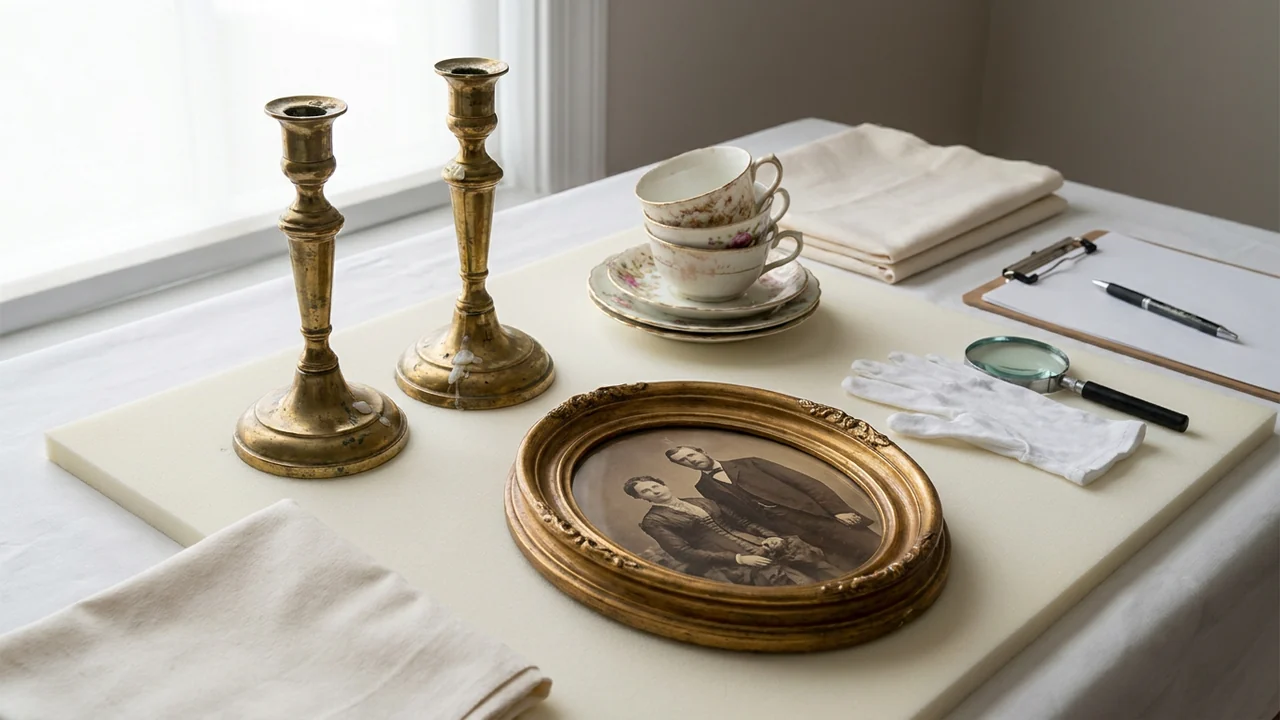
Few claim questions cause more unnecessary panic for policyholders—and more friction at the estimating bench—than how to schedule wedding gifts, heirloom furniture, or decades-old household goods when original receipts burned in the fire or vanished moves ago. Contrary to common rumor on job sites, standard homeowners and commercial property policies do not void coverage simply because a paper receipt is missing or the insured received an item at zero out-of-pocket cost.
What policies actually require under Duties After Loss is reasonable proof of ownership, physical existence at the loss location, description, and value. Distinguishing insurance Like-Kind-and-Quality (LKQ) valuation from tax-basis rules in IRS Publication 547 and IRS Publication 584 allows restoration teams and adjusters to substantiate gifts and inherited property without stalling schedules.
Valuing Gifts, Inherited Goods, and Receiptless Items
Alternative Proof Matrix When Original Receipts Are Missing
How estimators substantiate existence, age, and quality tier across common receiptless property scenarios.
| Item Origin Scenario | Primary Replacement Proof | Age & Condition Anchor | Depreciation Treatment | Common Policy Trap |
|---|---|---|---|---|
| Recent Wedding or Shower Gifts | Registry archive emails, thank-you lists, brand packaging remnants | Event date establishes exact chronological age | Standard table dep from event date; 0% if still boxed/unused | Insured omits gifted items thinking $0 paid = $0 claim |
| Inherited Everyday Furniture | Underside maker stamps, hardware style, estate move records | Condition grade and construction era (effective age) | Low-to-moderate dep if solid wood; zero if verified antique | Examiner uses modern particleboard comp instead of solid hardwood |
| Cash-Purchased Tools & Gear | Manuals, charger docks, serial numbers, workshop scene photos | Serial date code, model launch year, grip/blade wear | Condition-adjusted useful life; cap if actively used | Blanket 50% 'unknown age' penalty applied across shop |
| Inherited Jewelry, Silver, & Art | Estate probate lists, prior insurance riders, jeweler appraisals | Hallmarks, artist signature, appraisal date | Zero depreciation on appreciating/rare items; silver market comp | Exceeds unscheduled Coverage C sublimit ($1,500-$2,500) |
| Total-Loss Vaporized Closet/Kitchen | Pre-loss social/family photos, bank recurring spends, debris count | Household size, typical closet density, visible hangers/springs | Weighted average condition across household age band | Vague '100 shirts' claim without visual context triggers audit |
Why Acquisition Cost ($0 for Gifts) Does Not Control Insurance Valuation
Insureds frequently under-report gifts because they assume an insurance payout reimburses what they personally spent out of pocket. Under standard Replacement Cost Value (RCV) and ACV policy language, insurable interest stems from lawful ownership and possession at the time of loss—not whether the insured paid retail, bought on clearance, or received the item as a gift.
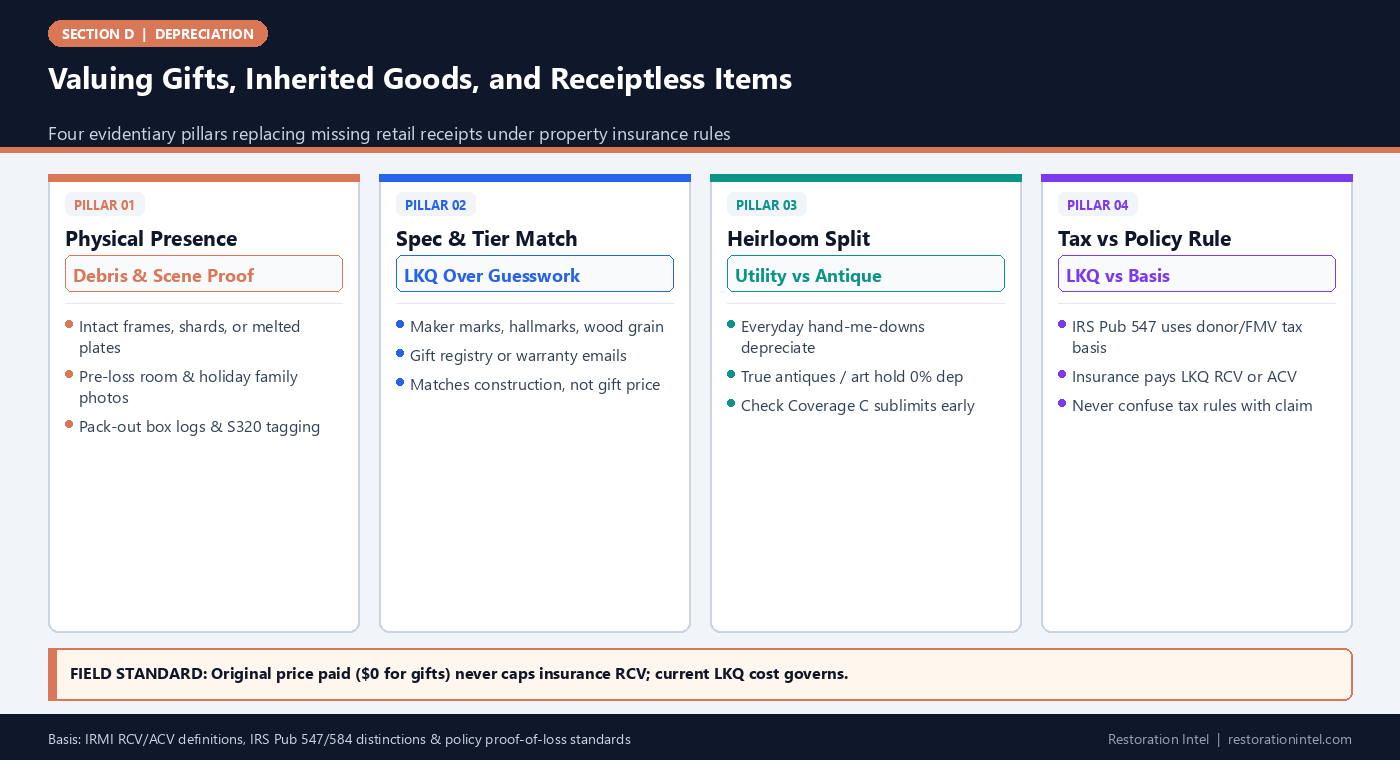
A high-end stand mixer gifted at a bridal shower carries the exact same RCV and useful-life profile as an identical mixer bought with a credit card. This differs sharply from federal casualty-loss tax rules in IRS Publication 547, where tax deductions compare Fair Market Value loss against adjusted cost basis (for gifts, often the donor’s basis). Mixing tax basis logic into an insurance inventory cheats the policyholder out of valid coverage.
- Market replacement anchor: Price gifts at today’s retail Like-Kind-and-Quality cost, ignoring promotional clearance or $0 recipient acquisition cost.
- Registry and email mining: Online wedding/baby registries and gift-receipt emails remain searchable in cloud accounts years after paper copies are lost.
- Unopened gift proof: If a gifted appliance or cookware set remained factory-sealed in a closet until the loss, document box seals for 0 percent physical depreciation.
Separating Inherited Utility Goods From True Antiques
Not every piece of furniture passed down from a grandparent qualifies as a zero-depreciation antique. Desk examiners routinely push back when estimators tag mass-produced 1970s bedroom sets as ‘antique heirlooms’ simply because they carry sentimental value. Sentimental attachment is non-compensable under property insurance; construction quality and collector market demand are what matter.
Split inherited items into two clear tracks. Functional hand-me-downs (mid-century solid walnut credenzas, cast-iron skillets, quality hand tools) are depreciated based on physical condition and realistic effective age, often with a solid-construction RCV comp rather than disposable flat-pack furniture. True antiques, fine art, and signed collectibles require provenance, maker hallmarks, or independent market comparables to justify zero depreciation or appraised ACV.
- Construction forensics: Photograph dovetail drawers, solid-wood undersides, brass caster stamps, and upholstery tacking to justify higher LKQ construction tiers.
- Maker-mark lookup: Record backstamps on porcelain, hallmarks on silver, and foundry marks on ironware before pack-out or disposal.
- Sublimit early warning: Flag inherited jewelry, silverware, furs, and firearms immediately so Coverage C special caps are checked before finalizing expectations.
Substantiating Missing Receipts Through Forensic Scene & Digital Traces
When receipts are destroyed or long discarded, proof comes from triangulation rather than a single document. Field technicians photographing charred debris or water-logged rooms should capture physical remnants—metal skillet handles, spring coils, appliance chassis tags, melted ceramic bases—before any haul-off begins. Even in total structural collapse, metal fasteners and appliance rating plates survive surprisingly well.
Back at the estimating desk, pair scene remnants with secondary digital artifacts: background details in family holiday photos, home-tour listing pictures from when the house was purchased, warranty registration confirmations, credit-card merchant summaries, and owner-manual PDFs saved on a phone. As outlined in restoration documentation standards, physical existence proof paired with specific model attributes makes receiptless claims straightforward to audit.
- Do not discard wreckage prematurely: Hold charred or corroded remains of high-value receiptless items until photo/serial documentation clears QA.
- Use pre-loss lifestyle photos: Family birthday or living-room photos cleanly establish room furnishings, artwork, and electronics present prior to the loss.
- Consistent age narratives: Align reported purchase/gift dates with the homeowner’s move-in dates and major life events to prevent credibility red flags.
Depreciation Rules When Exact Purchase Date Is Unknown
When an item’s exact purchase year is genuinely unknown, some carriers default to an arbitrary 50 percent depreciation penalty or assign maximum useful-life age. That blanket penalty is inappropriate when physical inspection proves the item was lightly used or mid-life. Under ANSI/IICRC S320 field documentation, visible wear indicators—intact cord insulation, clean fabric nap, tight drawer slides, and unblemished chrome—provide an objective basis for condition-driven depreciation.
When coding unknown-age items, enter a documented age range or effective age tied to model-era clues (for example, ‘Model manufactured 2019–2021 per serial badge; good condition; est. effective age 4 yrs’) rather than leaving the age field blank. Blank fields invite automated maximum-depreciation defaults during carrier import.
- Never leave age blank: Use model launch windows, serial date-codes, or verified move-in anchors to supply a defensible estimate.
- Condition-anchored brackets: Pair conservative age ranges with timestamped close-up condition photos.
- Worksheet discipline: Use structured household room-by-room inventory templates modeled on IRS Pub 584 organization while pricing strictly under insurance LKQ.
Practitioner Verification Checklist (D-16)
- Verify physical existence at the loss site via wreckage photos, intact tags, pack-out logs, or pre-loss lifestyle images before scheduling.
- Document gift and inherited items at current retail LKQ replacement cost—never $0 acquisition cost or tax-basis figures.
- Capture maker stamps, serial numbers, wood joinery, and silver hallmarks to separate solid/heirloom tiers from generic goods.
- Supply a model-era or condition-based effective age on every receiptless line so automated imports do not trigger blank-age penalties.
- Screen inherited jewelry, silverware, collectibles, and firearms against Coverage C policy sublimits before final submission.
Standards, Authority References & Related Reading
Primary standards, insurance definitions, and sibling Restoration Intel guides referenced in this brief:
- IRMI Insurance Glossary: Actual Cash Value (ACV)
- IRMI Insurance Glossary: Replacement Cost Value (RCV)
- IRS Publication 547: Casualties, Disasters, and Thefts
- IRS Publication 584: Casualty, Disaster, and Theft Loss Workbook
- Related Guide: RCV vs ACV Fundamentals in Contents Claims: How Replacement Cost, Depreciation, and Holdbacks Actually Work
- Related Guide: Zero-Depreciation Categories: Antiques, Fine Art, Collectibles, Bullion, and Appreciated Goods
- Related Guide: Constructing a Contents Depreciation Dispute Packet That Desk Examiners Respect
- Related Guide: Field Guide: Condition-Grade Definitions Rubric (New / Mint / Good / Fair / Poor / Damaged)
- Related Guide: A Price Tag on a Lost Item Is Worth Nothing
.md twin for desk QA and team training.Frequently Asked Questions
Can an insurance company deny a claim item just because I lost the receipt?
No. Standard property policies require reasonable proof of loss and ownership, not original paper receipts. Scene wreckage, pre-loss photographs, serial numbers, warranty emails, and bank statements are all accepted forms of substantiation.
Are wedding or birthday gifts valued differently than items I bought myself?
No for insurance settlement purposes: gifts are valued at their Like-Kind-and-Quality replacement cost and depreciated according to age and condition just like purchased goods.
Do inherited items automatically receive zero depreciation?
Only if they qualify as true antiques, fine art, rare collectibles, or appreciating goods whose value does not decline through wear. Ordinary inherited furniture and household goods still depreciate based on physical condition and effective age.
Why do adjusters sometimes mention IRS Publication 584?
IRS Pub 584 provides a practical room-by-room household inventory workbook format, though its tax-deduction cost-basis rules differ from insurance RCV/ACV contract settlement.