Direct Answer: When fire origin indicators, failed plumbing fittings, lithium chargers, or suspected arson patterns appear, crews must halt packing inside the origin boundary, preserve items completely untouched in situ, photograph wide-to-macro sequences without moving debris, and transfer tagged artifacts only under forensic chain-of-custody sign-off.
.md twin for estimator QA and carrier file documentation.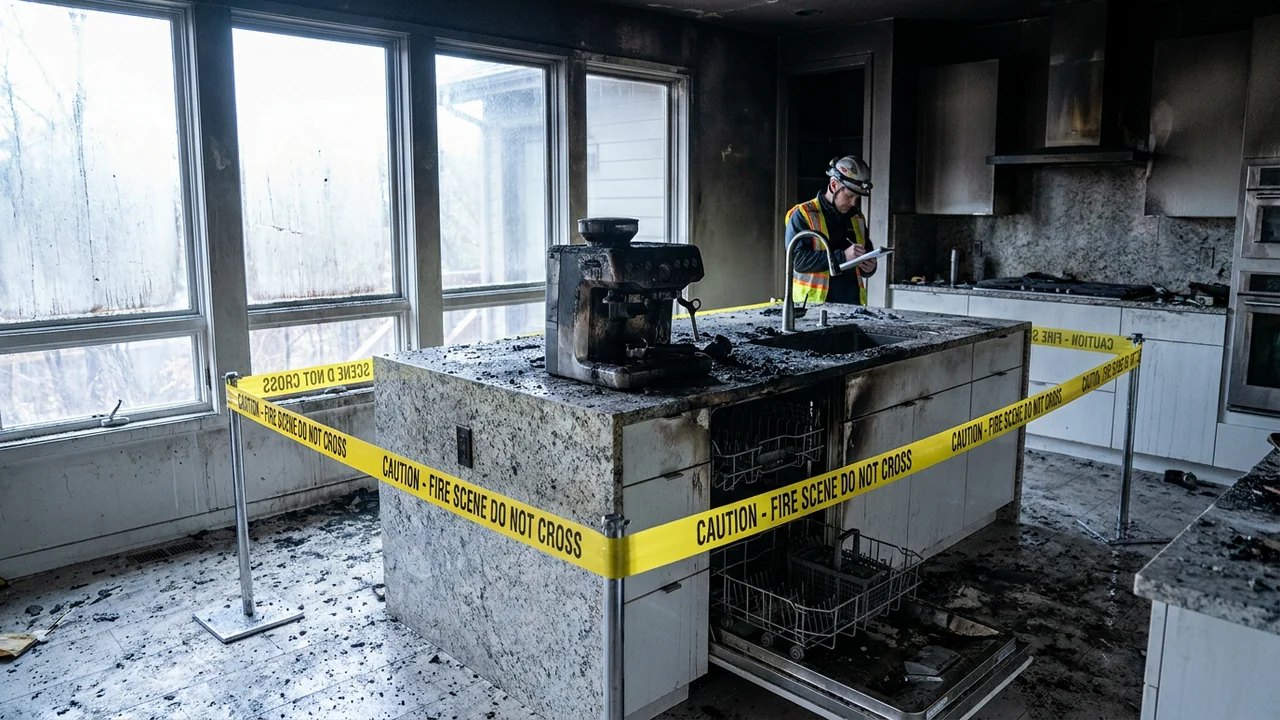
Every time a restoration crew sweeps charred debris into a shovel or unscrews a burst braided supply line to stop a drip without forensic clearance, they risk committing spoliation of evidence. In property subrogation and Special Investigation Unit (SIU) cases, courts can exclude expert testimony, sanction parties, or bar recovery against a negligent manufacturer or contractor if the physical artifact was altered, discarded, or stripped of its surrounding spatial context.
Aligned with NFPA 921, NIST OSAC forensic standards, IRMI subrogation principles, and ANSI/IICRC S320, this Field Guide defines the exact freeze boundaries, packaging rules, and custody logs crews must follow when an origin hold applies.
Subrogation & Arson Spoliation-Hold Field Protocol
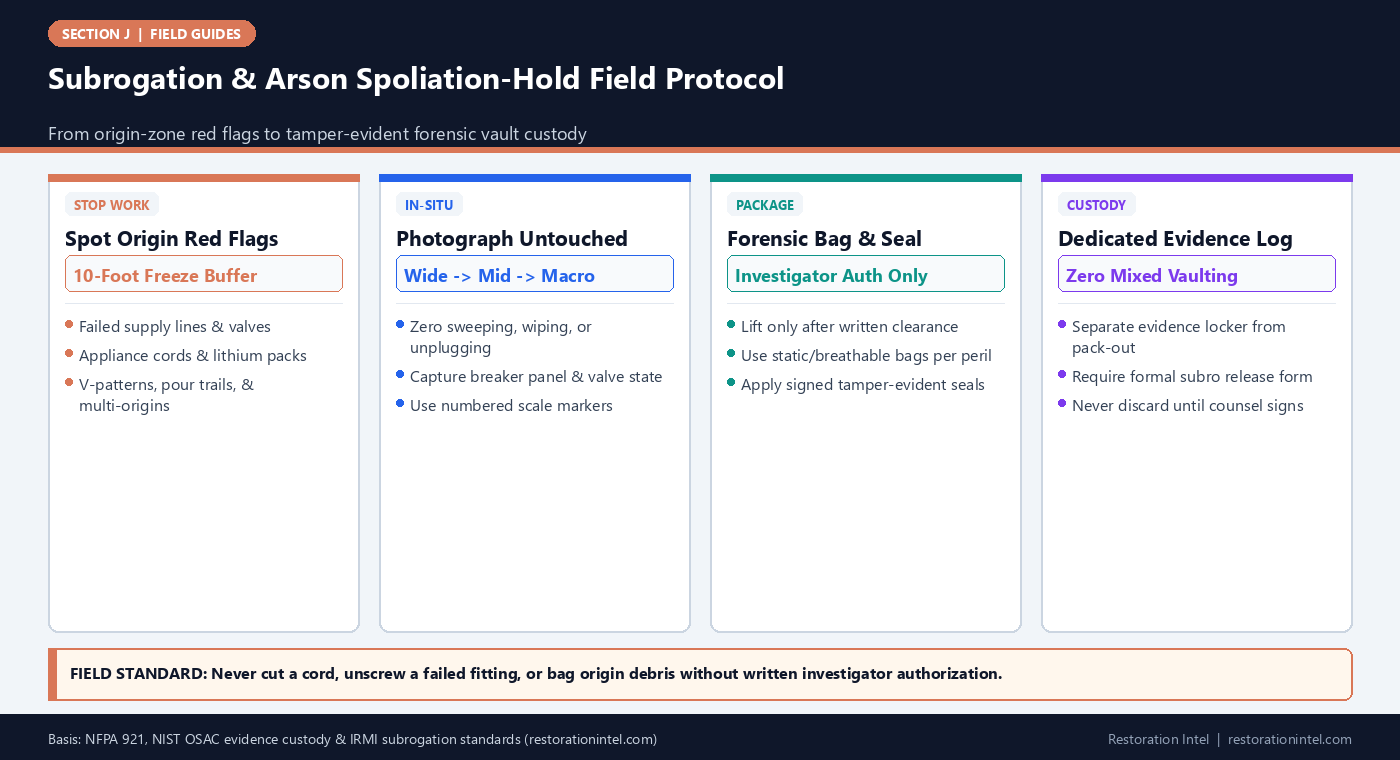
Origin-Zone Spoliation-Hold & Evidence Preservation Matrix
Apply these immediate stop-work boundaries and custody rules whenever field crews encounter potential subrogation or SIU triggers.
| Origin Trigger / Suspect Artifact | Immediate Crew Boundary | Prohibited Crew Actions | Required In-Situ Photo Sequence | Custody & Packaging Rule |
|---|---|---|---|---|
| 1. Failed Plumbing Fitting / Braided Line / Filter | Isolate upstream shutoff valve; freeze 6-ft zone around failed joint | Never unscrew, wrench-tighten, cut hose, or discard cracked plastic nut | Upstream valve position -> full cabinet -> macro of fracture/threads | Leave installed for joint inspection; if removal authorized, cap/bag entire assembly intact |
| 2. Appliance Cord, Power Strip or Control Board | Freeze room quadrant; leave plug seated in wall receptacle | Never unplug, strip jacket, or reset tripped GFCI/AFCI breakers | Breaker panel face -> wall outlet/plug -> charred cord path -> appliance plate | Certified investigator directs cut/removal; package dry in rigid box with tamper seal |
| 3. Lithium-Ion Battery, E-Bike or Charger | Establish outdoor thermal-safe buffer if hot; freeze charger outlet | Never pull cell pack out of melted shell or submerge in general trash | Outlet/charger connection -> charred floor footprint -> cell markings | After thermal stabilization, isolate in fire-rated mineral/vermiculite drum per hazmat/forensic lead |
| 4. Space Heater or Portable Heating Unit | Freeze 8-ft perimeter around unit and nearby combustibles/drapes | Never roll heater aside or vacuum ash beneath chassis | 360-degree room burn patterns -> proximity to bedding/wall -> bottom tip-switch | Tag and leave in place until origin engineer clears removal |
| 5. Suspected Arson / Pour Pattern / Multiple Origins | Immediate all-stop exit from room; notify PM, adjuster, and fire marshal | Zero debris shoveling, zero deodorizing fogging, zero soot wiping | Exit doorway overview ONLY if already inside; do not disturb floor ash | Turn scene over to Fire Marshal / SIU; use clean metal cans ONLY by forensic request |
| 6. Sprinkler Head / Suppression Pipe Failure | Shut system main per fire dept/facility; freeze ceiling drop zone | Never remove failed head with pipe wrench or discard deflector cap | Valve status -> ceiling mount -> floor splash radius -> head stamp | Keep head threaded to drop nipple if removed under joint expert protocol |
What Spoliation Means and How Pack-Out Crews Accidentally Trigger It
Spoliation occurs when physical evidence relevant to foreseeable litigation or subrogation recovery is lost, altered, or destroyed before opposing parties have a fair opportunity to inspect it. Restoration crews rarely cause spoliation intentionally; instead, well-meaning technicians clean up broken glass, haul out a melted toaster, or throw away a ruptured washing-machine hose during Day-1 emergency stabilization.
Under NFPA 921 fire investigation standards and civil litigation rules, altering the scene around a point of origin—even by moving furniture legs out of ash patterns or flipping circuit breakers back on—can permanently destroy arc-mapping and burn-vector clues. Once an adjuster, insurer subrogation unit, or fire investigator flags a potential hold, the restoration team’s job shifts from rapid cleanup to disciplined scene preservation outside the perimeter.
- Day-1 subrogation screen: Ask the project manager and carrier adjuster at dispatch whether cause-and-origin (C&O) is still open.
- Zero-alteration rule: Do not touch, clean, deodorize, or unplug anything inside a flagged origin zone until written clearance arrives.
- Neighboring-room caution: Work safely in unaffected rooms only after marking the origin zone doorway with bright red ‘DO NOT ENTER / EVIDENCE HOLD’ tape.
Recognizing Red Flags Before Moving Debris or Disconnecting Utilities
Crews must recognize origin and arson red flags even when dispatch did not flag subrogation in advance. On water losses, look for recently installed braided stainless lines with split polymer nuts, cracked refrigerator icemaker tees, newly soldered copper joints, or failed plastic filter housings. On fire losses, watch for localized charring around outlets, power strips, cordless tool chargers, space heaters, unusual floor burn trails, or multiple unconnected points of ignition.
When any red flag appears, treat the immediate 6-to-10-foot radius as a frozen forensic zone. Photograph the electrical breaker panel positions (noting tripped vs off handles without toggling them), water shutoff valve orientation, and wide room layout before stepping back.
- Breaker-panel freeze: Shoot a sharp straight-on photo of the entire breaker directory and toggle positions—never flip a tripped breaker to test power.
- Appliance-plug rule: Photograph wall plugs seated inside receptacles before anyone unplugs a suspect appliance.
- As-found floor ash: Never sweep or walk through irregular floor char patterns or melted carpet zones until cleared by C&O.
Forensic Packaging, Tamper-Evident Sealing, and Separate Evidence Custody
When a subrogation engineer or certified fire investigator authorizes the restoration team to remove or transport an evidence artifact after joint inspection, standard pack-out cardboard and packing peanuts are unacceptable. Sharp metal edges puncture standard bags, and plastic bags trap moisture inside wet debris—promoting mold growth that obscures microscopic failure surfaces—while volatiles require airtight clean metal paint cans or nylon bags managed directly by the investigator.
Package dry mechanical or electrical artifacts individually inside clean, rigid, unused cartons padded to prevent shifting, seal every flap with signed and dated tamper-evident evidence tape, and record each artifact on a dedicated Forensic Evidence Chain-of-Custody Log completely separate from household pack-out boxes.
- One-item-per-container rule: Never combine two suspect hoses, valves, or cords in the same bag or carton.
- Breathable vs sealed media: Use paper bags/rigid boxes for dry or damp biological/soot items unless the forensic team specifies vapor-tight metal cans for ignitable liquid testing.
- Signature across the seal: Write initials and date spanning across the tamper tape onto the box surface so any opening breaks the signature.
Managing Multi-Month Spoliation Holds in the Warehouse
Subrogation lawsuits and manufacturer defect claims often take 12 to 36 months to resolve—long after the homeowner’s furniture has been cleaned and returned. Storing a tagged evidence box on an active residential pallet invites accidental disposal during warehouse rack cleanouts. Every spoliation-hold item must sit inside a locked, dedicated Evidence Vault Cage with restricted key access.
Never discard, auction, or return a spoliation-hold artifact—even if the storage period expires or the homeowner calls asking for it—without written release signed by the carrier’s subrogation counsel or assigned claims representative.
- Isolated storage cage: Separate forensic evidence pallets physically and digitally from standard residential storage bays.
- Quarterly hold audit: Review open evidence tags every 90 days with the carrier subrogation desk to bill approved storage or secure written disposition.
- Written-release gate: Require a signed formal Evidence Release Order before transferring custody to an outside lab, shipping via tracked courier, or destroying.
Practitioner Verification Checklist (J-08)
- Verify open cause-and-origin or subrogation status at dispatch and scan rooms for failed fittings, suspect cords, or burn-pattern red flags before starting cleanup.
- Enforce an immediate 6-to-10-foot freeze boundary with red barrier tape whenever an origin or arson indicator is spotted.
- Capture untouched wide-to-macro in-situ photographs, including breaker-panel handle positions and shutoff valves, without altering any artifact.
- Package cleared evidence items individually in unused rigid cartons or specified forensic containers with signed tamper-evident seals.
- Store held artifacts in a locked, segregated Evidence Vault Cage and never release or discard without written counsel/adjuster authorization.
Standards, Authority References & Related Reading
Primary standards, insurance definitions, and sibling Restoration Intel guides referenced in this brief:
- NFPA 921 Guide for Fire and Explosion Investigations
- NIST Organization of Scientific Area Committees for Forensic Science
- IRMI Insurance Glossary: Subrogation
- ANSI/IICRC S320 Standard for Professional Contents Restoration
- Related Guide: Field Guide: Chain-of-Custody Form Elements & Pack-Out Sign-Off Template
- Related Guide: Field Guide: Non-Salvageable Disposal Authorization & Witness-Log Template
- Related Guide: Field Guide: Subrogation & Manufacturer Defect Escalation Flags on Appliance-Origin Losses
- Related Guide: Salvage Credits and Buy-Back Rules When Insureds Keep Partially Damaged Contents
- Related Guide: The Specialty Codes
.md twin for desk QA and team training.Frequently Asked Questions
What should a crew do if they have to shut off a broken water line that is part of a subrogation claim?
Close the upstream angle stop or main shutoff valve cleanly without wrenching on the failed fitting or hose itself, photograph the valve and intact failed joint in place, and immediately notify the project manager and adjuster.
Can a restoration contractor take forensic samples for ignitable liquids on a suspected arson job?
No. Collection and laboratory testing of fire debris for accelerants must be performed by qualified fire investigators or forensic specialists under strict NFPA 921 and ASTM protocols.
How long must a contractor hold subrogation evidence in storage?
Hold tagged evidence until the carrier’s subrogation unit or legal counsel provides a formal written release or transfer order—never discard it on a standard 30-day or 90-day warehouse timeout.
Why must forensic evidence be tracked separately from the homeowner's pack-out manifest?
Because residential pack-out boxes return to the home at reset, whereas subrogation artifacts must remain sealed under uninterrupted forensic chain of custody for months or years of expert inspections.