Direct Answer: Run every damaged item through two sequential gates—technical safety/restorability first, then economic feasibility against Replacement Cost and Actual Cash Value—using distinct material rules for soft goods, upholstery, solid vs engineered casegoods, and electronics before wrapping a single box.
.md twin for estimator QA and carrier file documentation.
Packing everything in a house and sorting it back at the warehouse looks busy on Day 1, but it destroys project margins and creates carrier friction. Shipping, cleaning, and storing a $180 particleboard bookcase that swelled at the base—or a five-year-old TV whose circuit board absorbed acidic PVC smoke—costs more than replacing the item outright.
Grounded in ANSI/IICRC S320, S500, S700, and RIA best practices, this Field Guide delivers a 60-second decision tree across the four highest-volume residential and office asset families.
60-Second Four-Family Contents Triage Decision Tree
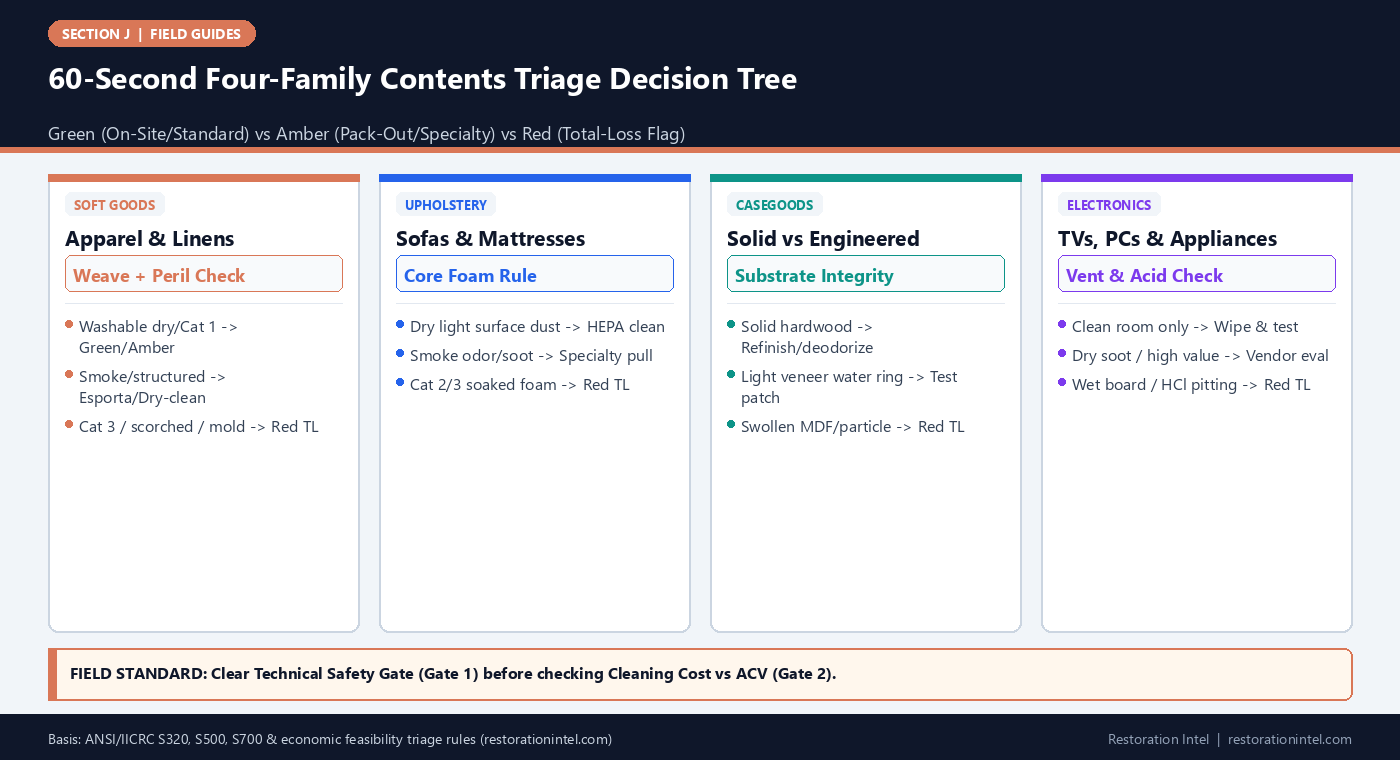
Quick-Triage Decision Matrix Across Soft Goods, Upholstery, Casegoods & Electronics
Assign Green, Amber, or Red triage tags at walkthrough using the physical verification test in the right column.
| Asset Category | Green (On-Site / Standard Clean) | Amber (Pack-Out / Specialty Process) | Red (Non-Salvageable Flag) | 60-Second Field Test |
|---|---|---|---|---|
| 1. Everyday Washable Apparel & Bedding | Dry exposure or clean Cat 1 splash; no dye bleed | Moderate dry smoke, soot, or Cat 2 requiring specialized wash | Cat 3 sewage, visible mold growth, heat-melted synthetics, scorch | Check care tag, elastic integrity, and deep fold odor |
| 2. Tailored Suits, Silk, Wool & Leather | Unexposed closet interior behind closed gasketed door | Light/moderate dry smoke needing specialized dry-cleaning/ozone | Shrinkage from high heat, Cat 2/3 wetting, brittle cracked leather | Inspect lining seams and shoulder pads for moisture or heat stiffness |
| 3. Area Rugs & Tapestries | Light surface dust or clean Cat 1 corner dampness | High-value wool/hand-knotted rug with soot or Cat 2 edge exposure | Cat 3 immersion, delaminated latex glue backing, active mold | Flip corner to check backing glue and dye-crocking transfer |
| 4. Upholstered Sofas, Chairs & Mattresses | Light dry dust/soot outside flame room; no fluid penetration | High-value frames needing extraction, dry-cleaning, & chamber deodorization | Any Cat 2/3 core foam wetting, urine/sewage, severe protein smoke | Press cushion core + smell zipper seam; wet foam cannot be sanitized safely |
| 5. Solid Wood Casegoods (Oak, Maple, Walnut) | Dry room protection or superficial smoke film | Moderate soot, white water rings, or swollen dovetail drawers | Charred structural joints, deep split panels, or heavy Cat 3 raw wood | Inspect underside/back panel for solid timber vs stamped MDF |
| 6. Veneer, Laminate & Particleboard (MDF) | Completely dry zone; wipe surface dust only | High-value commercial veneer with intact substrate and minor film | Any edge swelling, bubbling veneer, delaminated backing, or sagging shelf | Run finger along bottom toe-kick and rear edge for mushy/swollen fiber |
| 7. TVs, Computers & Consumer Electronics | Clean unaffected room; power off & wrap safely | High-value server/studio/pro audio exposed to dry smoke only | Internal moisture, Cat 2/3 splash, melted bezel, or visible HCl metal pitting | Shine penlight through rear cooling vents for soot clumping or corrosion |
| 8. Small & Major Kitchen Appliances | Clean zone or light dry dust on sealed exterior | Prosumer range/espresso unit with intact electronics & light soot | Submerged lower motor/board, heavy protein grease inside vents, pitted chrome | Check underside fan vents, cord insulation stiffness, and control bezel |
Running the Two-Gate Triage Filter Before Wrapping Boxes
Field technicians should never default to ‘pack it all and let the office decide.’ Every object passes through two rapid gates on site. Gate 1 is Technical Feasibility: can the item be returned to a safe, sanitary, odor-free, and functional pre-loss state under S500, S520, S700, and S320? If the answer is no—such as a mattress saturated with Category 3 water or an MDF desk bubbling along its base—the item stops immediately at Red.
Gate 2 is Economic Feasibility: if an item is technically cleanable, does the combined pack-out, cleaning, deodorization, storage, and reset labor stay comfortably below its depreciated Actual Cash Value (and Replacement Cost)? As explored in A Pack-Out Record Is Not a Priced Inventory, flagging borderline low-value items early saves carrier pushback and keeps truck space focused on high-margin restorable contents.
- Gate 1 beats Gate 2: Never run cost math to justify keeping an unsafe Category 3 or Condition 3 porous item.
- Sentimental override flag: Low-ACV heirlooms (baby blankets, photo albums, handmade quilts) may bypass Gate 2 only with explicit owner/adjuster written approval.
- Representative test patch: On questionable smoke-stained finishes, run one documented 4-inch test clean before packing an entire room.
Soft Goods and Upholstery: Reading Fibers, Linings, and Foam Cores
Textiles absorb odor molecules and suspended soot faster than hard surfaces, yet modern specialized wet-washing and ozone/hydroxyl chambers recover a remarkable share of dry-smoke apparel when fibers have not been scorched. Check elastic waistbands, nylon linings, and synthetic suede first—heat hardens or melts polymers long before cotton chars.
Upholstered furniture and mattresses hinge on what sits beneath the fabric. Multi-layer polyurethane foam cores, batting, and stapled dust covers trap Category 2/3 contaminants and heavy smoke tar where surface extraction cannot penetrate. Always inspect underneath the sofa skirt and unzip cushion covers to examine interior foam color and smell before tagging Amber.
- Mattress sanitation rule: Mattresses exposed to Category 2/3 water or heavy smoke odor should be flagged total loss immediately.
- Bag-by-tier rule: Separate high-value tailored dry-clean garments from bulk everyday laundry bags during pack-out.
- Carpet/rug backing check: Inspect latex-glued tufted rugs for delamination or mildew odor before sending to a rug wash plant.
Casegoods: Separating Solid Joinery from Swollen Particleboard
To an untrained eye from across a room, a $2,800 solid cherry credenza and a $240 paper-foil particleboard media console look similar in wide room photos. Up close, their restoration profiles diverge completely. Solid hardwood tolerates controlled drying, HEPA/chemical-sponge soot removal, and fine furniture refinishing even after moderate exposure.
Engineered wood (particleboard, MDF, hardboard drawer bottoms) acts like a compressed sponge. Once standing water or high humidity swells the edges or loosens cam-lock fasteners, the core cannot shrink back to factory thickness. Always check the raw underside edge, toe-kick, and rear panel—where manufacturers rarely seal laminate—before deciding to pack.
- Bottom-edge touch test: Press the lowest unpainted rail or back edge of cabinets; crumbly or expanded fiber means immediate Red total loss.
- Veneer blister check: Heat and moisture lift thin wood veneers off MDF cores into hollow bubbles that cost more to re-press than replace on mid-tier furniture.
- Solid-wood identification: Photograph dovetail drawer joints, maker’s marks, and solid underside grain to support Amber specialty restoration.
Electronics Triage: Vents, Acidic Smoke, and Hidden Moisture
Never plug in a smoke- or water-exposed television, computer, or audio receiver on site to ‘see if it still works.’ Energizing damp or conductive soot-coated circuit boards causes instant micro-shorts that destroy recoverable data and create fire hazards. Visual triage relies on external moisture lines, cooling-vent inspection with a penlight, and checking bare metal I/O ports for white or green acidic corrosion.
Even dry smoke contains fine carbon and acidic compounds pulled straight across internal fans while equipment ran during the fire. Unless a certified electronics restoration vendor confirms safe ultrasonic/deionized cleaning makes sense relative to the unit’s rapid depreciation curve, mid-tier consumer electronics exposed to heavy smoke or any Category 2/3 moisture default to Red.
- Zero power-on test: Keep all suspect electronics unplugged and note ‘Not tested due to moisture/soot risk’ on the log.
- Port-oxidation check: Inspect HDMI, USB, and RCA jacks with a penlight; powdery oxidation signals internal acidic damage.
- Data-first distinction: Separate hardware replacement valuation from critical hard-drive data recovery needs on home offices.
Practitioner Verification Checklist (J-09)
- Apply Gate 1 (Technical Safety & Restorability) before Gate 2 (Cleaning Cost vs ACV) on every triage decision.
- Inspect cushion foam cores, rug backings, and garment linings before tagging soft goods or upholstery as Amber restorable.
- Check unpainted bottom rails and rear panels on all bookcases, dressers, and cabinets to separate solid wood from swollen particleboard.
- Never power on wet or smoke-exposed electronics; inspect cooling vents and rear I/O jacks with a penlight for soot or corrosion.
- Attach color-coded Green, Amber, or Red triage tags linked to item photos so pack-out crews and disposal teams never cross lanes.
Standards, Authority References & Related Reading
Primary standards, insurance definitions, and sibling Restoration Intel guides referenced in this brief:
- ANSI/IICRC S320 Standard for Professional Contents Restoration
- ANSI/IICRC S500 Water Damage Standard
- ANSI/IICRC S700 Fire & Smoke Restoration Standard
- Restoration Industry Association (RIA)
- Related Guide: Field Guide: IICRC S500, S520, and S700 Quick-Reference Thresholds for Contents Triage
- Related Guide: Field Guide: Photographic Proof Angles Required to Substantiate Odor, Corrosion, and Hidden Moisture
- Related Guide: Field Guide: Condition-Grade Definitions Rubric (New / Mint / Good / Fair / Poor / Damaged)
- Related Guide: Furniture Valuation and Depreciation: Solid Wood vs Veneer, Upholstery Grade, and Custom Joinery
- Related Guide: Cleaning Cost vs Depreciated ACV: Navigating the Economic Feasibility Trap on Restorable Contents
.md twin for desk QA and team training.Frequently Asked Questions
Why should field crews never plug in wet or smoky electronics to verify whether they still work?
Powering up equipment with internal condensation or conductive carbon soot can short-circuit power supplies, erase recoverable hard-drive data, and spark secondary electrical fires.
Can swollen MDF or particleboard furniture ever be dried flat and restored?
No. Once water penetrates compressed wood fibers and adhesives break down, the board swells irreversibly and loses fastener-holding strength.
When does a technically cleanable item still receive a Red total-loss flag?
When the combined cost of pack-out, specialty cleaning, deodorization, storage, and reset exceeds the item’s depreciated Actual Cash Value or replacement cost, and the item has no documented sentimental override.
Why unzip sofa cushions during a quick field triage?
Upholstery fabric may look only lightly soiled while interior polyurethane foam cores hold deep Category 2/3 moisture, microbial odors, or heavy smoke tar that cannot be reliably extracted.