Direct Answer: Enforce a strict 3-to-4-character room code, standardized carton-size and handling codes, a structured Box ID (`[ROOM]-[TYPE]-[SEQ]`), and dual-panel label placement on every pack-out container so multiple crew shifts and warehouse forklifts never misroute or collide on box numbers.
.md twin for estimator QA and carrier file documentation.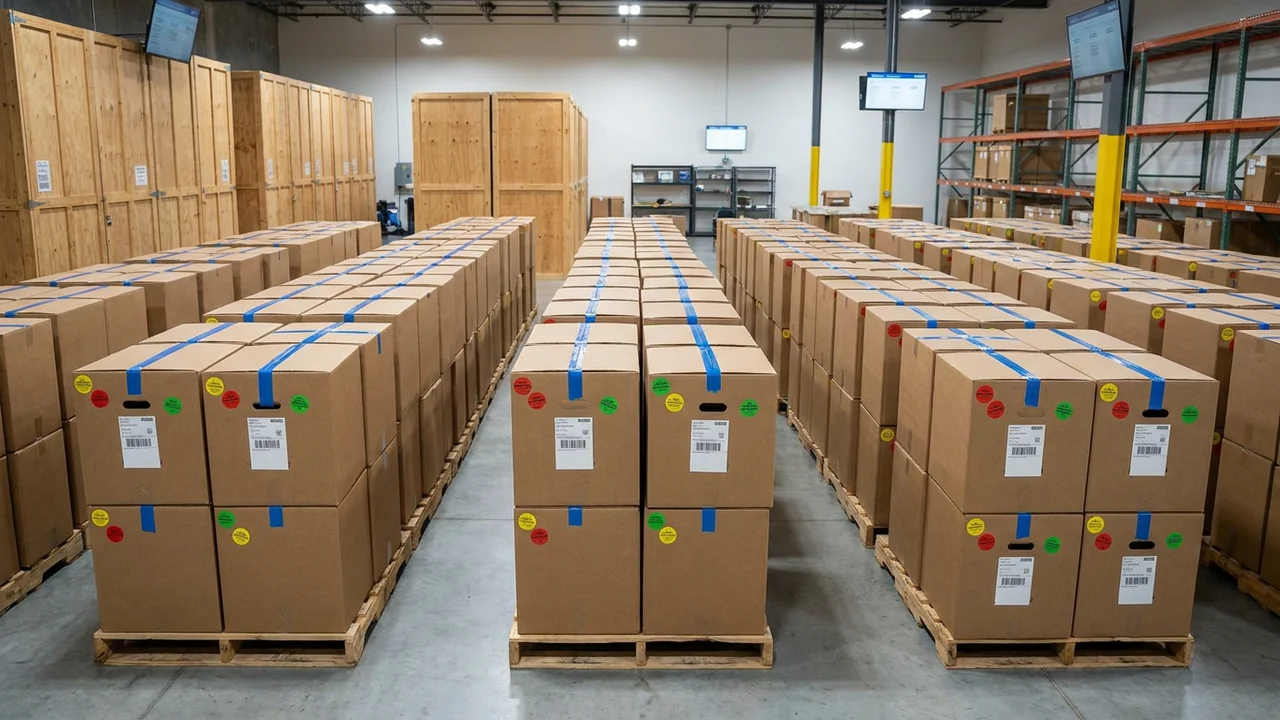
Walk into an unstandardized restoration warehouse after two crews packed out a 4,000-square-foot fire loss across three days and you will see the same failure pattern: one crew wrote `MSTR` while another wrote `MB`, three separate boxes are numbered `KIT-12`, and labels slapped across top flaps disappear the moment pallets stack three high.
Designed to pair directly with ANSI/IICRC S320 inventory traceability and the shared vocabulary principles in The Specialty Codes, this taxonomy locks down every room prefix, carton code, handling flag, and vault coordinate used across multi-crew operations.
Standard Multi-Crew Box-Labeling & Vault Taxonomy
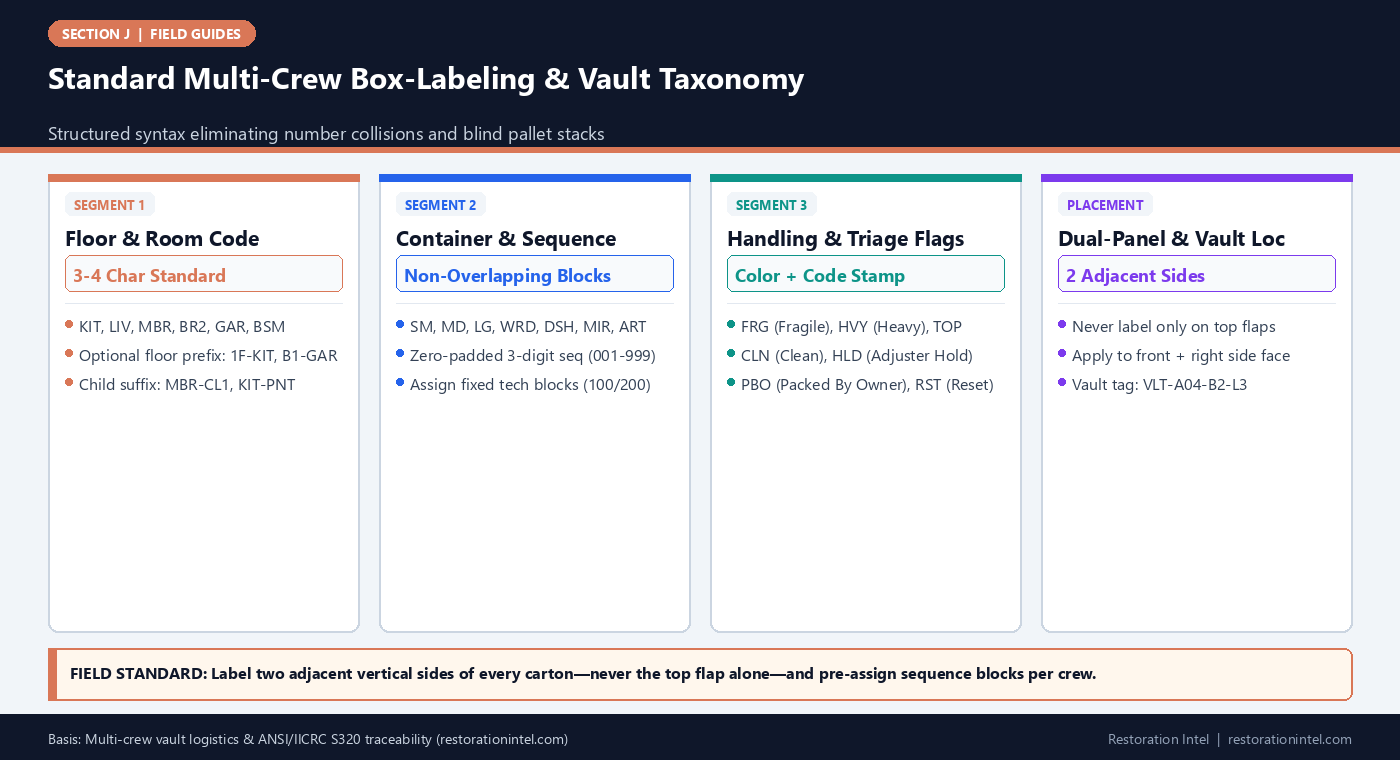
Master Abbreviation & Box-Labeling Taxonomy Reference
Print and laminate this code table inside every pack-out truck kit and warehouse receiving desk.
| Code Group | Approved Abbreviations | Full Definition | Prohibited Ambiguous Variants | Operational Usage Rule |
|---|---|---|---|---|
| Primary Living Spaces | ENT, HAL, LIV, FAM, DIN, SUN | Entry, Hallway, Living, Family, Dining, Sunroom | FR, LR (ambiguous), Front Rm, Den1 | Match floorplan room name; add digits only for multi-zone (HAL1, HAL2) |
| Kitchen & Service | KIT, PNT, BRK, LND, UTL, MUD | Kitchen, Pantry, Breakfast Nook, Laundry, Utility, Mudroom | Kitch, Wash, Boiler, Back Entry | Treat walk-in pantry as KIT-PNT when linked to kitchen |
| Bedrooms & Baths | MBR, BR2, BR3, MBA, BTH, OFC | Primary Bed, Bed 2/3, Primary Bath, Bath, Home Office | Master, Kid Rm, Guest, Study, Toilet | Use child suffix -CL1 / -CL2 for walk-in closets (MBR-CL1) |
| Storage & Exterior | GAR, BSM, ATT, PAT, SHD, CRW | Garage, Basement, Attic, Patio, Outbuilding Shed, Crawl | BSMT, Cellar, Shop, Yard | Prefix floor level on large commercial/multi-story: 2F-OFC-004 |
| Container Type Codes | SM, MD, LG, WRD, DSH, MIR, ART, TOT | Small, Medium, Large, Wardrobe, Dishpack, Mirror, Art Crate, Plastic Tote | Box, Big Box, Clothes, Glass, Tub | Always distinguish double-wall Dishpacks (DSH) from standard LG boxes |
| Handling & Status Flags | FRG, HVY, TOP, PBO, CLN, HLD, REG | Fragile, Heavy, Top-Load Only, Packed By Owner, Clean/Process, Adjuster Hold, Regulated | Careful, Breakable, Wait, Mine | Stamp HLD in red ink; REG marks locked-cage privacy/evidence bins |
| Vault Coordinate Syntax | VLT-[Zone][Aisle]-B[Bay]-L[Level] | e.g., VLT-A02-B4-L2 (Zone A, Aisle 2, Bay 4, Tier 2) | Back corner, Left wall, Upstairs | Update digital manifest immediately whenever pallet moves bays |
Preventing Multi-Crew Number Collisions on Large Pack-Outs
When three technicians pack boxes simultaneously across a large home or commercial building, sequential numbering (`001, 002, 003`) collides within the first hour unless sequence ranges are allocated before the first roll of tape is pulled. Two boxes labeled `KIT-LG-004` sitting on different pallets destroy warehouse reconciliation and cause phantom duplicates in estimating imports.
Solve collisions before unloading the truck by assigning non-overlapping 100-block ranges per technician or per room team: Crew Lead / Tech A receives `001–099`, Tech B receives `100–199`, Tech C receives `200–299`, or each primary room gets an explicit pre-printed barcode roll. If using handheld barcode printers, encode the unique Job ID + Box ID into every scannable label.
- Pre-allocated blocks: Write each technician’s assigned Box ID range on the doorway tape and morning huddle whiteboard.
- No recycled numbers: If a box label tears or a carton is consolidated before loading, void that number on the log rather than reusing it.
- Pre-printed roll discipline: When using pre-numbered barcode rolls, scan the first and last sticker of each room sheet into the job header.
The Dual-Panel Placement Rule for High-Density Vault Racking
Warehouse crews stack pack-out cartons four to six boxes high on wooden pallets and wrap them in stretch film. Placing the single box label on the top lid hides it completely the moment another box lands on top. Placing it on only one side guarantees half your boxes face inward toward the center of the pallet stack.
Enforce the two-adjacent-side rule: every carton receives an identical primary label on its front face and a twin label (or mirrored barcode sticker) on the adjacent right side face, positioned in the upper corner where pallet corner-boards do not cover the text. For pad-wrapped furniture, attach a heavy Tyvek string tag tied cleanly to a structural leg or stretcher—never stick adhesive labels directly onto finished wood or leather.
- Zero top-only labels: Top lids are strictly for optional ‘THIS SIDE UP / TOP-LOAD’ arrows—never the primary Box ID.
- Outward-facing pallet rule: Stack every box on the pallet with at least one of its two labeled faces visible from the aisle.
- Zero-adhesive furniture rule: Tie tags to furniture legs or wrap pads externally; direct tape/stickers strip lacquer and pull leather dye.
Handling Special Flags: PBO, Adjuster Hold, and Regulated Cages
Standard room-and-box codes tell you where an item came from, not how the warehouse must treat it next. Adding explicit status flags (`CLN`, `HLD`, `PBO`, `REG`, `RST`) right below the Box ID lets forklift operators route incoming pallets instantly without opening flaps to ask what is inside.
Boxes marked `HLD` (non-salvageable items held pending carrier inspection) must be segregated onto red-tagged hold pallets so cleaning technicians do not accidentally spend labor deodorizing total-loss dishes. Similarly, `PBO` (Packed By Owner) tells receiving benches and estimators that the sealed contents were packed prior to crew arrival.
- Color-coded tape discipline: Use standard kraft/clear tape for restorable packs (`CLN`), orange/red flags for `HLD`, and serialized numbered seals for `REG` privacy/evidence bins.
- Fragile + Heavy pair: Mark heavy dishpacks (`DSH`) and book cartons (`SM`) with `HVY` on top and sides to protect lower-back safety and prevent crushing light boxes underneath.
- Reset-ready flag (`RST`): Apply green check stickers only after cleaning, QA, and resealing finish so delivery crews never load unprocessed boxes.
Maintaining Vault Coordinate Hygiene Across Multi-Month Storage
A perfectly labeled box is still lost if the warehouse crew moves a pallet from Aisle 2 to Overflow Bay 9 during a busy storm week without updating the coordinate register. Adopt a simple four-part vault address—`VLT-[Zone][Aisle]-B[Bay]-L[Level]`—printed clearly at rack eye level.
Pair every physical pallet move with an immediate barcode scan or clipboard rack-transfer entry. Running a 10-minute Friday afternoon rack reconciliation ensures every active claim can locate 100 percent of its cartons and furniture pieces prior to homeowner reset.
- Pallet-sheet sleeve: Slip a master list of every Box ID stacked on that pallet inside a clear pouch stapled to the outer stretch wrap.
- Single-claim-per-pallet rule: Never mix boxes from two different customer claims onto one storage pallet.
- Move-scan discipline: Any forklift operator who shifts a pallet bay logs the old and new coordinate before dropping the forks.
Practitioner Verification Checklist (J-11)
- Publish the laminated master room and container abbreviation chart inside every pack-out truck and intake bench.
- Assign non-overlapping Box ID sequence blocks to each technician or room team before packing starts.
- Place identical Box ID labels on two adjacent vertical sides of every carton—never solely on top flaps or directly on finished furniture.
- Mark handling and workflow flags (FRG, HVY, PBO, HLD, REG) visibly beside the primary Box ID.
- Record standardized vault coordinates (`VLT-ZoneAisle-Bay-Level`) upon intake and keep one claim per storage pallet.
Standards, Authority References & Related Reading
Primary standards, insurance definitions, and sibling Restoration Intel guides referenced in this brief:
- ANSI/IICRC S320 Standard for Professional Contents Restoration
- Restoration Industry Association (RIA)
- Verisk XactContents Platform Overview
- Verisk Xactimate Estimating Platform
- Related Guide: Field Guide: The Universal Room-by-Room Contents Capture Order Checklist
- Related Guide: Field Guide: Chain-of-Custody Form Elements & Pack-Out Sign-Off Template
- Related Guide: Field Guide: Verisk XactContents & Symbility Field-Mapping Reference Sheet
- Related Guide: Field Guide: Calculating Pack-Out Box Count and Vault Square-Footage Estimates on Day-1 Walkthroughs
- Related Guide: The Specialty Codes
.md twin for desk QA and team training.Frequently Asked Questions
Why should crews avoid sticking box labels on top flaps?
Once boxes are stacked three to five high on warehouse pallets, top labels become completely invisible. Labeling two adjacent vertical side faces keeps every Box ID readable from the aisle.
How do you stop two technicians from accidentally creating duplicate Box IDs in the same kitchen?
Pre-allocate fixed numeric blocks per technician (for example, Tech A uses 001–099, Tech B uses 100–199) or issue unique pre-printed sequential barcode sticker sheets at morning huddle.
What does PBO mean on a restoration box label?
PBO stands for Packed By Owner. It documents that the homeowner taped or packed the container prior to crew arrival, limiting contractor verification of interior pre-pack condition.
Should different customers' boxes ever share a warehouse pallet if each claim is small?
No. Keep one claim per pallet or clearly partitioned vault cage at all times to eliminate cross-claim mix-ups during reset loading.