Direct Answer: Defending fire, smoke, and protein-residue contents scope requires separating technical non-salvageability from economic total loss using ANSI/IICRC S700 and S320 test-cleaning receipts, char or heat-distortion photos, and side-by-side restoration-versus-ACV/RCV math before any damaged personal property leaves the loss site.
.md twin for estimator QA and carrier file documentation.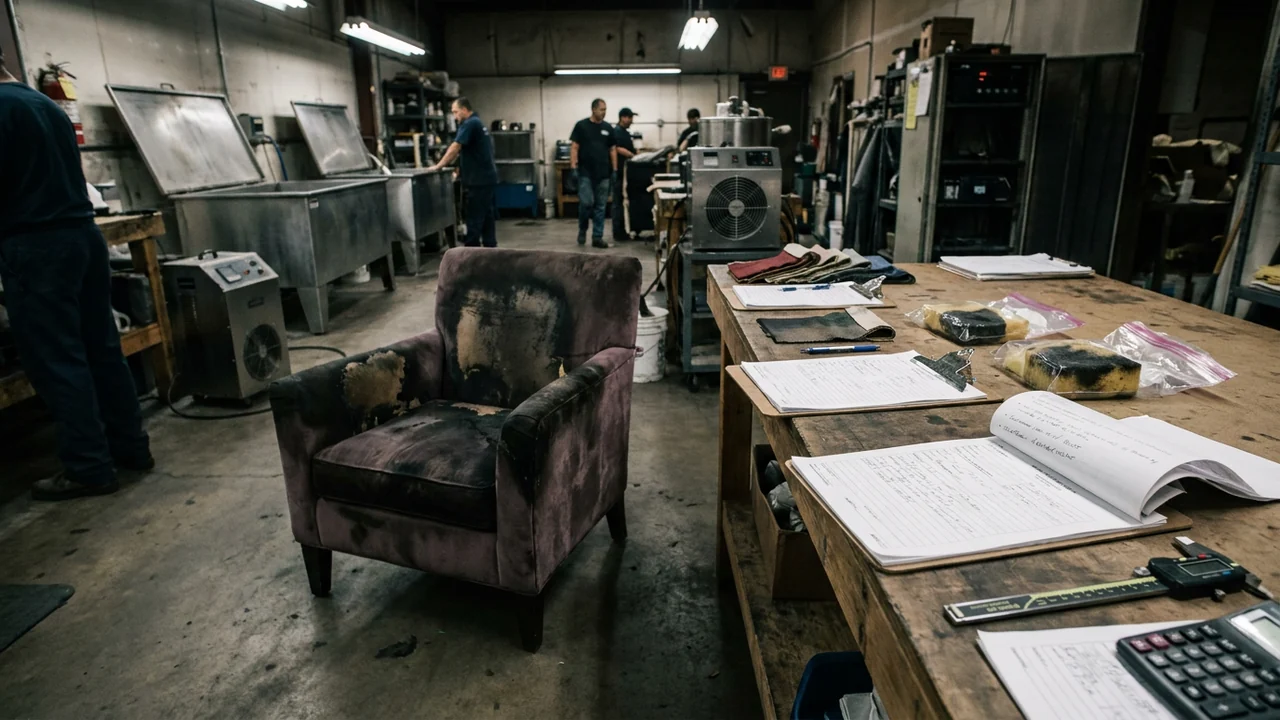
Fire and protein-smoke claims routinely break down at the estimating desk rather than on the truck. Field crews can see melted appliance housings, blistered lacquers, and pungent grease-laden aerosolized protein residue embedded in open-cell upholstery foam, yet desk examiners reviewing low-resolution room overviews often redline pack-out labor or demand blanket surface cleaning on items that cannot technically or economically return to pre-loss condition.
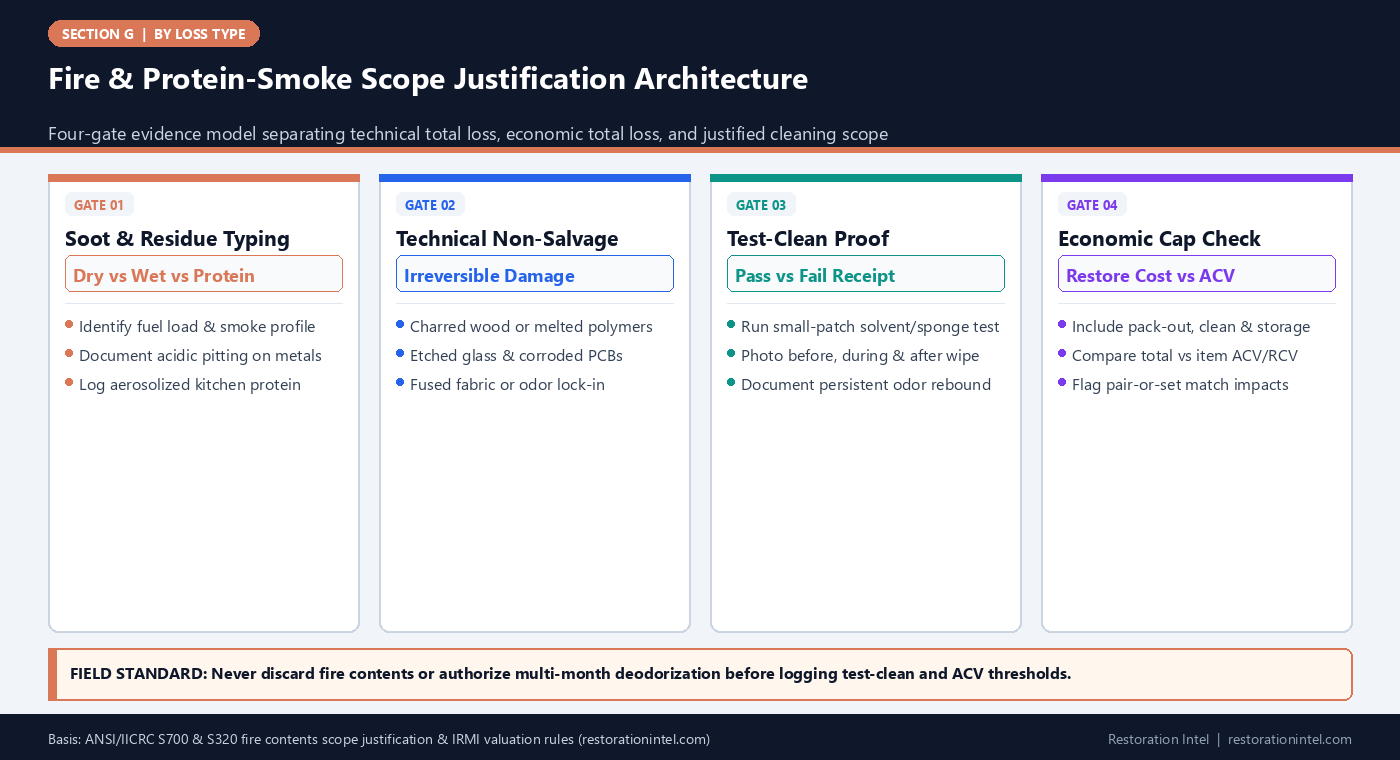
Bridging that gap requires aligning every line item with the technical benchmarks in ANSI/IICRC S700 for fire and smoke restoration and ANSI/IICRC S320 for contents processing. Rather than relying on subjective crew notes such as ‘smells bad’ or ‘heavy smoke,’ scope justification must categorize soot chemistry, record controlled test-cleaning outcomes, and compare total restoration cost against depreciated replacement economics.
When estimators present clean scope segregation in XactContents alongside itemized Actual Cash Value (ACV) and Replacement Cost Value (RCV) benchmarks, adjusters gain an auditable decision file. That structure prevents costly mid-claim re-inspections, limits unbilled storage extensions, and protects policyholders from premature disposal disputes.
Fire & Protein-Smoke Scope Justification Architecture
Fire, Smoke & Protein-Residue Disposition & Carrier Justification Matrix
How restoration estimators match specific thermal or smoke damage mechanisms to defensible disposition paths and desk-review proof.
| Residue / Damage Type | Typical Affected Contents | Primary Failure Mechanism | Justified Disposition | Required Carrier Proof |
|---|---|---|---|---|
| Direct Char & Thermal Melt | Appliance housings, acrylics, laminated furniture | Structural polymer deformation, blistering, or charring | Technical Total Loss | Macro melt/char photos, brand/model plate, pre-disposal log |
| Protein Smoke (Kitchen Grease) | Unsealed wood, upholstery, mattresses, drapes | Microscopic lipid-protein film that turns rancid in porous fibers | Test-Clean or Total Loss | Yellow/amber wipe-pad test, proximity to stove, odor rebound note |
| Synthetic Wet Soot | Plastics, coated surfaces, matte painted wood | Smearing and acidic etching upon moisture or friction contact | Specialty Clean or Replace | Dry-sponge smear test photo, acid-pitting macro, labor-vs-ACV math |
| Dry Cellulosic Soot | Hardwood furniture, ceramics, sealed metals, glassware | Loose carbon deposition removable via HEPA and chemical sponge | Restorable (Pack-Out Clean) | Room soot-line photo, cleaning unit code, post-clean QA sign-off |
| Thermal / Corrosive Electronics | TVs, computers, kitchen smalls, HVAC controls | Acidic soot + suppression moisture corroding solder joints | Bench Diag or Total Loss | Certified electronics bench report, serial plate, corrosion photo |
| Suppression Water + Soot Mix | Paper records, upholstered sofas, particleboard | Soot carried deep into swelling core fibers via hose-stream water | Technical Total Loss | Moisture meter reading, swelling macro, wet-soot wicking photo |
Separating Technical Non-Salvageability From Economic Total Loss
Carrier adjusters evaluate total-loss requests through two distinct lenses: technical impossibility and economic irrationality. Technical non-salvageability applies when an item suffers irreversible physical or chemical alteration—such as charred structural frames, warped engineered wood, crazed finishes, etched aluminum or chrome trim, or melted synthetic textiles. Even if a crew spent infinite labor hours wiping carbon off a blistered refrigerator door, the item cannot regain pre-loss integrity.
Economic total loss occurs when an item is physically cleanable in principle under ANSI/IICRC S700, yet the combined cost of packing, transport, ultrasonic or hand cleaning, ozone or hydroxyl deodorization, storage, and return exceeds a defensible threshold relative to replacement pricing. On high-volume everyday goods such as mass-market flat-pack shelving, low-cost linens, or older small appliances, pack-out and two-stage deodorization can quickly exceed ACV.
Mixing those two rationales inside one vague ‘ruined by smoke’ column invites immediate desk redlines. As outlined in Two Standards, One Truck, disciplined packets tag every condemned line with its exact category—technical failure with photographic damage proof, or economic total loss backed by a transparent restore-versus-replace worksheet.
- Technical condemnation markers: Document physical warping, finish bubbling, soot impregnation into unsealed grain, or corrosive pitting on electrical contacts.
- Full-burden restoration math: Include pack-out labor, carton/wrap materials, vault storage days, cleaning hours, and pack-back delivery when comparing against ACV or RCV.
- Avoid arbitrary blanket rules: Never mark an entire bedroom total loss solely because a hallway had heavy smoke unless soot penetration or economic math supports each line.
Justifying Protein-Residue and Invisible-Odor Condemnation
Protein fires—such as unattended stovetop grease, burnt roasts, or oven flare-ups—create one of the most contentious documentation gaps in property claims. Unlike plastic or rubber fires that paint walls black, protein combustion produces a nearly transparent, amber-tinted lipid aerosol that settles onto cabinets, drapes, lamp shades, and sofa cushions without dramatic visual contrast.
Desk examiners working strictly from wide-angle room photos often question why a spotless-looking sectional sofa or mattress requires intensive thermal deodorization or replacement. Without tactile and chemical evidence in the file, an insurer sees zero visible damage and pushes back on both pack-out cleaning and total-loss claims.
To defend protein-residue scope, field teams must make the invisible film visible and measurable. Pairing high-contrast raking-light surface shots with dry chemical-sponge or white microfiber wipe comparisons on uncleaned versus test-cleaned patches turns an invisible odor complaint into undeniable visual proof aligned with Fire Contents Restoration Protocols.
- White-wipe contrast test: Photograph a clean white chemical sponge or solvent-dampened cloth beside the discolored amber grease film pulled from upper cabinet faces or appliance tops.
- Porous core penetration note: Explain why lipid aerosols bond to polyurethane foam, down fill, and unsealed particleboard where surface wiping cannot reach.
- Odor rebound documentation: Record whether an item re-emits rancid odor after a 24-hour sealed poly-bag test or heated-chamber trial prior to authorizing full-lot cleaning.
Structuring Restore-vs-Replace Worksheets for Desk Examiners
When an item falls into the economic gray zone—neither visibly melted nor effortlessly wipeable—the estimating desk must show its work. A clean restore-vs-replace comparison sheet lists the item’s verified room, quantity, brand/model, estimated RCV, depreciated ACV, itemized restoration labor and deodorization units, and net variance.
Estimators should pay close attention to policy mechanics and carrier expectations covered in Contents Cleaning SLAs by Category. If a third-party administrator sets a soft ceiling—such as requiring adjuster pre-approval whenever restoration exceeds 50 to 70 percent of ACV—surfacing those borderline assets during the first 48 to 72 hours prevents crews from spending unrecoverable shop hours on items the carrier ultimately elects to cash out.
Equally important is separating restoration service billing from insured total-loss property schedules. Keep pack-out, cleaning, and vaulting line items on the contractor mitigation/contents invoice while routing non-salvageable RCV/ACV lines into the policyholder’s contents valuation schedule in XactContents.
- Three-bucket claim summary: Present Cleanable/Restorable, Hold for Adjuster/Test-Clean, and Verified Non-Salvageable totals on the packet cover page.
- Sublimit and pair-or-set flags: Identify matched dining sets, multi-piece sectionals, or sublimited collections early so partial salvage does not leave mismatched remnants.
- Storage clock control: Tie vault-storage duration directly to documented adjuster hold approvals rather than open-ended warehouse dwell time.
Pre-Disposal Protocol and Supplement Defense on Fire Losses
Disposing of burnt or smoke-saturated belongings before adjuster verification is the quickest way to forfeit claim recovery. Even when a fire marshal or safety officer orders rapid debris clearing, crews should never haul off non-salvageable household assets without capturing minimum proof: wide room context, item-level damage photo, brand/model rating plate where readable, and count verification.
Where hazardous melted polymers, lithium batteries, or firefighting foam residues create storage hazards on site, document the safety condition explicitly and obtain written authorization from the adjuster or insured before landfill disposal. If an item is too charred to read a serial tag, photograph remaining hardware, dimensions, material thickness, and comparable undamaged roommates (such as a surviving matching chair) to anchor Like-Kind-and-Quality replacement pricing.
Finally, run a pre-submission QA audit linking every non-salvageable line item and high-dollar cleaning line to at least two timestamped photographs. Following ANSI/IICRC S320 chain-of-custody standards ensures that if a desk examiner requests a supplement review 60 days later, the evidentiary trail remains intact.
- Zero undocumented haul-off: Require crew-lead sign-off confirming rating plates and damage macros exist for every condemned Tier 1 asset over $500 RCV.
- Quarantine questionable lots: Hold disputed soft goods in sealed poly bags on site or in an isolated warehouse bay until written cash-out or clean approval arrives.
- Written disposal authorization: Archive signed homeowner and adjuster non-salvageable release forms inside the master claim packet.
Practitioner Verification Checklist (G-18)
- Classify smoke profile (dry cellulosic, wet synthetic, or kitchen protein) on the initial walkthrough packet before assigning cleaning methods.
- Execute and photograph small-patch test cleaning on questionable cabinetry, upholstery, and metals before committing full crew labor.
- Compare full-burden restoration cost (pack-out, specialty clean, deodorization, storage, return) against verified ACV and RCV for borderline items.
- Obtain written adjuster and insured sign-off plus full photo/rating-plate proof prior to disposing of any non-salvageable fire contents.
- Separate contractor cleaning and storage invoices cleanly from the insured’s non-salvageable contents replacement schedule.
Standards, Authority References & Related Reading
Primary standards, insurance definitions, and sibling Restoration Intel guides referenced in this brief:
- ANSI/IICRC S700 Fire & Smoke Restoration Standard
- ANSI/IICRC S320 Standard for Professional Contents Restoration
- Verisk XactContents Platform Overview
- IRMI Insurance Glossary: Actual Cash Value (ACV)
- Related Guide: Structure Fire, Smoke & Protein-Residue Losses: Non-Salvageable vs Restorable Criteria
- Related Guide: Structure Fire, Smoke & Protein-Residue Losses: Damage Evidence & Forensic Photography Rules
- Related Guide: Contents Restoration After Fire: Pack-Out Protocols, Cleaning Methods, and Insurance Inventory
- Related Guide: Contents Cleaning SLAs by Category
- Related Guide: Two Standards, One Truck: Documentation When the Brand and the Scorecard Disagree
.md twin for desk QA and team training.Frequently Asked Questions
Why do adjusters challenge total-loss claims on protein-smoke losses?
Protein fires leave thin, nearly clear amber grease films rather than thick black soot, so standard wide-angle room photos often look undamaged. Pairing wipe-pad contrast photos, raking-light shots, and documented odor rebound after test cleaning gives desk examiners objective proof.
What percentage of replacement value makes fire contents restoration uneconomical?
While policy language governs final settlement, carriers and TPAs commonly scrutinize cleaning scope once total restoration, deodorization, pack-out, and storage costs approach 50 to 70 percent of ACV or RCV. Presenting side-by-side math early avoids wasted labor.
Can melted plastics or heat-warped electronics be cleaned under ANSI/IICRC S700?
No. Cleaning removes surface smoke residues, not thermal deformation, polymer embrittlement, or corrosive circuit-board damage. Items showing heat distortion, crazed coatings, or failed electronics bench diagnostics belong on the technical non-salvageable schedule.
What proof is required if a fire burned off an appliance or tool rating plate?
Document the charred unit in context with physical measurements, surviving hardware, control-panel layout, and any pre-loss receipts, manuals, or undamaged matching components so estimators can substantiate an accurate Like-Kind-and-Quality replacement.