Direct Answer: Mold and prolonged-humidity triage separates non-salvageable from restorable contents by material porosity and Condition 2 versus Condition 3 status: deeply colonized porous goods (mattresses, upholstery, particleboard, paper) are condemned under ANSI/IICRC S520 and EPA guidance, while Condition 2 textiles and non-porous or sealed semi-porous hard goods remain restorable when cleaning cost stays below ACV.
.md twin for estimator QA and carrier file documentation.
Determining what can be safely cleaned versus what must be condemned on a microbial claim sits at the intersection of building science, occupant health, and claim economics. Unlike a clear-water pipe leak where drying restores most household goods, fungal hyphae actively secrete enzymes that digest cellulose, adhesives, natural fibers, and surface coatings while embedding microscopic structures deep inside porous cores.
Both ANSI/IICRC S520 and US EPA mold remediation guidance classify contents across three porosity tiers: non-porous, semi-porous, and porous. Applying that material matrix alongside the distinction between Condition 2 settled spores and Condition 3 active growth prevents two costly mistakes—condemning expensive, easily wiped metal or glass items unnecessarily, or attempting futile surface wipes on mold-colonized foam mattresses and MDF cabinetry.
Equally critical is documenting where restoration transitions from technically possible to economically irrational under IRMI ACV principles. When specialized containment cleaning, HEPA vacuuming, laundering, and clearance verification exceed an item’s depreciated value, estimators must present clear disposition criteria aligned with ANSI/IICRC S320.
Microbial Contents Disposition Matrix: Porosity & Condition
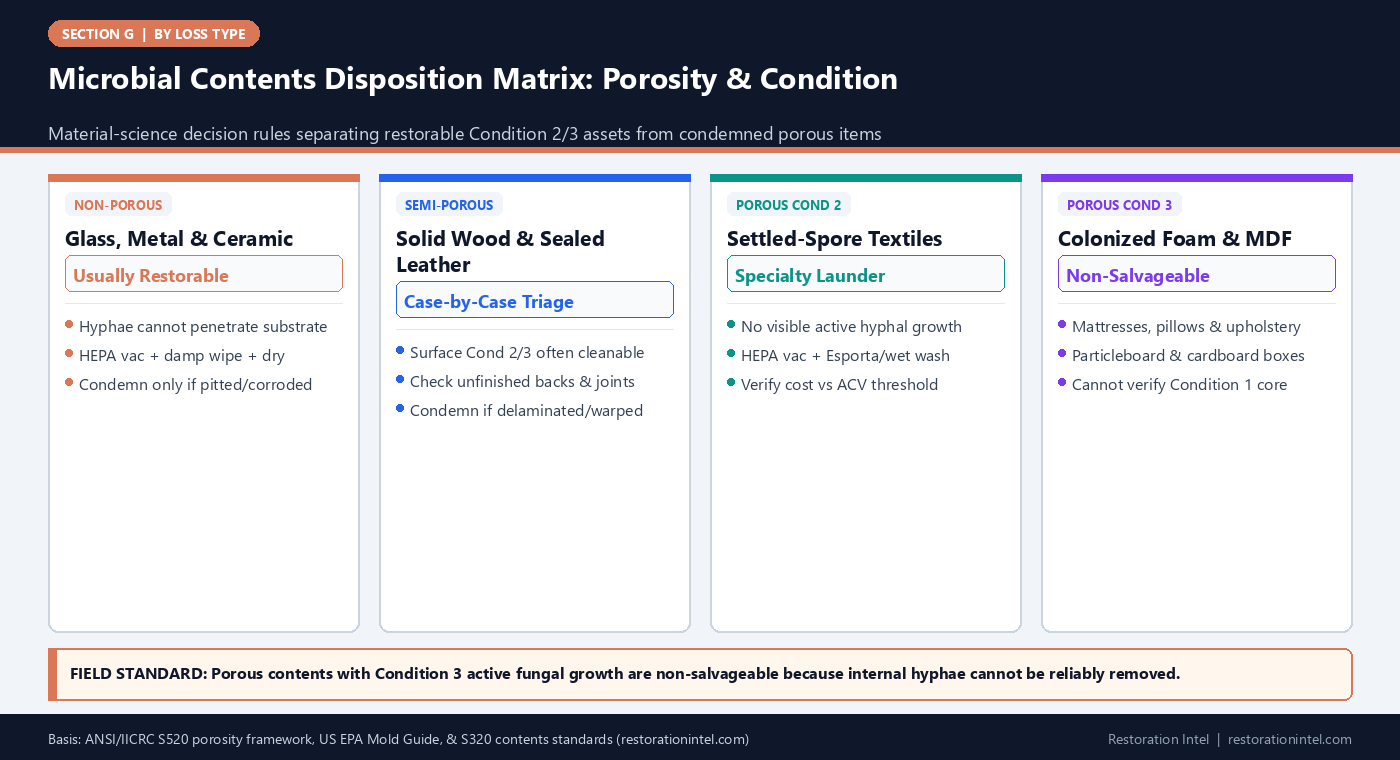
Non-Salvageable vs Restorable Decision Criteria for Mold & Humidity Losses
Practical triage standards across common household and commercial contents categories under S520 and EPA guidance.
| Content Category | Material Porosity | Restorable Condition | Non-Salvageable Trigger | Disposition Rationale |
|---|---|---|---|---|
| Mattresses, Box Springs & Pillows | Porous (Open-Cell Foam / Batting) | Condition 1 or light uncolonized Condition 2 (exterior encasement only) | Any Condition 3 mold growth, wet staining, or prolonged >70% RH mustiness | Internal foam and ticking retain hyphae and allergens; cannot sanitize core |
| Upholstered Sofas & Dining Chairs | Porous Fabric + Wood Frame | Light Condition 2 settled spores on removable/washable covers | Condition 3 growth on fabric, batting, or unfinished interior frame | Needle-punched foam and deck cloth cannot be reliably returned to Condition 1 |
| Particleboard / MDF Furniture | Porous / Engineered Composite | Dry Condition 2 surface dust on intact melamine laminate | Swollen edges, Condition 3 growth on raw backs, or adhesive delamination | Unsealed wood chips absorb moisture and sustain deep fungal colonization |
| Solid Hardwood Furniture & Antiques | Semi-Porous (Sealed vs Raw) | Surface Condition 2/3 on intact polyurethane/lacquer finish | Structural rot, veneer delamination, or deep colonization on unfinished undersides | Sealed finish blocks hyphae; unfinished crevices require specialist assessment |
| Clothing, Linens & Draperies | Porous Woven Textiles | Condition 2 settled spores or minor localized washable mildew | Heavy Condition 3 staining/digestion, dry-clean-only silk rot, or cost > ACV | Wet-wash/specialty laundering removes spores when fibers remain structurally sound |
| Books, Paper Files & Cardboard | Porous Cellulose | Dry Condition 2 dust via HEPA brush vacuuming | Condition 3 foxing/mold mats, cockled wet pages, or active spore clusters | Cellulose adhesives feed rapid fungal digestion; archive freeze-dry only for high-value |
| Appliances, Tools & Cookware | Non-Porous (Metal, Glass, Hard Plastic) | Condition 2 or surface Condition 3 on accessible exteriors | Internal mold in insulated fridge walls, motor windings, or corroded PCBs | Non-porous exteriors clean fully; sealed foam insulation cavities do not |
Why Material Porosity Controls Microbial Cleanability
Porosity determines whether fungal structures remain on top of a surface or anchor irreversibly inside it. On non-porous materials such as tempered glass, stainless steel, glazed ceramic dishware, and high-density molded plastics, mold can grow on surface dust films or skin oils, yet hyphae cannot tunnel into the crystal or polymer matrix. Physical HEPA vacuuming followed by detergent damp-wiping removes both live colonies and residual allergenic fragments.
Porous materials—open-cell polyurethane foam, cotton batting, mattresses, cardboard, insulation, ceiling tiles, and particleboard—present microscopic pore networks where moisture lingers and fungal hyphae weave around individual fibers. Under US EPA mold remediation guidance, heavily moldy porous items generally cannot be cleaned and should be discarded because vacuuming and wiping reach only the outermost millimeter while leaving viable spores, mycelia, and microbial fragments embedded inside.
Semi-porous items such as solid hardwood, unfinished leather, and unsealed stone sit in the middle. When finish coatings remain intact and moisture exposure was brief, controlled physical removal can often restore them to Condition 1; when prolonged humidity lifts veneers, swells joints, or penetrates raw backsides, the item shifts to non-salvageable.
- Inspect hidden undersides: Always check the unsealed bottom dust cover of sofas, raw backs of dressers, and hollow core interiors before calling wood furniture restorable.
- Separate dust-film growth from substrate rot: Surface mildew on sealed metal or glass cleans readily; fungal digestion inside cellulose or foam demands condemnation.
- Account for adhesives and glues: Older hide glues, wallpaper pastes, and starch bookbindings act as high-nutrient food sources during prolonged humidity events.
Distinguishing Condition 2 Settled Spores From Condition 3 Active Growth
One of the sharpest technical boundaries in ANSI/IICRC S520 lies between Condition 2 and Condition 3 contents. A dining room chair standing twenty feet from a moldy basement stairwell may carry settled airborne spores (Condition 2) across its fabric cushion without any active germination or hyphal anchoring. Condemning every porous textile in a house solely because airborne spores drifted upstairs inflates claim severity unnecessarily.
Conversely, treating Condition 3 porous items—where moisture or high relative humidity triggered visible hyphal growth directly on upholstery, drapery linings, or closet leather—as if they were simple Condition 2 dust exposes occupants to persistent allergens and odor rebound. Visual magnification, raking light, moisture readings, and tactile inspection distinguish loose settled dust from anchored fungal mats.
When Condition 2 contamination affects washable wardrobes, curtains, and bedding, specialized wet-cleaning or antimicrobial-free detergent laundering paired with HEPA pre-vacuuming achieves reliable spore removal, provided processing cost stays justified under microbial contents protocols.
- Condition 2 clothing rule: Garments in closed drawers or adjacent dry closets without visible growth or dampness are typically restorable via specialized laundering.
- Condition 3 condemnation rule: Shoes, leather belts, upholstered headboards, and closets showing visible white/green/black colonization require careful material-by-material condemnation.
- Avoid ozone shortcuts: Never rely on ozone or deodorizing foggers to salvage Condition 3 porous cushions without physical source removal.
Prolonged Humidity Damage Without Visible Mold: Warping, Corrosion, and Foxing
Prolonged high humidity—such as an air-conditioning failure in a summer home or unconditioned storage at 75 to 90 percent relative humidity—damages contents even before thick fuzzy mold colonies appear. Wood panels absorb ambient moisture unevenly, splitting mitered corners, lifting thin veneers, warping piano soundboards, and seizing drawer slides.
Meanwhile, consumer electronics, camera optics, firearms, and musical brass suffer electrochemical corrosion, fungus etching on multi-coated camera lenses, and white oxidation on aluminum chassis. Paper collections, stamp albums, and unframed prints develop permanent brown foxing spots and cockled fibers that cannot be pressed flat at standard restoration pricing.
Documenting these humidity-induced physical failures separately from fungal colonization strengthens claim files under ANSI/IICRC S320. Even where visible mold spots are light, structural delamination, lens fungus etching, or circuit oxidation renders affected assets technically non-salvageable.
- Optical and electronic corrosion: Check camera glass, binoculars, and printed circuit boards for milky fungus filaments or green copper oxidation.
- Veneer and lamination failure: Photograph bubbled tabletops, split cabinet joints, and delaminated speaker enclosures caused by sustained moisture absorption.
- Leather bloom vs rot: Differentiate harmless fatty-acid wax bloom on leather from active fungal pitting that scars hides permanently.
Sensitive Occupants, High-Value Exceptions, and Economic Cutoffs
Field teams occasionally encounter households with immunocompromised occupants, severe asthma, or physician-documented mold sensitization, as well as high-value heirloom furniture, fine art, or rare books that homeowners refuse to discard reflexively. Restoration contractors must never offer medical advice or diagnose health risk; instead, coordinate with an independent IEP and document objective cleanliness tolerances.
For irreplaceable semi-porous or porous treasures—such as museum-grade oil paintings, historic textiles, or rare bound volumes—general contents technicians should halt cleaning and escalate to specialized art conservators or archival freeze-drying labs. Attempting DIY solvent wiping on fragile canvas or gilt frames destroys cultural and financial value.
For ordinary household goods, enforce transparent economic cutoffs aligned with IRMI ACV math. If HEPA containment prep, specialty cleaning, and post-cleaning verification on a $250 particleboard bookshelf or mid-grade area rug cost $320, recommend cash-out settlement rather than pushing marginal restoration.
- Escalate fine art & archives: Route damaged paintings, heirloom quilts, and vital bound documents to qualified conservators rather than shop wiping.
- Separate technical vs medical requests: Route occupant-driven extra disposal requests on cleanable Condition 2 items through adjuster approval rather than assuming coverage.
- Enforce ACV cost caps: Flag low-value porous items immediately where containment cleaning labor exceeds replacement cost.
Practitioner Verification Checklist (G-20)
- Classify every affected item by porosity tier (non-porous, semi-porous, porous) and S520 status (Condition 1, 2, or 3) before assigning cleaning.
- Condemn mattresses, box springs, upholstered foam cushions, particleboard furniture, and damp cardboard exhibiting Condition 3 active mold.
- Inspect hidden surfaces—including sofa undersides, cabinet backs, and refrigerator door seals—for unseen colonization before clearing items.
- Document prolonged-humidity structural failures (veneer lift, wood warping, lens fungus, PCB corrosion) alongside visible fungal growth.
- Compare full containment cleaning and laundering costs against ACV/RCV and escalate fine art or sensitive-occupant cases through the adjuster/IEP.
Standards, Authority References & Related Reading
Primary standards, insurance definitions, and sibling Restoration Intel guides referenced in this brief:
- ANSI/IICRC S520 Mold Remediation Standard
- US EPA Mold Remediation in Schools and Commercial Buildings / Guide
- ANSI/IICRC S320 Standard for Professional Contents Restoration
- IRMI Insurance Glossary: Actual Cash Value (ACV)
- Related Guide: Mold & Prolonged Humidity Microbial Losses: First-24-Hour Contents Triage & Stabilization
- Related Guide: Mold & Prolonged Humidity Microbial Losses: Damage Evidence & Forensic Photography Rules
- Related Guide: Mold & Prolonged Humidity Microbial Losses: Cleaning Methodology & Processing Documentation
- Related Guide: Mold & Prolonged Humidity Microbial Losses: Carrier Scope Justification & Total-Loss Defense
- Related Guide: IICRC Cat 3 Contents Pack-Out Protocol
.md twin for desk QA and team training.Frequently Asked Questions
Can a moldy mattress or upholstered sofa ever be safely restored under ANSI/IICRC S520?
In almost all residential and commercial losses, no. Once active Condition 3 mold penetrates open-cell foam, batting, or internal fabric backing, physical source removal cannot reliably return the interior core to Condition 1, making replacement the standard path.
Are solid-wood dining tables and dressers restorable after mold exposure?
Often yes, if the protective finish remained intact and moisture did not warp joints or lift veneers. Technicians must inspect raw undersides and drawer interiors; surface Condition 2 or light Condition 3 on sealed hardwood is typically cleanable via HEPA vacuuming and controlled damp wiping.
Why can clothing from a moldy home sometimes be saved when sofas cannot?
Washable woven garments can undergo full immersion specialty laundering or wet-cleaning cycles that physically flush spores out of relatively thin fabric layers, whereas thick multi-layer sofa cushions trap moisture and fungal fragments deep inside foam cores.
How should crews handle non-porous kitchenware and glass with visible mold?
Non-porous glass, metal, ceramic, and hard plastics do not absorb fungal hyphae. Under EPA and S520 standards, they are generally restorable via HEPA vacuuming, detergent washing, rinsing, and thorough drying—unless corrosion or etching damaged the surface.