Direct Answer: Carrier scope justification on mold and prolonged-humidity claims requires pairing S520 porosity and Condition 3 evidence with US EPA condemnation rules, separating water-mitigation scope from fungal-sublimit schedules in XactContents, and prioritizing high-value non-porous salvage when tight mold caps apply.
.md twin for estimator QA and carrier file documentation.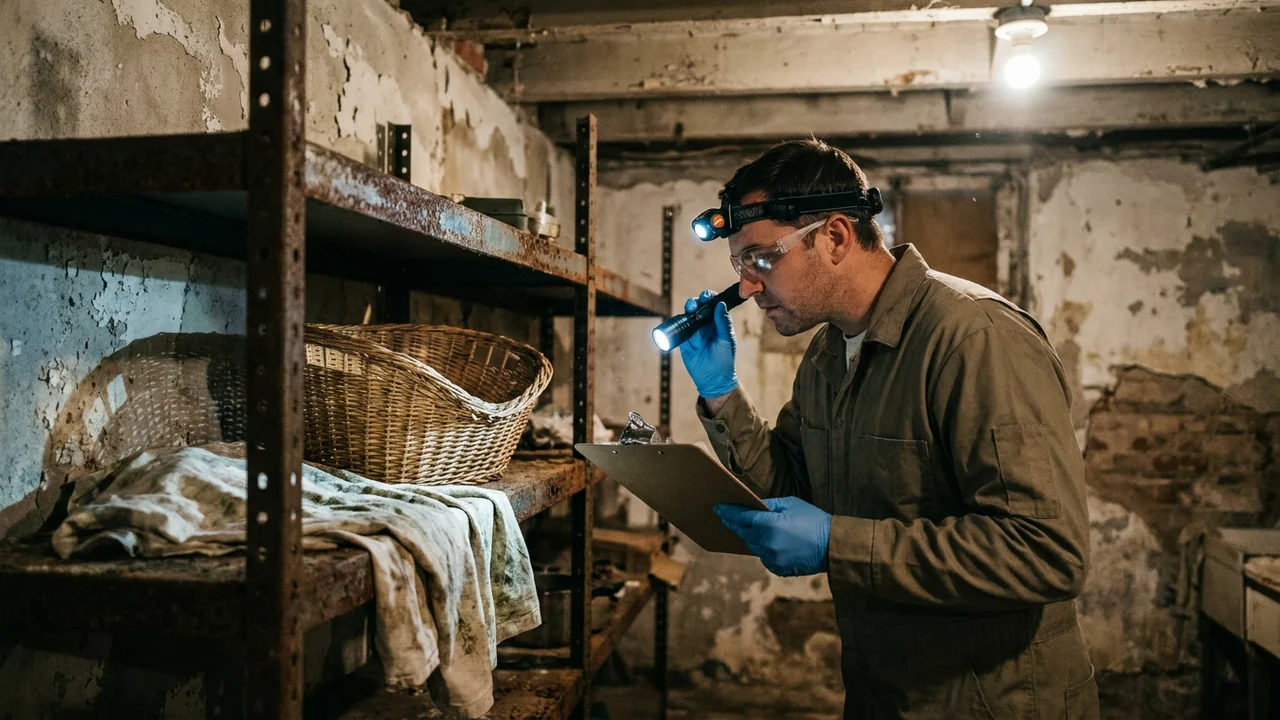
No contents loss category triggers tighter desk-examiner pushback than mold and prolonged humidity. Unlike sudden fire or Category 1 pipe bursts, residential and commercial property policies frequently exclude long-term moisture seepage or cap microbial cleanup and contaminated property replacement under tight fungi endorsements—turning every borderline sofa, wardrobe, and cleaning invoice into a high-stakes coverage and technical battleground.
Contractors must stay strictly inside technical documentation and never offer policy coverage opinions. At the same time, estimators who understand how adjusters evaluate sudden-water triggers, fungi sublimits, and restore-versus-replace economics can build files backed by ANSI/IICRC S520 and US EPA mold remediation guidance that withstand desk audit without stalling for months.
By pairing transparent porosity condemnation evidence with clean XactContents pricing and IRMI ACV comparisons, restoration teams defend non-salvageable porous goods against unrealistic ‘wipe-and-keep’ redlines while helping policyholders extract maximum utility when sublimits constrain total payout.
Mold Contents Scope Justification & Sublimit Strategy
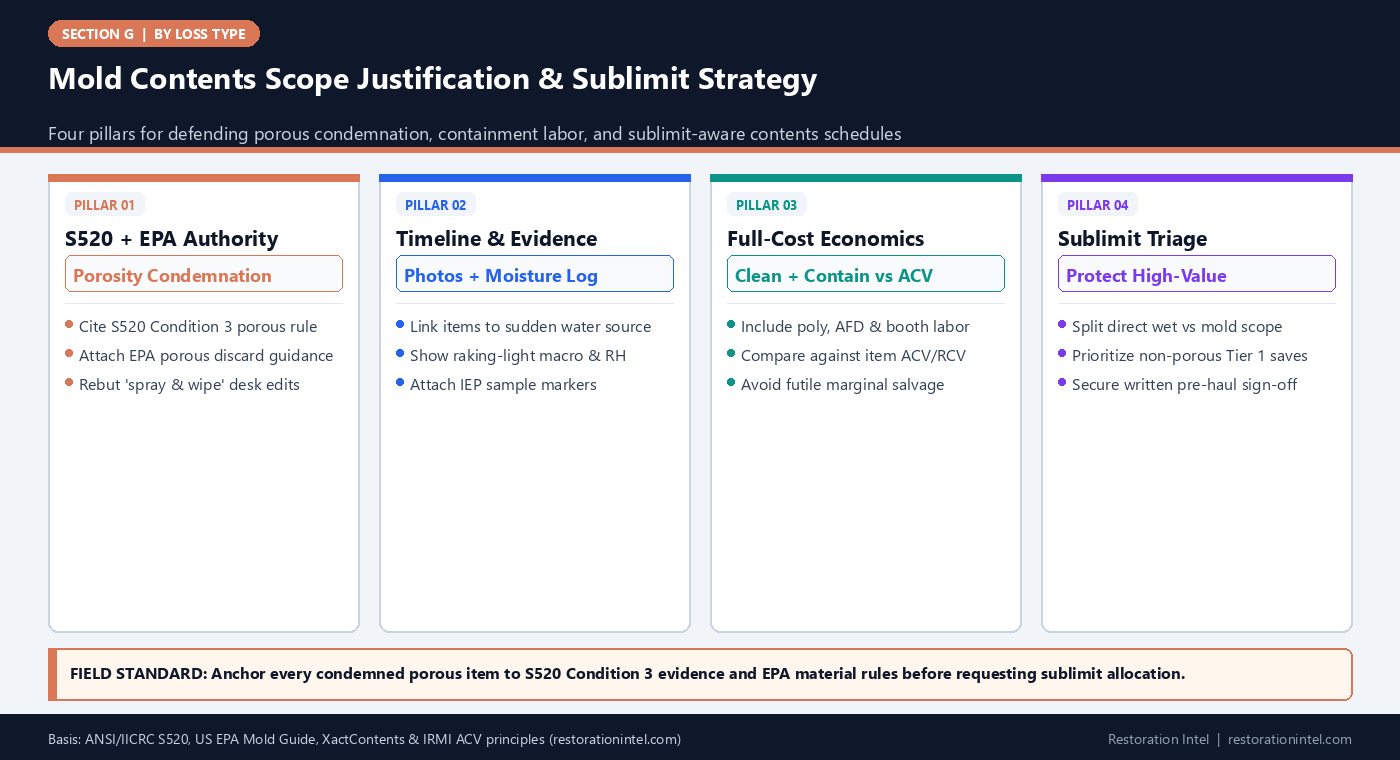
Common Carrier Objections on Mold Contents & Audit-Ready Technical Rebuttals
How estimators respond to recurring desk-examiner redlines on microbial contents cleaning and total-loss claims using verified standards.
| Carrier / Desk Objection | Underlying Examiner Concern | Verified Technical Authority | Evidence Packet Addition | Recommended Claim Action |
|---|---|---|---|---|
| "Just wipe and disinfect the mattress/sofa" | Reluctance to pay RCV/ACV on high-ticket upholstered goods | ANSI/IICRC S520 & EPA Mold Guide (porous core retention) | Raking-light Condition 3 seam/underside macro + porosity note | Hold item in containment until written non-salvage approval |
| "Containment & HEPA AFD are over-scoped" | Treating contents pack-out like routine moving labor | ANSI/IICRC S520 Condition 2/3 cross-contamination control | Floorplan Condition 1–3 map + photo of zippered poly airlock | Separate containment setup lines clearly from box-handling units |
| "Visible dust is pre-existing, not sudden loss" | Distinguishing covered water-triggered bloom from long-term neglect | S520 moisture-timeline & psychrometric corroboration | Plumbing/roof breach context shot + wood MC% + IEP report | Present factual timeline; leave policy causation ruling to carrier |
| "Why launder Condition 2 clothes instead of cash-out?" | Avoiding specialty cleaning bills above replacement ACV | IRMI ACV vs restoration cost-benefit parity | Unit laundry rate vs itemized wardrobe ACV/RCV comparison | Prioritize high-value/recent garments; cash out low-ACV basics |
| "Clean particleboard bookcase instead of replacing" | Assuming laminate surface equals non-porous solid wood | S520 semi-porous/porous composite delamination rule | Swollen edge macro + raw unfinished particleboard back photo | Demonstrate adhesive failure and deep fiber colonization |
| "Fungi sublimit exhausted—stop work" | Tight endorsement cap ($5k–$10k) covering structure + contents | Scope segregation between direct water damage and fungi work | Cleanly split water-wet lines from mold-remediation lines | Request written owner & adjuster priority directive immediately |
Rebutting Unrealistic 'Spray-and-Wipe' Desk Redlines With S520 and EPA Rules
The most frequent friction point on mold contents claims occurs when a desk examiner instructs the crew to wipe down mold-spotted mattresses, fabric dining chairs, or particleboard dressers with an antimicrobial spray instead of listing them as non-salvageable. That pushback usually stems from treating fungal growth like surface soot or dust rather than a penetrating biological root system.
A concise written rebuttal anchored to ANSI/IICRC S520 and US EPA mold remediation guidance resolves most technical standoffs quickly. Estimators should explain that open-cell polyurethane foam, fabric batting, raw engineered wood chips, and paper absorb moisture and anchor microscopic hyphae internally, while dead spores remain allergenic—making surface antimicrobial wiping technically ineffective for returning Condition 3 porous contents to Condition 1.
Always attach the matching raking-light macro of Condition 3 growth on seams, undersides, or raw backsides alongside the item’s law tag or manufacturer plate. Combining authoritative public guidance with unmistakable close-up proof gives adjusters the file cover they need to approve replacement under carrier documentation standards.
- Never argue informally: Put S520 Condition 3 and EPA porous-material citations directly inside the XactContents line-item F9 notes.
- Show internal exposure: Pair exterior photos with unzipped cushion covers, flipped box-spring ticking, or unfinished MDF back panels.
- Invite physical or IEP verification: Hold disputed porous pieces sealed inside containment if an adjuster requests a field IA or IEP reinspection.
Separating Direct Water Damage Scope From Fungi Sublimit Schedules
Many property policies apply a strict dollar sublimit to ‘fungi, wet or dry rot, or bacteria’—often $5,000 or $10,000 combined across structure teardown, IEP testing, and contents remediation—unless an expanded endorsement was purchased. When estimators lump direct Category 1 or 2 water-ruined belongings together with secondary mold remediation under one blended spreadsheet, they can unintentionally consume scarce sublimit dollars on items ruined solely by water saturation.
Without making coverage determinations, restoration teams should structure schedules transparently so the adjuster can apply policy terms accurately. Separate items destroyed purely by direct water immersion (such as swollen books or soaked electronics sitting directly under a burst supply line) from items requiring specialized microbial containment, HEPA processing, or Condition 3 mold condemnation.
Similarly, keep containment engineering, negative-pressure HEPA scrubber rentals, and warehouse quarantine processing clearly itemized apart from insured personal property valuation lines in XactContents so the examiner can audit labor rates against accepted restoration workflows.
- Two-bucket damage coding: Distinguish direct water-saturation damage from secondary Condition 2/3 microbial impact in item condition notes.
- Sublimit burn-rate tracking: Flag early when combined structure and contents mold estimates approach common endorsement caps.
- Zero policy interpretation: Present factual cause-and-effect observations and let the licensed adjuster assign sublimit or coverage buckets.
Defending Containment Labor and Economic Restore-vs-Replace Thresholds
Desk examiners accustomed to standard move-out box rates frequently question why a microbial pack-out includes extra hours for 6-mil poly containment, two-stage airlocks, PPE, HEPA pre-vacuuming, and airlock damp-wiping. Presenting those tasks as unexplained ‘prep labor’ invites automatic cuts.
Justify containment and processing labor by tying each line item directly to S520 cross-contamination prevention and worker respiratory requirements, supported by photos of the installed zipper barrier, negative-pressure HEPA air scrubber, and quarantine bay intake. At the same time, run honest economic triage against IRMI ACV values before packing marginal low-dollar goods.
If HEPA-vacuuming, poly-encapsulating, hauling, booth-cleaning, and returning a heavily dusted $120 flat-pack nightstand costs $210 in fully burdened labor, recommending total-loss settlement saves carrier dollars and protects contractor credibility when defending higher-value solid-wood or textile restorations.
- Show full-cycle restoration cost: Include containment setup, PPE consumables, HEPA booth hours, and return delivery in restore-vs-ACV comparisons.
- Cut low-ACV marginal cleaning early: Recommend cash-out on inexpensive replaceable goods so budget focuses on heirlooms and high-value assets.
- Photo-prove engineering controls: Include timestamped shots of airlocks, manometers, and sealed poly transport wraps inside the billing packet.
Sublimit-Constrained Prioritization and Pre-Disposal Protection
When a policyholder faces a low fungi sublimit that cannot cover both full structural remediation and all contaminated personal property, prioritizing contents triage becomes an essential service. Work alongside the homeowner and adjuster early to rank salvageable items by financial replacement cost, functional urgency, and emotional irreplaceability.
Because non-porous glass, metal, cookware, and sealed solid-wood pieces clean quickly at modest unit labor cost, prioritizing high-value non-porous and Condition 2 washable essentials often preserves far more household utility per sublimit dollar than spending limited funds on marginal borderline upholstery. Obtain written authorization from both insured and carrier before disposing of any condemned porous assets.
Keep every disposal release form, pre-bagging Condition 3 photo, and brand/model record archived in one audit-ready packet aligned with TPA SLA documentation rigor and contents inventory standards so post-claim supplements or appraisals never stall for missing evidence.
- Prioritize high-ROI salvage: Focus limited microbial cleaning budgets on non-porous appliances, tools, solid wood, and vital records.
- Lock written sign-offs: Archive signed non-salvageable waivers and adjuster disposal authorizations before landfill transport.
- Audit photo-to-line parity: Verify every condemned and cleaned line item carries linked visual proof prior to final submission.
Practitioner Verification Checklist (G-24)
- Cite ANSI/IICRC S520 Condition 3 porous criteria and US EPA mold guidance inside line-item notes whenever condemning foam, upholstery, or MDF.
- Attach raking-light macro damage photos, room RH/moisture logs, and IEP sample references to prove active microbial growth or humidity warping.
- Separate direct water-saturation damage schedules from fungal-containment and microbial cleaning estimates for clean sublimit accounting.
- Compare full-burden containment and booth-cleaning cost against item ACV/RCV so marginal low-dollar goods are not over-restored.
- Obtain written insured and adjuster disposal authorization—plus 100% rating-plate and condition photo coverage—before discarding condemned items.
Standards, Authority References & Related Reading
Primary standards, insurance definitions, and sibling Restoration Intel guides referenced in this brief:
- ANSI/IICRC S520 Mold Remediation Standard
- US EPA Mold Remediation in Schools and Commercial Buildings / Guide
- Verisk XactContents Platform Overview
- IRMI Insurance Glossary: Actual Cash Value (ACV)
- Related Guide: Structure Fire, Smoke & Protein-Residue Losses: Carrier Scope Justification & Total-Loss Defense
- Related Guide: Mold & Prolonged Humidity Microbial Losses: Non-Salvageable vs Restorable Criteria
- Related Guide: Mold & Prolonged Humidity Microbial Losses: Damage Evidence & Forensic Photography Rules
- Related Guide: Mold & Prolonged Humidity Microbial Losses: Cleaning Methodology & Processing Documentation
- Related Guide: Two Standards, One Truck: Documentation When the Brand and the Scorecard Disagree
.md twin for desk QA and team training.Frequently Asked Questions
How should estimators respond when an adjuster asks crews to spray and wipe a moldy sofa?
Cite ANSI/IICRC S520 and US EPA mold guidance explaining that porous foam and fabric batting trap fungal hyphae and allergenic dead spores internally, attach raking-light Condition 3 seam/underside photos, and hold the item in containment if reinspection is requested.
Why separate direct water-damage contents from mold-affected contents in a claim packet?
Many policies cap microbial cleanup under a fixed fungi sublimit. Clearly distinguishing items ruined by direct sudden water saturation from items requiring microbial containment or mold condemnation lets the adjuster apply policy terms accurately.
What makes microbial pack-out labor higher than a standard clean-water pack-out?
S520 microbial protocols require 6-mil poly containment, negative-pressure HEPA air scrubbers, two-stage airlocks, OSHA 1910.134/1910.132 PPE, HEPA pre-vacuuming, poly encapsulation, airlock damp-wiping, and segregated quarantine vaulting.
When a fungi sublimit is tight, which contents should be prioritized for cleaning?
Focus limited remediation dollars on high-value non-porous items (appliances, cookware, tools, sealed electronics), solid-wood heirlooms with intact finishes, vital records, and essential Condition 2 washable clothing while cashing out low-ACV porous goods.