Direct Answer: Safe pack-out on chemical, hazmat, asbestos, and lead-soot losses requires engineering three-stage negative-pressure poly containment and airlock pass-through transfers before moving any item, double-bagging and exterior-wiping containers at the warm threshold, sequencing extraction from clean buffers to hot zones, and isolating loaded totes inside dedicated transport and quarantine vault bays.
.md twin for estimator QA and carrier file documentation.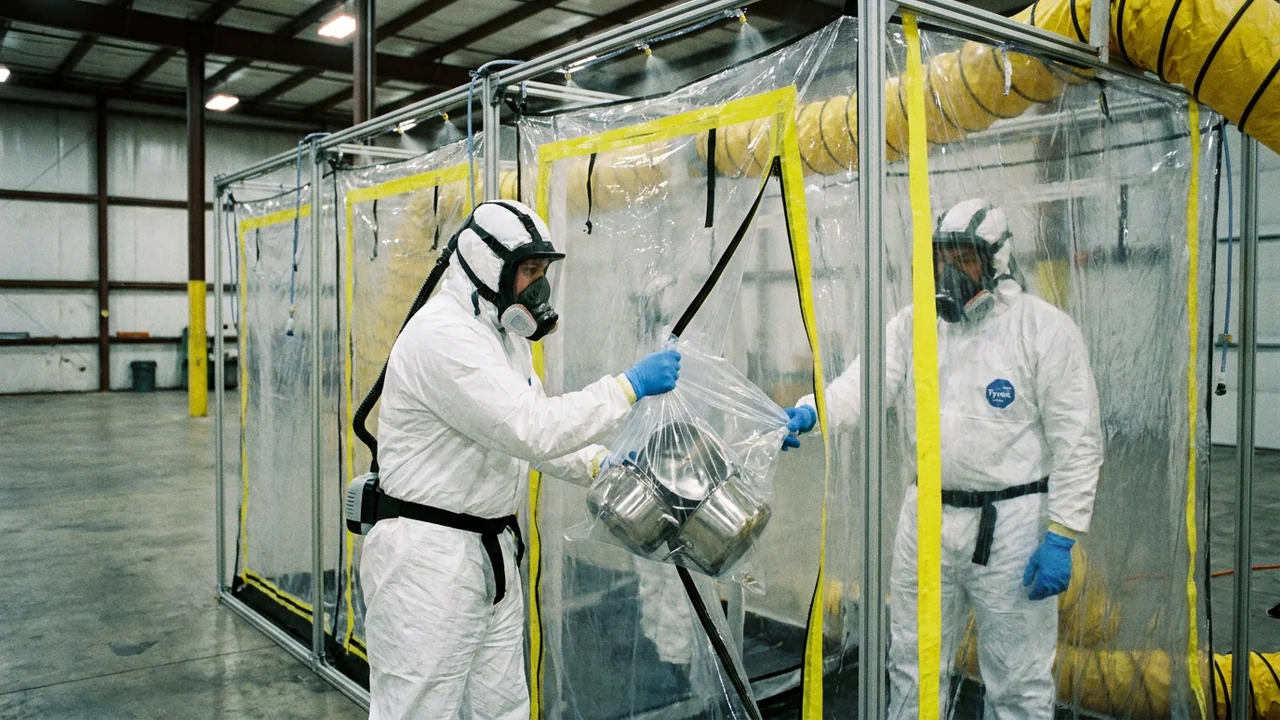
A pack-out crew that treats a lead-soot or asbestos-affected residence like an ordinary household move can turn a single-wing incident into a facility-wide contamination claim within two hours. Unwrapped dolly wheels track heavy-metal dust down clean corridors, open cardboard cartons shed fibers in elevators, and contaminated blankets stacked beside unrelated residential claims inside a storage warehouse create multi-claim cross-contamination exposure.
Under ANSI/IICRC S320 and ANSI/IICRC S520 containment principles, plus OSHA 1910.134 respiratory controls, pack-out sequencing is governed by air-pressure gradients and clean-side/dirty-side handoffs. Nothing exits the contaminated footprint without passing through a structured bagging, exterior wet-wipe, and airlock inspection station.
Furthermore, transport and temporary warehousing of hazmat-exposed contents sit inside strict federal and state boundaries under the EPA Hazardous Waste Framework and Department of Transportation rules. Restoration contractors must verify that free liquids, reactive chemicals, and regulated asbestos-containing wastes are never packed or hauled as ordinary personal property, deferring regulated waste manifesting to properly licensed haulers.
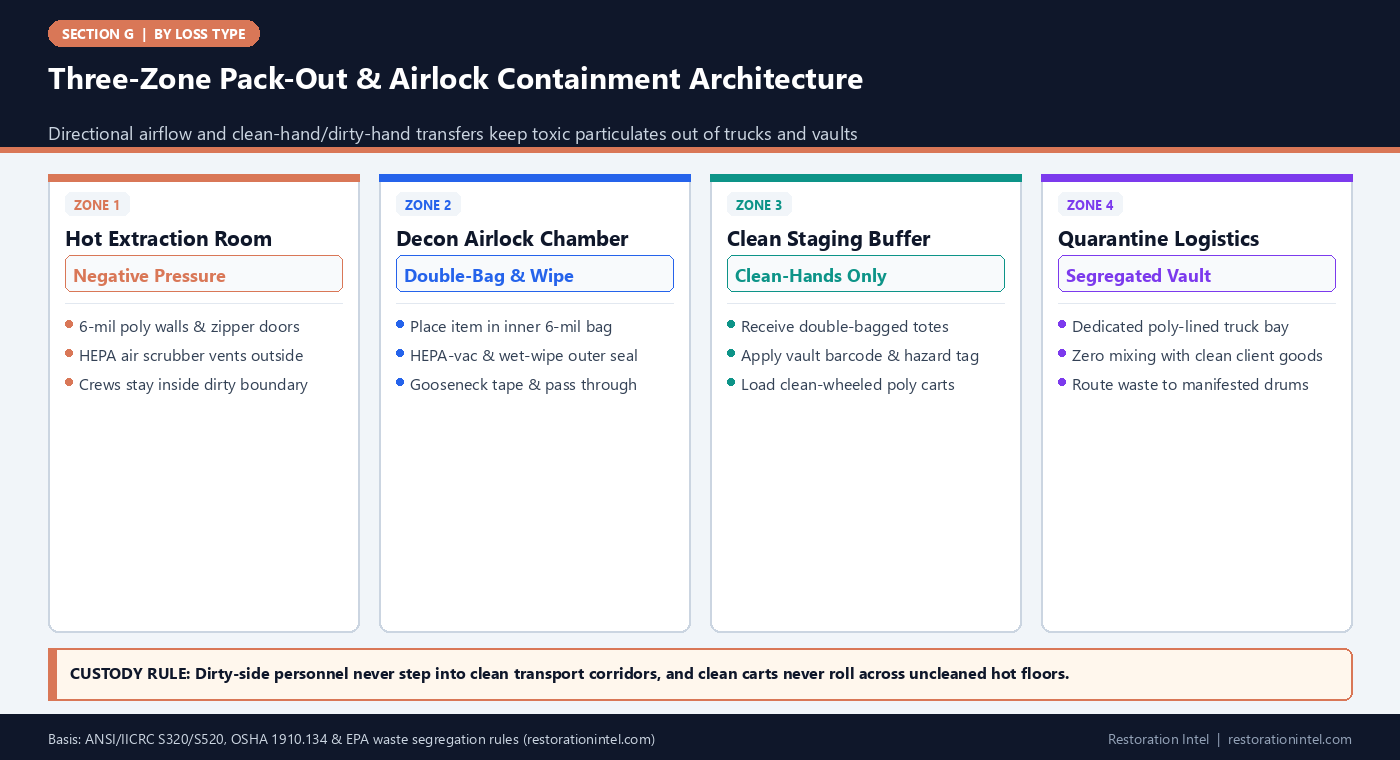
Three-Zone Pack-Out & Airlock Containment Architecture
Containment Zone Controls & Packaging Sequence for Hazmat Pack-Outs
Operational control points across the hot extraction zone, decontamination airlock, clean transport corridor, and quarantine vault.
| Workflow Stage / Zone | Engineering & Poly Barrier Spec | Packaging & Seal Standard | Crew Role & PPE Boundary | Top Cross-Contamination Failure |
|---|---|---|---|---|
| 1. Clean-Buffer Extraction | Isolate unaffected rooms first using sealed doors and poly flap barriers | Standard double-walled cartons labeled 'CLEAN-BUFFER / VERIFIED' | Clean-zone team in base PPE; zero entry from hot-zone personnel | Packing clean hallway items after hot-zone demolition has already started |
| 2. Hot-Zone Prep & Wrap | 6-mil flame-retardant poly enclosure under negative pressure via HEPA scrubber | Rigid latches/totes or 6-mil poly inner wraps; avoid breathable cardboard | Hot-zone techs in full Tyvek coveralls, gloves, and fit-tested respirators | Using unsealed corrugated cardboard that absorbs moisture or sheds dust |
| 3. Airlock Bagging & Wipe | Three-chamber flap airlock (dirty / wash-wipe / clean pass-through) | Double-bag 6-mil poly with gooseneck-twisted, tape-sealed necks | Dirty-side tech passes inner sealed item without crossing threshold | Passing un-wiped bags directly onto clean-side wooden pallets |
| 4. Clean-Side Tote & Scan | Clean poly drop floor outside airlock with dedicated clean rolling carts | Rigid sealed plastic totes labeled with barcode, room ID, and hazard class | Clean-side tech scans barcode and inspects outer bag seal integrity | Tearing outer poly bags on sharp metal edges during rushed cart loading |
| 5. Dedicated Transport Bay | Poly-lined cargo floor/walls; dedicated truck or sealed compartmentalized pod | Strapped rigid totes; zero loose textiles or unbagged equipment | Driver verifies manifest count and keeps cab/clean gear segregated | Co-loading hazmat-exposed totes onto a box truck carrying clean pack-backs |
| 6. Quarantine Vault & Waste Exit | Isolated negative-air or locked poly-bay warehouse zone; separate waste drum pad | Palletized shrink-wrapped totes on impervious drip trays; red tags outward | Vault tech logs rack location and separates restorable vs waste pallets | Storing uncleaned lead/asbestos totes in open climate racks near clean furniture |
Engineering Three-Zone Poly Containment and Negative-Air Flow Before Moving a Single Box
Before any restorable item leaves a chemical, asbestos, or lead-soot room, containment must be built and smoke-tested. Standard single-flap plastic curtains tear and flutter open whenever carts roll through, allowing negative-pressure reversals that push airborne fibers into hallways. High-risk contents pack-outs rely on rigid frame or zip-pole 6-mil poly enclosures equipped with weighted triple-flap airlocks and dedicated HEPA-filtered negative-air machines exhausting outdoors or into verified scrubber stages.
Confirming negative pressure direction—either via digital differential pressure gauges or non-toxic smoke tubes at the doorway seam—ensures air always pulls inward from clean corridors toward the contaminated extraction room. Meanwhile, floor protection inside the clean approach corridor must remain isolated from hot-zone boot covers by a sticky-mat and boot-wash threshold.
Just as critical is banning porous cardboard inside hot zones. Uncoated corrugated boxes act like sponges for chemical vapors, trap asbestos dust inside fluted edges, and collapse during exterior wet wiping. Rigid gasketed plastic totes and heavy 6-mil poly sheeting provide wipeable, non-absorptive containment from extraction bench to cleaning facility.
- Verify airflow direction first: Test airlock flaps before opening closets or lifting tarps so negative draw pulls dust away from clean halls.
- No cardboard in hot zones: Use latched polypropylene totes and heavy-gauge poly bags rather than corrugated moving boxes.
- Protect power and HVAC chases: Tape off floor registers, electrical conduit penetrations, and elevator seams along the extraction path.
Double-Bagging, Gooseneck Sealing, and Exterior Wipe-Down at the Airlock Threshold
The airlock pass-through is where cross-contamination either stops permanently or escapes into the rest of the project. Inside the hot extraction zone, technicians place restorable hard goods—such as stainless cookware, sealed tools, or small machinery—into a first 6-mil poly bag, twist the neck, fold it into a gooseneck, and tape it shut. That inner bag is HEPA-vacuumed or damp-wiped inside the airlock chamber before entering the clean-side outer bag held by the clean-zone teammate.
By keeping dirty-side gloves strictly inside the inner chamber and clean-side hands strictly on the outer bag cuff, crews break the surface-transfer chain cleanly. Once the outer bag is gooseneck-sealed, the clean-side technician applies the room-and-item barcode and hazard-class sticker onto the outside—never forcing clean-side estimators to open a hazmat bag later just to identify its contents.
Large non-porous appliances and machinery that cannot fit inside poly bags require full 6-mil poly cocooning with double-taped seams, padded edge guards over sharp sheet-metal corners so wrap does not puncture in transit, and an exterior HEPA/wet-wipe pass prior to rolling across clean thresholds.
- Pad sharp corners before bagging: Wrap knife edges, machine brackets, and glass rims in foam sleeves inside the inner bag so corners never slice through poly seals.
- Gooseneck seal discipline: Twist, fold back 180 degrees, and band with heavy duct/poly tape—simple knot ties leak airborne particulates under compression.
- Outer hazard + barcode visibility: Place clear inventory tags, room codes, and contaminant icons on the outer clean bag before loading into totes.
Pack-Out Sequencing: Clean-Buffer Perimeter First, High-Load Hot Zones Last
Order of operations determines both labor efficiency and cross-contamination risk. Whenever a loss affects only part of a building—such as a mechanical room asbestos release or a localized lab chemical spill—crews must pack out and remove verified clean-buffer rooms first while the hot zone remains sealed under negative pressure. Clearing unaffected contents early eliminates accidental exposure if containment doors experience heavy traffic later.
Inside the contaminated footprint, sequencing moves from upper surfaces and lightly dusted fixtures downward to floor-level debris, and from restorable high-value equipment toward condemned non-salvageable piles. Pulling restorable stainless tools or sealed clinic instruments first minimizes how long cleanable assets sit beside disturbed waste.
As noted in IICRC Cat 3 Contents Pack-Out Protocol and Two Standards, One Truck, field leads must maintain separate cart crews and dedicated dolly sets for clean versus contaminated phases so equipment never bridges zones.
- Clean-to-dirty master sequence: Evacuate verified clean perimeter rooms before breaching seals on contaminated extraction bays.
- Top-to-bottom within rooms: Clear upper shelves and hanging assets before disturbing floor dust or lower cabinets.
- Separate dolly fleets: Color-code carts and straps so hot-zone wheels never touch clean-side elevator lobbies or truck ramps.
Dedicated Transport, Quarantine Vault Bays, and Regulated Disposal Manifest Separation
Cross-contamination does not end when the box truck rolls away from the property. Loading double-bagged lead-soot totes onto the same trailer as cleaned residential linens or general household vaults jeopardizes every customer stored in that warehouse. Hazmat-exposed restorable contents must travel in poly-lined dedicated vehicles or sealed containment pods and unload directly into an isolated, labeled quarantine bay at the processing plant.
Inside the warehouse, quarantine pallets belong on impervious containment trays—never raw wood floors—with clear physical separation from clean reset staging and active drying chambers. Every pallet must carry a manifest showing contaminant class (asbestos, lead-soot, acid/solvent residue), IH testing status, and whether items await decontamination or adjuster disposal sign-off.
Crucially, crews must keep restorable cargo completely separate from regulated waste streams. Under the EPA Hazardous Waste Framework, liquids, reactive chemicals, and friable asbestos debris must not be transported by unlicensed contents trucks; coordinate directly with permitted hazmat haulers for drummed waste exit.
- Poly-lined cargo decks: Line truck beds with heavy poly and tape seams before loading hazmat-exposed totes; strip and bag lining after decon.
- Quarantine bay signage: Restrict warehouse quarantine racks to trained decon personnel and log every tote entry and exit scan.
- Zero unlicensed waste hauling: Leave RCRA hazardous waste drums and regulated ACM waste strictly to licensed environmental transporters.
Practitioner Verification Checklist (G-34)
- Construct and airflow-test a three-stage 6-mil poly containment airlock with HEPA negative-air filtration prior to moving contaminated contents.
- Pack out verified clean-buffer rooms first using separate clean-zone crews and carts before opening hot-zone extraction pathways.
- Replace porous cardboard with latched plastic totes and double-bag items in 6-mil poly with gooseneck seals and exterior airlock wipe-downs.
- Attach room-level barcodes, asset IDs, and contaminant hazard labels to the clean outer bag before totes enter transport vehicles.
- Transport restorable hazmat totes in dedicated poly-lined vehicles to a segregated warehouse quarantine bay, keeping regulated waste drums with licensed haulers.
Standards, Authority References & Related Reading
Primary standards, insurance definitions, and sibling Restoration Intel guides referenced in this brief:
- ANSI/IICRC S320 Standard for Professional Contents Restoration
- ANSI/IICRC S520 Mold Remediation Standard
- OSHA 1910.134 Respiratory Protection Standard
- US EPA Hazardous Waste Framework
- Related Guide: Chemical, Hazmat, Asbestos & Lead-Soot Contamination Losses: First-24-Hour Contents Triage & Stabilization
- Related Guide: Chemical, Hazmat, Asbestos & Lead-Soot Contamination Losses: Damage Evidence & Forensic Photography Rules
- Related Guide: Chemical, Hazmat, Asbestos & Lead-Soot Contamination Losses: Cleaning Methodology & Processing Documentation
- Related Guide: IICRC Cat 3 Contents Pack-Out Protocol
- Related Guide: Two Standards, One Truck: Documentation When the Brand and the Scorecard Disagree
.md twin for desk QA and team training.Frequently Asked Questions
Why are standard cardboard moving boxes prohibited inside asbestos, lead-soot, or chemical hot zones?
Corrugated cardboard absorbs liquid chemicals, traps microscopic fibers inside fluted seams, and cannot be wet-wiped cleanly at an airlock threshold. Latched rigid plastic totes and 6-mil poly double-bags prevent tearing and allow full exterior decontamination.
What does a three-stage airlock accomplish during a hazmat contents pack-out?
It separates dirty extraction technicians from clean transport crews through an intermediate wash/wipe chamber under negative pressure, ensuring items are bagged, externally decontaminated, and scanned on the clean side without anyone tracking dust out.
Can hazmat-exposed restorable totes be stored in the same warehouse aisle as regular fire/water pack-outs?
No. Even double-bagged hazmat-exposed items should be staged in a physically segregated, clearly labeled quarantine bay until they pass decontamination and Industrial Hygienist clearance, eliminating cross-contamination risk to other policyholders’ property.
Who is allowed to transport condemned chemical drums or friable asbestos waste off-site?
Only properly licensed and insured hazardous-waste or asbestos-abatement transporters operating under applicable EPA, DOT, and state manifests—not standard contents restoration moving vans.