Direct Answer: Defending chemical, hazmat, asbestos, and lead-soot contents scopes requires separating standard pack-out labor from regulated PPE, containment, and Industrial Hygienist testing lanes, substantiating constructive total loss whenever full-cycle decon plus manifested disposal exceeds LKQ replacement value, and packaging microscopy reports, custody chains, and signed disposal manifests for desk review.
.md twin for estimator QA and carrier file documentation.
Hazmat, asbestos, and lead-soot contents claims face intense scrutiny at the carrier desk because unit costs look radically higher than routine water or wood-smoke pack-outs. When an estimator submits a single blended invoice that inflates standard box-packing rates to cover Tyvek suits, negative-air enclosures, Industrial Hygienist lab runs, and drummed waste haul-off, desk examiners and third-party auditors strip the lines immediately.
Winning first-pass approval requires structuring the claim packet the way an adjuster and environmental consultant audit it. As explored in The Adjuster Desk: One Standard, Two Chairs and The 2026 TPA Survival Guide, carriers evaluate contents scopes across separate technical and financial lanes: verified lab hazard proof, line-by-line restorable vs total-loss economics in XactContents, and third-party disposal receipts under the EPA Hazardous Waste Framework.
Equally important is staying strictly inside contractor scope boundaries when policies contain pollutant exclusions, asbestos sublimits, or Ordinance and Law triggers. Restoration estimators do not interpret coverage grants or deliver legal advice; their job is to supply transparent, unassailable technical evidence so the carrier, policyholder, and adjuster can apply policy terms accurately.
Carrier Scope & Total-Loss Defense Packet Architecture
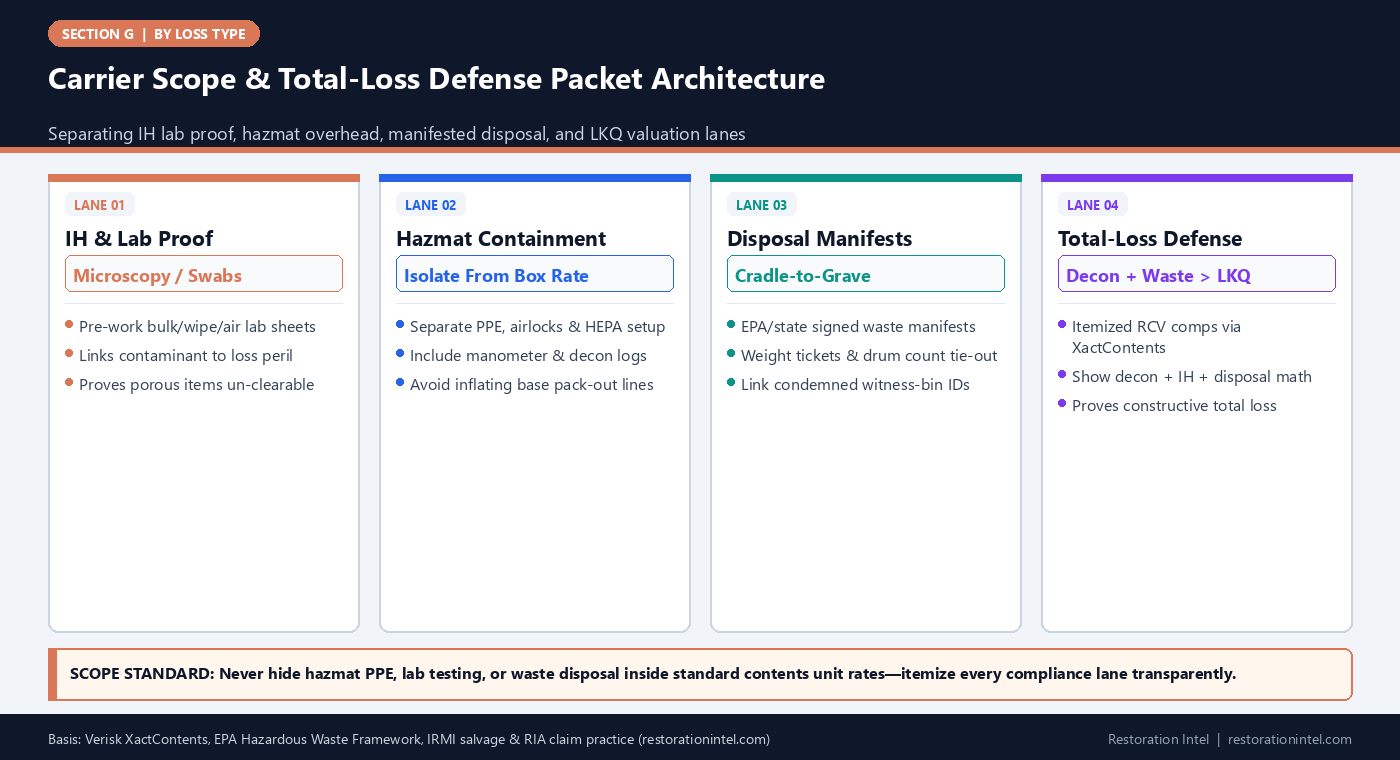
Carrier Review Lanes, Common Audit Pushbacks, and Required Defense Artifacts
Structuring a hazmat, asbestos, or lead-soot contents submission so staff adjusters, IA examiners, and environmental auditors can verify every line.
| Claim Packet Lane | Core Billing / Valuation Elements | Typical Desk Examiner Pushback | Defensible Verification Artifact | Policy & Scope Boundary |
|---|---|---|---|---|
| 1. Environmental & IH Testing | Pre-work PLM/TEM asbestos bulk, lead AAS wipes, chemical PID/GC-MS screens | 'Testing not authorized or redundant with structural mitigation' | Signed IH scope protocol + floorplan linking samples directly to contents zones | Keep IH lab invoices separate from contractor cleaning lines |
| 2. PPE, Containment & Negative Air | OSHA Tyvek/respirator kits, triple-flap poly airlocks, HEPA scrubbers, manometers | 'Standard pack-out already includes basic drop cloths and masks' | Day-1 hazard screening log + OSHA PPE matrix + continuous manometer readout | Explain contaminant-driven upgrade from standard S320 dust PPE |
| 3. Segregated Decon Labor | HEPA-wet-HEPA passes, ultrasonic immersion cycles, chelating wash, batch QA | 'Cleaning hours exceed typical smoke-soot production benchmarks' | Time-and-material decon logs + batch tag sheet + post-clean IH clearance pass | Justify extra cycles via clearance standard rather than vague complexity |
| 4. Manifested Waste Disposal | Drummed liquids, double-bagged ACM textiles, hazmat transport & landfill tip fees | 'Why wasn't debris hauled in the general structural roll-off?' | Signed EPA/state waste manifests, drum weight tickets, and witness-bin photos | Confirm licensed hauler invoicing; never mark up unverified disposal guesses |
| 5. Constructive Total-Loss Matrix | Non-salvageable RCV/ACV schedule paired with avoided decon + waste cost | 'Why not clean the mid-grade furniture and appliances instead?' | Side-by-side table: (Decon + IH Clearance + Disposal) vs verified LKQ RCV | Show carrier saves net dollars by condemning marginal items |
| 6. Pollutant / Sublimit Separation | Clean-buffer extraction vs contaminated-zone handling vs abatement support | 'Entire contents invoice dumped under limited pollutant/debris cap' | Room-by-room peril tagging separating smoke/water work from regulated hazmat | Provide clean data splits; leave final sublimit allocation to the adjuster |
Separating Standard Contents Labor From Regulated Hazmat, PPE, and Abatement Support
The fastest way to stall a six-figure chemical or asbestos contents invoice is burying specialized regulatory compliance inside generic pack-out line items. Price-list software defaults assume standard cardboard boxes, nuisance dust masks, and unimpeded hallway dollies. When an estimator bumps box rates by 300 percent without itemizing the underlying drivers, desk review flags the estimate as rate padding—even when the contractor actually lost money executing triple-chamber airlocks.
Defensible estimates split the scope into distinct, transparent lanes: verified clean-buffer contents pack-out billed at standard production norms, hazmat containment and OSHA 1910.132/134 PPE ensembles billed with crew-entry logs, specialized decon labor supported by ANSI/IICRC S320 process records, and third-party Industrial Hygienist or licensed abatement pass-through invoices.
Whenever a project spans multiple rooms with uneven contamination—such as an industrial fire where lead paint only affected the older mezzanine while modern offices suffered ordinary smoke—tagging every line item by contamination zone prevents a carrier from applying a restrictive pollutant cap across clean areas unnecessarily.
- Zone-tag every line item: Label lines cleanly as ‘Standard Smoke/Water Buffer’ versus ‘IH-Confirmed Hazmat/ACM/Lead Zone.’
- Attach crew PPE entry logs: Back up Tyvek suits, P100/OV cartridges, and decon-airlock hours with signed daily hot-zone entry sheets.
- Exclude structural abatement: Keep building pipe-wrap removal and structural lead scraping strictly on the licensed abatement contract—never mix into contents.
Proving Constructive Total Loss When Decontamination and Manifested Disposal Exceed RCV
Adjusters push back on total-loss lists when items look physically unbroken in wide-angle photos. To defend non-salvageable determinations without friction, estimators must pair material-porosity documentation with transparent break-even math grounded in IRMI salvage economics and XactContents replacement pricing.
For porous assets like mattresses, rugs, and paper archives, the primary defense is technical impossibility: attach the IH lab report and material-porosity standard explaining why internal clearance cannot be verified. For semi-porous or mid-tier hard goods—such as laminate desks, residential appliances, or standard hand tools—the decisive defense is constructive total loss.
Build a side-by-side comparison column showing Current Verified LKQ RCV next to Total Restoration Cost (airlock extraction + HEPA/ultrasonic decon + wastewater disposal + post-clean IH swab test). When restoring a $400 tool chest requires $480 in compliant processing and testing, the spreadsheet proves on a single line that total-loss settlement is the most economical outcome for the insurer.
- Never omit clearance testing from decon cost: A restore estimate without post-clean IH verification understates true restoration expense.
- Cite verifiable LKQ retail comps: Anchor replacement RCV with active retail SKUs so constructive total-loss ratios rest on real market numbers.
- Include witness-bin photo links: Tie every condemned schedule row directly to grouped red-tagged staging photos shot before disposal.
Packaging Microscopy Reports, Chain-of-Custody Logs, and Disposal Manifests for Desk Review
Environmental consultants hired by insurance carriers audit claims backwards from proof to invoice. They check whether the initial Industrial Hygienist microscopy or chemical assay actually covers the rooms packed out, whether box/drum counts match physical waste tickets, and whether final clearance swabs cover the same lots billed for cleaning.
As emphasized in Before Anything Goes and Restoration Industry Association (RIA) documentation best practices, assembling a bound digital evidence index turns a chaotic 300-page PDF dump into a 10-minute desk approval. Place an executive cover sheet up front summarizing total line count, clean vs condemned split, lab dates, and manifest serials.
Crucially, never submit unsigned or draft waste disposal estimates as final proof when actual regulated haul-off occurred. Attach executed cradle-to-grave hazardous waste or asbestos manifests showing generator ID, transporter license, receiving facility signature, and certified scale weights matched to the condemned contents witness log.
- Executive index cover page: Map Section 1 (IH Lab Reports), Section 2 (Custody & Manometer Logs), Section 3 (Disposal Manifests), and Section 4 (LKQ Schedule).
- Tie weights to bin counts: Reconcile total condemned drum/bag counts in witness photos against certified landfill or incinerator weight tickets.
- Highlight clearance dates: Pair every restorable processing invoice directly with its signed post-clean IH clearance certificate.
Navigating Pollutant Sublimits, Asbestos Endorsements, and Multi-Adjuster Escalations Professionally
Commercial and residential property policies vary dramatically on chemical pollutants, asbestos testing, and debris removal caps. Some policies exclude pollutant cleanup unless caused by a specified peril like fire or explosion; others impose strict sublimits (such as $10,000 or $25,000) on pollutant extraction and testing while covering ordinary smoke-damaged replacement under main personal property limits.
As outlined in Three Adjusters, Three Economies, staff desk examiners, independent field adjusters, and third-party environmental consultants evaluate those boundaries differently. Contractors preserve credibility—and avoid unauthorized practice of law or public adjusting—by presenting unbundled facts rather than arguing policy interpretation.
When subrogation or coverage complexity slows approval, escalate through structured technical addenda: offer an itemized pre-clean vs total-loss cost sensitivity table, confirm whether subrogation holds block immediate disposal, and document customer-approved holds transparently until the insurer issues written authorization.
- Stay inside technical fact-reporting: Document contamination type, peril link, and compliant cost structure—never tell insureds a sublimit ‘does not apply.’
- Flag sublimit bottlenecks early: Alert the policyholder and adjuster as soon as IH estimates suggest hazardous disposal or testing could pressure policy caps.
- Keep standby/quarantine logs clean: If coverage review pauses disposal or cleaning, document warehouse quarantine charges under written authorization.
Practitioner Verification Checklist (G-36)
- Separate standard contents pack-out lines from regulated PPE, triple-chamber containment, Industrial Hygienist testing, and manifested disposal lanes.
- Include pre-work IH microscopy, lead-wipe, or chemical lab reports linked by room and sample ID to every contaminated inventory zone.
- Support constructive total-loss recommendations with side-by-side XactContents LKQ RCV versus full-cycle decon, clearance, and disposal costs.
- Attach signed cradle-to-grave disposal manifests, drum counts, and certified scale tickets matched to pre-disposal witness-bin photographs.
- Maintain strict scope neutrality on pollutant exclusions and sublimits, escalating coverage questions in writing to the adjuster before unauthorized work.
Standards, Authority References & Related Reading
Primary standards, insurance definitions, and sibling Restoration Intel guides referenced in this brief:
- Verisk XactContents Platform Overview
- US EPA Hazardous Waste Framework
- IRMI Insurance Glossary: Salvage
- Restoration Industry Association (RIA)
- Related Guide: Chemical, Hazmat, Asbestos & Lead-Soot Contamination Losses: Non-Salvageable vs Restorable Criteria
- Related Guide: Chemical, Hazmat, Asbestos & Lead-Soot Contamination Losses: Damage Evidence & Forensic Photography Rules
- Related Guide: Chemical, Hazmat, Asbestos & Lead-Soot Contamination Losses: Cleaning Methodology & Processing Documentation
- Related Guide: The Adjuster Desk: One Standard, Two Chairs
- Related Guide: The 2026 TPA Survival Guide
.md twin for desk QA and team training.Frequently Asked Questions
Why do carriers reject hazmat contents estimates that simply multiply standard pack-out rates?
Blending specialized PPE, poly airlocks, negative-air scrubbing, and waste manifesting into inflated base packing rates looks like arbitrary markup to automated and desk audits. Itemizing compliance lanes separately ties every dollar to a verifiable artifact.
What documentation proves constructive total loss on mid-grade tools or appliances exposed to lead-soot or chemicals?
A line-by-line comparison showing current LKQ replacement RCV alongside total restoration cost—including containment extraction, HEPA/ultrasonic decon labor, wastewater drumming, and post-clean IH clearance testing—backed by witness photos.
Should contents contractors interpret pollutant exclusions or asbestos sublimits for the homeowner?
No. Contractors provide technical documentation, lab reports, and compliant scope options while leaving policy coverage, exclusion, and sublimit determinations strictly to the adjuster, licensed public adjuster, or coverage counsel.
What proves that condemned hazardous contents were actually disposed of legally?
Signed cradle-to-grave hazardous or asbestos waste manifests carrying generator, licensed transporter, and permitted facility signatures alongside certified weight tickets tied back to witness-bin inventory IDs.