Direct Answer: The handoff between field capture and desk estimating succeeds only when Project Managers enforce a structured Minimum Viable Capture Packet gate, resolve missing specs before warehouse storage buries the boxes, and govern strict SLA timers between pack-out completion and claim schedule submission.
.md twin for estimator QA and carrier file documentation.
Across restoration companies of every size, the single widest operational seam sits between the pack-out truck and the estimating desk. Field crews measure success by how quickly a smoke-damaged home is cleared before rebuild begins; desk estimators measure success by whether every line in XactContents or Xactimate survives carrier scrutiny without revision kicks.
When no formal handoff gate connects those two teams, field crews toss raw photo folders and handwritten box sheets over the wall, then roll onto the next emergency. Days later, estimators discover missing appliance model tags, unlabeled cartons stacked three vaults deep, and ambiguous non-salvageable counts. As explored in A Pack-Out Record Is Not a Priced Inventory, a custody log alone leaves the desk unable to price or justify claims.
For Restoration Project Managers, Contents Division Leads, and General Managers, fixing this handoff unlocks immediate cash-flow velocity and protects labor margin. Defining a clear Minimum Viable Capture Packet, running a 24-hour desk acceptance check before vault stacking, and eliminating finger-pointing through shared ANSI/IICRC S320 terminology turns two disconnected departments into a single high-throughput pipeline.
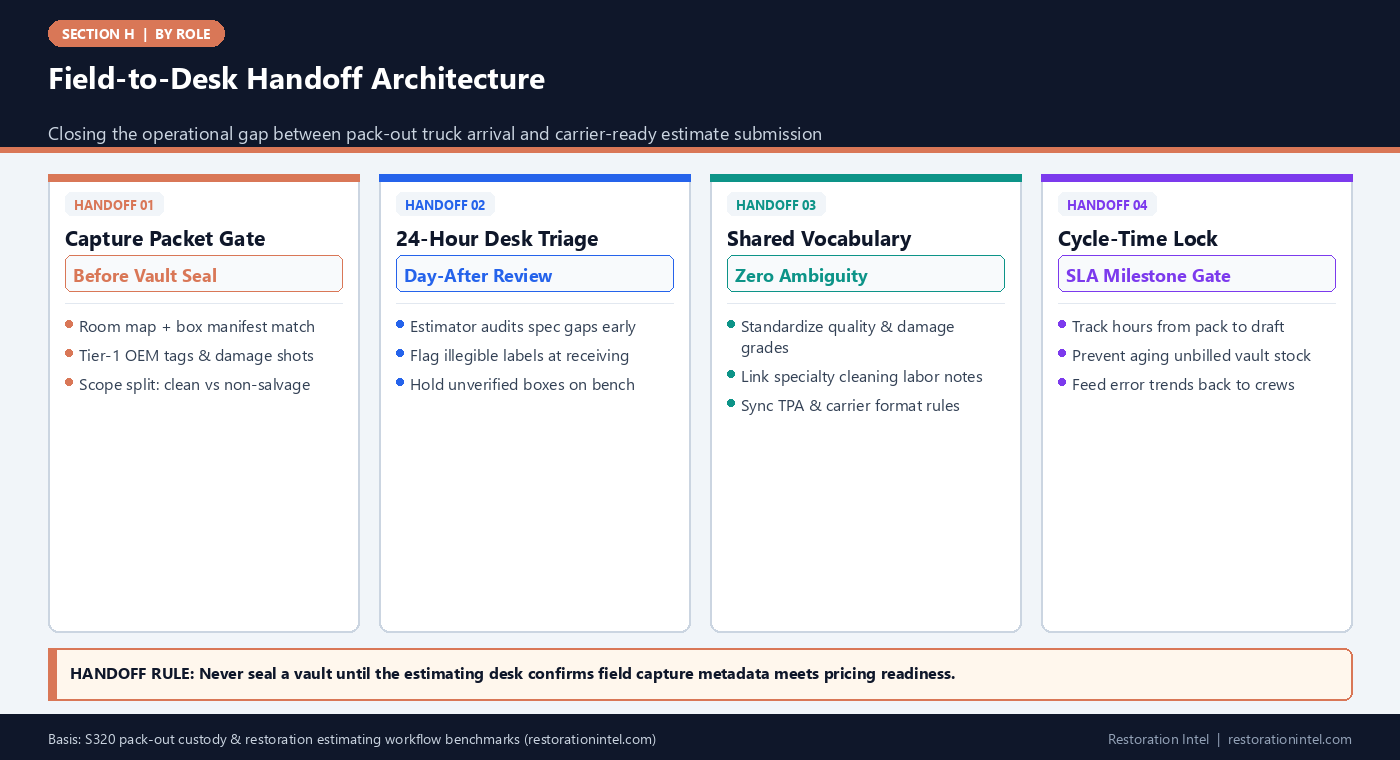
Field-to-Desk Handoff Architecture
Field-to-Desk Handoff Failure Modes & Division Lead Controls
Mapping the recurring breakdowns between pack-out crews and desk estimators alongside preventive governance controls.
| Handoff Breakdown | Root Cause at Transfer | Financial & SLA Consequence | Preventive Division Lead Control | SLA Window |
|---|---|---|---|---|
| Vague Box Descriptions | Crews write generic room labels without item family or quantity bands | Estimators unseal vaulted boxes to identify contents, burning 2-4 unbilled hours per vault | Reject generic labels at warehouse receiving bench before stacking | Within 24 hrs of load-in |
| Missing OEM Specs on Tier 1 | Techs photograph appliance fronts but skip rear or door-jamb model plates | Adjuster applies builder-grade comp, cutting RCV by 30-60% or demanding re-inspection | Require estimator photo-completeness sign-off prior to site release or disposal | Same-day / pre-disposal |
| Split Cleaning vs Total-Loss Notes | Field verbalizes discard promises to insured without syncing desk non-salvageable list | Duplicate labor billed on discarded goods or homeowner disputes over missing heirlooms | Mandatory single master disposition status field per line (Clean / Total Loss / Leave) | End of each field shift |
| Unlinked Specialty Labor | Crews execute delicate hand-cleaning or ozone prep without recording difficulty tier | Estimating desk under-bills complex restoration hours using base box-pack rates | Use structured field difficulty codes tied directly to Xactimate/XactContents line items | Daily crew debrief |
| Orphaned Return Trips | Estimators sit on incomplete files for 10 days before flagging missing basement photos | Rebuild contractor has already gutted room; physical evidence is gone permanently | Enforce 24-hour desk acceptance audit while loss site and boxes remain accessible | Max 24 hrs post-capture |
Defining the Minimum Viable Capture Packet Before Crews Clear Site
Estimators cannot build defensible schedules from partial context. Before an RPM marks field capture complete, the Crew Lead must deliver a standardized Minimum Viable Capture Packet—not just a cloud folder of JPEG files. That packet pairs the locked room map and total box/asset manifest with clear disposition tags showing what stayed on site, what entered cleaning bays, and what was documented as non-salvageable.
Every Tier 1 item (typically over $500 replacement value or sublimit-sensitive) must carry three confirmed elements in the packet: context placement, damage/peril proof, and legible brand/model identification. Low-value dense groupings must carry readable shelf-context photos plus realistic unit counts and material/quality indicators (e.g., solid wood vs particleboard, stainless cookware vs coated aluminum).
Requiring this packet while the truck is still in the driveway—or at worst before boxes leave the warehouse receiving bench—shifts quality verification upstream. As highlighted in The Hands Were Always the Bottleneck, streamlining the cognitive handoff between physical handling and digital indexing is where divisions recover their sharpest throughput gains.
- Mandatory disposition tag: Every logged unit or carton leaves site tagged Clean-Off-Site, Clean-On-Site, Non-Salvageable, or Left-With-Insured.
- Quality tier cue: Field notes include simple grade cues (Builder, Mid-Grade, Prosumer, Custom/Luxury) so desk estimators anchor LKQ fast.
- Exception log attached: Crew leads list known inaccessible areas (locked safes, collapsed ceilings) directly in the handoff memo.
The 24-Hour Warehouse Receiving Bench Gate
Once wooden vaults are strapped and stacked three high in a back warehouse aisle, fixing a documentation error becomes brutally expensive. Forklift pull time, vault unsealing, manual carton sifting, and re-stacking easily erase the profit on an entire mid-sized pack-out.
Smart General Managers institute a 24-hour receiving bench hold rule. Newly arrived contents remain accessible at floor level while the assigned contents estimator performs a rapid intake audit of the capture packet. During that 24-hour window, the estimator checks whether high-dollar assets have legible model plates, whether carton labels support line-item pricing without guesswork, and whether any cleaning-method flags need immediate technician testing.
If gaps appear—say, a box labeled ‘Dining Room Fragiles’ lacks piece counts on crystal stemware—the warehouse team opens that single carton at the receiving bench, snaps the missing shelf-spread photo, and updates the manifest before the vault ever rises to upper racking. That single discipline saves dozens of forklift hours every month.
- Floor-level QA window: Hold incoming pack-out cartons in an accessible staging lane until the estimator signs off on packet completeness.
- Same-day exception ticket: Route missing-spec requests through a tracked internal ticket rather than informal hallway texts.
- Test-clean verification loop: Flag borderline smoke or microbial items at receiving so technicians run verifiable test cleans before full-scope billing.
Eliminating Friction Through Shared Taxonomy and Labor Translation
Field crews and desk estimators frequently speak two different languages. Technicians think in physical labor—heavy carry-outs, triple-soot scrubbing, soot-sponge detailing on carved trim, or delicate wrap time—while desk estimators think in software line items across XactContents, Xactimate, or carrier templates. When crews fail to record why a three-hour dining set took six hours to wrap and de-soot, estimators default to standard base units and leave earned revenue unbilled.
Division leads bridge this gap by building a standardized translation sheet linking field conditions to estimating line logic. Crews do not need to memorize software category codes, but they do need structured checkboxes for stairs, long carries, heavy manipulation, specialty crating, heavy protein soot, and ultrasonic sub-assembly disassembly.
Holding a bi-weekly 30-minute calibration huddle between lead technicians and senior estimators—reviewing two closed jobs side by side—rapidly aligns both teams. Technicians see how blurry tags cost the company money, and estimators learn which physical constraints actually slow production on site.
- Structured labor modifiers: Capture flight count, carry distance, heavy-item crew count, and specialty cleaning setup on every shift log.
- Bi-weekly file post-mortems: Review one smoothly approved claim and one disputed revision side by side with field and desk leads.
- Shared photo naming convention: Index photos by Room Code + Asset/Box ID so estimators never scrub through chronological camera rolls.
Enforcing Handoff SLAs and Preventing Unbilled Vault Aging
Every day a completed pack-out sits un-estimated in the warehouse represents frozen working capital: storage bays are occupied, crews have been paid payroll, and carrier cash hasn’t moved. Worse, carrier TPA programs documented in Contents Cleaning SLAs by Category impose tight submission windows that penalize slow desk handoffs.
Project Managers and General Managers should track two hard handoff clocks: Field-to-Desk Transfer Time (target under 24 hours from final truck arrival) and Desk-to-Submission Cycle Time (target 3 to 5 business days for standard residential schedules, phased submissions for large commercial losses). Watching these two clocks prevents work-in-process (WIP) from piling up silently behind a busy estimating queue.
When estimating backlog builds up during regional weather events or peak fire season, division leadership should trigger pre-planned surge relief—such as phased room-by-room schedule releases or overflow desk support—rather than letting completed field captures go stale in queue.
- 48-hour WIP ceiling: Escalate any pack-out file that sits over 48 hours without active estimating assignment.
- Phased large-loss drops: Submit Priority-1 living essentials and kitchen schedules first while complex garage/basement inventories finalize.
- Feedback loop to field bonuses: Tie crew quality incentives partially to first-pass desk packet acceptance rather than box count alone.
Practitioner Verification Checklist (H-03)
- Require a complete Minimum Viable Capture Packet (room map, box manifest, disposition tags, Tier-1 OEM photos) before releasing field crews.
- Hold newly packed cartons in a floor-level warehouse QA lane for up to 24 hours until the estimating desk verifies metadata completeness.
- Log field labor modifiers (stairs, long carries, heavy rigging, heavy soot/protein prep) on a structured shift form tied to estimating codes.
- Track Field-to-Desk Transfer Time (<24 hours) and Desk-to-Submission Cycle Time on weekly division operations dashboards.
- Run bi-weekly calibration reviews pairing field crew leads with desk estimators to eliminate recurring photo and labeling gaps.
Standards, Authority References & Related Reading
Primary standards, insurance definitions, and sibling Restoration Intel guides referenced in this brief:
- ANSI/IICRC S320 Standard for Professional Contents Restoration
- Verisk XactContents Platform Overview
- Verisk Xactimate Estimating Platform
- Restoration Industry Association (RIA)
- Related Guide: Restoration Project Manager & Contents Division Lead: Capture & Documentation Execution Workflow
- Related Guide: Restoration Project Manager & Contents Division Lead: Pricing, LKQ Sourcing & Valuation Defensibility
- Related Guide: A Pack-Out Record Is Not a Priced Inventory
- Related Guide: The Hands Were Always the Bottleneck
- Related Guide: Contents Cleaning SLAs by Category
.md twin for desk QA and team training.Frequently Asked Questions
How quickly should field capture packets reach the estimating desk after pack-out?
Within 24 hours of final truck load-in, ideally synced at the end of each field shift so estimators can catch missing photos or box labels while cartons are still accessible at floor level.
What belongs in a Minimum Viable Capture Packet?
A locked room directory, box-to-room manifest, disposition tags (clean, non-salvageable, left behind), wide-angle room baselines, Tier-1 rating-plate photos, and field labor difficulty modifiers.
Why do estimators reject field photos even when crews took hundreds of pictures?
Volume does not equal usability. Unlabeled chronological camera rolls without doorway anchor tags, missing close-ups of model/serial tags, and shadowy pre-move shots force manual guesswork that adjusters reject.
How can a General Manager prevent warehouse vaults from turning into unbilled storage backlog?
Enforce a 24-hour desk acceptance gate before high-bay stacking and monitor WIP aging dashboards daily so no completed pack-out sits un-estimated past 48 hours.