Direct Answer: Restoration Project Managers and Division Leads protect schedule credibility and claim velocity by enforcing verifiable Like-Kind-and-Quality (LKQ) retail sourcing, separating restoration labor from RCV/ACV valuation schedules, applying tax and freight consistently, and preventing inflated third-party marketplace comps.
.md twin for estimator QA and carrier file documentation.
Nothing stalls a contents claim faster at the carrier desk than sloppy Like-Kind-and-Quality (LKQ) pricing. When an estimate attaches a $2,400 discontinued third-party marketplace listing to a mid-grade consumer coffee maker, or substitutes generic placeholder rates on custom cabinetry and commercial equipment, the desk examiner stops trusting the entire schedule and begins auditing every single line.
While desk estimators build the line-item spreadsheets inside XactContents or Symbility, the Restoration Project Manager, Contents Division Lead, and General Manager own the operational policy behind valuation defensibility. Under IRMI Replacement Cost Value (RCV) and Actual Cash Value (ACV) principles, every price must reflect real-world replacement economics rather than wishful MSRP extremes.
Building a disciplined pricing governance standard protects both sides of the house. Carriers approve clean schedules faster with fewer supplement rounds, insureds receive fair indemnification for the exact quality tier they owned, and the restoration company avoids writing off uncompensated estimator rework caused by preventable valuation disputes.
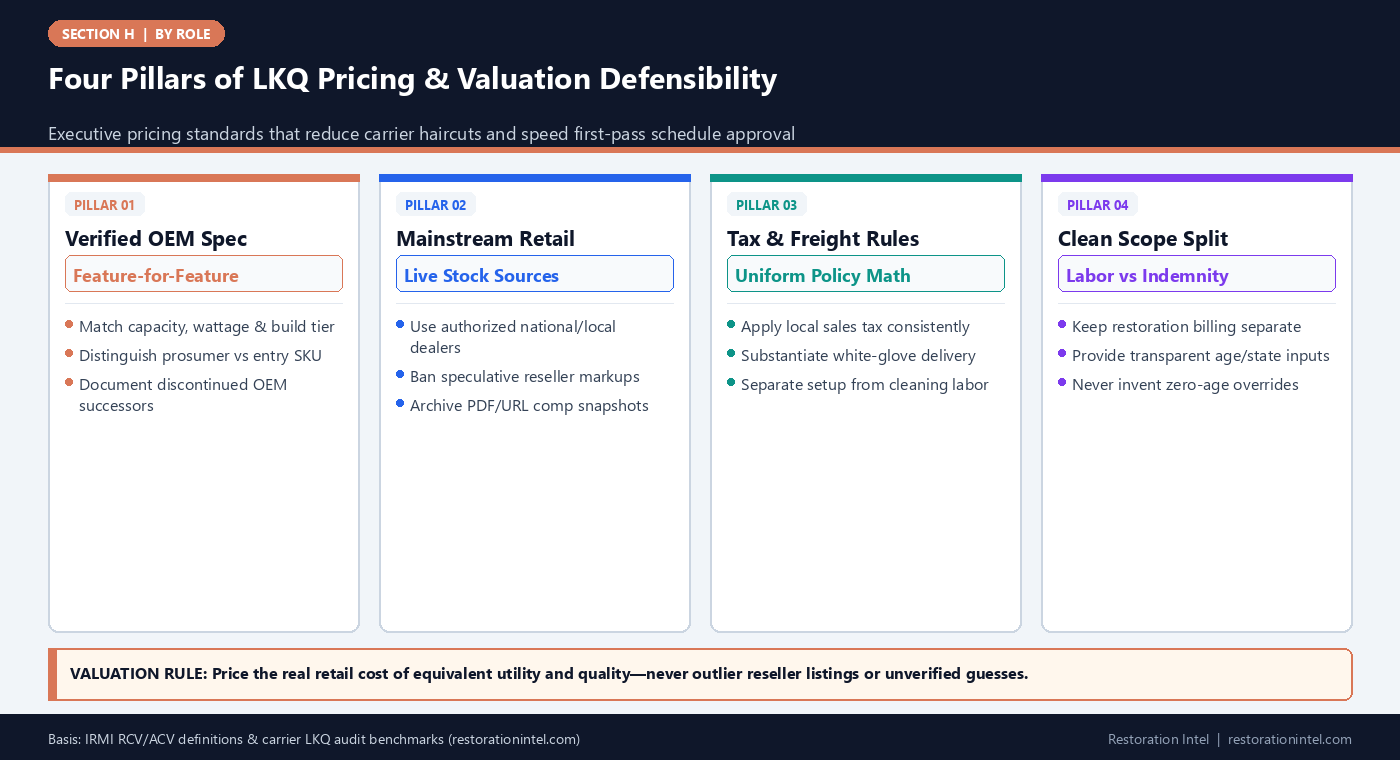
Four Pillars of LKQ Pricing & Valuation Defensibility
LKQ Sourcing Governance & Carrier Dispute Prevention Matrix
Operational rules for Division Leads auditing high-scrutiny pricing categories prior to carrier or TPA submission.
| Valuation Element | Defensible Standard | Common Estimating Pitfall | Carrier Desk Response | Division Lead Audit Action |
|---|---|---|---|---|
| Discontinued Electronics / Appliances | Match key functional specs (size, panel type, BTU/cu-ft, series tier) to current OEM successor | Pulling inflated vintage collector listings from third-party auction/reseller sites | Examiner rejects comp entirely and replaces with lowest entry-level model | Mandate authorized retailer links + OEM spec comparison note |
| Custom Furniture & Cabinetry | Anchor to material species, joinery, fabric grade, and documented artisan or trade dealer quotes | Using big-box particleboard catalog items for solid hardwood or custom upholstery | Insured receives drastically understated ACV and files immediate supplement | Require material/maker photos and written dealer quote on >$1,500 lines |
| Sales Tax & Freight | Apply jurisdictional sales tax uniformly and itemize necessary freight/assembly for heavy goods | Double-taxing catalog totals or adding arbitrary flat shipping percentages | Audit software flags math inconsistencies and delays whole-packet approval | Configure jurisdiction tax rule once per claim and verify freight receipts |
| Age & Condition Inputs | Record documented age bands and honest pre-loss condition (Good/Average/Fair) with photo backing | Marking 10-year-old household items as age 0 or 'Mint' across the entire schedule | Destroys estimator credibility; triggers 100% line-by-line desk override | Spot-check age distribution curve across rooms before release |
| Cleaning vs Replacement Economics | Compare verified restoration labor/processing cost against current LKQ replacement RCV | Cleaning a $90 microwave for $140 in labor without total-loss threshold check | Carrier caps payout at RCV and refuses excess restoration labor invoice | Enforce automated cleaning-to-RCV ratio ceiling (typically 60-75%) |
| Specialty & Commercial Gear | Verify industry dealer pricing, calibration fees, and OEM-authorized replacement quotes | Estimating commercial POS, dental, or shop tools using consumer retail catalogs | Severe undervaluation or coverage-classification dispute under BPP rules | Route specialized commercial assets to vendor/OEM quote desk |
Enforcing True Like-Kind-and-Quality (LKQ) Standards Over Price Extremes
LKQ does not mean the cheapest object that shares a noun, nor does it mean the most expensive boutique listing found online. When a storm or fire destroys a five-year-old stainless steel French-door refrigerator with an integrated ice dispenser, true LKQ requires matching capacity, configuration, finish, and reliability tier—not downgrading the insured to a bare white top-freezer unit, and not pricing a commercial built-in luxury column.
Because Xactimate and Symbility handle catalog lookup and custom item pricing differently, division leads must set clear internal sourcing hierarchies regardless of estimating software. Primary comps should pull from established national retailers, manufacturer direct stores, or verified regional dealers with real inventory availability. Third-party marketplace scalpers listing discontinued models at three times original MSRP must be strictly prohibited.
As emphasized in A Price Tag on a Lost Item Is Worth Nothing, a dollar figure without verifiable identity and source proof collapses under review. Requiring estimators to save URL/PDF comp snapshots for every line above $500 turns valuation challenges into fast, factual exchanges.
- Authorized dealer rule: Ban unverified marketplace reseller markups and out-of-stock auction screenshots as primary RCV anchors.
- Feature-matching notes: Document three decisive specs (e.g., dimensions, material/capacity, feature tier) whenever substituting a discontinued model.
- Snapshot archiving: Store dated price-comp PDFs inside the claim packet because live retail URLs expire or shift within weeks.
Governing Age, Depreciation Inputs, and Transparent ACV Math
Restoration contractors do not adjudicate policy depreciation—adjusters do—but contractors heavily influence whether initial ACV calculations start from accurate facts. Leaving age fields blank or entering zero years across an entire lived-in home triggers immediate skepticism at the carrier desk. Experienced desk examiners know a family of four does not own zero-year-old patio sets, mattresses, and kitchen appliances simultaneously.
Division leads should establish an honest, repeatable protocol for collecting age and condition inputs. During walkthrough or insured interviews, ask for approximate purchase year bands (under 2 years, 3–5 years, 6–10 years, 10+ years) on major furnishings and appliances, cross-checking against appliance manufacturing date codes on rating plates whenever visible. Honest condition grading helps insureds just as much: a well-kept solid oak dining table from 2012 carries far longer remaining useful life than a neglected laminate table from 2021.
Understanding how adjusters evaluate line-item approvals helps leadership keep restoration pricing clean and credible. Separating verifiable condition facts from policy depreciation disputes preserves contractor neutrality while giving the insured solid documentation.
- Serial-plate date decoding: Train estimators to check OEM serial formats that encode manufacture year on major appliances and HVAC-adjacent gear.
- No blanket zero-aging: Audit schedules for suspicious age uniformity before submission; realistic homes show varied age distributions.
- Neutral operator posture: Provide documented pre-loss age and condition facts without promising specific holdback percentages to the homeowner.
Keeping Cleaning-vs-Replacement Thresholds Economically Rational
One of the fastest ways for a contents division to lose credibility—and get slapped with payment caps—is billing more in cleaning, deodorization, and handling labor than an item costs to replace new. While genuine heirlooms or custom items with irreplaceable sentimental value may justify specialized restoration above replacement price when pre-approved in writing, ordinary household goods follow strict economic logic.
Division leads should enforce a hard pre-cleaning economic gate inside the estimating workflow. Before authorizing ultrasonic, hand-detailing, or textile specialty cleaning on mid-to-low tier goods, estimators compare total end-to-end restoration cost (pack-out, handling, cleaning, deodorization, storage allocation, and pack-back) against current LKQ replacement RCV. Once total restoration approaches 60 to 75 percent of RCV—subject to carrier program guidelines—the item belongs on the non-salvageable review track unless sentimental or sublimit factors dictate otherwise.
Managing this threshold proactively shows adjusters that the contractor respects claim economics. Carriers willingly approve robust restoration invoices on high-value furnishings, electronics, and sentimental goods when they see the contractor proactively flagging uneconomical low-value items for replacement.
- Fully burdened restore test: Include pack-out, cleaning, deodorization, and pack-back labor—not just bench cleaning minutes—when testing against RCV.
- 60–75% decision band: Trigger automatic RPM/adjuster consultation whenever projected restoration exceeds program economic thresholds.
- Sentimental override log: Obtain signed adjuster and insured pre-approval before investing labor above RCV on heirloom pieces.
Handling Commercial Equipment, Taxes, Freight, and Specialty Quotes
Commercial contents claims—restaurants, medical offices, machine shops, and retail stock—break standard residential catalog workflows. Commercial kitchen ventilation hoods, point-of-sale terminals, dental chairs, and custom tooling rarely sit inside consumer estimating databases with accurate installation, calibration, or freight pricing.
Project Managers leading commercial intakes must route specialty assets straight to authorized OEM dealers or equipment distributors for formal written quotes covering unit price, mandatory crating/freight, factory commissioning, and local tax rules. Attempting to wing commercial valuation from consumer search results exposes the insured to severe under-indemnification and puts the contractor in the crosshairs of commercial general adjusters.
Finally, audit sales tax and delivery freight uniformly across every schedule. Depending on state claim regulations and carrier rules, tax applies on replacement goods consistently—never haphazardly on half the spreadsheet—and white-glove delivery for heavy appliances or sectionals should be itemized transparently rather than hidden inside inflated unit prices.
- Vendor quote dossier: Attach formal PDF dealer quotes for commercial machinery, specialty medical gear, and custom millwork.
- Uniform tax logic: Confirm jurisdictional tax rates on contents RCV once at claim setup and lock spreadsheet formulas.
- Separate freight & setup: List delivery, haul-away, and calibration as clear supporting items rather than inflating base SKU prices.
Practitioner Verification Checklist (H-04)
- Verify that every Tier 1 item (>$500 RCV) carries an authorized national/local retail comp snapshot or OEM dealer quote.
- Ban third-party marketplace scalper listings and unverified out-of-stock prices from LKQ schedules.
- Audit age and pre-loss condition entries across the schedule to eliminate unrealistic blanket zero-age inputs.
- Run a fully burdened cleaning-cost versus RCV check (60–75% band) before authorizing restoration on mid-to-low value items.
- Confirm uniform jurisdictional sales tax, necessary freight, and clear separation between restoration service invoices and RCV/ACV schedules.
Standards, Authority References & Related Reading
Primary standards, insurance definitions, and sibling Restoration Intel guides referenced in this brief:
- Verisk XactContents Platform Overview
- Symbility Claims Support Portal
- IRMI Insurance Glossary: Replacement Cost Value (RCV)
- IRMI Insurance Glossary: Actual Cash Value (ACV)
- Related Guide: Restoration Project Manager & Contents Division Lead: Team Handoff Between Field Capture and Desk Estimating
- Related Guide: Restoration Project Manager & Contents Division Lead: Handling Non-Salvageable Lists & High-Dollar Exceptions
- Related Guide: Xactimate vs. Symbility
- Related Guide: Which Xactimate Line Items Do Adjusters Actually Approve?
- Related Guide: A Price Tag on a Lost Item Is Worth Nothing
.md twin for desk QA and team training.Frequently Asked Questions
What makes an LKQ replacement comp defensible to a carrier desk examiner?
A defensible LKQ comp matches the damaged item’s core specifications, capacity, material grade, and quality tier using a current, in-stock price from an authorized national or regional retailer—backed by a saved PDF/URL snapshot.
Why should contractors avoid third-party reseller listings for discontinued items?
Out-of-print items on third-party marketplaces frequently reflect speculative collector or shortage pricing rather than genuine replacement utility, prompting adjusters to reject the line and substitute low-tier comps.
Should restoration cleaning invoices and RCV replacement schedules be combined into one estimate?
No. Keep physical restoration services (pack-out, cleaning, deodorization, storage) cleanly separated from non-salvageable replacement valuation schedules so coverages and tax/depreciation rules stay clear.
When does cleaning an item stop making economic sense?
When fully burdened restoration costs—including pack-out, cleaning, deodorization, storage, and pack-back—reach roughly 60 to 75 percent of current LKQ replacement cost, unless the item holds documented heirloom value with written approval.