Direct Answer: Company Owners, General Managers, and Contents Division Leads govern sustainable profitability by tracking gross margin by workflow stage, vault capacity turnover, first-pass adjuster acceptance rate, estimator rework hours, and Days Sales Outstanding (DSO) rather than relying on top-line pack-out revenue alone.
.md twin for estimator QA and carrier file documentation.
Contents divisions often look deceptively healthy on a top-line sales report while quietly starving the business of cash and margin. A branch can book $150,000 in monthly pack-out and cleaning contracts, fill every warehouse aisle with wooden vaults, and still bleed profit through unbilled double-handling, aging storage receivables, estimator rework loops, and slow carrier supplement cycles.
For Company Owners, General Managers, and Contents Division Leads, running contents as a disciplined profit center requires measuring operational throughput end to end—from day-one intake inside Xactimate or carrier portals through ANSI/IICRC S320 processing and final pack-back release. Without segmented metrics, high-margin cleaning jobs mask chronic losses in chaotic estimating or stalled long-term storage.
Evaluating division health through balanced KPIs—combining gross margin by stage, first-pass adjuster acceptance rate, cycle-time velocity, and TPA scorecard performance—gives RIA-minded executives objective levers to coach crews, price staffing decisions accurately, and scale capacity without sacrificing cash flow.
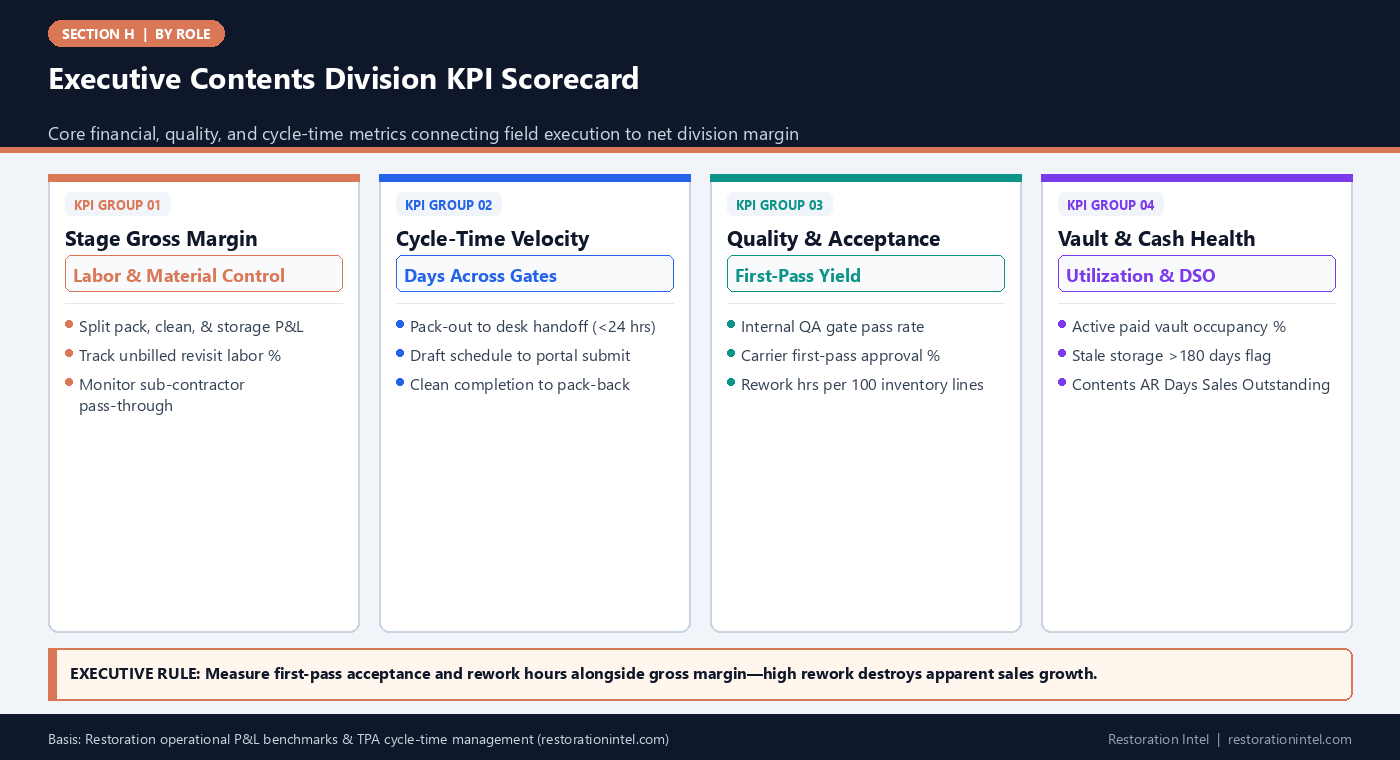
Executive Contents Division KPI Scorecard
Executive Contents Division KPI Framework & Intervention Triggers
Core operating metrics tracked weekly and monthly by General Managers and Contents Division Leads to spot margin leakage early.
| KPI Metric | Formula / Operational Definition | Healthy Benchmark Direction | Red-Flag Failure Signal | Executive Intervention |
|---|---|---|---|---|
| Pack-Out & Cleaning Gross Margin | (Recognized Job Revenue – Direct Field Labor, Consumables, & Subcontractors) / Revenue | Consistent stage-level target protecting overhead & warehouse rent | Pack-out margin healthy while bench cleaning labor runs over budget | Audit crew wrap times, cleaning chemistry SOPs, and unbilled specialty codes |
| Field-to-Submission Cycle Time | Calendar business days from final pack-out load-in to carrier-ready schedule upload | 3 to 5 business days on standard residential; phased drops on large losses | Drafts stalling 10+ days in estimating queue; TPA SLA breaches | Enforce 24-hr capture packet handoff and trigger surge estimating capacity |
| First-Pass Adjuster Acceptance Rate | Submitted Schedules Approved With <5% Variance / Total Submitted Schedules | Rising first-pass approvals with minimal revision kicks | Repeated carrier cuts on generic comps, missing OEM plates, or poor photo proof | Tighten pre-submission QA audit gate and coach Tier-1 rating-plate capture |
| Inventory Rework Hours / 100 Lines | Total estimator + warehouse hours spent fixing missing specs, unsealing vaults, or revising kicked lines | Trending downward toward minimal exception handling | Estimators burning 3+ hours per 100 lines hunting box contents or revising LKQ | Enforce 24-hr receiving bench hold before high-bay vault stacking |
| Vault Occupancy & Aging Ratio | Revenue-producing vaults occupied vs total bay capacity; share aged >180 days | 75-85% active paid utilization with steady pack-back velocity | >90% full with non-paying holdovers or stalled rebuild backlog | Bill monthly storage draws aggressively; audit delayed rebuild schedules |
| Contents DSO & Unbilled WIP | Average days from invoice/milestone submission to collected cash + unbilled completed work | Aligning tightly with carrier interim draw & completion release cadence | Growing unbilled WIP from completed pack-outs awaiting desk pricing | Tie PM/estimator scorecards to clean WIP-to-invoice conversion speed |
Tracking Gross Margin by Workflow Stage Instead of One Blended Job Number
Blending pack-out labor, bench cleaning, climate-controlled storage, and pack-back delivery into a single job-level profit figure hides operational leaks. A division can hit acceptable blended margin solely because six months of passive vault storage offset terrible field packing efficiency or heavy overtime during ultrasonic processing.
General Managers should structure accounting job codes into four clean buckets: Pack-Out & Transport, Cleaning & Deodorization, Storage & Vault Handling, and Pack-Back & Reset. Tracking direct crew hours and consumables separately against each bucket exposes immediately whether a crew is over-consuming boxes, dragging out fragile wrapping, or losing hours to disorganized receiving benches.
Separating storage revenue from labor margin is equally crucial during slow rebuild seasons. Storage carries high gross margin only when monthly invoices are billed and collected regularly; uncollected storage held until final completion creates deceptive paper profits while draining real operating cash.
- Four-bucket job costing: Separate pack-out, bench processing, storage, and pack-back costs on every P&L review.
- Consumables ratio check: Track cardboard, bubble wrap, and specialty cleaning chemical spend as a steady percentage of pack-out revenue.
- Unbilled return-trip tag: Code every secondary site visit caused by missed field photos or skipped rooms as direct rework cost.
Measuring First-Pass Adjuster Acceptance and Estimator Rework Drag
Cycle time only tells half the story if speed produces sloppy estimates that bounce right back from the carrier desk. Sending a 500-line schedule out in 48 hours achieves nothing if the examiner kicks it back for missing rating plates, inconsistent tax, or questionable LKQ comps—adding two weeks of supplement friction and hours of unpaid estimator revision labor.
Leading operators measure First-Pass Adjuster Acceptance Rate alongside Rework Hours per 100 Lines. Tracking how often carrier reviewers within Verisk Property Claims Solutions or TPA platforms approve submitted contents scopes without major downward revision directly links QA rigor to cash speed.
When evaluating workflow investments—whether hiring additional estimating staff, re-engineering field checklists, or adopting computer-vision capture tools—analyzing hidden labor drag as detailed in The $7,986 Hiding in Your Xactimate reminds owners to measure total loaded hours (field capture + desk lookup + revision cycles) rather than headline software speed.
- Revision root-cause tally: Classify every carrier pushback into missed capture, weak LKQ source, missing S320 justification, or policy dispute.
- True loaded hours: Measure total field + estimating + QA hours per 100 submitted lines rather than field packing hours alone.
- Gatekeeper incentive alignment: Reward estimators and RPMs for first-pass approval velocity rather than raw line volume.
Balancing TPA Scorecard SLAs Against Net Division Profitability
Managed-repair network assignments deliver steady volume, but poorly governed TPA work can quietly crowd out higher-margin retail and commercial contracts. Because TPA scorecards weigh rapid customer contact, timely upload milestones, and strict adherence to category cleaning SLAs, missed timers punish future dispatch volume.
Smart Owners and GMs run dual visibility across program tiers: monitor SLA compliance clocks daily to stay inside top network tiers, while auditing net margin and Days Sales Outstanding (DSO) by carrier program quarterly. If one referral source routinely forces heavy uncompensated administrative revisions or stretches payment past 90 days, leadership has objective data to adjust capacity allocation or escalate fee-schedule exceptions.
The goal is deliberate portfolio management—using predictable TPA baseline volume to cover fixed warehouse rent and core labor while preserving crew agility for complex commercial and high-margin direct losses.
- Program-level P&L slice: Run quarterly net margin and DSO rankings comparing direct-to-consumer, commercial, and each TPA network.
- Automated SLA alerts: Trigger 12-hour advance warnings inside job management boards before any portal upload milestone expires.
- Capacity floor discipline: Reserve 20 to 30 percent flexible crew/vault capacity for rapid-response commercial or large-loss intakes.
Governing Warehouse Vault Turnover, Unbilled WIP, and Cash Conversion
A full warehouse feels reassuring until you inspect how many vaults have stopped generating active labor or collectible monthly cash. When structure rebuild delays stretch past six or nine months, non-paying or disputed vaults lock up floor space and force the company to turn away fresh high-margin pack-outs.
General Managers must monitor two cash-protection indicators every Monday morning: Unbilled WIP Aging (completed pack-outs or cleaning runs waiting more than 48 hours for invoice submission) and Stale Vault Ratio (percentage of bays occupied past 180 days or awaiting past-due storage draws). Converting completed milestones into interim progress draws—pack-out plus cleaning upon completion, monthly storage billed cleanly on the first of each month, and pack-back billed at delivery—keeps payroll funded.
By tying intake capacity checks, handoff timers, pre-submission QA, and collection cadence into one weekly scorecard, leadership builds a resilient contents division capable of scaling cleanly through catastrophic storm and fire surges.
- Milestone draw billing: Invoice pack-out and completed cleaning promptly rather than holding 100% of billing until final move-back.
- Monthly storage cycle: Run automated monthly storage billing and flag any claim exceeding 60 days past due for immediate carrier/insured follow-up.
- Monday WIP stand-up: Review every job sitting between pack-out complete and estimate submitted in a 15-minute weekly executive huddle.
Practitioner Verification Checklist (H-08)
- Segment division P&L and direct labor tracking across four distinct stages: Pack-Out, Cleaning, Storage, and Pack-Back.
- Track Field-to-Desk Handoff (<24 hours) and Pack-Out-to-Submission Cycle Time (3–5 days standard) on a weekly WIP dashboard.
- Measure First-Pass Adjuster Acceptance Rate and Rework Hours per 100 lines to quantify true estimating and capture quality.
- Audit active vault occupancy, stale bays (>180 days), and monthly storage billing cadence every Monday morning.
- Review net margin, DSO, and SLA compliance quarterly by carrier and TPA program to optimize capacity allocation.
Standards, Authority References & Related Reading
Primary standards, insurance definitions, and sibling Restoration Intel guides referenced in this brief:
- Restoration Industry Association (RIA)
- ANSI/IICRC S320 Standard for Professional Contents Restoration
- Verisk Property Claims Solutions
- Verisk Xactimate Estimating Platform
- Related Guide: Restoration Project Manager & Contents Division Lead: Team Handoff Between Field Capture and Desk Estimating
- Related Guide: Restoration Project Manager & Contents Division Lead: Quality Assurance Review & Pre-Submission Audit
- Related Guide: The 2026 TPA Survival Guide
- Related Guide: Contents Cleaning SLAs by Category
- Related Guide: The $7,986 Hiding in Your Xactimate
.md twin for desk QA and team training.Frequently Asked Questions
Why is top-line contents revenue misleading without stage-level gross margin?
High monthly sales can mask severe profit leaks—such as unbilled field return trips, slow bench cleaning, or uncollected storage—until labor and consumable costs are tracked separately across pack-out, cleaning, storage, and pack-back.
What is a healthy cycle time from pack-out completion to claim schedule submission?
For standard residential losses, divisions should target 24 hours from final truck arrival to desk handoff and 3 to 5 business days total to carrier-ready schedule submission, using phased drops for large commercial losses.
How does First-Pass Adjuster Acceptance Rate improve division cash flow?
High first-pass acceptance cuts weeks out of carrier supplement loops, eliminates unpaid estimator revision hours, and accelerates interim draw releases for completed pack-out and cleaning labor.
How can a General Manager prevent warehouse storage bays from choking new intake capacity?
Bill storage monthly rather than waiting until pack-back, audit bays aged past 180 days for rebuild bottlenecks, and maintain 15 to 25 percent reserve capacity before peak storm or fire seasons.