Direct Answer: During initial loss-walkthrough intake, a Field Contents Technician and Pack-Out Crew Lead establish life-safety boundaries and PPE requirements, map affected versus clean staging zones, triage time-sensitive essentials and moisture-vulnerable goods, calculate carton, padding, and vault requirements, and secure documented scope alignment before taping the first box.
.md twin for estimator QA and carrier file documentation.
The first forty-five minutes on a loss site determine whether a pack-out finishes on schedule with intact custody records or spirals into unbilled material runs, cross-contamination mistakes, and missing-item disputes. When a Pack-Out Crew Lead steps across the threshold, the project manager or mitigation lead has often already signed an emergency work authorization, yet the physical realities of staircases, blocked hallways, active dehumidifiers, and mixed peril zones still rest on the field team to translate into an executable floor plan.
Rushing straight to unfolding dish packs without a structured intake walkthrough is one of the fastest ways to lose both labor margin and forensic evidence. Under ANSI/IICRC S320, contents professionals are expected to evaluate health and safety hazards, establish condition baselines before manipulation, and prevent secondary damage caused by improper handling or staging. Once crews touch a shelf or unplug an appliance, the undisturbed loss state disappears forever.
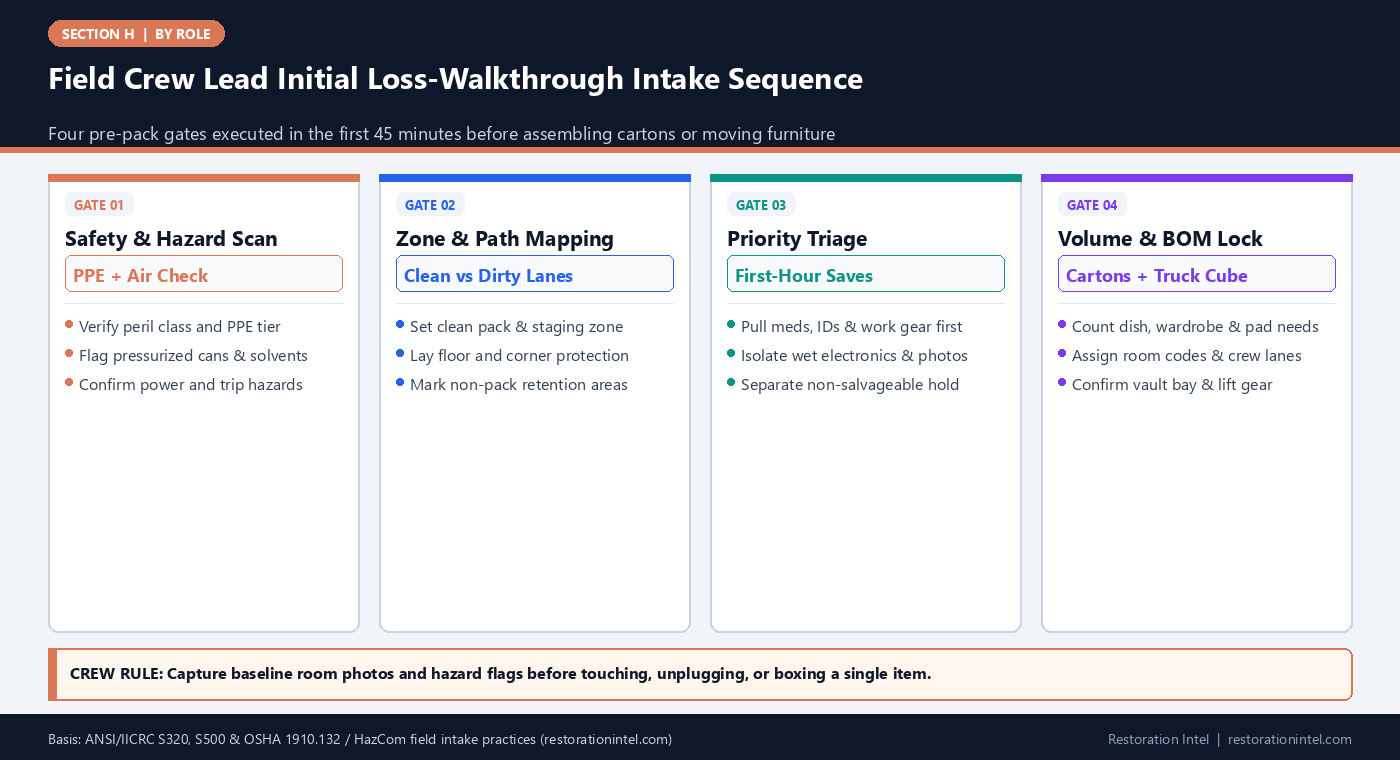
A disciplined field intake converts chaotic rooms into a repeatable sequence: clear PPE and chemical screening first, zone boundaries and floor protection second, urgent stabilization and homeowner essentials third, and room-by-room volume math fourth. Teams that execute those four gates consistently avoid the common trap outlined in A Pack-Out Record Is Not a Priced Inventory—mistaking rapid physical removal for defensible claim documentation.
Field Crew Lead Initial Loss-Walkthrough Intake Sequence
Field Crew Lead Intake Matrix by Peril and Building Condition
Before deploying packing stations, the Crew Lead matches personal protective equipment, staging geometry, and first-hour stabilization steps to the observed peril.
| Loss Condition | Minimum Field PPE & Hazard Check | Staging & Path Containment | First-Hour Triage Priority | Intake Scope Watchout |
|---|---|---|---|---|
| Cat 1-2 Clean or Grey Water | Nitrile gloves, waterproof boots, eye protection; check subfloor slip risk | Poly runner from wet rooms to dry driveway; elevate cartons on pallets | Lift wood furniture legs onto blocks; pull wet rugs, books, and electronics | Do not pack damp textiles into sealed poly bags without immediate drying tag |
| Cat 3 Sewage or Floodwater | Impervious coveralls, double nitrile/heavy gloves, face shield, P100/respirator per assessment | Strict dirty-to-clean airlock; zero cross-traffic over unaffected carpet | Segregate porous non-salvageable goods in hold zone; sanitize non-porous hard goods | Never mix Category 3 items with upper-floor unaffected cartons inside one truck bay |
| Structure Fire & Smoke Soot | Half-face P100/OV respirator, Tyvek suit, cut-resistant over-gloves, eye protection | Negative-pressure buffer at exit; tack mats and Masonite on traffic lanes | Dry-sponge or isolate polished metals, stone, and HVAC-exposed electronics | Inspect aerosol cans, propane, and lithium batteries before warm truck loading |
| Protein or Heavy Odor Fire | Respirator with organic vapor/particulate cartridge; nitrile gloves changed between zones | Sealed poly staging for soft goods; dedicated clean-hand tech for tablet and labels | Separate porous pantry/plastics from stainless, glass, and sealed hard goods | Document subtle greasy film under macro light before wiping any surface |
| Pre-1980 Structure or Suspect Debris | Pause disturbance; confirm lead/asbestos clearance with PM before touching dust-coated items | Isolate suspect room with poly barrier until licensed clearance arrives | Photograph undisturbed room boundaries from threshold only | Field contents crews must never disturb unverified suspect friable materials |
| Commercial Office or Retail Loss | High-vis vest on loading docks, safety-toe boots, standard nitrile/cut gloves | Verify elevator reservation, loading dock clearance, and badge access hours | Tag client PII files, POS terminals, and active workstations with owner rep | Keep server racks and proprietary records under written dual-custody sign-off |
Pre-Entry Safety Screening, PPE Selection, and Peril Verification
An intake walkthrough starts at the curb, not inside the kitchen. The Crew Lead confirms the utility status of electricity, gas, and water with the project manager or mitigation supervisor, checks overhead ceiling sag in water-saturated rooms, and evaluates air quality before bringing helpers indoors. Under OSHA 1910.132 Personal Protective Equipment rules, the crew lead cannot rely on a generic box of latex gloves for every job; PPE must match actual exposure hazards, from sharp broken glass and wet drywall nails to soot particulates and sewage splash risks.
Chemical and combustible screening belongs inside the first ten minutes of every garage, basement, or utility-room sweep. Under OSHA Hazard Communication (HazCom) principles, crews must identify household pesticides, pool chlorine, fuel cans, paint thinners, damaged lithium-ion tool packs, and pressurized aerosols before boxing or loading them into an enclosed box truck. Hazardous materials that cannot legally ride in a standard contents vault require explicit hold tagging and owner notification.
Peril verification also prevents costly mis-scoping when the initial dispatch note says clean pipe leak but the walkthrough reveals standing water that wicked past seventy-two hours or traveled across subfloor soil. Cross-checking observed conditions against ANSI/IICRC S500 water categories ensures the crew sets appropriate containment rather than treating grey or black water goods like dry move-out furniture.
- Threshold baseline video: Walk every affected and adjacent room with a steady camera before moving drapes, opening closets, or rolling back rugs.
- Hazmat quarantine corner: Tape off a ventilated driveway or exterior pad spot for fuel cans, aerosols, cleaners, and swollen battery packs.
- Structural pause trigger: Halt room entry immediately if ceiling drywall bows, floor joists feel spongy, or live standing water contacts outlets.
Mapping Clean vs. Affected Zones, Access Paths, and Staging Lanes
Once safety hazards are cleared, the Crew Lead designs traffic flow so dirty footwear, soot-coated dolly wheels, and damp pads never contaminate unaffected rooms or finished hallways. Every pack-out needs three clearly marked zones: the active extraction room, a dry packing and labeling station positioned near the exit, and a protected path leading to the truck ramp. Floor runners, taped Masonite, neoprene door-jamb guards, and stair rail wraps go down before the first dish pack leaves the kitchen.
On multi-story homes or commercial suites, poor staging creates bottlenecks that cut crew output in half—a dynamic explored in The Hands Were Always the Bottleneck. When four technicians crowd around one narrow hallway table waiting for tape or labels, labor burns without moving boxes. Assigning dedicated roles during intake—one clean-hand photographer/logger, two packers at the station, and one runner staging sealed cartons by room—keeps hands moving without smearing soot onto barcode tags.
Equally important is marking physical exclusion zones during intake. If a master bedroom closet or locked filing cabinet sits outside the agreed pack-out boundary, wrap bright blue painter tape across the door frame and photograph it alongside the homeowner or site contact so nobody packs excluded items by mistake.
- Clean-hand / dirty-hand split: Assign at least one clean-hand technician to handle tablets, barcode labels, and exterior carton marking on soot or Category 3 jobs.
- Stairwell and elevator protection: Pad banisters, elevator cab walls, and threshold transitions before moving large case goods or wardrobe cartons.
- Dry-zone pallet staging: Keep finished cartons elevated off damp concrete garage slabs using wood pallets or plastic dunnage sheets.
First-Hour Triage: Homeowner Essentials, Fragiles, and Rapid-Decay Items
Every residential pack-out starts with an immediate essentials sweep alongside the policyholder. Prescription medications, eyeglasses, hearing aids, passports, checkbooks, school laptops, keys, pet food, and seventy-two hours of clean clothing must stay with the family rather than disappearing inside vault row twelve. Logging those owner-retained essentials on a quick handover sheet prevents midnight phone calls to the project manager asking which warehouse rack holds a child’s inhaler.
Simultaneously, the Crew Lead identifies items on a tightening biological or corrosion clock. Wet leather shoes, waterlogged photo albums, uncoated cast iron, fine-art canvases, and powered electronics exposed to humidity or acidic smoke residue deteriorate rapidly after the first day. Pulling moisture-sensitive electronics for immediate desiccant staging and interleaving damp paper keeps salvageable goods from crossing into total loss while general household packing proceeds.
For Category 3 pack-out environments or heavy smoke losses, non-salvageable porous waste should never be loaded onto the clean truck just to make a room look empty. Setting a clearly labeled non-salvageable hold area during intake keeps contaminated foam cushions and saturated particleboard out of the vault stream.
- Essentials go-bag check: Confirm medications, IDs, chargers, and daily work devices are physically separated before general room boxing starts.
- Moisture-clock priority: Stabilize wet photographs, solid wood veneers, and electronics before packing dry attic or hallway closets.
- Electronics power-down rule: Photograph rear cable ports before disconnecting, and never power on wet or soot-coated electronics to test function.
Estimating Cartons, Crew Hours, and Vault Cube During the Walkthrough
Running out of dish packs or moving blankets at 2:30 PM turns a disciplined pack-out into wasted drive time and rushed wrapping at dusk. Experienced Crew Leads walk each room with a mental conversion formula rather than guessing from the curb: standard kitchen cabinets plus pantry shelves typically consume twelve to twenty-two dish packs and medium cartons; an average bedroom closet uses four to six wardrobe cartons; and densely stocked garages or basements often hide twice the carton volume of open living rooms.
Accurate intake math also separates standard cartons from specialty handling materials. Frameless mirrors, glass dining tops, stone statuary, oversized flat-screen televisions, and upright pianos require telescoping mirror cartons, crating stock, corner boards, and two-person lift straps. Calling those specialty materials into the warehouse dispatcher during the initial walkthrough allows a supply drop while the crew completes baseline photography.
Finally, translate room counts into realistic truck cube and vault projections. Knowing whether the loss fills two wooden storage vaults or nine vaults tells the warehouse coordinator where to stage empty containers and prevents double-handling cartons onto temporary floor space back at the shop.
- Dense-zone multiplier: Double initial carton estimates for packed pantries, craft rooms, home libraries, and multi-drawer tool chests.
- Heavy-item lift audit: Flag safes, commercial printers, stone tables, and treadmills over 150 pounds during intake to schedule liftgates or extra hands.
- Material buffer rule: Load 15 percent extra packing paper, stretch film, and tape onto the primary truck so crews never substitute thin wrapping near shift end.
Practitioner Verification Checklist (H-09)
- Complete life-safety, utility, PPE, and HazCom screening across all rooms before bringing packing materials inside.
- Record unbroken threshold-to-room baseline video and still photos prior to moving, unplugging, or boxing any contents.
- Establish floor protection, clean-hand vs dirty-hand zones, and clearly taped homeowner retention boundaries.
- Segregate prescriptions, vital documents, electronics, and rapid-decay items before launching general room boxing.
- Calculate carton types, specialty mirror/TV packs, crew hours, and projected vault count and confirm scope boundaries with the homeowner or PM.
Standards, Authority References & Related Reading
Primary standards, insurance definitions, and sibling Restoration Intel guides referenced in this brief:
- ANSI/IICRC S320 Standard for Professional Contents Restoration
- ANSI/IICRC S500 Water Damage Standard
- OSHA 1910.132 Personal Protective Equipment Standard
- OSHA Hazard Communication Standard (HazCom)
- Related Guide: Field Contents Technician & Pack-Out Crew Lead: Capture & Documentation Execution Workflow
- Related Guide: Restoration Project Manager & Contents Division Lead: Initial Scope & Loss-Walkthrough Intake
- Related Guide: A Pack-Out Record Is Not a Priced Inventory
- Related Guide: IICRC Cat 3 Contents Pack-Out Protocol
- Related Guide: The Hands Were Always the Bottleneck
.md twin for desk QA and team training.Frequently Asked Questions
How long should a Crew Lead spend on the initial walkthrough before packing begins?
On a typical three-bedroom residential loss, expect 30 to 45 minutes for safety checks, baseline video, zone protection, essentials separation, and carton counts. Large commercial or multi-unit losses may require 60 to 90 minutes, which saves hours of mid-day rework.
What items should the homeowner always keep out of the pack-out?
Prescription medications, government IDs, passports, financial records, everyday laptops and chargers, keys, eyeglasses, pet supplies, and three to five days of clothing should remain with the policyholder and be noted on an owner-retained log.
Why must hazardous household chemicals stay off standard contents vaults?
Under OSHA HazCom and transport safety rules, fuels, pressurized aerosols, pool chlorine, solvents, and damaged lithium-ion batteries create fire, leak, and fume hazards inside closed trucks and climate-controlled warehouse vaults.
How does intake differ between Cat 1-2 water and Cat 3 or fire losses?
Cat 1-2 intake focuses on rapid moisture separation and lifting furniture off wet flooring, whereas Cat 3 and fire intake require strict PPE, clean-hand/dirty-hand staging, and immediate hold-zone isolation to prevent cross-contamination.