Direct Answer: Contents Estimators defuse homeowner and business-owner friction by explaining documentation versus policy settlement boundaries plainly, recording owner-reported values neutrally without promising payouts, and showing transparent status tracking across cleanable, total-loss, and pending items.
.md twin for estimator QA and carrier file documentation.
By the time a Contents Estimator and Claim Packet Specialist speaks with a homeowner or business owner, the client is already exhausted. They have watched crews pack their kitchen into numbered boxes, seen soot-blackened rooms stripped to studs, and received confusing explanations about deductibles, recoverable depreciation, and what their policy might pay. When the inventory spreadsheet finally arrives for review, frustration over missing items, low ACV checks, or sentimental losses often lands directly on the estimator.
Handling that friction skillfully requires two parallel disciplines: empathy for human disruption and strict technical neutrality under Restoration Industry Association (RIA) and ANSI/IICRC S320 professional boundaries. A restoration contents estimator is a documentation and valuation-support specialist—not the claims adjuster making coverage decisions and not a licensed public adjuster negotiating policy interpretation.
When estimators cross that line by promising ‘insurance will buy you a brand-new set’ or dismissing a business owner’s unphotographed tools out of hand, trust collapses. Clear, structured communication grounded in the difference between RCV, ACV, and evidentiary proof keeps the conversation constructive.
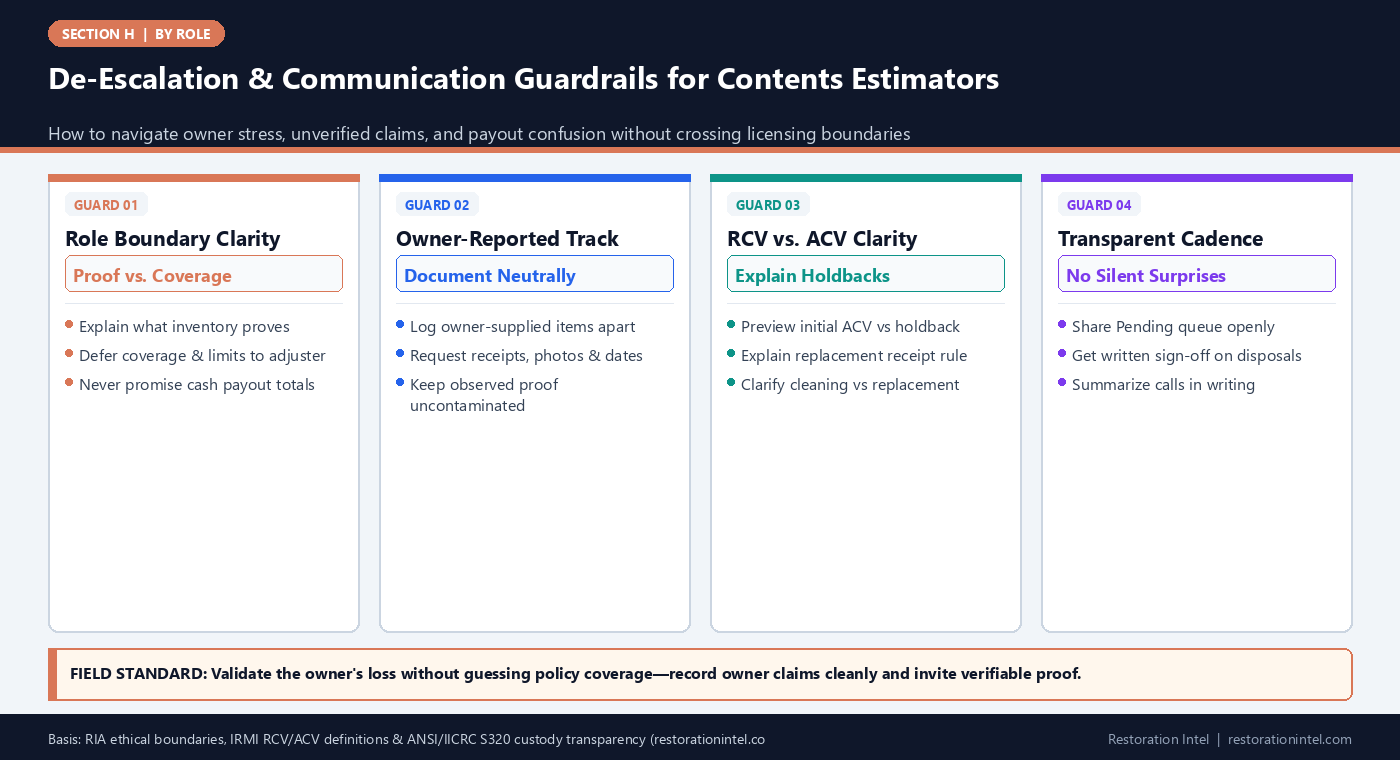
De-Escalation & Communication Guardrails for Contents Estimators
High-Stress Owner Friction Scenarios & Neutral Estimator Response Scripts
Practical communication frameworks that resolve common homeowner and commercial client disputes while protecting claim integrity.
| Owner Friction Trigger | Underlying Fear / Confusion | Boundary Trap to Avoid | Constructive Estimator Response | Follow-Up File Action |
|---|---|---|---|---|
| 1. 'My ACV check is way too low to replace this!' | Confusing initial ACV payout with total RCV recovery on replacement-cost policies | Criticizing the carrier or promising full replacement check without receipts | Explain how ACV reflects pre-loss age/condition and how holdback releases upon replacement | Verify item ages/condition notes are accurate; refer policy timing questions to adjuster |
| 2. 'Your list missed 30 things from my burned closet!' | Items reduced to ash or hauled before pack-out never appeared in site photos | Either flatly refusing to list them OR entering them as camera-observed facts | Invite an itemized Owner-Reported list with approximate ages, brands, and past photos | Log under Owner-Reported / Unobserved section with supporting receipts or snapshots |
| 3. 'That discontinued heirloom cost way more than your comp!' | Emotional value vs functional LKQ replacement pricing on standard lines | Arguing that the heirloom is worthless or inflating an arbitrary retail price | Explain LKQ spec matching and move unique/antique pieces to Specialist Appraisal hold | Provide owner path to submit prior appraisals, dealer history, or maker info |
| 4. 'Why are you cleaning my things instead of buying new?' | Worry over lingering smoke odor or frustration with pack-back timelines | Dismissing health/odor concern or condemning restorable items without S320 basis | Walk through S320 cleanability standards, post-clean inspection, and cost-vs-RCV math | Flag specific items for supervisor odor/quality inspection prior to pack-back sign-off |
| 5. 'Who authorized throwing away my garage tools?' | Communication breakdown during emergency Cat 3 or debris stabilization | Blaming the field crew or altering historical logs defensively | Review timestamped disposal photos and signed authorization records calmly | Audit custody trail; document any missing items neutrally for PM/adjuster review |
| 6. 'How fast will the insurer pay our commercial claim?' | Business interruption stress and cash-flow pressure on replacement gear | Committing to adjuster turnaround timelines outside contractor control | State exact internal submission date and what open owner docs are still needed | Send written status tracker separating submitted schedules from Pending items |
Setting Clear Boundaries Between Documentation and Policy Coverage
The root of most homeowner and business-owner anger during contents estimating is misaligned expectations created in week one. When a field technician casually tells a stressed owner, ‘Do not worry, your policy covers everything new,’ the estimator spends the next month absorbing shock when depreciation, deductibles, and specialty sublimits reduce the initial settlement check.
A skilled Contents Estimator resets those expectations calmly and early without sounding cold or adversarial. State in plain language what the restoration team controls and what the carrier controls: the estimator’s job is to build the most complete, factually supported inventory and replacement-research record possible under ANSI/IICRC S320; the insurance adjuster’s job is to apply policy terms, ACV depreciation rules, sublimits, and deductibles.
Maintaining that boundary also protects the company legally. Giving unauthorized coverage advice or negotiating policy interpretation on an insured’s behalf crosses into public adjusting restrictions in most jurisdictions—whereas building rock-solid technical evidence serves every legitimate stakeholder equally.
- Plain-English role script: ‘Our team documents every damaged item and researches comparable replacement specs; your adjuster applies policy coverage and depreciation terms.’
- Explain RCV vs. ACV neutrally: Clarify why RCV research and initial ACV cash payments differ without promising holdback outcomes.
- Never speculate on sublimits: Note when items belong to sublimit-sensitive classes and recommend the owner confirm caps directly with their adjuster.
Handling Unobserved, Ash-Destroyed, or Owner-Reported Items Without Conflict
In severe fires and rapid flood cleanouts, some property disappears before a camera ever arrives—paper files, melted plastic storage bins, or damaged items discarded by emergency responders. When owners notice those items missing from the draft spreadsheet, they often accuse the restoration team of undercounting or siding with the insurer.
The fix is built directly into the three-pile architecture described in A Pack-Out Record Is Not a Priced Inventory. Instead of refusing to record items the crew could not photograph—or pretending the crew saw them—the estimator provides a structured Owner-Reported Addendum template. The client lists missing items, approximate quantities, ages, and any corroborating proof such as credit card statements, digital receipts, warranty registrations, or pre-loss family photos showing the room.
Recording owner-reported losses respectfully while tagging their source transparently lets the client feel heard without compromising the observed integrity of the primary schedule.
- Structured Owner-Reported log: Give owners a simple column-matched form for items destroyed beyond visual identification.
- Pre-loss proof prompts: Suggest practical evidence sources—Amazon/retail order histories, pre-loss smartphone photos, and service invoices.
- Clear source separation: Present Observed and Owner-Reported totals cleanly so neither side confuses the evidentiary basis.
Managing Commercial Owner Pressure and Downtime Urgency
Business owners facing a restaurant, clinic, office, or workshop loss react very differently from residential homeowners. Their primary friction point is rarely sentimental value—it is operational downtime, lease obligations, payroll continuity, and whether critical equipment will be cleaned quickly or held indefinitely in valuation review.
When communicating with commercial clients, the estimator avoids vague schedule promises and instead shares a prioritized critical-path tracker. Separating mission-critical production equipment from low-priority back-office storage lets the owner review high-impact items first, verify serial numbers and vendor quotes rapidly, and approve expedited cleaning or replacement requests without wading through 400 lines of stationery.
Documenting equipment downtime dependencies neutrally—while reminding the owner to coordinate business-income claims directly with their adjuster—keeps communication crisp and aligned with carrier approval norms.
- Critical-asset first review: Share top-20 operational equipment rows with commercial owners within 48 hours of intake.
- Vendor-quote collaboration: Invite the business owner’s regular OEM equipment dealer to supply official replacement or diagnostic letters.
- Written status cadence: Send brief, dated weekly summaries listing items cleared, items in cleaning, and items awaiting owner docs.
Closing Every Difficult Conversation With Written Confirmation
High-stress phone calls fade into conflicting memories within 48 hours. An owner who verbally agrees to discard a warped laminate desk on Tuesday may ask on Friday why it is not on the pack-back truck—or remember a verbally discussed estimate range as a guaranteed settlement figure.
Every substantive conversation regarding missing items, age confirmations, specialty appraisals, or non-salvageable sign-offs must end with a three-bullet recap email logged to the job file. The recap states what was reviewed, what specific documents or approvals the owner is supplying next, and what target date the updated packet moves to the PM or adjuster.
Consistent written follow-through protects the estimator, reassures anxious policyholders that their input is tracked, and provides a clean audit trail if disputes escalate later in the claim lifecycle.
- Same-day 3-bullet recap: Summarize decisions, open owner action items, and next file milestone after every tough call.
- Mandatory written disposal consent: Never rely on verbal hallway approval to haul away borderline personal property.
- PM escalation trigger: Loop in the Restoration Project Manager immediately if an owner demands coverage concessions or threatens legal action.
Practitioner Verification Checklist (H-23)
- Explain the restoration estimator’s documentation boundary clearly on first contact, deferring coverage, sublimit, and payout decisions to the adjuster.
- Provide a structured Owner-Reported template for ash-destroyed or pre-haul missing items while keeping observed photographic proof strictly separated.
- Clarify RCV comparable research versus initial ACV payments and replacement-receipt holdback mechanics without promising settlement amounts.
- Prioritize commercial owners’ mission-critical equipment lists early and invite verified OEM dealer quotes or pre-loss purchase records.
- Send a dated three-bullet written recap after every disputed item call and obtain signed consent before any borderline disposal.
Standards, Authority References & Related Reading
Primary standards, insurance definitions, and sibling Restoration Intel guides referenced in this brief:
- Restoration Industry Association (RIA)
- ANSI/IICRC S320 Standard for Professional Contents Restoration
- IRMI Insurance Glossary: Actual Cash Value (ACV)
- IRMI Insurance Glossary: Replacement Cost Value (RCV)
- Related Guide: Contents Estimator & Claim Packet Specialist: Initial Scope & Loss-Walkthrough Intake
- Related Guide: A Pack-Out Record Is Not a Priced Inventory
- Related Guide: Contents Estimator & Claim Packet Specialist: Handling Non-Salvageable Lists & High-Dollar Exceptions
- Related Guide: Contents Estimator & Claim Packet Specialist: Quality Assurance Review & Pre-Submission Audit
- Related Guide: Which Xactimate Line Items Do Adjusters Actually Approve?
.md twin for desk QA and team training.Frequently Asked Questions
How should a Contents Estimator explain why an ACV payout is lower than replacement cost?
Explain neutrally that initial ACV reflects the item’s pre-loss age and condition (replacement cost minus physical depreciation), while recoverable depreciation holdbacks under an RCV policy are typically governed by proof of replacement and policy terms reviewed by the adjuster.
What should an estimator do when a homeowner insists burned or missing items were in a room with no photos?
Never refuse the claim out of hand and never fabricate visual proof. Record the items in a clearly labeled Owner-Reported section and ask the insured for supporting evidence such as digital receipts, warranty records, or pre-loss family photos.
Can a restoration Contents Estimator negotiate policy coverage or sublimits with the carrier?
No. Unless properly licensed as a public adjuster in that jurisdiction and contracted in that capacity, a restoration estimator provides factual inventory documentation, cleaning scope, and LKQ pricing support rather than legal policy negotiation.
What single habit reduces homeowner disputes over non-salvageable items?
Walking the owner through timestamped damage photos and obtaining written itemized disposal sign-off—paired with a clear written recap—before any contested item leaves the property.